Imagine being 28 years old, freshly married, and standing in a tiny apartment where the only thing growing faster than your frustration is the number of failed businesses in your wake. For Marc Lou, the founder of ShipFast, this wasn't a hypothetical—it was a Tuesday. After failing at 30 different startup attempts and seeing a pandemic wipe out his only stable revenue stream, he reached a breaking point. But instead of quitting, he pivoted his entire philosophy. He stopped building in the dark and started the building in public movement for his own brand. This shift didn't just lead to a successful product; it created a permanent social media distribution strategy that now generates over $1.5 million a year.
Why Building in Public is Your Startup Insurance
In the traditional startup world, founders are often terrified of someone "stealing" their idea. They toil in silence for 12 months, only to launch to the sound of crickets. The creator economy for founders has flipped this script. When you choose to build in public on X, you are effectively buying an insurance policy against product failure. If your app fails, you still keep the audience. If the market shifts, you still have the trust of your followers. Marc Lou’s journey highlights that even when his apps made zero dollars, his transparency built an identity that people wanted to follow.
The core of this personal brand for business growth is the realization that products are ephemeral, but distribution is forever. By documenting the journey on YouTube or other platforms, you transition from a nameless developer to a relatable protagonist. This narrative hook is what separates a commodity tool from a brand. People don't just buy ShipFast because it’s a NextJS boilerplate; they buy it because they’ve watched Marc's 30-startup-long redemption arc on Starter Story.
"Each failure is not a failure if you don't give up. It's just a matter of making small bets... and sharing them so you never start from zero again."
Choosing Your Distribution Platform: Text vs. Video
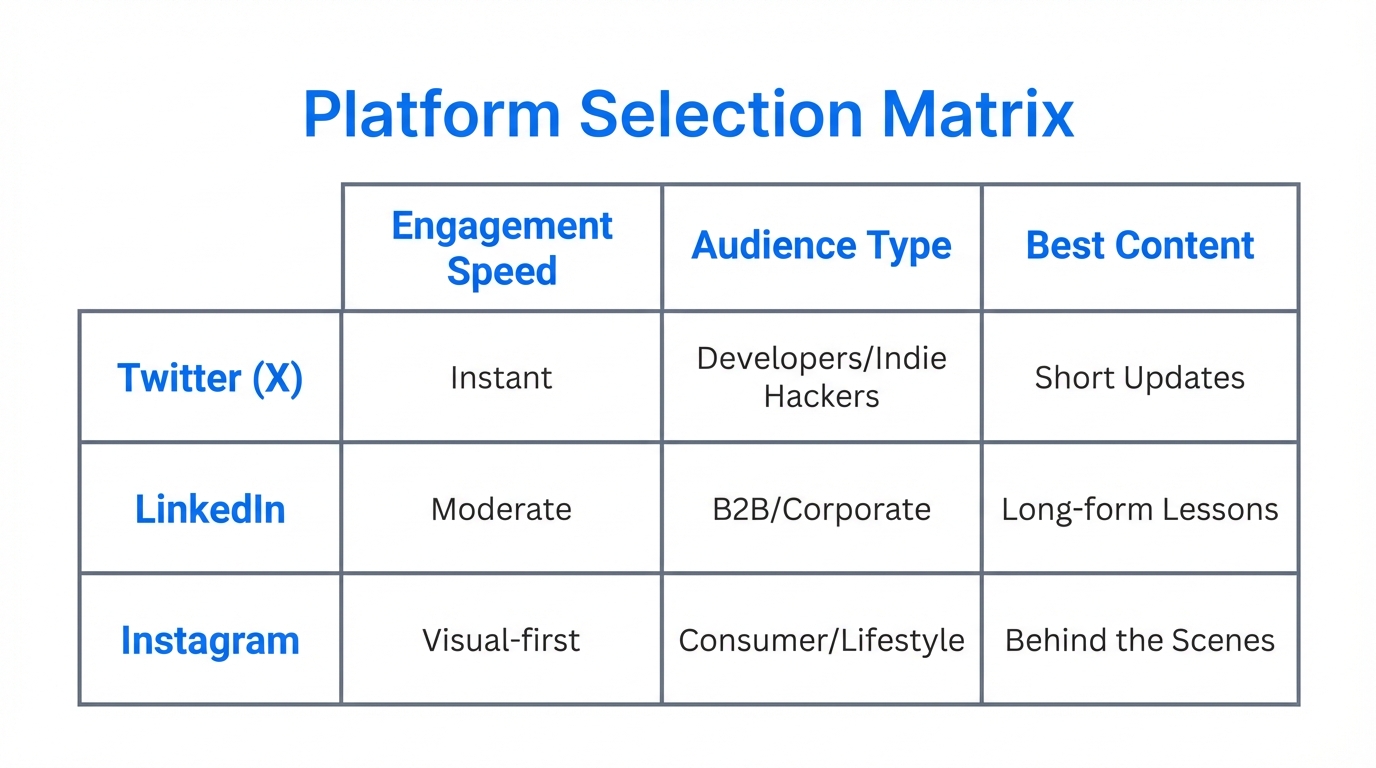
Not every founder needs to be a YouTuber. The content marketing for startups landscape is diverse, and the best platform is the one you can show up to consistently. Marc Lou experimented with everything from viral skits to deep-dive interviews. He suggests that you must learn where you are comfortable sharing. If you are an engineer who thinks in bullet points, Twitter (X) is your natural habitat. If you have a flair for the dramatic or want to show the physical reality of your 'cockroach-infested apartment' days, TikTok or YouTube offers a higher ceiling for emotional connection.
| Platform | Format | Primary Benefit | Best For |
|---|---|---|---|
| X (Twitter) | Short-form text | Rapid iteration & networking | Developers & B2B Founders |
| YouTube | Long-form video | High trust & storytelling | Documentarians & Educators |
| TikTok | Short-form video | Viral discovery | UGC-style & Consumer apps |
| Professional text/vlog | High LTV partnerships | SaaS & Agency owners |
Choosing the right medium is critical for a sustainable social media distribution strategy. For example, if you're building a highly visual tool like a Canva alternative, showing the design process on Instagram or TikTok is non-negotiable. However, if you are solving a deep technical pain point, a weekly thread on X detailing your architectural decisions will attract the right kind of high-intent peers. Don't force a format that feels like a chore; if you hate being on camera, your audience will feel that friction.
The 'Highs and Lows' Content Framework
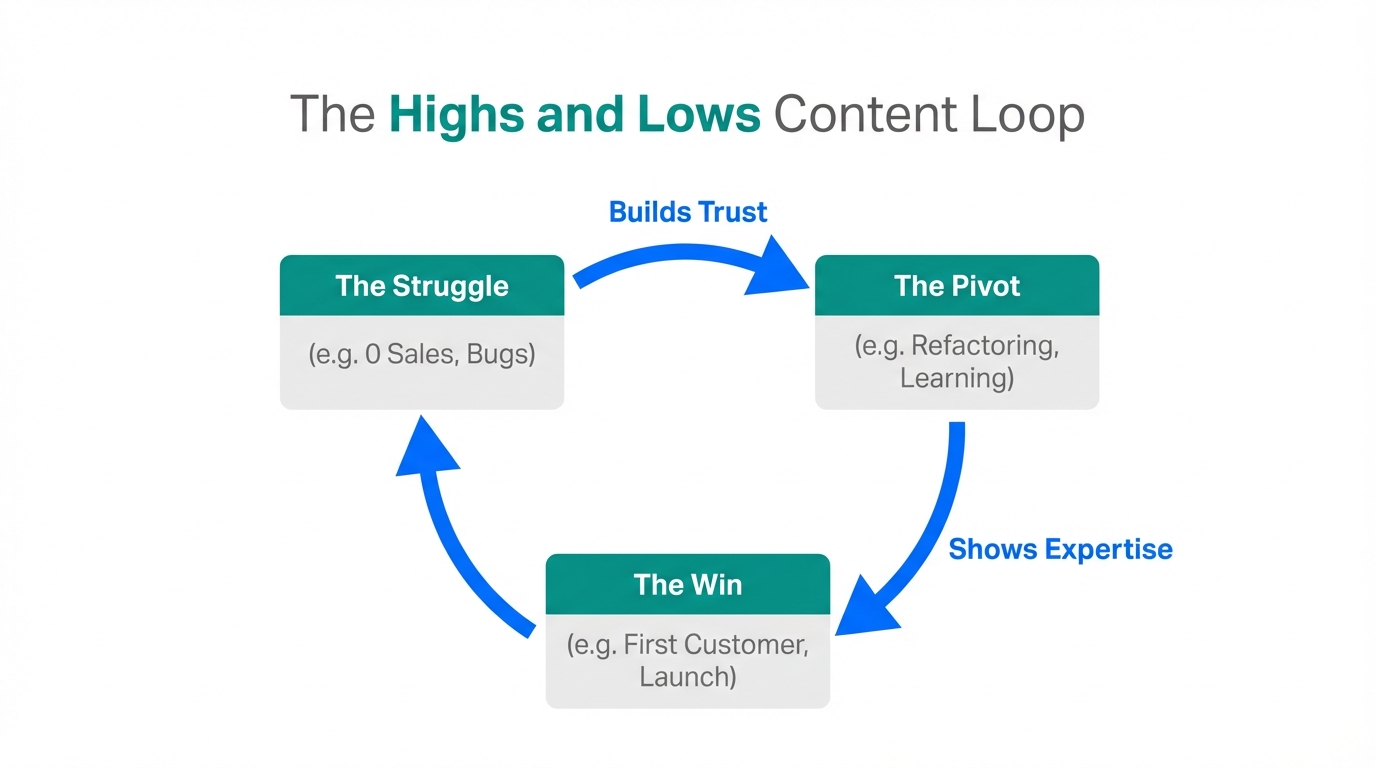
Authenticity is the currency of the creator economy for founders. Most people only post their "Winner" screenshots from Stripe, but the real growth happens when you share the losses. Marc Lou’s story became legendary not because of the $1.5M year, but because he was willing to admit he was working as a waiter for $10 an hour while telling people he was the next Mark Zuckerberg. This "Highs and Lows" framework builds a radical level of trust that no corporate marketing campaign can replicate.
To implement this, your content should follow a 70/30 rule: 70% should be the 'in-the-trenches' work—the bugs, the failed launches, and the 12-square-meter apartments. The remaining 30% should be the 'Highs'—the revenue milestones, the product-market fit moments, and the lifestyle freedom. When you share a low, you invite your audience to root for your comeback. When you share a high, they feel like they won with you. This emotional investment is the secret sauce of personal brand for business growth.
"I lived in a 12-square-meter room with cockroaches... I wanted to show a different path, and that requires showing the ugly parts too."
Turning Followers Into a Beta-Testing Engine
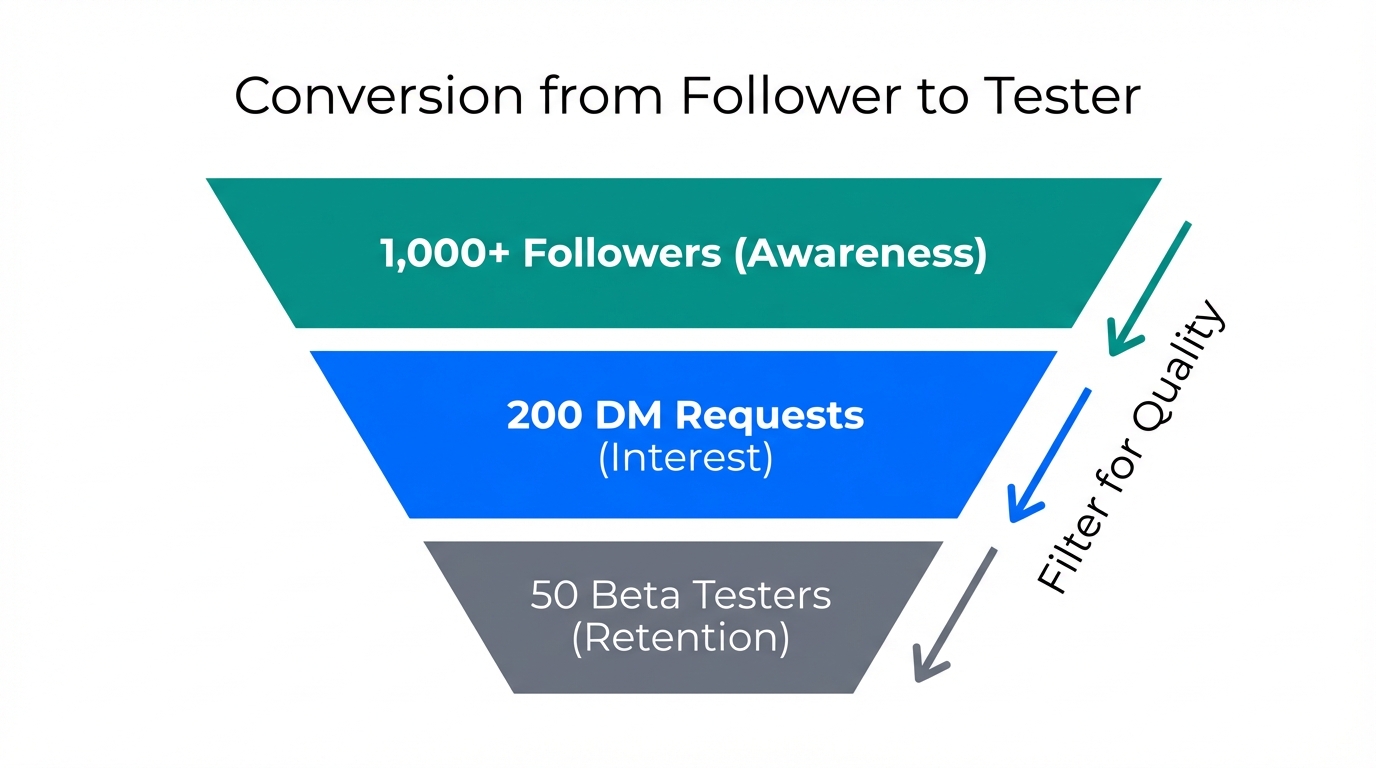
The fastest way to fail is to build something nobody wants. By building in public, you turn your social feed into a live focus group. Instead of spending six months on an AI startup that gets zero customers, you can post a mockup on X or Threads and gauge interest in hours. Marc learned this the hard way when his early AI projects failed because he was an engineer who didn't understand marketing. Now, he uses his audience to validate every "painkiller" app before writing a single line of code.
This rapid feedback loop is essential for content marketing for startups. When you share a feature idea and 50 people tell you it’s useless, you’ve just saved yourself weeks of development. Conversely, when people start asking if they can pay you via crypto or alternative methods because they want the tool so badly, you’ve found product-market fit. Once your personal brand gains traction, using platforms like Stormy AI can help you identify micro-influencers and UGC creators who align with your niche to further amplify your building-in-public updates and reach new cohorts of beta testers.
From Creator to Founder: The ShipFast Case Study
The transition from "guy who tweets" to "founder of a multi-million dollar business" happens at the intersection of utility and community. Marc Lou realized that while his small "vitamin" apps (like habit trackers) were fun, his true success came from "painkiller" apps that solved immediate problems for other developers. He noticed he was repeating the same setup tasks for every new project—landing pages, Stripe integration, and SEO headers. By productizing his own workflow, he created ShipFast.
His distribution was already built. When he launched ShipFast, he didn't need a massive ad budget on Google Ads or TikTok Ads. He simply told his existing followers: "I built this for me, you can have it too." The result? $500 in the first two hours, $40,000 in the first month, and peaks of $135,000 per month. This is the power of moving an audience from social platforms to a paid product. You aren't just selling a tool; you are selling a proven methodology that the audience has watched you refine in real-time.
To sustain this growth, Marc leverages "free tool marketing." He builds small, viral tools like logo generators or productivity trackers and places a subtle banner for ShipFast on them. This creates a constant stream of new leads without recurring ad spend. For founders looking to scale this outreach, platforms like Stormy AI provide the AI-powered search and discovery needed to find more creators who can talk about these free tools, creating a compounding distribution engine.
"I remove expectations from anything I launch. I told my wife maybe we'll make $100. We made $500 in two hours. That's when I knew everything had changed."
Conclusion: Start Now and Ship Fast
The ShipFast guide to building in public isn't about having a perfect plan; it's about removing the barrier between you and your audience. Marc Lou’s 30 failures weren't wasted time—they were the tuition he paid to learn that distribution is the only unfair advantage in the startup world. Whether you choose to share your journey on X, LinkedIn, or YouTube, the goal remains the same: build a personal brand that acts as a permanent launchpad for every idea you ever have.
If you're feeling stuck, follow Marc's advice: build the smallest version of your app as fast as you can, and share the process. Don't wait for the perfect idea or the perfect code. The market doesn't care about perfection; it cares about solutions to its pain. Start now, ship fast, and let the world watch you build.