In 2026, the cost of innovation is at an all-time high, yet the cost of replication has never been lower. While most entrepreneurs obsess over 'disrupting' industries with entirely new concepts, a quiet elite—led by the principles of investors like Mohnish Pabrai and Warren Buffett—is scaling to eight and nine figures by practicing what Pabrai calls shameless cloning. This isn't about intellectual property theft; it is about recognizing a proven distribution model that hits you in the head like a 2x4 and adapting it to your niche before the market catches up.
Scaling your business this year requires a shift from 'inventing' to 'auditing.' By utilizing high-signal research environments like the Value Investors Club, you can identify anomalies in how competitors acquire customers and replicate those engines with surgical precision. This guide will walk you through the framework of the 'Shameless Cloner' and how to apply these rigorous competitor analysis techniques to your growth hacking and influencer marketing ROI.
The Pabrai Framework: Why Cloning Beats Innovation
 19:55
19:55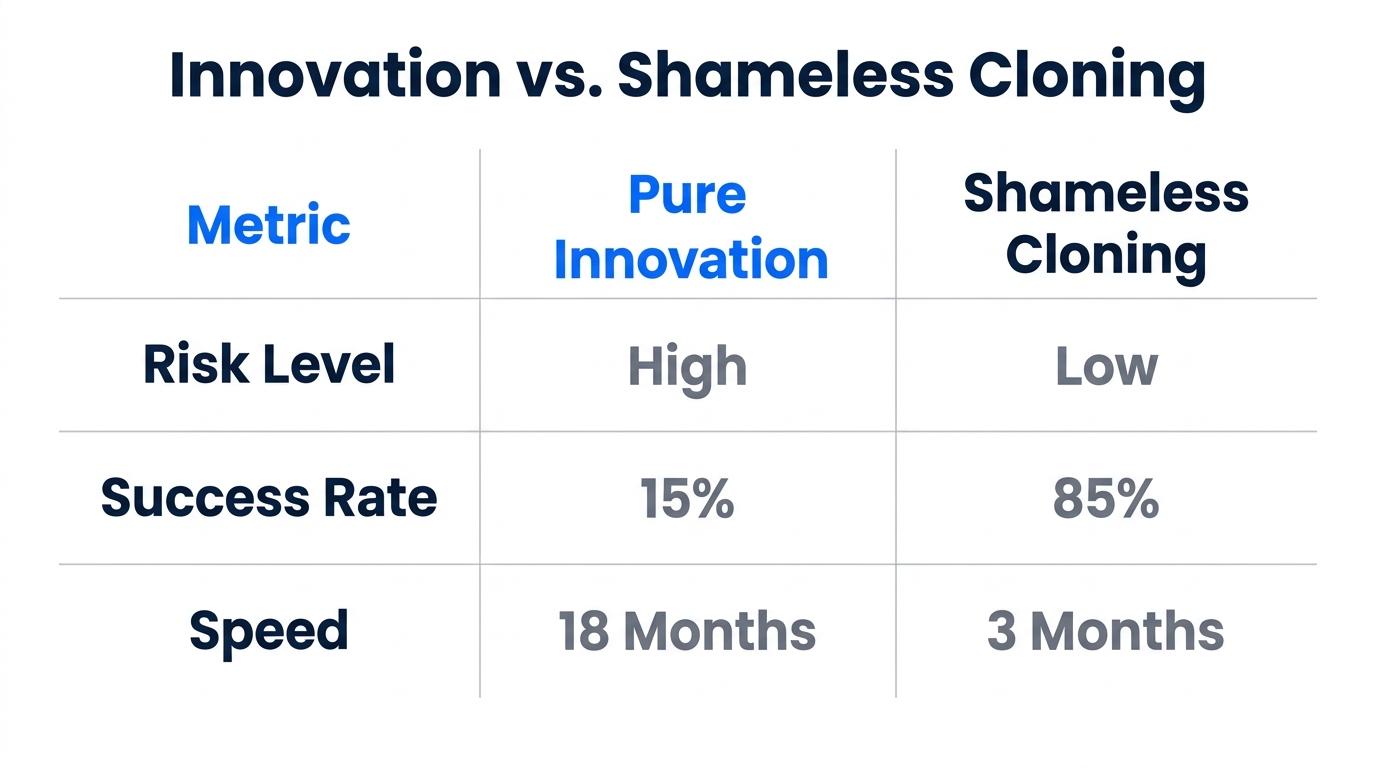
Mohnish Pabrai, the founder of Pabrai Investment Funds, has built a career on the thesis that you don't need to be a genius to get rich; you just need to be a learning machine. In 2026, where digital environments shift weekly, the most effective business scaling strategies often involve looking at what is already working and asking, 'And then what?'
The core of the Shameless Cloner framework is the no-brainer anomaly. Pabrai often cites Warren Buffett’s early days of reading the Moody’s Manuals—thousands of pages of fine-print data—to find companies where the earnings per share were higher than the stock price. This was an anomaly that didn't require complex Excel modeling; it was a simple, mathematical certainty. When you find a distribution channel where your competitor is spending $1 to make $10, you don't need to innovate. You need to clone.
"The highest level of intellect is simplicity. If you can't explain your thesis to a ten-year-old in four sentences, it's an automatic pass."
Most marketers fail because they over-leverage their creativity instead of their math. Just as Rick Guerin, an early partner of Buffett and Charlie Munger, was 'in a hurry' and got wiped out during the 1973 drawdown, many modern startups burn their runway on 'untested' creative strategies. The winning move is to wait for the 2x4 moment: an opportunity so obvious that the risk is low and the uncertainty is the only thing keeping others away.
From Price Club to Costco: The Evolution of Cloned Distribution
41:08One of the most powerful examples of this strategy is the lineage of the warehouse retail model. Sol Price founded Price Club, an absolute revolution in retail distribution strategy. He didn't just build a store; he built a membership-driven ecosystem that prioritized low margins and high volume. Did Sam Walton try to 'out-innovate' Sol Price? No. He visited Price Club, realized it was the 'Holy Grail,' and shamelessly cloned it to create Sam’s Club.
Walton was the ultimate competitor auditor. He famously said there was no human alive who spent more time in competitor stores. He would lay on the floor in Brazilian supermarkets to measure aisle widths with his own body [Source: Walmart History]. He wasn't looking for 'inspiration'; he was looking for data-backed efficiency. He took the best parts of Sears, Kmart, and Price Club, combined them, and eventually killed his competitors with their own tactics.
| Strategy Component | The Innovator (Price Club) | The Shameless Cloner (Walmart/Costco) |
|---|---|---|
| Risk Profile | High (Untested Model) | Low (Proven Model) |
| Market Entry | First Mover | Fast Follower |
| Focus | Discovery | Operational Excellence |
| Outcome | Disrupted | Dominant Market Leader |
In 2026, this 'game of inches' has moved to social feeds. Instead of measuring aisles, we measure hook rates, click-through rates, and audience quality. Platforms like Stormy AI allow you to perform the same type of obsessive audit Sam Walton performed, but for TikTok Ads and influencer campaigns. By finding a 'candle display' (a high-converting ad format) in a competitor's 'badly run store' (a failing campaign), you can extract the spark of genius and scale it yourself.
The Value Investors Club Methodology for Digital Audits
20:50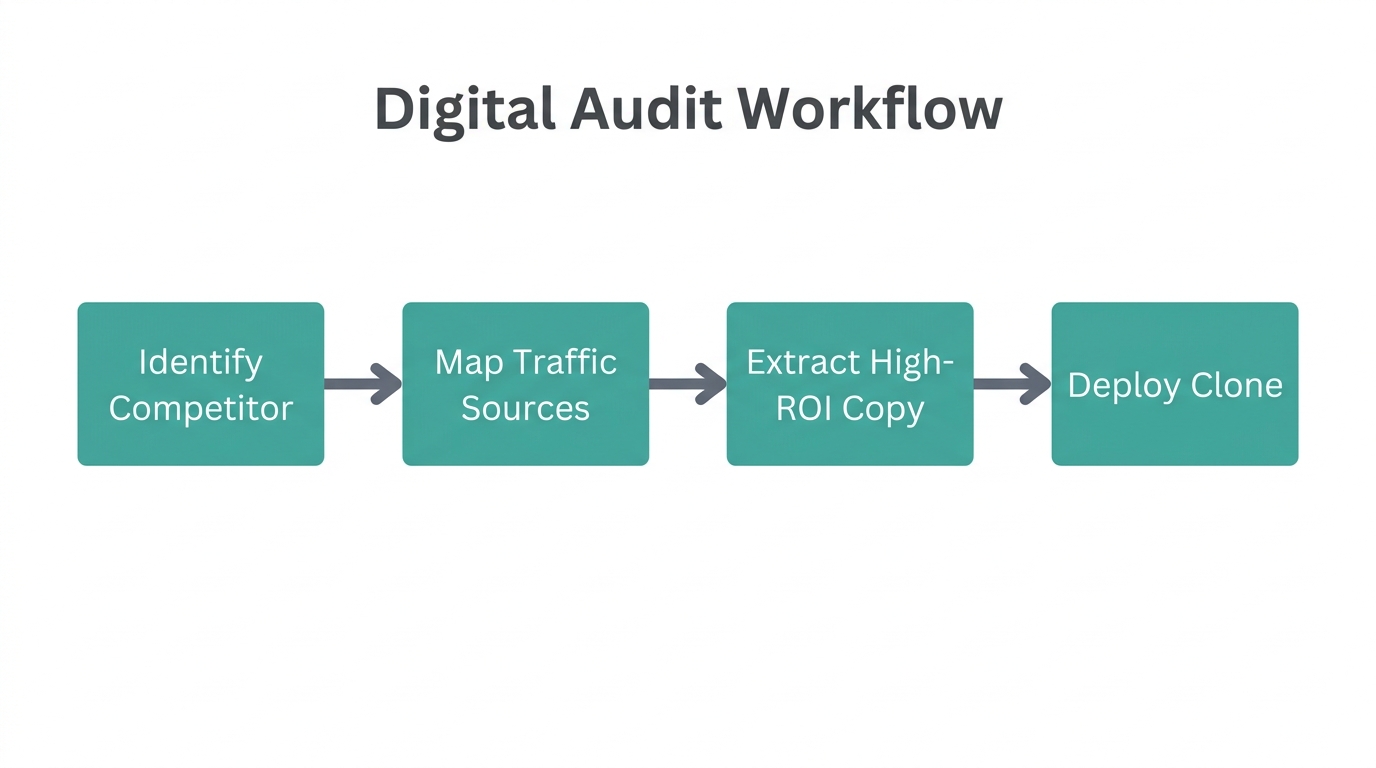
The Value Investors Club (VIC) is a curated community where the world's top hedge fund managers post their best ideas. The barrier to entry is high, and the quality of research is unparalleled. Pabrai suggests that for most people, reading VIC write-ups is a 'shortcut'—someone has already done the 14-hour-a-day 'Moody’s Manual' work for you.
You can apply the VIC methodology to your competitor analysis by looking for 'digital anomalies.' Here is how to audit a competitor’s customer acquisition engine using the 'VIC Lens':
- Look for the 'Too Hard' Pile: Most businesses have complex, multi-touch funnels that are hard to track. Ignore them. Look for the 'single-player games'—companies relying on one or two clear influencer partnerships or a specific UGC style that is consistently driving volume.
- Analyze the 'Margin of Safety': If a competitor is repeatedly working with the same group of 'micro-influencers,' it’s a sign that the influencer marketing ROI is stable. They have found a pocket of high conversion and low cost [Source: Investopedia].
- Seek High Uncertainty, Low Risk: A brand might be testing a new platform like LinkedIn for B2B influencer marketing. The market thinks it's 'uncertain,' but if the engagement numbers show a clear mismatch between CPM and Lead Quality, the risk is actually low.
"If you need Excel to figure out if an investment is good, it’s an automatic pass. The best ideas are no-brainers that you can do in your head."
Social ROI vs. Financial ROI: The Dakshana Approach
53:10Pabrai’s philanthropy, the Dakshana Foundation, is managed like a mathematical game. Most non-profits are 'all heart,' but Dakshana is all 'input-output ratios.' They spend roughly $800 to prep a high-IQ, impoverished student for the IIT entrance exam. If the kid gets in, their lifetime earnings jump from $60/month to $120,000+/year. The Social ROI is off the charts because they cloned a proven coaching model and scaled it with military-grade efficiency.
In marketing, we often fall into the 'heart' trap. We run campaigns because they 'feel on-brand' or 'look beautiful.' The Dakshana approach requires you to ignore the vanity and focus on the Social ROI of the creator. Are you spending $1,000 on a creator with a 1.3% conversion rate, or are you finding the 'Dakshana' equivalent—a creator who costs less but has a 70% 'yield' in terms of audience trust and conversion?
To achieve this, you must treat your marketing spend as capital allocation. Use tools to detect fake followers and engagement fraud—analogous to how Pabrai avoids 'fraudulent' stocks. If a creator’s audience isn't real, your 'input' is wasted, and your 'output' is zero. In 2026, Stormy AI helps marketers find these high-yield creators by vetting their audience quality automatically, ensuring your ROI math holds up without needing a 'complex Excel model.'
The 5-Step Playbook for Shameless Campaign Cloning
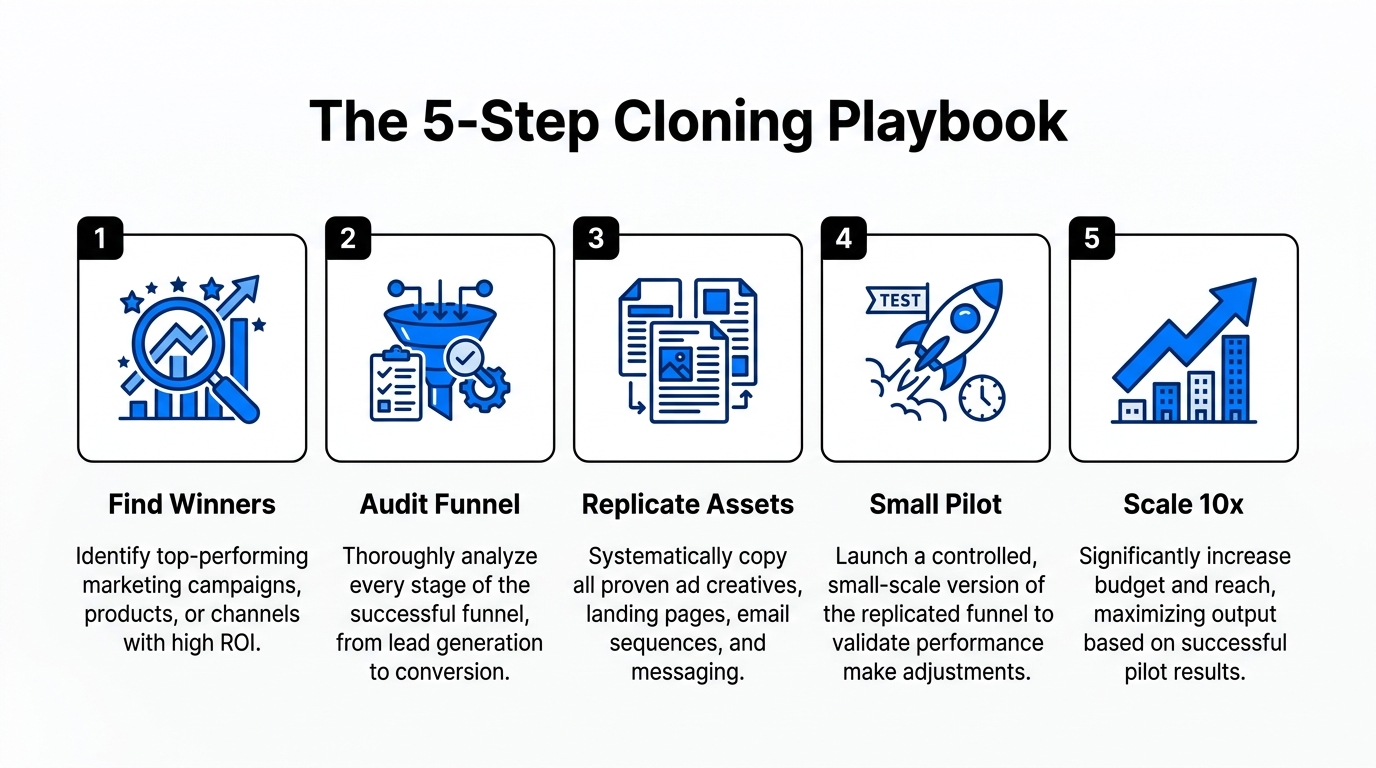
Scaling using the 'Shameless Clone' strategy isn't about being lazy; it's about being intensely disciplined. Follow this playbook to scale your distribution in 2026:
- Identify the Winner: Find a competitor whose growth is 'hitting you with a 2x4.' Look for brands that are consistently appearing in your feed or dominate a specific niche on TikTok or YouTube.
- Deconstruct the 'Unit of Success': Is it their hook? Their pricing? The specific type of creator they use? Use the VIC methodology to write a 4-5 sentence 'thesis' on why their distribution is working.
- Audit the Creators: Use an AI-powered search engine to find creators who match the profile of the competitor's winners. Don't just look for 'size'; look for 'yield' [Source: Influencer Marketing Hub]. Check for audience quality and engagement fraud to ensure you have a margin of safety.
- Clone the 'Social Math': Replicate the offer and the creative format, but improve the Social ROI. If the competitor is paying top-tier prices for celebrities, you can often clone the same results by using a fleet of 50-100 micro-creators through an automated influencer outreach tool.
- Automate the Follow-Up: Just as Pabrai automates his wealth through Berkshire Hathaway B-shares, you should automate your creator relationships. Set up AI agents to handle the daily outreach and follow-ups while you focus on high-level strategic decisions.
Conclusion: The Virtue of Simplicity
The Shameless Clone Strategy is about humility. It is the humility to admit that you don't need to be the smartest person in the room—you just need to be the best at identifying what is already working. Whether it’s John Arrillaga owning every building within two miles of Stanford or Sam Walton measuring aisle widths, the path to becoming a billionaire (or a market leader) is paved with proven models and simple math.
As we move through 2026, stop trying to invent the next Price Club. Instead, look for the Price Club that is already thriving and build your Costco on top of it. Focus on high-uncertainty, low-risk opportunities, and use the power of AI to audit, vet, and clone your way to the top. When the math is this simple, you don't need Excel—you just need the courage to be a shameless cloner.