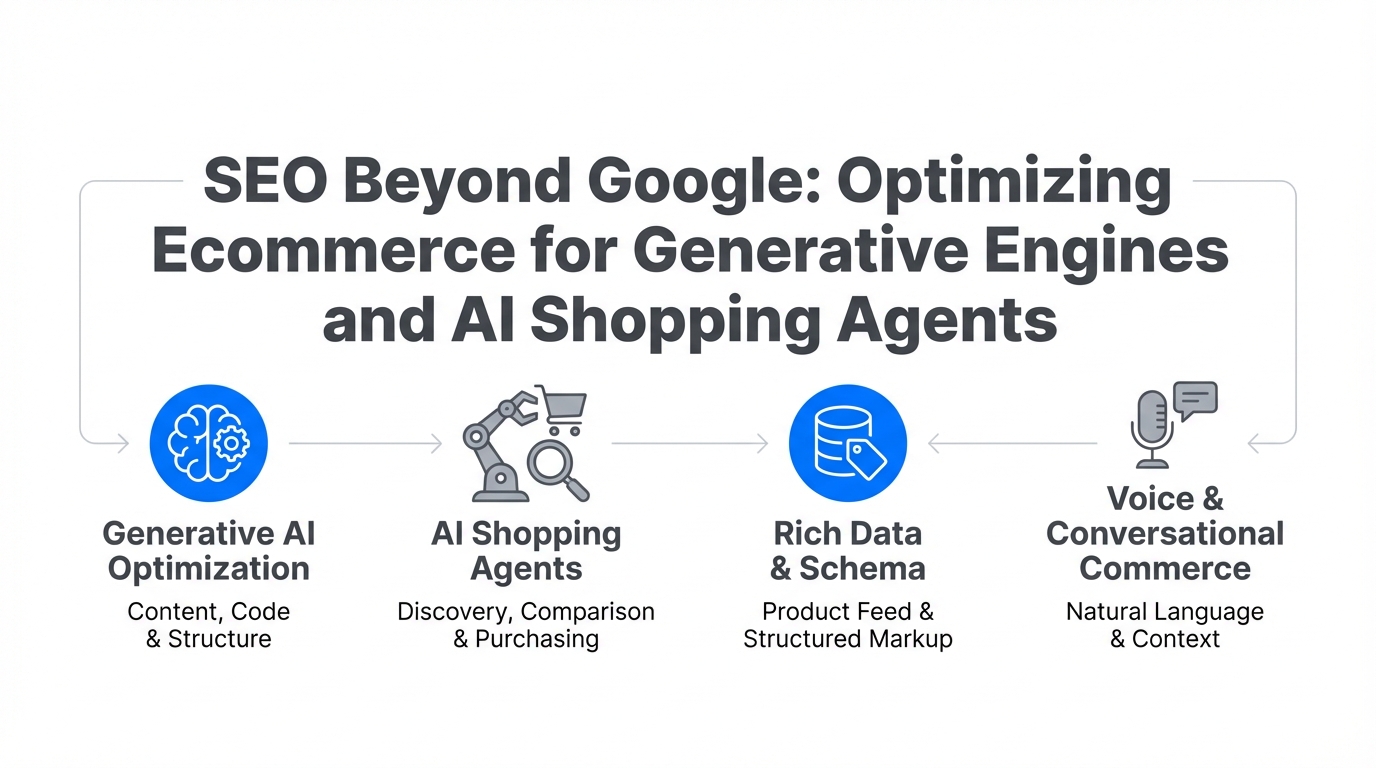
The digital storefront is undergoing its most radical transformation since the invention of the crawler. For decades, ecommerce success was synonymous with winning the Google SERP, a landscape dominated by the blue link and the featured snippet. However, as we approach 2026, the paradigm is shifting from "search results" to "generative answers." With global ecommerce sales projected to reach $6.88 trillion in 2026 according to Backlinko, the stakes for visibility have never been higher. But here is the catch: the entity doing the "looking" is no longer just a human with a keyboard; it is increasingly an autonomous AI agent. Transitioning your strategy toward Generative Engine Optimization (GEO) and Answer Engine Optimization (AEO) is no longer a futuristic luxury—it is a survival requirement for the next era of digital commerce.
The Shift to GEO/AEO: Beyond Traditional Keywords
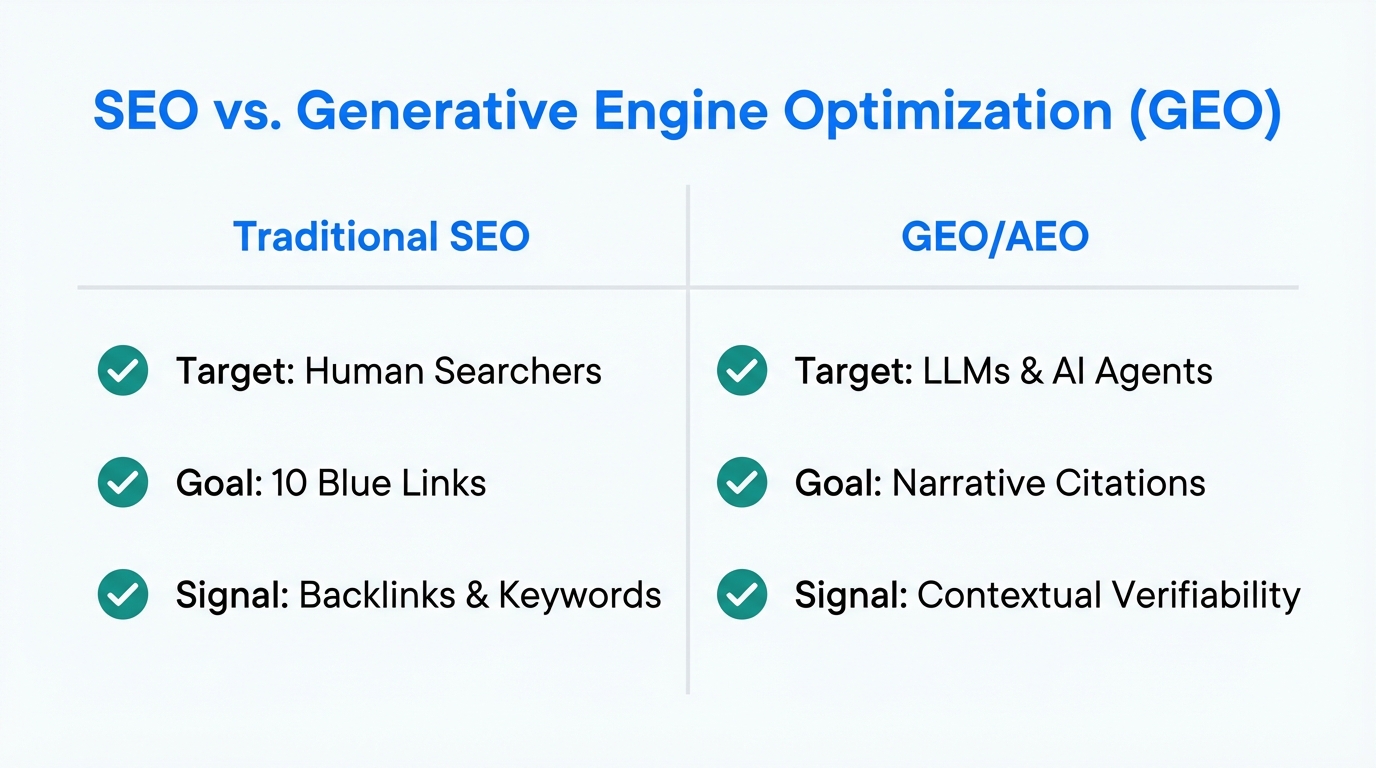
Traditional SEO focuses on matching keywords to user intent to rank high on a results page. Generative Engine Optimization, however, is about ensuring your brand and products are the primary data points cited by LLMs (Large Language Models) like ChatGPT, Gemini, and Perplexity. According to Passionfruit, the goal of GEO is to move beyond mere ranking and into the realm of authoritative citation.
When a user asks an AI assistant, "What is the most durable espresso machine for a small office under $500?" the AI does not provide a list of links. It synthesizes a recommendation based on the data it has ingested. To be that recommendation, your ecommerce site must provide structured, high-context data that AI models can easily parse. This involves a heavy emphasis on Entity-Based SEO—defining your products not just by what they are, but by their relationships to other concepts, problems, and solutions using frameworks like Schema.org.
"The future of search is not about being found; it is about being cited as the definitive answer by the engines that do the thinking for the consumer."Optimizing for Agentic AI: The Rise of Autonomous Shoppers
By 2026, we expect the rise of "Agentic AI"—autonomous shopping agents that act on behalf of the consumer. These agents will analyze product feeds managed through platforms like Google Merchant Center, read reviews, compare technical specifications, and even execute purchases without a human ever visiting a product detail page (PDP). According to SEO Discovery, this shift requires a fundamental restructuring of how we present product data.
To optimize for these agents, brands must move toward Hyper-Structured Data. This goes beyond basic Schema.org markup. It involves providing deep technical specifications, real-world performance metrics, and verified third-party data points in a machine-readable format. If an AI agent cannot verify your shipping speed, return policy, or material durability through your site's data layer, it will simply skip your product in favor of a competitor that offers full transparency.
| Feature | Traditional Ecommerce SEO | Agentic AI Marketing |
|---|---|---|
| Primary Target | Human Searchers / Google Crawler | Autonomous AI Shopping Agents |
| Content Focus | Keyword-rich descriptions | High-fidelity structured data & specifications |
| Metric of Success | SERP Rank / Click-Through Rate | Inclusion Rate in AI Recommendations |
| Update Frequency | Weekly / Monthly | Real-time API & Product Feed Sync |
The 'Perception Drift' Metric: Measuring AI Authority
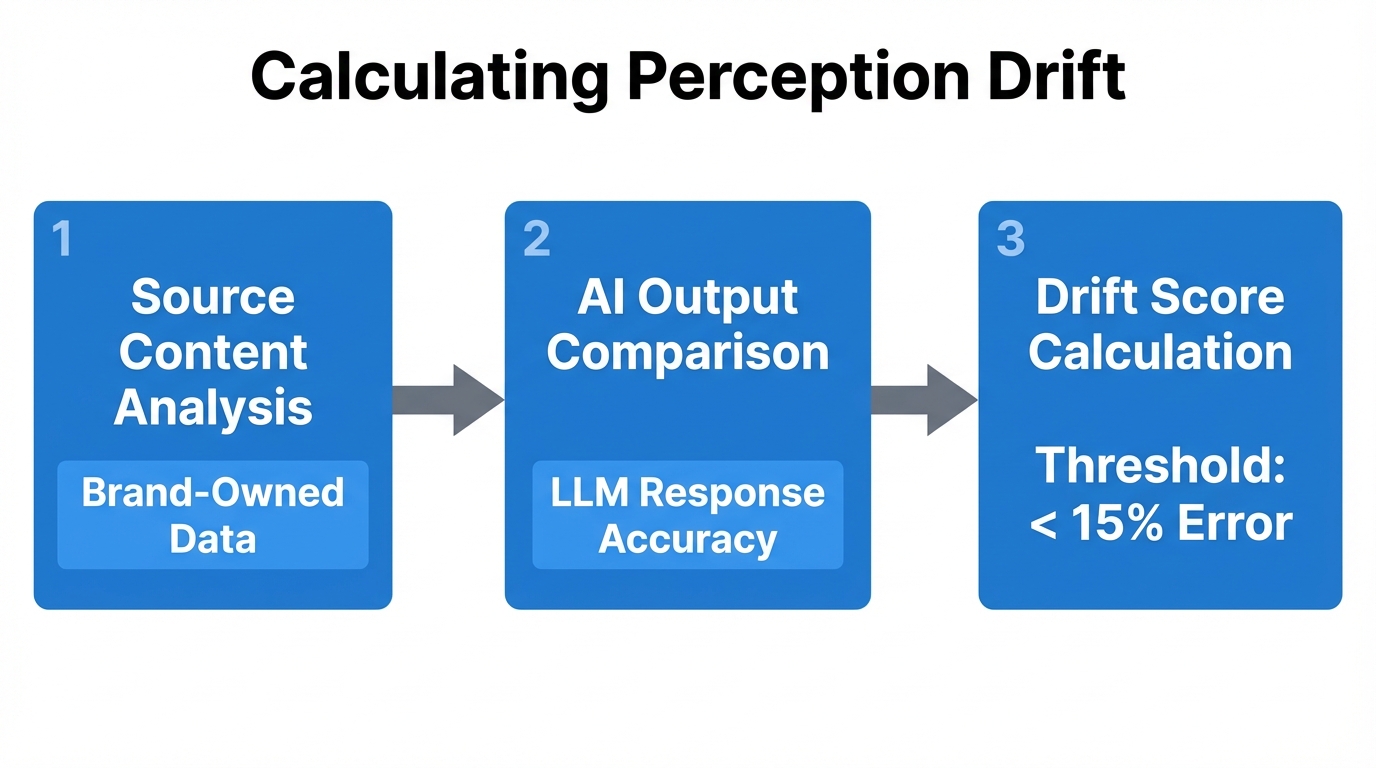
In 2026, the most important metric you aren't tracking yet will be Perception Drift. This concept, highlighted by AnalyticaHouse, refers to the delta between how a brand views itself and how AI models categorize that brand within their latent space. Because LLMs are trained on massive datasets, their "perception" of your brand is formed by every review, blog post, and social mention across the web.
If your brand sells "luxury skincare" but AI models categorize you as "budget-friendly organic," you have a perception drift problem. To fix this, brands need to flood the digital ecosystem with high-quality, consistent signals. This is where modern influencer marketing and UGC (User-Generated Content) become critical SEO levers. Managing these relationships at scale is essential; for instance, using tools like Stormy AI helps brands discover and vet creators who can produce the specific type of content that shifts AI categorization toward the desired niche authority.
"Perception Drift will become the 'Bounce Rate' of the AI era—if the model doesn't see you as an authority, you effectively don't exist in the recommendation loop."Composable Architecture: The Infrastructure of Speed
The technical foundation of your ecommerce site must evolve to support the speed required by next-gen generative engines. Composable Architecture—the practice of decoupling the frontend (the head) from the backend (the commerce engine)—is becoming the industry standard. As noted by SEO Discovery, this allows for much faster, more flexible page generation and data delivery.
When a generative engine requests data from your site to answer a user's prompt, it needs that data instantly. Sites built on monolithic, legacy platforms often suffer from latency that can lead to "timeout" errors in the AI's retrieval-augmented generation (RAG) process. By using a headless approach, you can ensure that your product data is served via optimized APIs that AI agents can consume with minimal friction. This speed isn't just for humans anymore; it is the prerequisite for being "crawlable" by the high-speed LLM scrapers of the future.
The 90-Day Scaling Protocol for AI Visibility
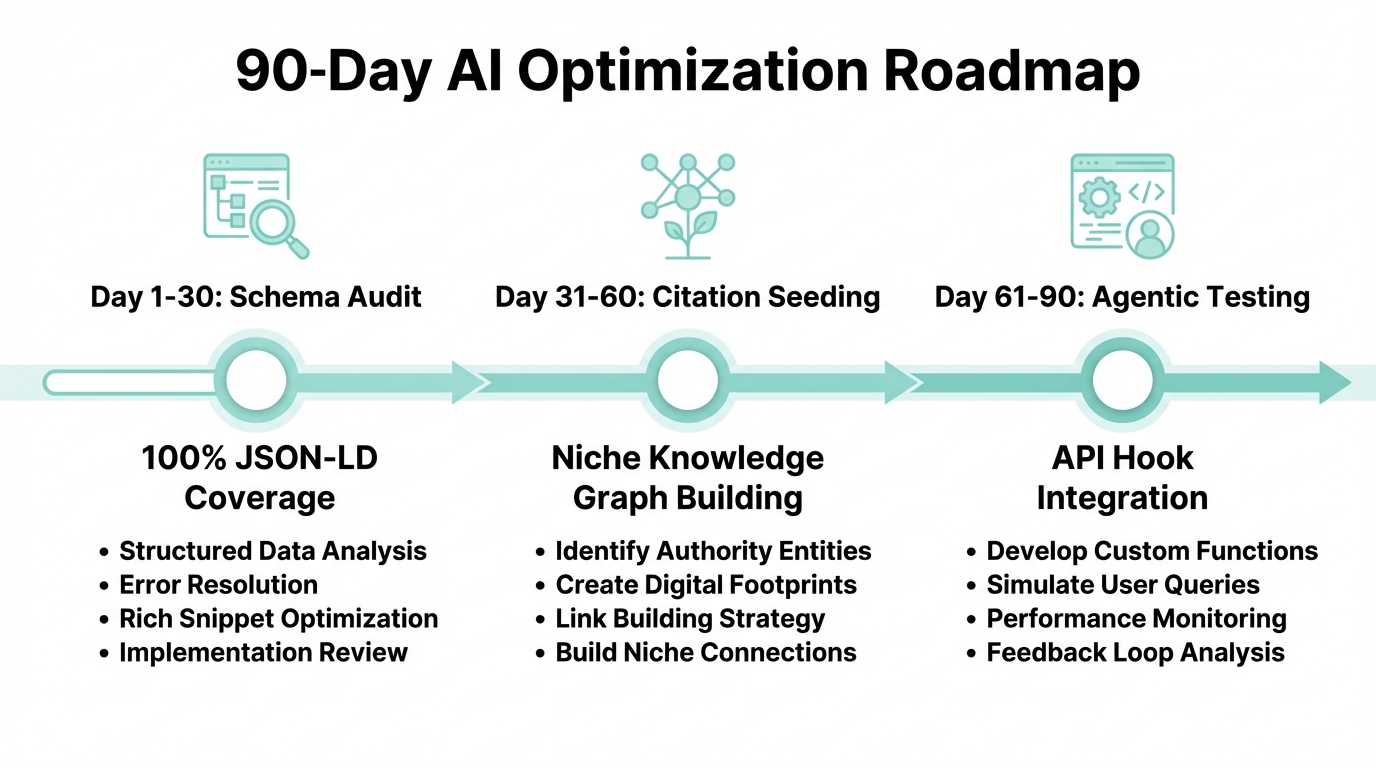
Preparing for the future of agentic AI marketing doesn't happen overnight. It requires a systematic approach to data enrichment and template optimization. Following a protocol similar to the one suggested by Passionfruit can help brands scale their AI-ready content effectively:
- Days 1–30: The Data Audit & Pilot. Audit your current product attributes. Are you providing enough "nodes" for an AI to connect? Launch a 100-page pilot using a tool like SEOmatic to test how well generative engines pick up your enhanced data.
- Days 31–60: Monitoring & Refinement. Use tools like Alli AI for bulk on-page optimization. Monitor whether your products are appearing in "AI Overviews" or ChatGPT search results. Refine your templates based on which attributes are being cited most.
- Days 61–90: Full-Scale Deployment. Deploy your optimized data across your entire catalog (1,000+ pages). Ensure you are using advanced schema tools like Rank Math SEO to provide the deepest possible context to search crawlers and AI agents alike.
During this scaling phase, internal linking is paramount. Aim for 5–15 internal links per page to prevent your programmatic pages from becoming orphans, a strategy recommended by expert Deepak Gupta. This creates a dense web of information that helps AI models understand the hierarchy and importance of your products.
Tools for the Generative Era
To succeed in AEO for ecommerce, you need a stack that can handle high-volume data processing and AI-driven content generation. Here are the tools currently leading the charge for 2025 and 2026:
- For Shopify Scaling: Use Indexly to speed up the crawling of new products and Smart SEO for automated, AI-powered meta tag and alt tag generation.
- For Magento Enterprise: The Amasty SEO Toolkit on Adobe Commerce provides the automated templates necessary for large-scale SKU management.
- For Content Enrichment: Use Clay to scrape and clean datasets, ensuring your product pages have unique, value-add information that avoids the "thin content" filters mentioned by SEOmatic.
- For Relationship Management: Platforms like Stormy AI can help you source UGC creators to build the external validation (backlinks and mentions) that AI engines require for trust.
Conclusion: The Future of Ecommerce SEO
The transition to future of ecommerce SEO is not about abandoning Google; it is about expanding your definition of a "searcher." By 2026, your most frequent visitor may be an AI agent looking for the best deal for its human owner. Winning that "click" requires a commitment to data transparency, technical speed via composable architecture, and an active management of your brand's perception in the AI latent space.
Start by auditing your structured data today. Ensure your technical specs are robust, your site speed is world-class, and your brand story is consistently told across the web. The brands that optimize for the agentic future will be the ones that capture the multi-trillion dollar opportunity of the next decade. Don't just build for humans—build for the intelligence that helps humans decide.