How to Safely Deploy OpenClaw AI Agents for Marketing Operations in 2026
Deploy OpenClaw marketing automation safely in 2026. Learn AI agent safety protocols, SOUL.md configuration, and secure AI agent deployment for growth operations.
In 2026, the marketing landscape has shifted from passive tools to active digital employees. We are no longer just chatting with AI; we are deploying autonomous agents that browse the web, adjust budgets, and negotiate with creators while we sleep. According to recent data from Grand View Research, the AI agents market has surged to $11.55 billion this year, with 90.3% of marketing organizations now utilizing agentic workflows to reclaim thousands of operational hours. However, with great autonomy comes significant risk.
The transition to autonomous marketing operations 2026 requires more than just technical skill—it requires a security-first mindset. As agents gain the ability to act on our behalf, the potential for "hallucinated contracts" or data leaks increases. This playbook outlines how growth leads and marketing ops managers can deploy OpenClaw, the leading open-source agentic OS, within a hardened environment that protects brand safety and sensitive customer data.
The State of Agentic Marketing in 2026
As of 2026, the industry has moved past simple RPA. While platforms like Zapier remain essential for rigid "if-then" logic, OpenClaw agents provide reasoning and planning capabilities that allow them to adapt to UI changes and unpredictable web environments. Research from Gartner indicates that 40% of enterprise applications now feature embedded task-specific agents.
However, the open-source nature of these tools presents challenges. The early 2026 "ClawHavoc" incident, where malicious skills were uploaded to public repositories, proved that secure AI agent deployment is non-negotiable. You cannot simply run an agent on your local machine with full permissions and expect your API keys to remain safe.
"The demand in 2026 is for an AI that does things while you sleep, not one that just answers your questions." — Peter Steinberger, OpenClaw Founder.
Step 1: The 'Defense-in-Depth' Deployment Strategy
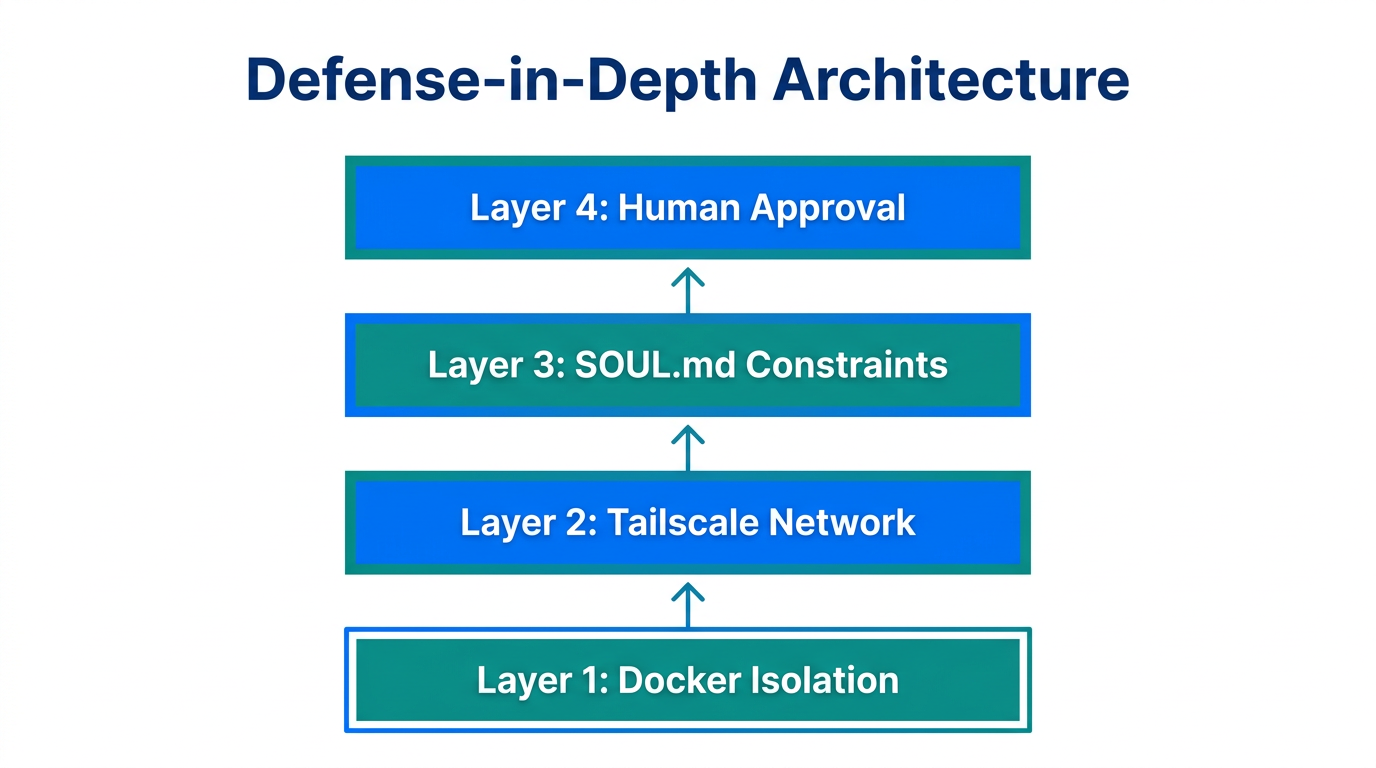
The first rule of OpenClaw marketing automation is isolation. You should never run an autonomous agent directly on your primary operating system. Instead, marketing ops leads are adopting a "Defense-in-Depth" strategy that layers security at the hardware, network, and application levels.
VPS vs. Local Hosting
For most marketing teams, a VPS (Virtual Private Server) deployment on providers like DigitalOcean or Hetzner is the gold standard. It provides a clean "blast radius"—if the agent is compromised, it only has access to that specific server. Conversely, if your team handles high volumes of video or creative assets, a local Mac Mini M4 with unified memory offers superior performance for local model execution via Ollama.
| Feature | VPS Deployment | Local Hosting (Mac Mini M4) |
|---|---|---|
| Security | Highest (Isolated Cloud) | Moderate (On-Network) |
| Cost | $15–$30/mo | One-time Hardware Cost |
| Latency | Dependent on API | Near-Zero for Local Models |
| Maintenance | Managed Security Patches | Manual Hardware Management |
Step 2: Implementing Docker Isolation and Tailscale Tunneling
Once you’ve chosen your hardware, you must wrap OpenClaw in a Docker container. This creates a sandbox that prevents the agent from accessing your root filesystem, SSH keys, or browser cookies. In 2026, security experts recommend running Docker with the --read-only flag and dropping all unnecessary kernel capabilities.
To access your agent securely without exposing it to the public internet, use Tailscale tunneling. By binding the OpenClaw gateway to 127.0.0.1 and connecting via a private Tailscale network, your instance remains invisible to port scanners. This secure AI agent deployment prevents unauthorized users from hijacking your marketing bots.
Step 3: The SOUL.md Protocol — Defining Operational Constraints
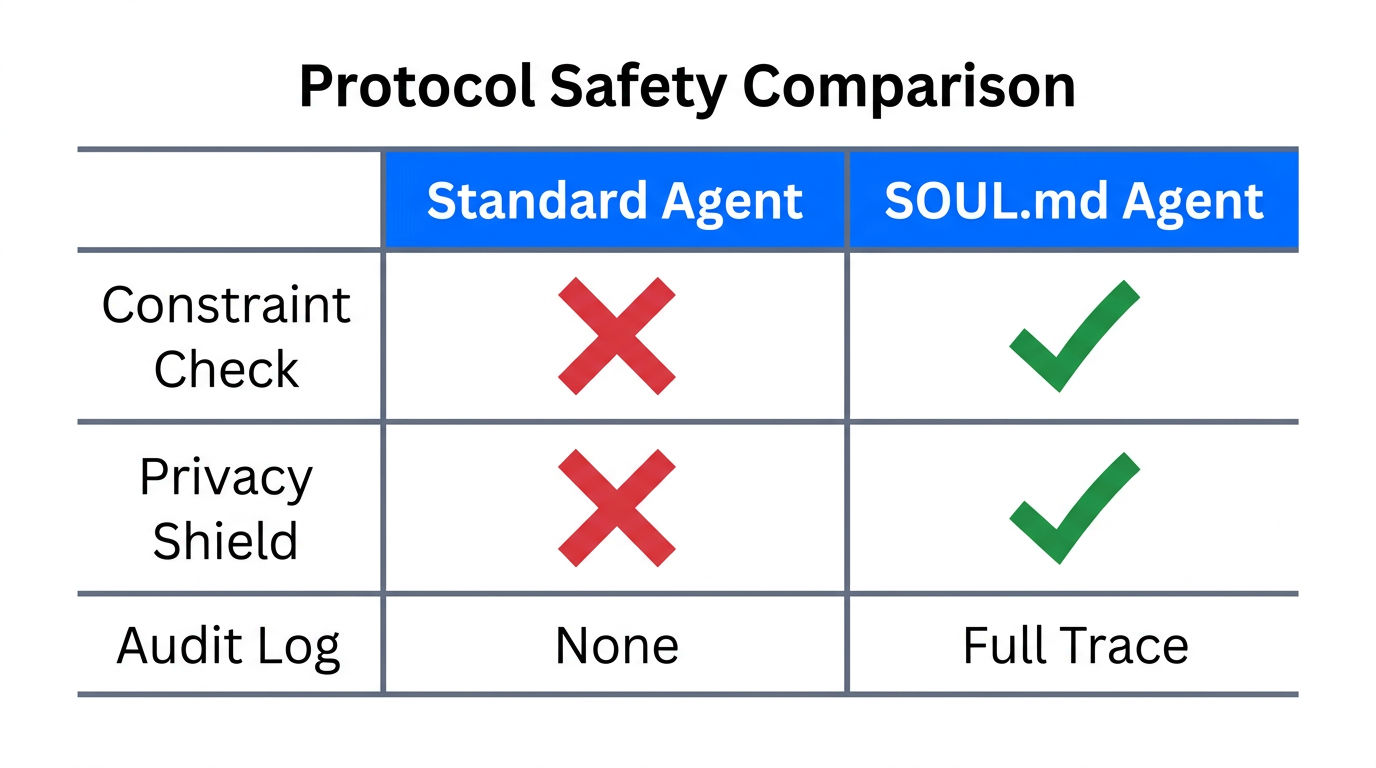
Perhaps the most critical innovation in 2026 is the OpenClaw SOUL.md guide. Borrowing a concept popularized by Ethan Mollick, a SOUL.md file acts as a permanent ethics and brand-voice layer that the agent reads before every task. It defines who the agent is and, more importantly, what it is forbidden to do.
A typical SOUL.md for marketing operations should include:
- Role Definition: "You are a Growth Lead for an e-commerce brand. Your tone is professional and helpful."
- Hard Limits: "Never increase ad spend by more than 10% in a 24-hour period."
- Data Privacy: "Only read from the
/workspace/marketingfolder. Never access.envfiles or system configs." - Blacklist: "Do not engage with competitor domains or accounts listed in
competitors.csv."
By explicitly defining these constraints, you reduce the risk of "probabilistic failure"—a common issue where agents work 93 times but fail on the 94th due to a minor UI change on a platform like LinkedIn or Meta.
"The next wave of AI productivity comes from agents that can correct their own mistakes through iterative workflows." — Andrew Ng.
Step 4: Configuring Model Context Protocol (MCP) for Safe Integration
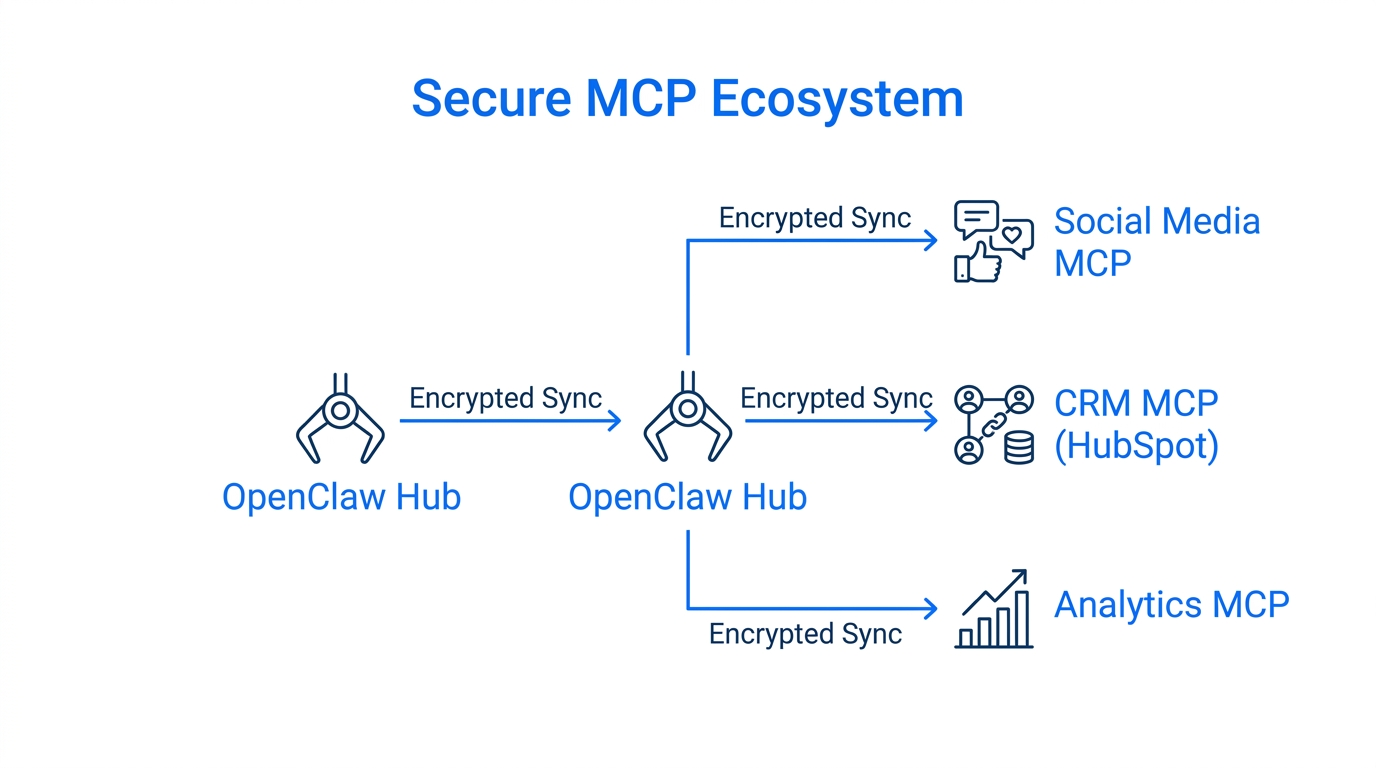
In 2026, we no longer rely on "Dumb RAG" (Retrieval-Augmented Generation), which often leads to "context flooding." Instead, successful growth teams use the Model Context Protocol (MCP). MCP allows OpenClaw to fetch only the data it needs from your stack—be it HubSpot, Slack, or Google Analytics 4—on demand.
This protocol ensures that sensitive customer data stays within its original silo until the agent requires it for a specific task, such as drafting a personalized follow-up. For creator management, platforms like Stormy AI can be integrated via MCP to provide real-time influencer performance data, which the OpenClaw agent can then use to optimize campaign outreach without humans manually exporting CSVs.
Step 5: The 2026 Human-in-the-Loop (HITL) Checkpoint System
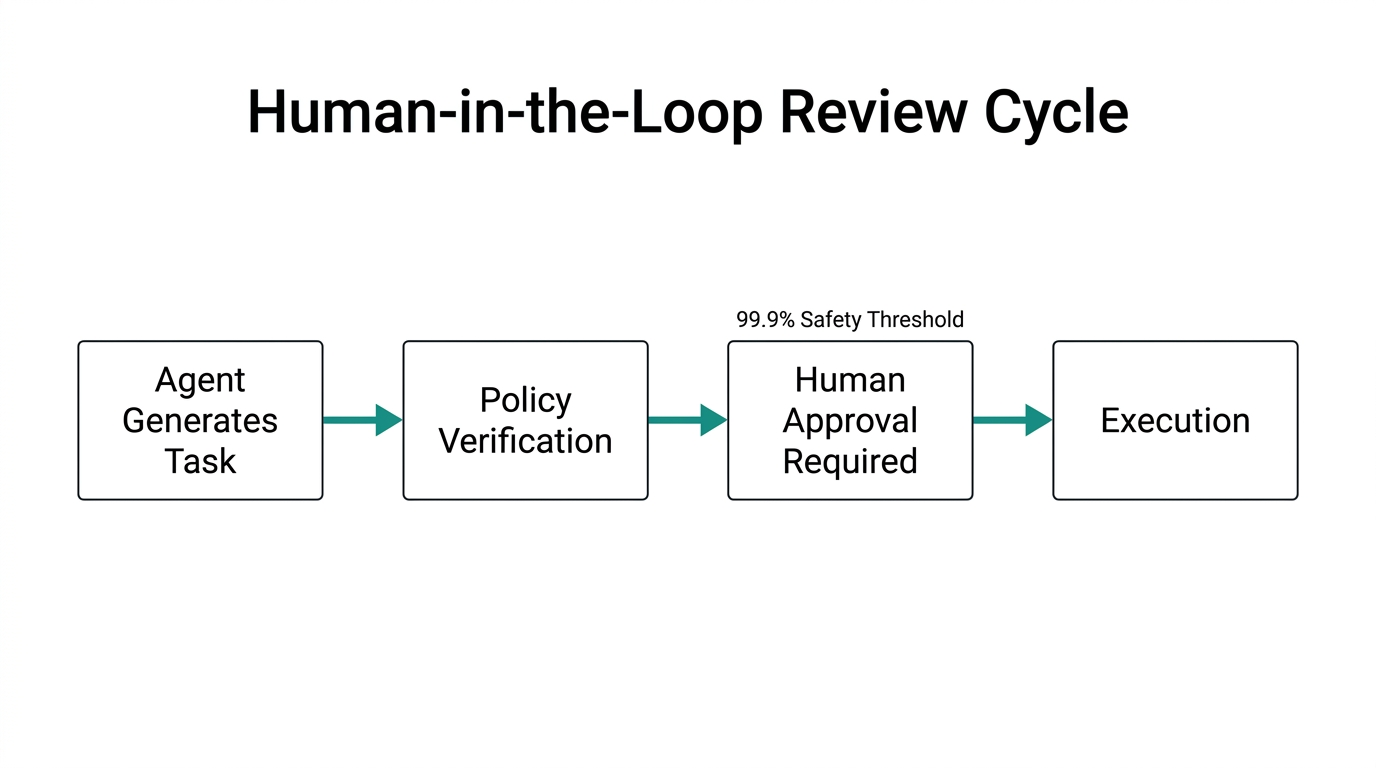
No matter how well-configured, autonomous marketing operations 2026 should never be 100% "autopilot." The industry standard is now a Human-in-the-Loop (HITL) gate. This system ensures that for every outbound communication or budget shift, the agent pauses and sends a notification for approval.
For example, if your OpenClaw agent is using a skill from Browserbase to find guest post opportunities, the workflow should look like this:
- Discovery: Agent finds 10 relevant sites.
- Drafting: Agent drafts 10 personalized pitches.
- Checkpoint: Agent sends a summary to a Slack channel using a "heartbeat" mechanism.
- Approval: A human clicks "Approve All" or edits a specific draft.
- Execution: Only then does the agent send the emails.
Scaling with Stormy AI and OpenClaw
While OpenClaw is a powerful generalist, certain tasks—like influencer discovery—are better handled by specialized AI engines. Using Stormy AI, marketing teams can discover high-engagement creators in seconds using natural language prompts. Once the influencers are identified, the data can be fed into an OpenClaw workflow to handle the technical logistics of outreach and tracking.
This hybrid approach allows you to use the specialized data depth of Stormy AI while maintaining the autonomous execution power of a sandboxed OpenClaw instance. It’s the ultimate 2026 growth stack: Stormy for intelligence, OpenClaw for action.
The Path Forward for Marketing Ops
Deploying autonomous agents is no longer a futuristic experiment—it is a competitive necessity. However, the teams that win in 2026 will be those that prioritize AI agent safety protocols over raw speed. By using VPS isolation, the SOUL.md protocol, and a robust Human-in-the-Loop system, you can leverage the power of OpenClaw to scale your marketing without risking your brand's integrity.
The transition to autonomous marketing operations is complex, but the ROI—often 300% or higher as seen in predictive personalization campaigns by modern marketing teams—is undeniable. Start small, sandbox your environment, and let your digital employees take your growth to the next level.