The digital gold rush has moved to the terminal. As US TikTok Shop sales reached a staggering $15.82 billion in 2025, representing a 108% year-over-year growth, the window for manual trend research is slamming shut. Brands that win today aren't just creative; they are fast. They leverage automation to identify winning products before the saturation curve peaks. Enter Claude Code—Anthropic’s agentic command-line interface—a tool that shifts the paradigm from simple chat-based AI to "Action AI" capable of executing complex TikTok Shop strategy workflows at scale. By the end of this guide, you will understand how to build an automated research engine that discovers, analyzes, and scripts high-converting content while your competitors are still scrolling their For You Pages.
The TikTok Shop Explosion and the Speed-to-Market Mandate
TikTok is projected to reach 1.9 billion monthly active users (MAU) globally by early 2026, according to recent user statistics. More importantly, the platform maintains an average engagement rate of 4.86%, which dwarfs Instagram’s 0.48%. For e-commerce brands, this engagement is the fuel for TikTok Shop’s commerce engine. However, the lifecycle of a TikTok trend is notoriously short. What is viral on Monday is often "cringe" by Friday.
To capture TikTok Shop ROI, brands must transition from reactive content creation to proactive, data-driven execution. This requires a growth hacking mindset where research is automated. According to data from Anthropic, roughly 34% of Claude users are now utilizing the tool for mathematical or computer-intensive tasks like automation, signaling a move away from simple text generation toward complex strategy execution.
"US TikTok Shop sales reached $15.82 billion in 2025—a 108% YoY growth that rewards brands capable of moving at the speed of the algorithm." [Source: EMARKETER]
What is Claude Code? The New Marketing Command Center
Unlike the standard web interface of Claude, Claude Code is a terminal-based agent. It lives in your development environment or command line, meaning it can read local files, execute terminal commands, and—crucially—interact with external APIs through the Model Context Protocol (MCP). This makes it an ideal engine for TikTok trend research tools.
When you run /init in Claude Code, it creates a CLAUDE.md file. This file acts as a persistent memory bank for your brand voice, target audience demographics, and conversion goals. For a TikTok marketer, this means every script generated or video analyzed is filtered through your specific brand DNA without needing to re-prompt the AI every single time. It represents a shift from context-switching between tabs to a unified "Terminal Dashboard."
Step 1: Automating Competitive Intelligence with Apify MCP
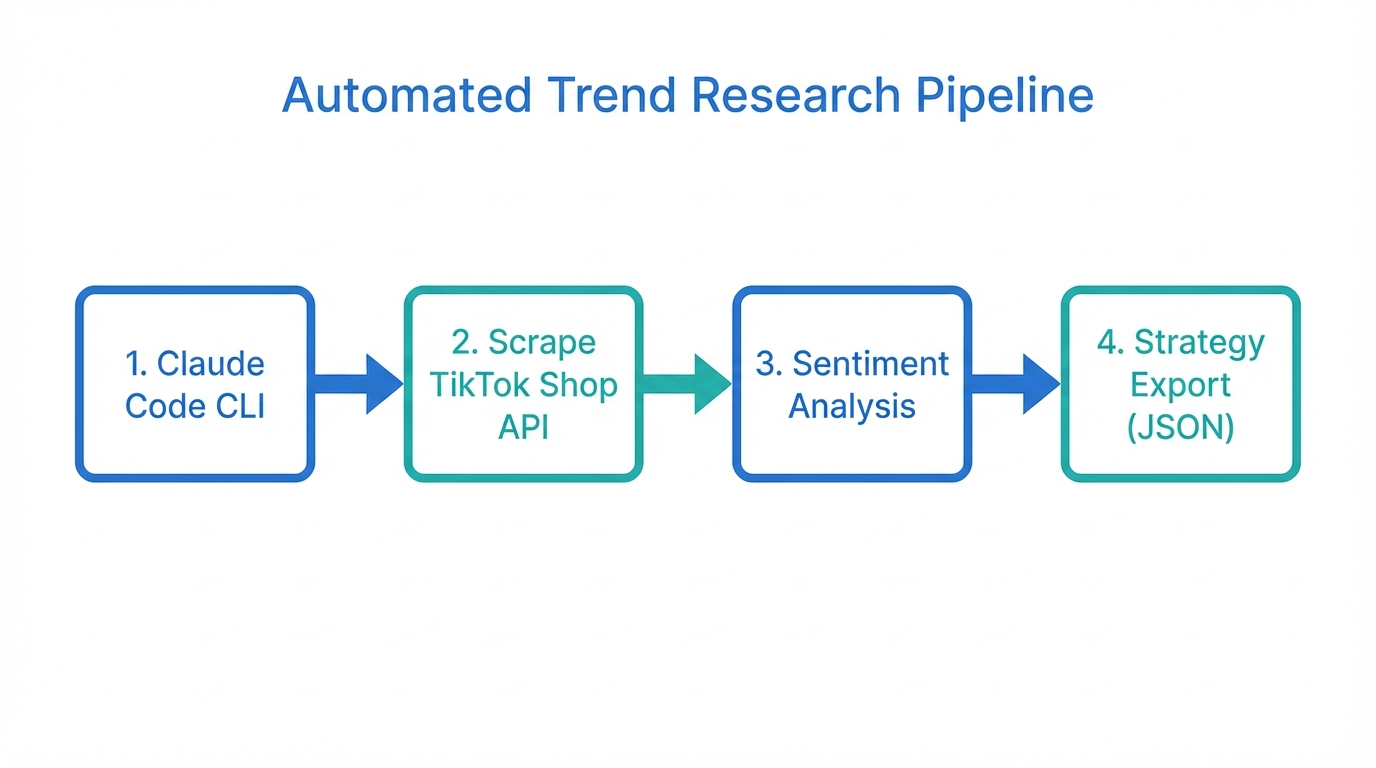
The first stage of a high-ROI TikTok Shop strategy is identifying what is already working. Instead of manual scrolling, you can use Claude Code paired with the Apify TikTok Scraper or the TikTok Ads Library Fast MCP. This allows Claude to pull real-time data on the top-selling products in your niche directly into your workspace.
By instructing Claude Code to "Scrape the top 50 trending products in the 'Skincare' category and identify common price points and shipping times," you gain a data-backed view of the competitive landscape. You can even use tools like Simon’s TikTok MCP Server to monitor specific competitor profiles for spikes in engagement, allowing you to intercept emerging trends before they go mainstream.
| Research Method | Manual Process | Claude Code Automation |
|---|---|---|
| Trend Discovery | 3-4 hours of scrolling FYP | 5 minutes via TikTok Scraper MCP |
| Competitor Analysis | Spreadsheet entry of likes/views | Real-time dashboarding in the terminal |
| Hook Extraction | Watching videos and transcribing | Automated transcript analysis of top 20 videos |
Step 2: The Viral Hook Playbook — Transcript Analysis
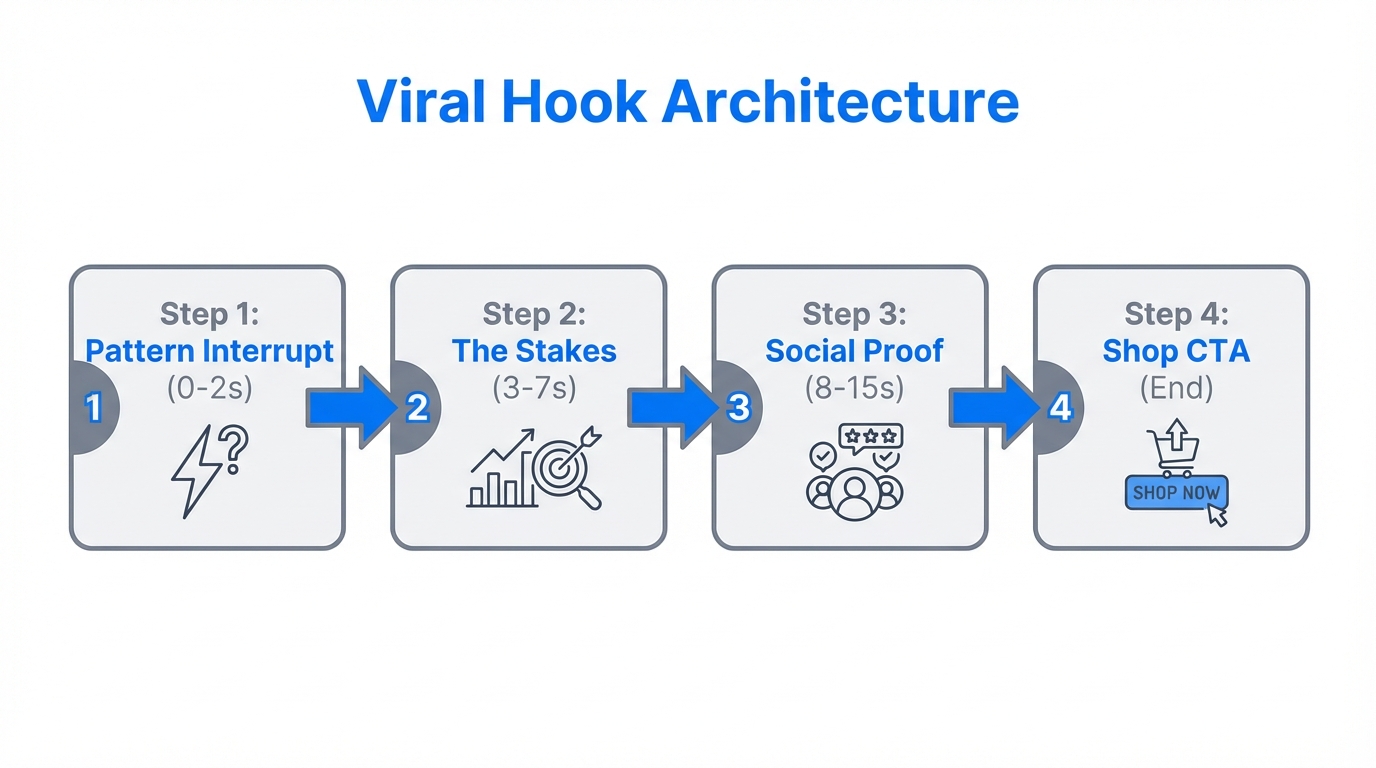
Content on TikTok lives or dies by the first three seconds. In fact, 63% of successful TikTok ads deliver their core message within that window, according to data from TikTok for Business. To replicate this success, you can use Claude Code to perform bulk transcript analysis.
The Workflow:
- Use a scraper to download the transcripts of the top 20 videos in your niche.
- Feed these transcripts to Claude Code.
- Instruct Claude to: "Extract the core pain points addressed in these videos and identify the 'hook patterns' (e.g., 'Stop doing X,' 'I wish I knew this sooner')."
- Generate 50+ localized video hooks based on these patterns, tailored to your specific product.
This method ensures your content isn't just creative—it's quantifiably aligned with what is already capturing attention. While manual research might catch one or two patterns, Claude Code can synthesize hundreds of data points to find the common denominator of virality. For teams looking to scale this process, platforms like Stormy AI streamline creator sourcing and outreach once the winning hooks are identified.
"Stop guessing what hooks your audience. Use automated transcript analysis to find the exact phrasing that keeps users from scrolling past your Shop ads."
Step 3: Scaling UGC and Influencer Management
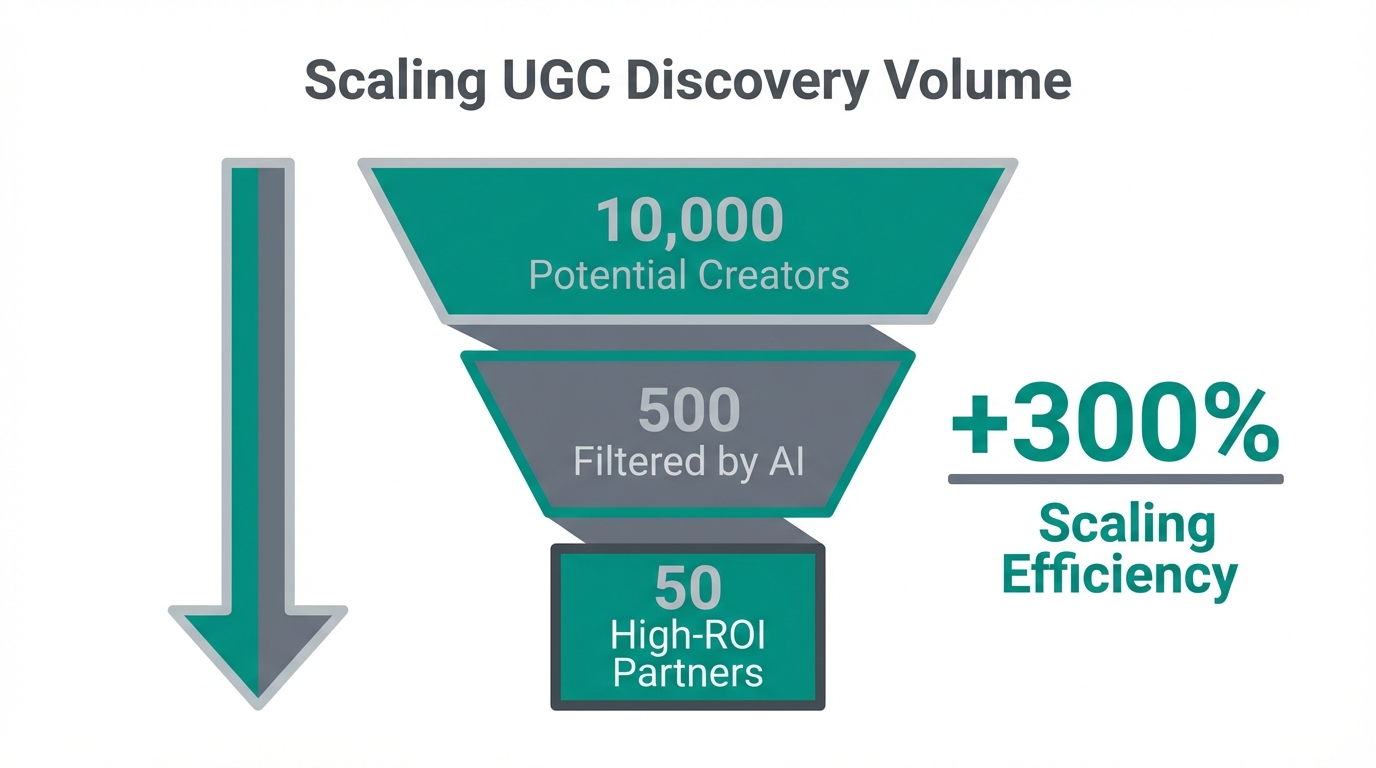
Once you have the data and the scripts, the next hurdle is execution. Finding the right creators to deliver these hooks is where many brands stumble. This is where AI influencer marketing research becomes essential. Using platforms like Stormy AI, marketers can source creators who specifically fit the niche data identified during the Claude Code research phase.
By using Stormy AI to discover creators with high engagement and verified audience quality, you can ensure that the hooks you’ve engineered are delivered to the right people. You can even use Claude Code to manage the outreach process. By connecting your email stack—using tools like Instantly or Lemlist—to your local terminal, you can have Claude draft and send hyper-personalized collaboration requests based on the creator's recent performance metrics.
Step 4: Programmatic Video Creation with FFmpeg
If you are running a high-volume TikTok Shop, you likely need a "Content Factory" approach. Claude Code can orchestrate local media tools like FFmpeg or Remotion to batch-produce videos. For example, you can provide Claude with a CSV of product features and have it write a Python script that overlays product images on trending background footage, adds auto-generated captions, and syncs the edit to a specific BPM.
This is particularly useful for testing multiple variations of an ad. Instead of an editor spending hours on 10 versions, Claude Code can generate 50 variations in minutes, allowing you to find the winning creative through brute-force testing. For brands that prefer a more visual interface for repurposing, tools like OpusClip can also be integrated into these workflows to chop long-form content into viral TikTok bites.
Step 5: Automated Ad Campaign Management via CLI
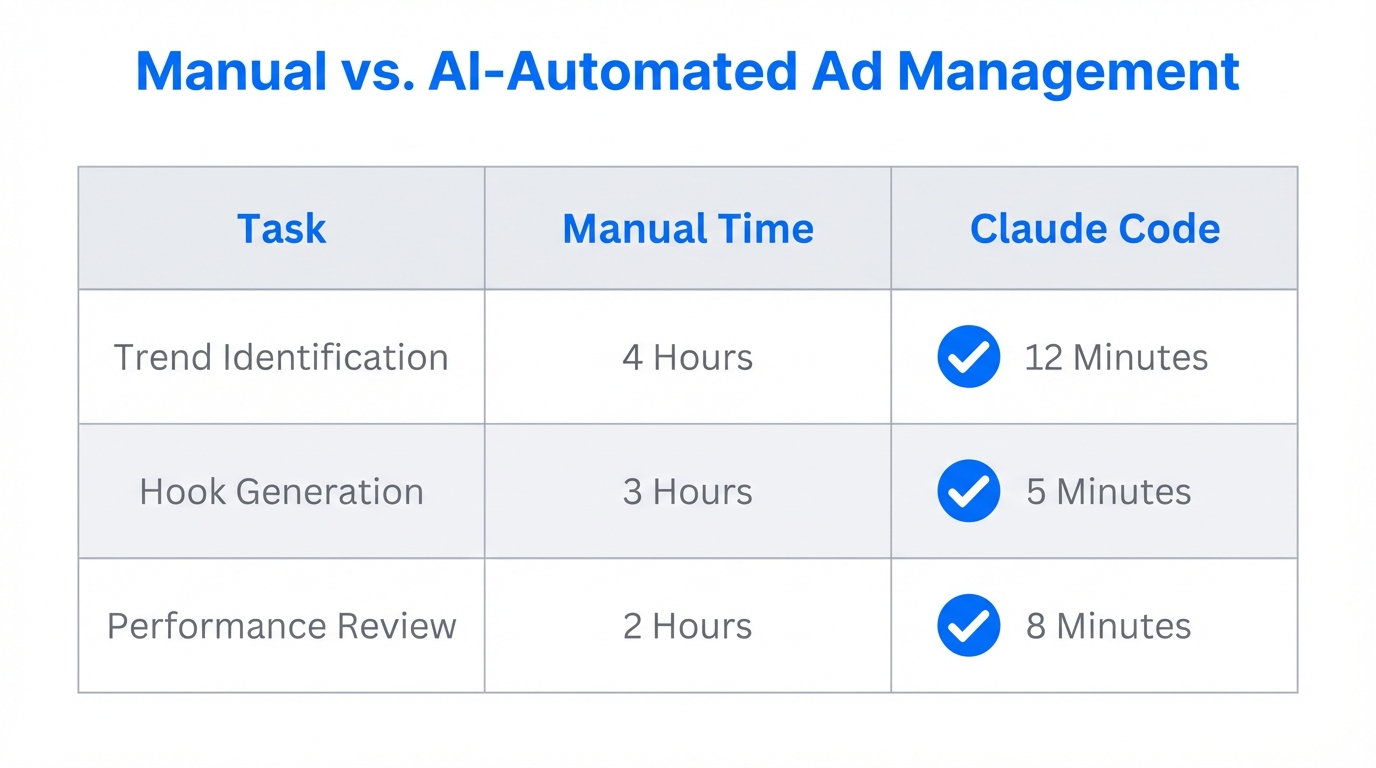
The automation doesn't stop at content. The TikTok Ads MCP Server allows Claude Code to manage your ad campaigns directly from the terminal. This eliminates the need to manually refresh the TikTok Ads Manager every hour.
You can give Claude specific autonomous instructions: "Check my TikTok Ads performance for the last 24 hours. Pause any ad group with a CPA over $15 and reallocate that budget to the top-performing creative." This level of programmatic management ensures you are always optimizing for ROI, even while you sleep. By staying in the terminal, you avoid the context switching that kills productivity, turning your command line into a high-performance marketing cockpit.
Avoiding the 'Over-Automation' Trap
While Claude Code automation is powerful, it is not a replacement for brand soul. One of the most common mistakes is direct repurposing—posting videos with watermarks from other platforms like Instagram Reels. TikTok’s algorithm penalizes this heavily. Use Claude Code to automate watermark removal or original rendering via FFmpeg to ensure native-feeling content.
Furthermore, avoid using automated "engagement bots" for likes and comments. According to Octoparse AI, these are red flags that trigger platform penalties. Your automation should focus on research, production, and scheduling, not faking social proof. Authentic storytelling still wins; AI just helps you find the story that people want to hear.
Conclusion: Building Your Autonomous Growth Engine
Scaling your TikTok Shop ROI in 2026 requires a blend of creative intuition and agentic automation. By using Claude Code to handle the heavy lifting of trend scraping, hook generation, and ad management, you free your team to focus on the high-level strategy and brand building that AI cannot replicate. Start by initializing your marketing terminal, connecting your MCP servers, and using tools like Stormy AI to bridge the gap between data-driven research and high-quality creator collaborations. The future of e-commerce isn't just automated—it's agentic.