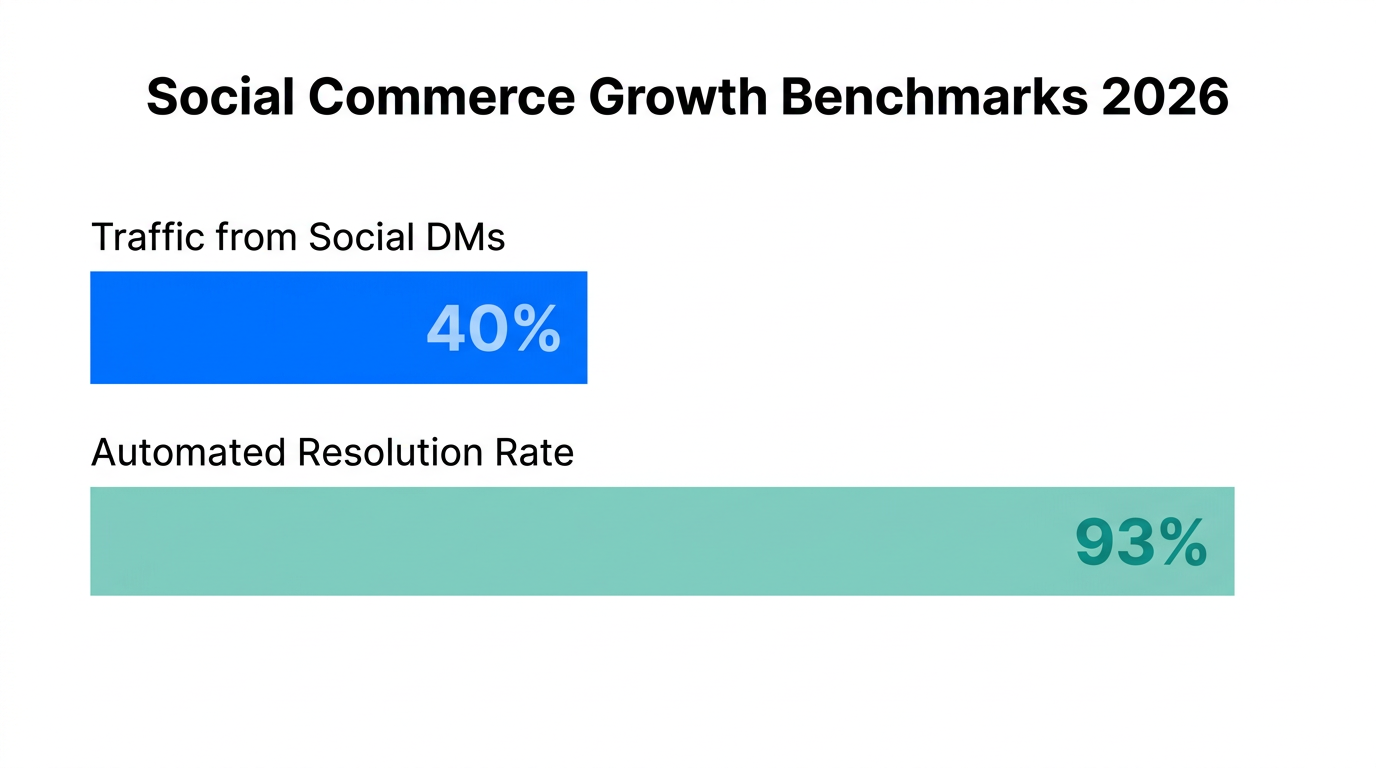
In 2026, the boundary between social media and storefront has effectively vanished. For modern brands, the Instagram DM or TikTok inbox isn't just a place for customer service; it is a high-velocity sales floor. With recent data showing that nearly 40% of e-commerce traffic now originates from social platforms, the ability to convert a casual comment into a confirmed order is the defining competitive advantage of the year. However, as volume scales, manual responses become impossible. Brands are now turning to a powerful dual-engine strategy: ManyChat for proactive social commerce automation and Gorgias for centralized, omnichannel support.
The State of Social Commerce in 2026
The global AI chatbot market has surged to an estimated $15.12 billion in 2026, according to Master of Code. We have moved past the era of "clunky" bots that frustrated users. Today, 89% of retail and CPG companies have fully integrated AI into their customer journey. The results are undeniable: AI-powered chat delivers 4X higher conversion rates compared to unassisted shopping sessions.
As Gartner predicted, over 80% of customer support organizations are now leveraging generative AI to enhance efficiency. For brands, this means shifting from reactive FAQs to proactive digital sales consultants that guide users through the funnel in the same place they discover content.
"The future of retail isn't on a website; it's in the conversation. If a customer has to leave their favorite social app to buy from you, you've already lost the sale."
ManyChat: Turning DMs into a Sales Engine
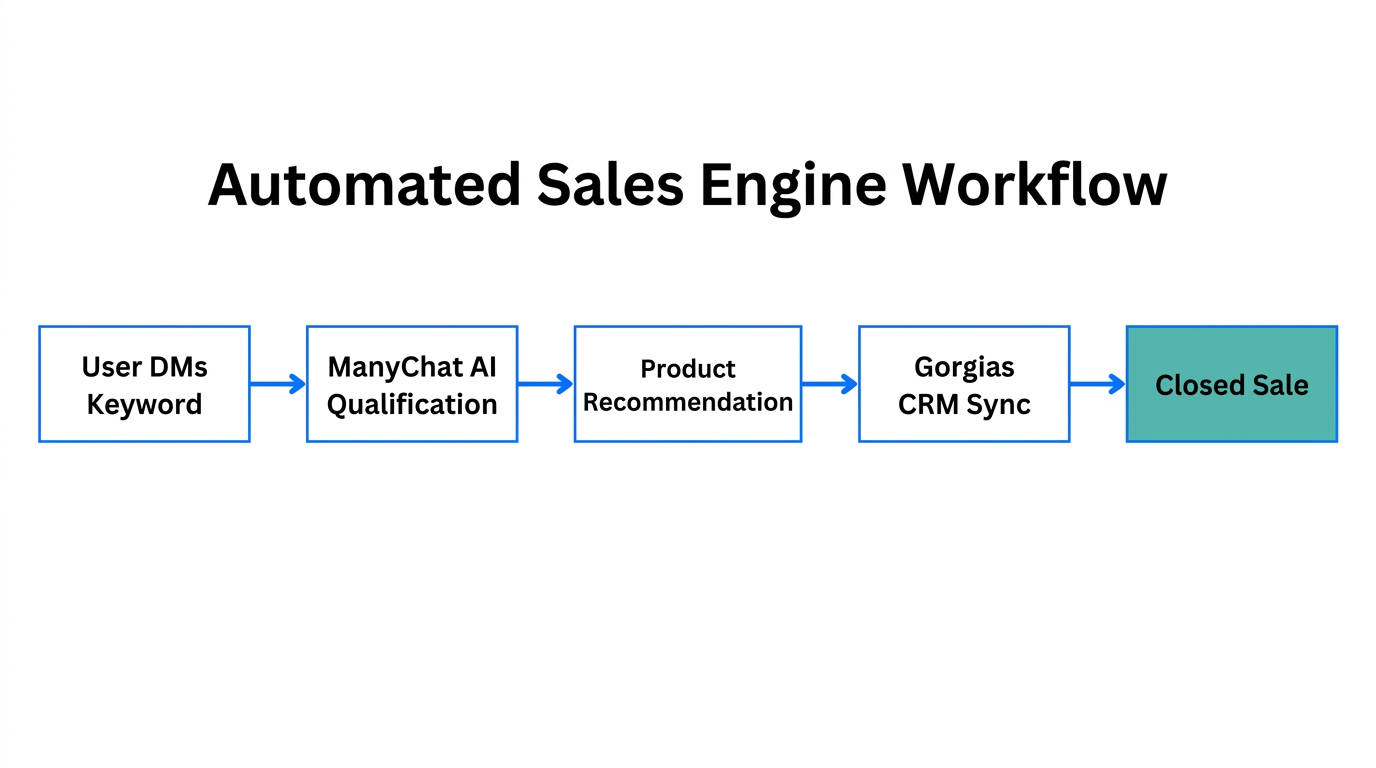
ManyChat has evolved into the gold standard for Instagram DM sales strategy. By creating automated flows triggered by keywords, story mentions, or comments, brands can engage users the micro-second their interest is piqued. A classic example of this success is Lego. By deploying "Ralph," an AI-powered chatbot on social messaging platforms, Lego managed to drive 25% of all their social media sales through automated gift-finding conversations.
In 2026, ManyChat social commerce goes beyond simple triggers. It now incorporates "Agentic AI"—as noted by Zowie—which uses Large Language Models (LLMs) to reason through complex shopper requests. Instead of a linear menu, the bot understands intent. If a user says, "I need a dress for a summer wedding in Tuscany," the bot doesn't just show dresses; it analyzes the context and pulls relevant inventory.
| Feature | Traditional Bot (2023) | Social AI Agent (2026) |
|---|---|---|
| Interaction | Static Button Menus | Natural Language Processing |
| Context | None (Single Session) | Omnichannel History |
| Goal | Ticket Deflection | Conversion & Discovery |
| Personalization | Generic "Hello [Name]" | Hyper-Personalized Recommendations |
Gorgias: The Backbone of Omnichannel Consistency
While ManyChat handles the front-end "magic" of social discovery, Gorgias e-commerce automation provides the infrastructure. One of the biggest mistakes brands make is siloing their social DMs from their main helpdesk. When a customer asks a question on Instagram and then follows up via email, they expect the brand to know who they are. Omnichannel customer service for brands is no longer optional—it is a baseline requirement.
By connecting Gorgias to your social DMs, you ensure that every interaction is logged in a single customer view on platforms like Shopify. This integration allows AI agents to resolve up to 93% of customer questions without human intervention. When a query is too complex, Gorgias seamlessly hands it off to a human agent with the full context of the automated social conversation.
This "Human-in-the-loop" model is what experts at Yuma AI highlight as the most sustainable path forward. It allows for high-empathy resolutions for complex issues while maintaining the lightning-fast speed customers now demand. In fact, 51% of consumers now prefer interacting with bots for immediate service.
"Efficiency is getting the answer right. Scaling is getting it right 10,000 times a day across six different social platforms simultaneously."
The 'Atomic' Knowledge Base: Preventing AI Hallucinations
The biggest fear for brands in 2026 is an AI bot "hallucinating"—making up a discount code or promising a delivery date it can't keep. To prevent this, successful brands use a Step-by-Step Playbook for creating 'atomic' knowledge bases. This strategy involves breaking down your brand's information into the smallest possible, non-conflicting units of data.
- Audit Your Source Data: Remove outdated PDFs or long-form manuals. AI performs better with concise, factual snippets.
- Structure by Intent: Instead of one giant FAQ page, create individual entries for "Shipping to UK," "Return Policy for Sale Items," and "Fabric Care." Platforms like Alhena AI specialize in hallucination-free data structuring.
- Sync with Live Inventory: Use PIM (Product Information Management) integrations to ensure your bot knows exactly what is in stock. There is no faster way to lose a social media customer acquisition lead than by recommending an out-of-stock item.
- Set Hard Guardrails: Explicitly tell the AI what it *cannot* talk about (e.g., legal advice or medical claims).
From Support Gatekeepers to Discovery Engines
Too many brands use chatbots as gatekeepers designed to keep customers *away* from their team. In 2026, the mindset has shifted: bots are discovery engines. Look at Sephora, whose "Virtual Artist" bot provides makeup advice and product recommendations, leading to an 11% improvement in conversion rates.
Similarly, H&M uses a digital stylist chatbot that quizzes customers on their style to recommend personalized outfits. This creates a curated shopping experience directly within the social app. To replicate this, your ManyChat flows should focus on proactive engagement. Instead of waiting for a support ticket, use a bot to reach out to users who interact with your UGC (User-Generated Content).
For brands looking to source the creators who spark these conversations, tools like Stormy AI are essential. By finding the right influencers to drive traffic to your DMs, you create a seamless loop: Stormy AI finds the creator, the creator drives the DM, and ManyChat closes the sale.
"A bot shouldn't just answer 'Where is my order?' It should answer 'What should I wear to my graduation?'"
Measuring Success: Containment Rate vs. CSAT
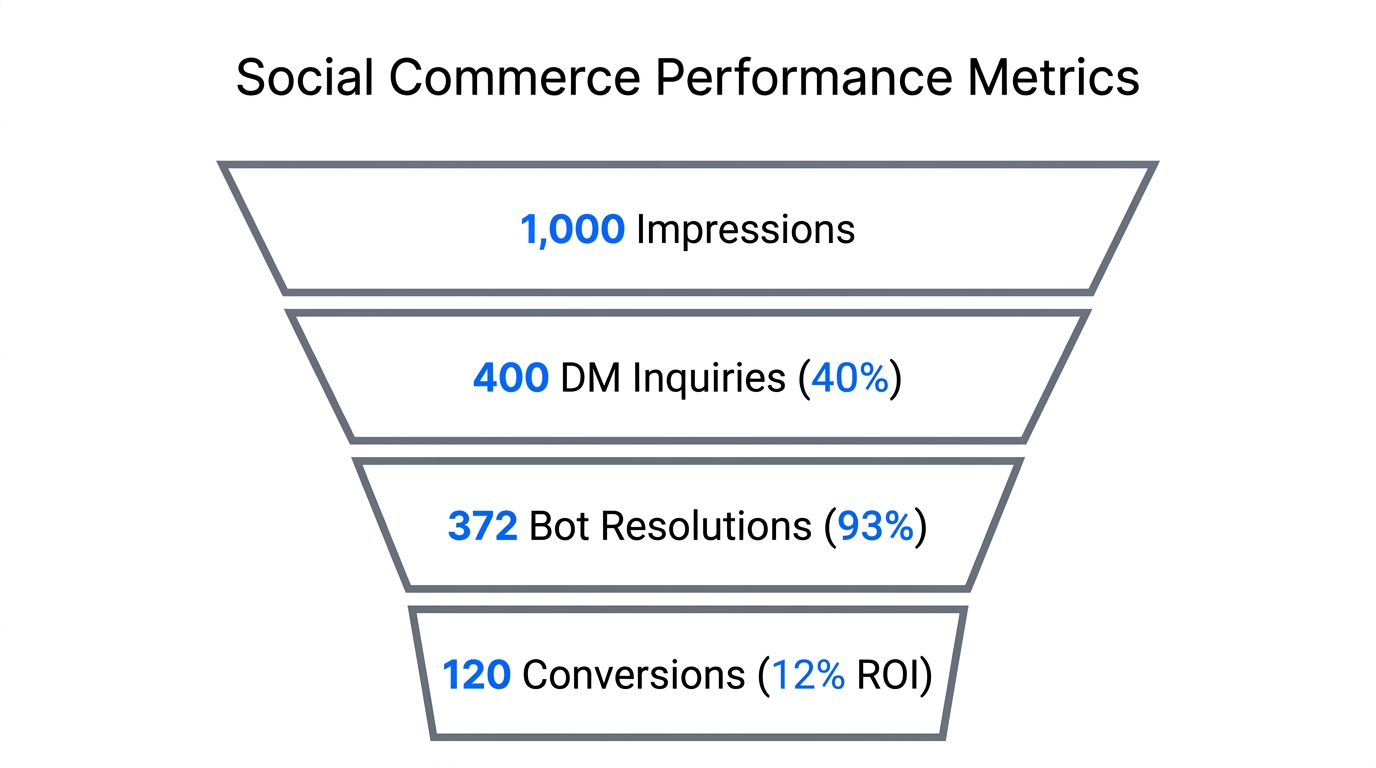
In the social-first era, traditional metrics like "Time to First Response" are less important than Containment Rate and CSAT.
- Containment Rate: The percentage of social conversations resolved entirely by AI without needing a human handoff. High containment in social commerce signals a frictionless discovery process.
- CSAT (Customer Satisfaction Score): Specifically for bot interactions. Since 56% of consumers believe bots will be capable of natural conversations by 2026 (Zendesk), anything less than a 4.5/5 rating indicates your bot is too transactional.
- Abandoned Cart Recovery: Proactive AI chat now recovers approximately 35% of abandoned carts. This is a massive revenue lever that should be tracked weekly.
| Metric | 2026 Benchmark | Why it Matters |
|---|---|---|
| Containment Rate | 75% - 90% | Scalability of support operations. |
| Bot CSAT | 4.7 / 5.0 | Brand perception and trust. |
| Conversion from DM | 12.3% | Direct impact on social ROI. |
| Cart Recovery Rate | 30%+ | Recapturing lost intent in real-time. |
Conclusion: Building Your 2026 Social Stack
Scaling social commerce requires more than just "being on social media." It requires an integrated ecosystem where discovery, automation, and support work in perfect harmony. By pairing ManyChat's proactive sales flows with Gorgias' omnichannel stability, brands can capture the 40% of social traffic that is currently being left on the table.
Start by cleaning your data into an atomic knowledge base, move your bots from "gatekeeper" to "consultant" mode, and never stop monitoring your containment rates. When you combine these tactics with high-quality creator content—sourced via platforms like Stormy AI—you aren't just running a social media account; you are running a fully autonomous growth engine. The technology of 2026 has made the "frictionless sale" a reality—it's time for your brand to claim its share.