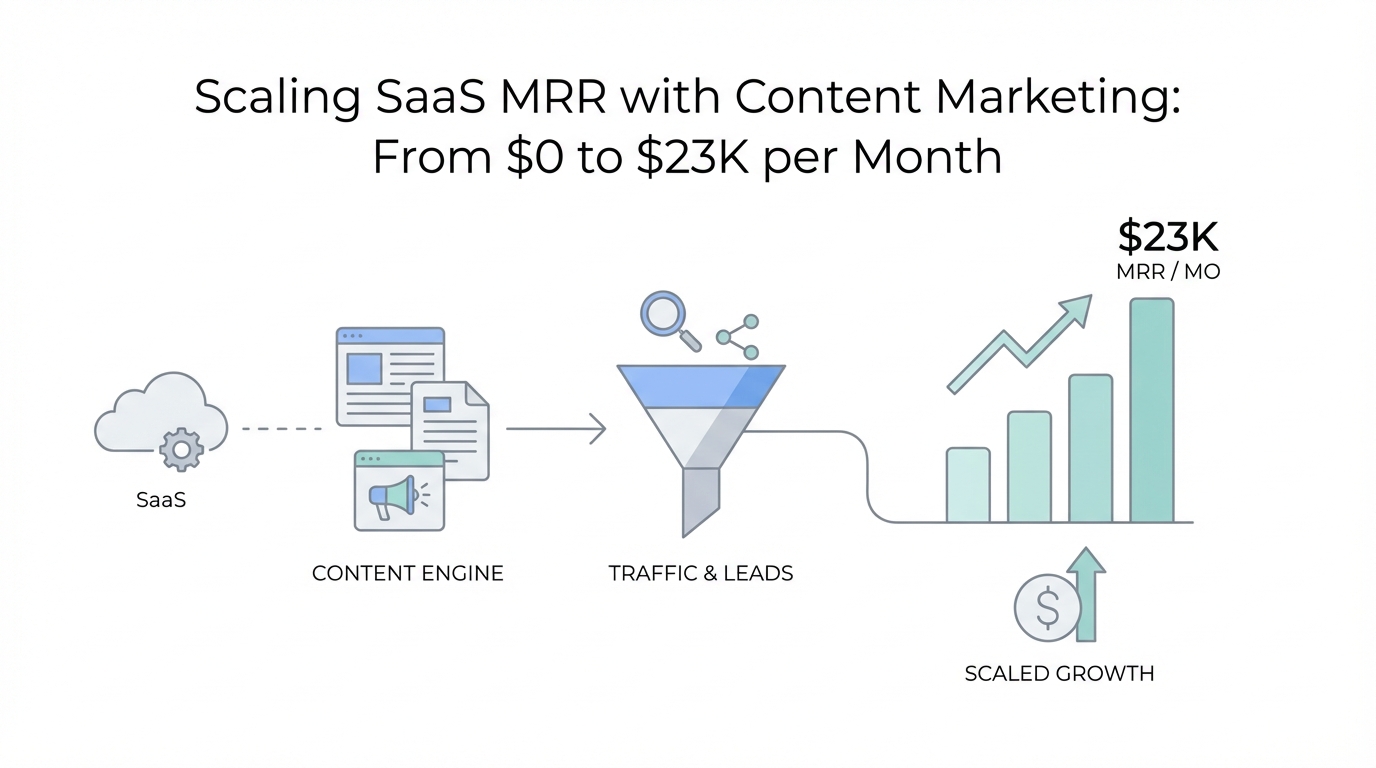
Building a successful SaaS isn’t always about reinventing the wheel or raising millions in venture capital. For solo founders like Andy Cloke, the path to a $23,000 monthly recurring revenue (MRR) business was paved with a simple, disciplined approach to saas customer acquisition. By identifying a gap in a growing ecosystem and doubling down on use-case-specific content marketing, Cloke transformed a side project into a life-changing micro SaaS. This growth-focused playbook breaks down how he leveraged platform distribution, content loops, and no-code interfaces to build a lean, high-margin business.
Finding the Right Foundation: The Platform Play

The foundation of this saas growth strategy lies in building on top of an existing, growing platform. For Data Fetcher, that platform was Airtable. By choosing to build an extension for an established marketplace, Cloke solved the hardest problem in SaaS: distribution. Instead of shouting into the void, he positioned his tool where users were already looking for solutions.
Building on a platform provides built-in trust and a steady stream of qualified leads. When you launch in a marketplace like Airtable's, users perceive your tool as an extension of the ecosystem they already rely on. Cloke notes that he gained his first customer just days after launching, a feat that is nearly impossible with a standalone web app without a significant marketing budget. The trade-off is platform risk, but for an indie hacker, the distribution benefits far outweigh the concerns of the platform one day building a native feature that overlaps with your tool.
A 6-Step Framework for SaaS Discovery

Before writing a single line of code, Cloke followed a structured framework to validate his idea. This process ensures that you aren't just building a "cool tool," but a product that solves a painful, recurring problem for a specific audience. This is essential for increasing mrr for micro saas because it narrows your focus to high-value opportunities.
- Step 1: Identify a Growing Platform: Use tools like Exploding Topics to find software ecosystems that are gaining massive traction but haven't reached full maturity yet.
- Step 2: Hunt for Pain Points: Scour Reddit, Twitter, and official community forums. Look for users asking, "How do I do X?" or complaining about missing features.
- Step 3: Borrow Proven Patterns: You don't need a 100% original idea. Look at successful add-ons for established platforms like Google Sheets and see if those same utilities exist on the newer platform.
- Step 4: Technical Validation: Verify that the platform has a public API or a mature SDK (Software Development Kit) that allows you to build the necessary functionality.
- Step 5: Napkin Math: Calculate the potential market. How many users does the platform have? How common is the problem? What are competitors on other platforms charging?
- Step 6: Risk Assessment: Analyze the platform’s roadmap. If the problem is too central to their core product, they might crush you; if it's a niche utility, you're likely safe.
Content Marketing: The 'Rinse and Repeat' Strategy

Once the product was built, the growth didn't come from generic brand awareness. It came from hyper-specific content marketing for saas. Cloke identified that users weren't searching for "Airtable API connector." Instead, they were searching for specific outcomes like "Import Facebook Ads to Airtable" or "Connect Google Analytics to Airtable."
He created a "rinse and repeat" content machine: for every popular integration, he wrote a detailed blog post and recorded a YouTube tutorial. These pieces of content targeted high-intent search terms. When a marketer is frustratedly Googling how to get their ad spend into their database, they find Data Fetcher's tutorial. This approach drove the business to its first $3,000 in MRR within a year. By focusing on use cases rather than features, you solve the user's immediate problem, making the conversion natural and frictionless.
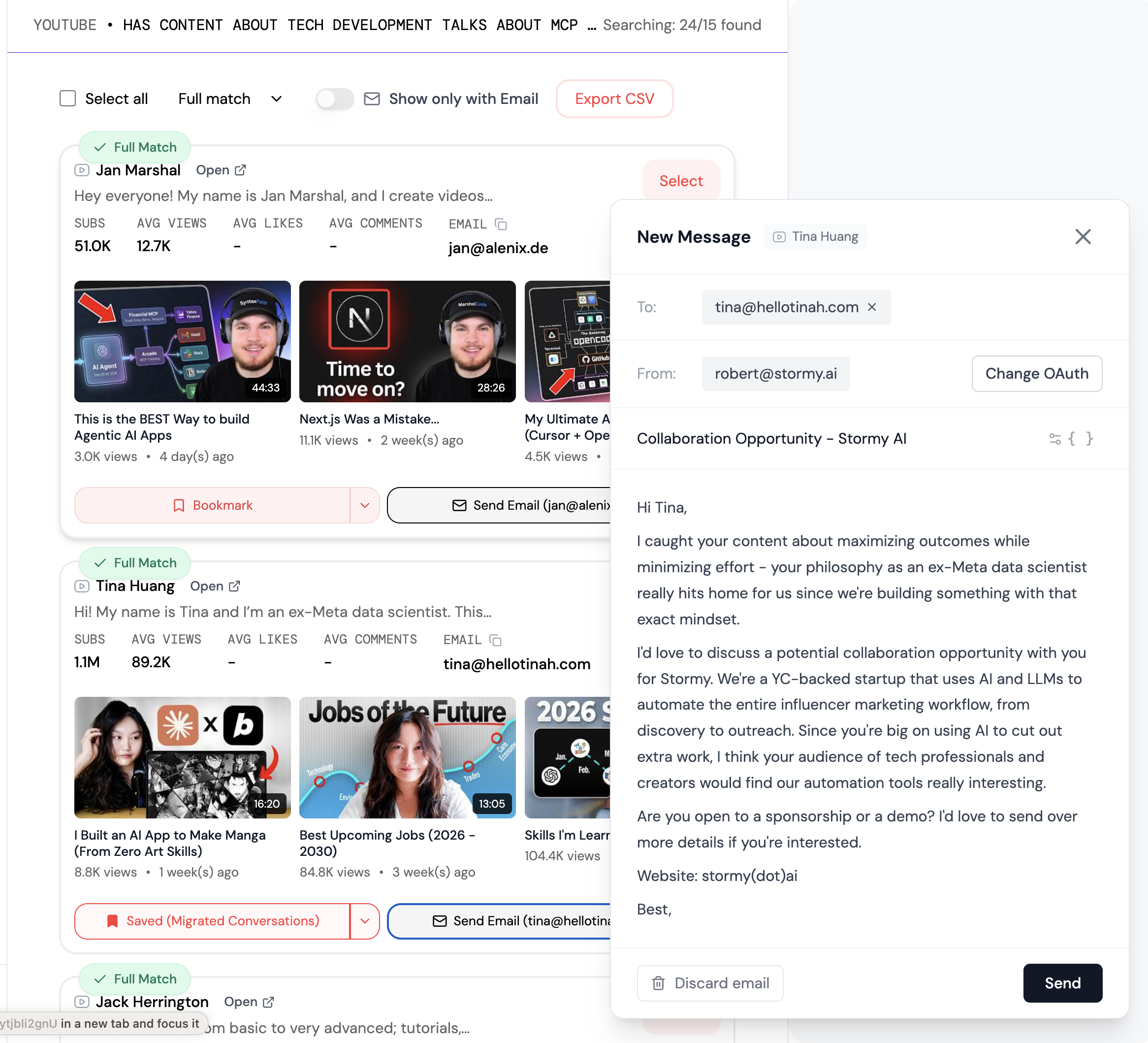
To amplify this content, many founders look toward influencer collaborations. While manual outreach is slow, using Stormy's AI search allows you to find creators who specialize in no-code, productivity, and SaaS tutorials across YouTube, TikTok, and LinkedIn instantly. Instead of browsing for hours, you can use natural language to find the exact creators who can put your tutorial in front of a larger audience. Once your campaign is live, you can use Stormy's post tracking to monitor views and engagement across every social platform in one dashboard.
Lowering the Barrier: The No-Code Revenue Multiplier

A major turning point for Data Fetcher was the realization that the initial tool was still too technical for the average business user. While the tool could connect to any API, many users didn't know what an API was. To scale, Cloke built custom no-code interfaces for the most popular integrations. This allowed users to simply click "Connect Facebook Ads" rather than configuring headers and endpoints manually.
This shift doubled the MRR by expanding the addressable market from developers and "power users" to general marketers and operations managers. If you want to know how to scale a saas business, look for ways to hide the complexity. The more technical barriers you remove, the higher your conversion rate will be. This transition took the business from $3,000 to $10,000 MRR in just the first year of focus.
When you've built these no-code features, you need to tell the world. This is where Stormy's AI outreach becomes a game-changer. You can set up an autonomous AI agent that discovers creators who talk about marketing automation and sends hyper-personalized emails while you sleep. By connecting multiple Gmail accounts and using automated follow-ups, you can ensure your new no-code features get the attention they deserve from the influencer community.
Growth Infrastructure: Lean Operations and High Margins

Despite making $23,000 a month, Data Fetcher remains a solo operation with an incredible 85% profit margin. This efficiency is achieved by using a lean tech stack and the right automation tools. The core app is built with TypeScript and React, utilizing Heroku for hosting and Hetzner for lower-cost background workers.
Managing a growing customer base as a solo founder requires offloading administrative tasks to software. Cloke uses Help Scout for support tickets, Plausible for privacy-focused analytics, and ChartMogul to track his saas growth strategy metrics. By keeping fixed costs low—around $3,500 total—he maintains the freedom that most founders dream of. This lean approach is the hallmark of a successful micro SaaS, where profitability is prioritized over headcount.
The Psychological Trap: Focus vs. Shiny Objects
One of the most overlooked aspects of increasing mrr for micro saas is the founder's psychology. Cloke admits to wasting months on "shiny object" side projects when growth slowed or boredom set in. The temptation to start something new is often a defense mechanism against the hard, repetitive work of scaling an existing product. According to research on entrepreneurial focus, novelty can often be the enemy of execution.
To combat this, he uses AI as a business coach to maintain accountability. Discipline is the true engine of growth. When you find a channel that works—like the integration-specific content strategy—your job is to double down on it, not to find a new channel. Growth often comes from doing the boring stuff 1% better every single day. Staying focused on the core product allowed Data Fetcher to cross the $20,000 MRR mark after three years of consistent effort.
User Testing: The Overnight Conversion Lever
The final piece of the growth puzzle was user testing. For an entire year, Cloke built features without actually watching someone use the product. When he finally sat down for an afternoon of user testing using tools like Hotjar, he discovered dozens of minor UX friction points that were causing potential customers to drop off during onboarding. Solving these issues resulted in an almost overnight increase in revenue and retention.
Talking to customers reveals why they choose your tool over competitors and where they get stuck. For Data Fetcher, it wasn't about adding more features; it was about making the existing ones easier to find and use. This highlights a critical lesson: saas customer acquisition is as much about plugging the leaks in your funnel as it is about pouring more traffic into the top.
As you scale these efforts, managing the relationships with creators who help promote your tool is vital. Stormy's creator CRM allows you to track every interaction, negotiation, and deal stage in one place. Instead of losing track of which influencer promised a video review, you can manage the entire campaign lifecycle within a dedicated dashboard, ensuring your marketing dollars always produce a return.
The Path Forward for Your SaaS
The story of Data Fetcher proves that with a clear saas growth strategy, even a solo founder can build a highly profitable business. By leveraging platforms, executing a use-case-specific content marketing for saas plan, and maintaining relentless focus, the path to $23K MRR becomes a repeatable process rather than a mystery. Start by identifying the platforms your target users already use, find their biggest pain points, and provide a no-code solution that feels native to their workflow.
Ready to find the creators who can help you scale your SaaS to the next level? Use Stormy's influencer analysis to vet potential partners for fake followers and engagement quality, ensuring your collaborations drive real MRR growth. The tools and the framework are ready—now it's time to build.