The era of treating influencer marketing as a mere awareness play is officially over. As the global influencer market size is projected to reach $24 billion in 2024 and surge to a staggering $32.55 billion by the end of 2025, the industry is undergoing a fundamental transformation. For years, marketers were forced to rely on "vanity metrics"—likes, views, and reach—that often failed to translate into actual revenue. Today, the focus has shifted toward performance influencer marketing, where success is measured by hard metrics like Cost Per Acquisition (CPA) and Return on Ad Spend (ROAS). This shift is being fueled by a move from static discovery tools to autonomous execution agents that can manage thousands of micro-creators simultaneously.
Scaling these partnerships manually used to be an operational nightmare. Coordinating 50, 500, or 5,000 micro-creators required massive teams and endless spreadsheets. However, with a 33% CAGR projected over the decade, brands are now deploying AI-driven influencer strategies to bridge the gap. By leveraging influencer CPA models and agentic workflows, performance marketers are finally seeing the efficiency they have long enjoyed in programmatic and search advertising. This playbook outlines how to deploy these technologies to maximize your micro-influencer ROI.
The Shift from Vanity Metrics to Performance CPA Models
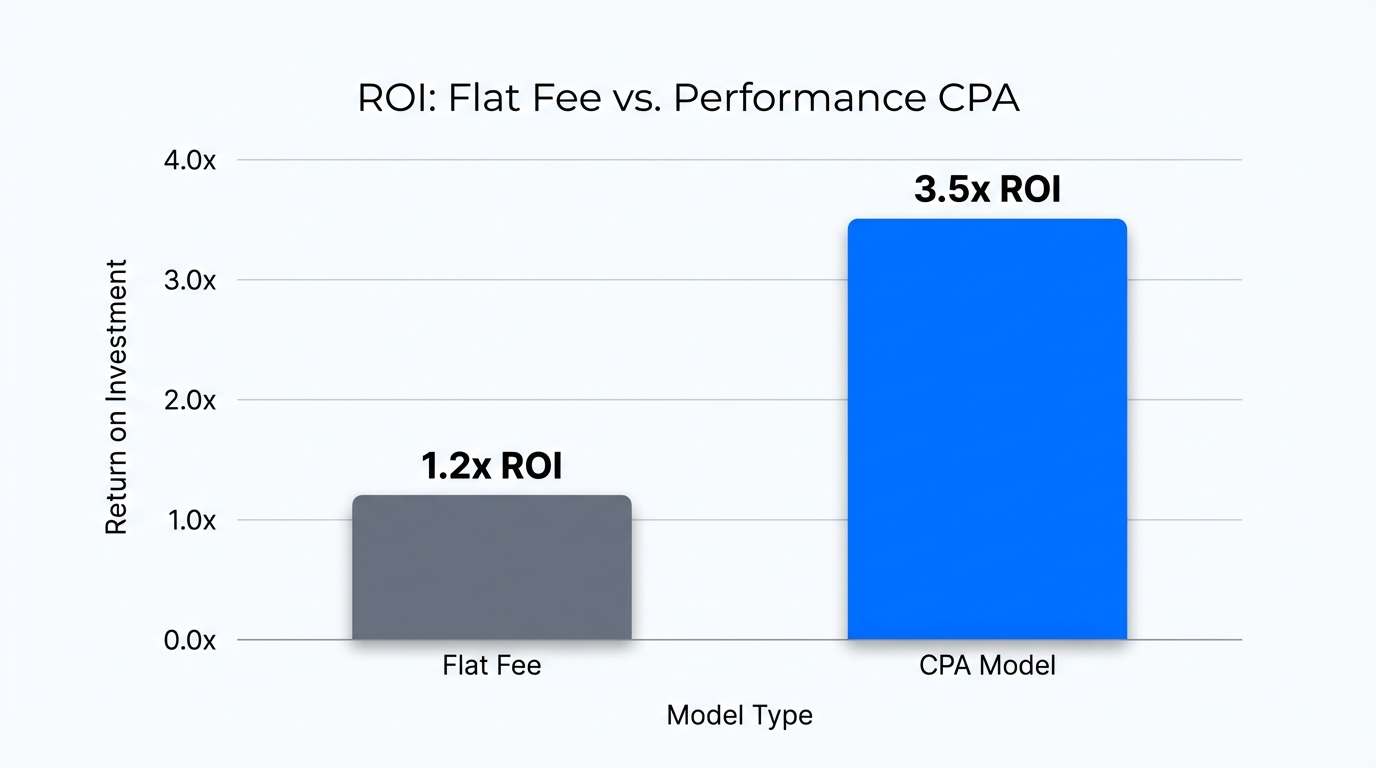
In the traditional model, brands paid influencers a flat fee based on their follower count. This was inherently risky; if a post flopped, the brand took the hit. The new influencer CPA model flips the script by aligning incentives. Creators are paid based on the actual sales or app installs they generate. While high-level celebrities often resist these models, micro-creators—those with 10K to 100K followers—are increasingly willing to work on commission-based structures, especially when they truly believe in the product.
According to research from Influencer Marketing Hub, approximately 59% of marketers are already using AI for daily operations, including filtering and performance prediction. These tools help identify which creators are most likely to convert before a single dollar is spent. By focusing on performance influencer marketing, brands can mitigate the risk of "engagement fraud," which still affects nearly 45% of influencers who use some form of artificial inflation, as noted by Social Media Today.
"The industry is moving from 'discovery tools' to 'execution agents'—autonomous systems that don't just find creators, but handle the negotiation and contracting independently."
The logic is simple: micro-creators often have higher niche authority and tighter engagement loops with their audience than mega-celebrities. When you combine this authenticity with a performance-based incentive, you create a self-optimizing engine. Creators are motivated to produce better content and promote it more frequently because their compensation is directly tied to their success. This is the cornerstone of driving sustainable influencer marketing ROI.
The "Agentic" Shift: Moving Beyond Legacy Databases
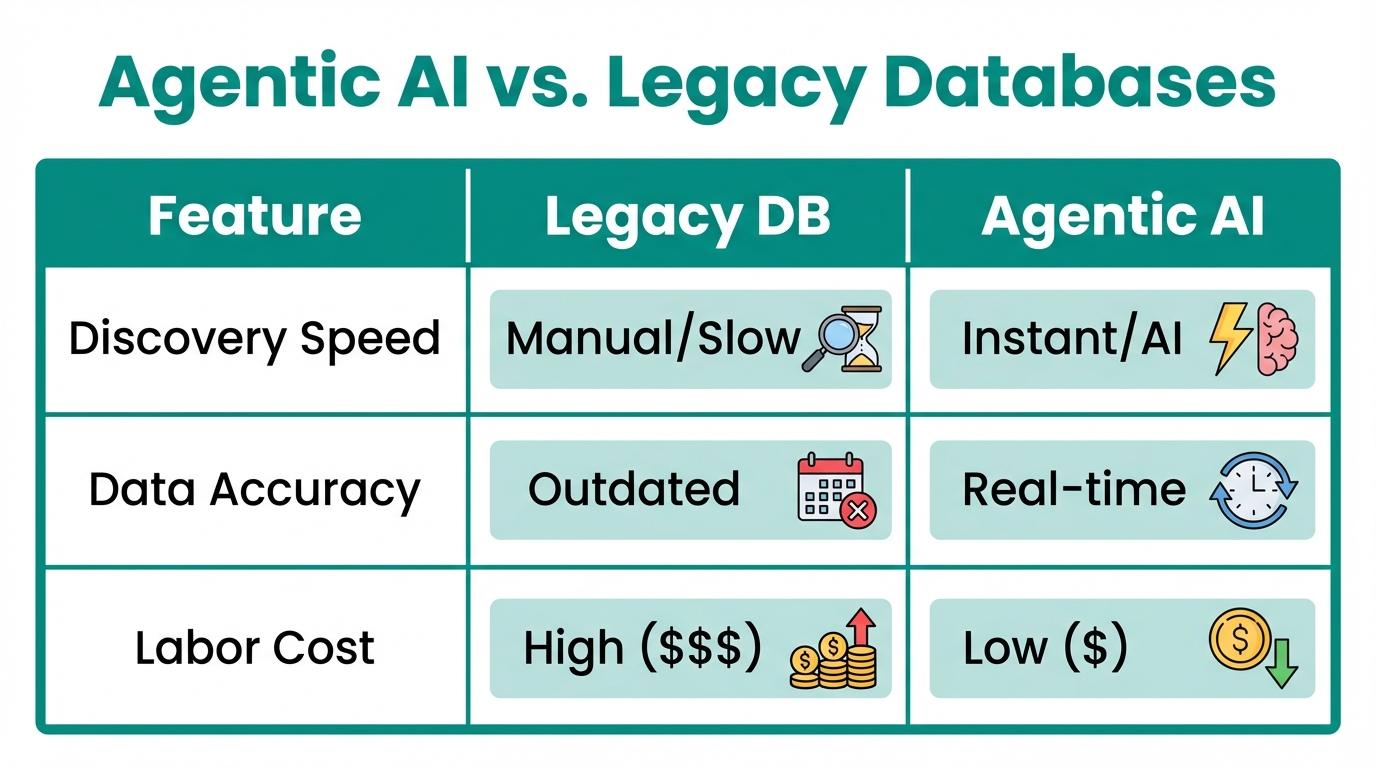
For the last decade, influencer marketing was powered by static databases where you could filter by location or follower count. However, these platforms are being replaced by "Agentic" AI. These aren't just search engines; they are ai influencer negotiation and execution assistants that can "reason" through tasks. Instead of a human scrolling through profiles, an agent can analyze thousands of video transcripts to find creators who align with a brand’s specific semantic values.
| Feature | Legacy SaaS Databases | Modern AI Agents |
|---|---|---|
| Discovery | Keyword-based search | Semantic/Contextual reasoning |
| Outreach | Manual templates | Hyper-personalized 1:1 automation |
| Negotiation | Human-led back-and-forth | AI-benchmarked 24/7 negotiation |
| Content Review | Manual approval workflows | Real-time 24/7 brand safety monitoring |
| Model | Flat-fee focus | Performance/CPA optimization |
As industry experts noted in Forbes, AI agents act as a "tireless, perfectly aligned digital C-suite," liberating human teams from the "tyranny of scale and logistics." This is particularly evident in the negotiation phase. Tools like Janney AI can handle initial communication loops, benchmarking rates in real-time to achieve up to 43% cost savings. This automation allows a single performance marketer to manage a creator pool that would have previously required a 10-person agency.
Efficiency in Action: How Shapermint Reduced Production Time by 70%
One of the most successful examples of this agentic approach is Shapermint. The brand developed a proprietary AI tool called Altair to handle the creative logistics of working with influencers. Instead of waiting for creators to come up with ideas—which often results in inconsistent quality—Altair generates scripts and storyboards for influencers based on historical performance data. This system helped the brand fuel $300M in revenue by scaling content production without scaling the headcount.
By reducing creative production time by 70%, Shapermint was able to test more hooks, more offers, and more creators than their competitors. This is the ultimate goal of performance influencer marketing: treat influencer content like a creative laboratory where winning variants are quickly identified and scaled. Platforms like Snaplama are now democratizing this capability, allowing smaller brands to enhance their User-Generated Content (UGC) through AI-driven strategies.
"Shapermint's use of AI reduced creative production time by 70%, proving that agents can handle the 'creative logistics' that typically bottleneck growth."
The Playbook: Deploying Agents for Micro-Influencer Scale
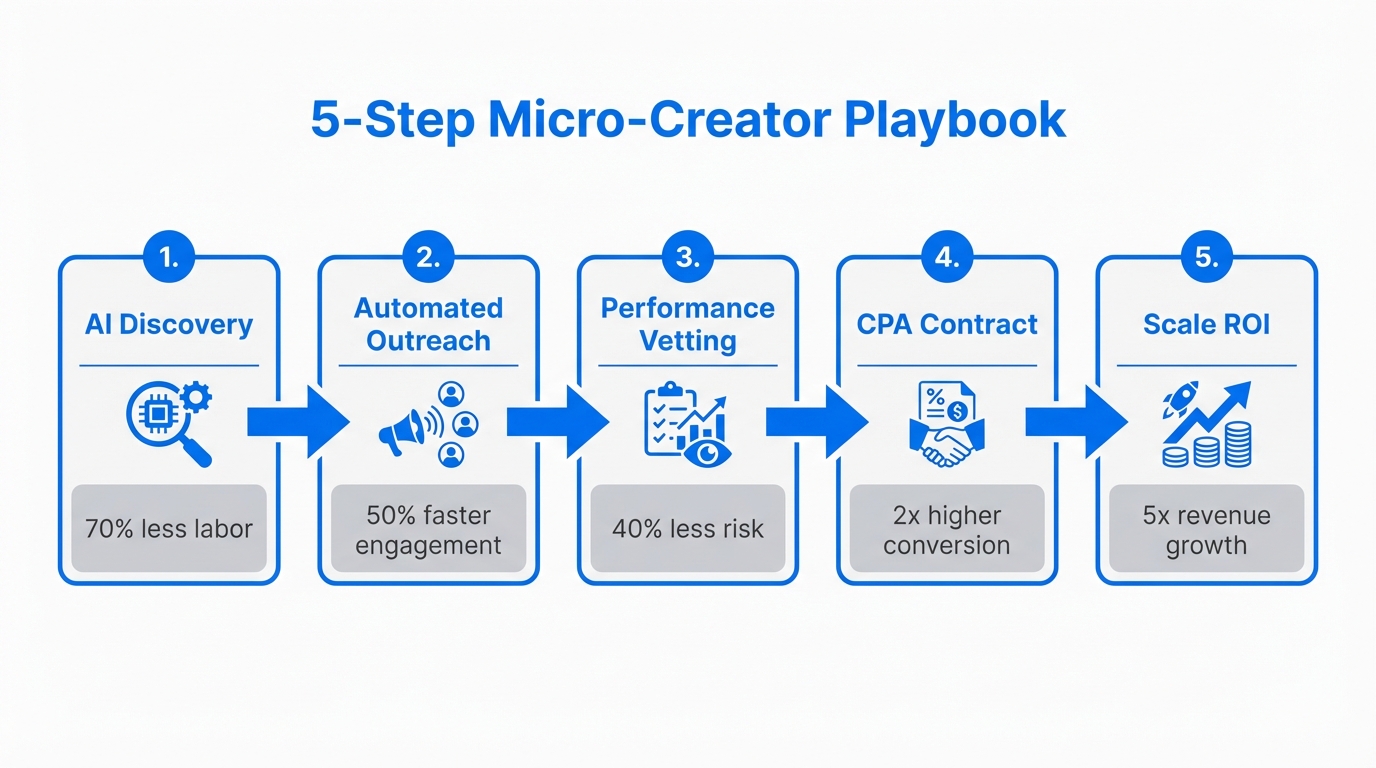
To transition to a fully performance-based model, brands must stop viewing influencers as a series of one-off campaigns and start seeing them as a data-driven pipeline. Here is the step-by-step playbook for deploying AI agents at scale:
Step 1: Agentic Discovery and Semantic Search
Instead of searching for broad keywords like "fitness," use semantic search to describe your ideal customer. Tell your discovery agent: "Find 50 creators who talk about sustainable parenting and have a high sentiment score in the Midwest US." This approach identifies creators whose audience is actually primed for your specific niche. Tools like InfluencerMarketing.ai allow for this level of nuanced discovery that manual searching misses.
Step 2: Automate the "Negotiation Loop"
Deploy agents like Janney AI to handle the initial 4–5 back-and-forth emails. The agent should present the performance-based CPA offer, handle objections about "flat fees," and provide the creator with onboarding materials automatically. This ensures your human team only spends time on the creators who have already agreed to your performance terms.
Step 3: Integrate Your Pipeline
The biggest mistake in performance influencer marketing is tool fragmentation. Using one tool for discovery, another for outreach, and a third for tracking creates data silos that kill efficiency. Modern platforms like Stormy AI streamline this by integrating discovery, vetting, and automated outreach into a single workflow, ensuring that your tracking links and creator data are always in sync.
Step 4: 24/7 Brand Safety and Monitoring
Once your creators are live, you cannot manually check every Story or post for compliance. Use AI agents to scan every piece of content for FTC disclosures and brand-safe language. According to Digiqt, flagging issues in seconds rather than days is critical for maintaining regulatory compliance and brand reputation in a high-volume environment.
Step 5: Scale Through AI Optimization (AIO)
Treat your influencer content as fuel for AI search engines. By seeding high volumes of micro-creator mentions, you influence the training data of AI models like Perplexity or Google Gemini. This "social proof" acts as a web of mentions that leads AI search engines to recommend your product to potential customers. This strategy, often called AI Optimization (AIO), is the next frontier of digital marketing.
Maintaining Brand Safety in the Era of Scale
As you move from 10 creators to 1,000, the risk of misaligned content increases exponentially. Brian Klais, Founder of URLgenius, emphasizes that while AI handles logistics, it cannot replace the "voice, personality, and human soul" of a brand, as mentioned on impact.com. This is why human oversight remains crucial for final content approvals.
However, AI is vastly superior at detecting "hallucinated compliance." An AI agent can scan thousands of hours of video content to find subtle mentions of competitors or inappropriate language that a human reviewer might miss due to fatigue. For performance marketers, this means you can scale without the fear of a viral PR scandal. The goal is to use Stormy AI or similar agentic platforms to handle the heavy lifting of vetting while your creative team focuses on high-level strategy.
"We are in the 'Oprah era of agentic AI,' where every niche task—from community management to creative directing—will have a dedicated agent."
Avoiding the Fragmentation Trap
Many brands fail because they try to stitch together a "Frankenstein" tech stack. They use one tool for audience authenticity (like those mentioned by iqfluence.io) and another for performance tracking. This leads to data silos and "integration headaches" that often negate the efficiency gains of using AI in the first place.
To truly maximize micro-influencer ROI, you need a single source of truth. This platform should manage the entire lifecycle: discovery, outreach, contract negotiation, content tracking, and finally, payment. By consolidating your efforts, you ensure that your performance influencer marketing strategy is driven by accurate, real-time data rather than guesswork.
Conclusion: The Future of Influencer Performance
The transition to performance-based influencer marketing is no longer optional for brands that want to remain competitive. By adopting an agentic workflow, you can reduce manual coordination by 60–70% while driving significantly higher conversion rates. Whether you are using AI to generate scripts like Shapermint or deploying automated negotiation loops to save costs, the goal is the same: predictable, scalable growth.
As we head into 2025, the brands that win will be those that treat influencer marketing with the same algorithmic rigor as their paid search and social campaigns. Start by moving away from vanity metrics, embracing influencer CPA models, and utilizing all-in-one platforms to manage your creator relationships. The Oprah era of agentic AI is here—it's time to put your agents to work.