Scaling Customer Acquisition: How Claude Code and MCP Drive a 23% Conversion Lift in 2026
Learn how Claude Code and Shopify MCP server integration drive a 23% conversion lift in 2026. Master agentic ecommerce workflows for customer acquisition.
By mid-2026, the ecommerce landscape has shifted from passive storefronts to agentic ecosystems. The days of simple chatbots that merely regurgitate FAQ pages are over. Today, the most successful brands are leveraging Claude Code and the Model Context Protocol (MCP) to build what industry experts call an "interactive ecommerce layer." This shift has resulted in a staggering 23% conversion lift for early adopters, fundamentally rewriting the playbook for customer acquisition and retention.
The 2026 Shift: MCP as the 'USB-C for AI'
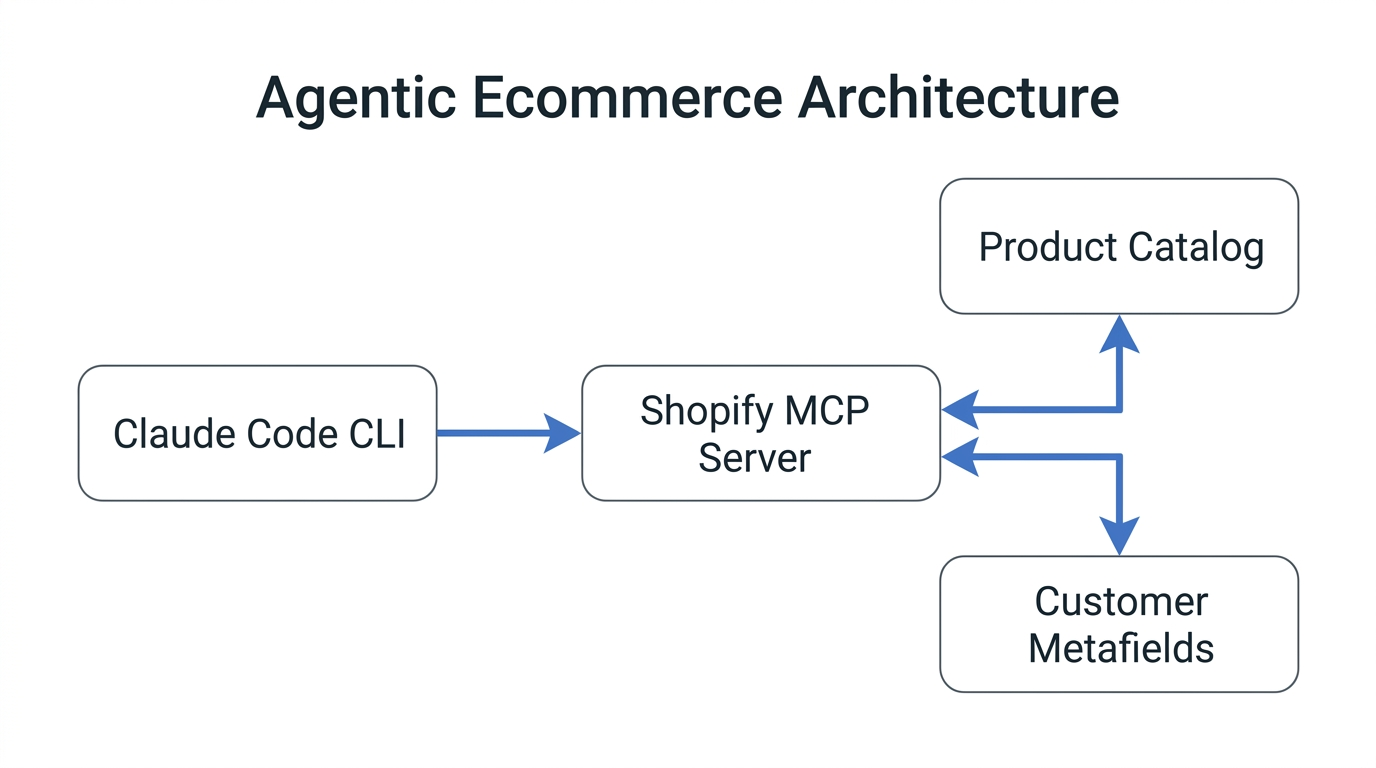
The biggest technical hurdle in 2025 was the fragmentation of data. AI models were smart, but they were "trapped in a box," unable to see live inventory levels, shipping status, or customer lifetime value without expensive custom integrations. Enter the Model Context Protocol (MCP). In 2026, MCP has become the universal standard—the "USB-C for AI"—that decouples intelligence from the tools themselves.
Instead of building a separate integration for every AI tool, brands now build an MCP server once. This allows any AI client—whether it's Claude Code, a specialized sales agent, or an internal logistics bot—to read and write natively to their business systems. According to Hallam, this standardization has lowered technical barriers so significantly that AI ROI is no longer stalled by integration costs.
"MCP isn't just a protocol; it's the bridge that allows AI to stop talking and start doing. It’s why we’re seeing nearly 20% of all major repository commits now handled by AI agents like Claude Code," notes a recent GitHub Octoverse report.
Case Study: How TUSHY Achieved 15% Conversion Rates
While the average ecommerce conversion rate often hovers between 2% and 3%, brands like TUSHY are shattering these benchmarks. By deploying AI agents that handle pre-sale queries with human-level nuance, they have achieved conversion rates as high as 15%. This is nearly double the performance of traditional human-led chat agents, as reported by Gorgias.
The secret lies in real-time personalization. When a customer asks, "Will this fit my specific toilet model?", the AI doesn't just link to a manual. It uses an interactive ecommerce layer to check the product specs, verify current stock in the nearest warehouse, and even suggest a complementary accessory—all in one conversational turn. This level of agentic ecommerce workflow turns a support query into a high-intent sales opportunity.
Furthermore, these agents are tireless. They recover approximately 35% of abandoned carts by engaging users at the exact moment of friction, a statistic verified by HelloRep. This proactive engagement is a primary driver behind the projected $22.6 billion AI-enabled ecommerce market by 2032.
The Playbook: Implementing the Shopify Dev MCP Server
To replicate these results, you need to connect your AI directly to your store's brain. In 2026, Shopify includes a native /api/mcp endpoint, allowing for seamless integration. Growth teams are also using Stormy AI’s search and discovery to feed the top of the funnel with creators who resonate with their target demographic, ensuring high-quality traffic for these AI agents to convert.
Step 1: Connect the Shopify Dev MCP Server
Use Claude Code’s terminal interface to link to the Shopify Dev MCP Server. This gives Claude the ability to query your GraphQL Admin API in natural language. Instead of writing complex queries, you can simply tell Claude: "Find all products with less than 10 units in stock and draft a restock email."
Step 2: Establish the Source of Truth
A common mistake is skipping the CLAUDE.md file. This file acts as the "brand bible" for your AI agent. It should contain your brand voice, return policies, and specific tool-calling instructions. Without it, you risk "context rot," where the AI begins to hallucinate policies or waste tokens on unnecessary clarifications, a warning highlighted by recent developer post-mortems.
Step 3: Deploy Automated Workflows
Integrate tools like FlowHunt to trigger Claude Code actions based on external events. For example, if a high-value customer (identified via an enterprise CRM) abandons a cart over $500, Claude can automatically generate a hyper-personalized discount code through the Stripe MCP and send it via a Klaviyo sequence.
"The future of ecommerce isn't just about selling; it's about building a codebase that sells for you while you sleep."
The Financial Impact: Lowering CAC and Inventory Costs
The shift to Claude Code ecommerce sales strategies isn't just about bells and whistles; it’s about the bottom line. AI-driven personalization delivers significant conversion rate increases of up to 23%, according to data from Envive. This directly lowers your Customer Acquisition Cost (CAC) because you are extracting more value from the same traffic.
| Metric | Traditional Workflow | AI Agentic Workflow (2026) |
|---|---|---|
| Conversion Rate | 2.5% - 3.5% | 12% - 23% |
| Support Ticket Resolution | 4-8 hours | Instant - 18% faster |
| Inventory Accuracy | Manual Audits | Real-time / 20% level reduction |
| Abandoned Cart Recovery | 10% (Generic Email) | 35% (AI-Personalized) |
Beyond sales, the operational savings are massive. Anchor Group notes that AI-enabled supply chain planning has reduced inventory levels by 20% and lowered overall operational costs by 10%. By allowing Claude Code to monitor stock levels and predict demand trends, brands avoid the capital-heavy trap of overstocking.
Best Practices: Permissions and Brand Safety
As agents become more autonomous, the risk of "unauthorized actions" increases. To ensure your AI sales agent operates within brand safety limits, you must master permissions control. In 2026, the standard practice is to use the /permissions command within Claude Code to allowlist safe terminal commands like npm test or git status, while requiring manual approval for financial transfers or database migrations.
Moreover, cost efficiency is a major consideration. While Claude 3.5 Opus is incredibly powerful, experts recommend using Claude 3.5 Sonnet for daily ecommerce automations. It provides the same agentic capabilities while saving approximately 50% on token costs.
While these AI agents handle the bottom-of-funnel conversions, top-of-funnel discovery is still best managed by human-led influence. Leading growth teams are using Stormy AI to identify high-quality UGC creators whose content drives the traffic that these AI-powered sales loops then convert. By pairing Stormy AI's creator discovery with Claude's conversion logic, brands create a self-sustaining growth engine.
Conclusion: Building the Future of Commerce
The integration of Claude Code ecommerce sales strategies and the Shopify MCP server is no longer a luxury—it is a competitive necessity. As we move through 2026, the distance between a customer’s intent and their purchase is shrinking. By automating the technical and conversational friction of the shopping experience, brands are not just scaling their acquisition; they are redefining what it means to be a modern retailer.
Start small: connect your store to an MCP server, define your brand voice in CLAUDE.md, and watch as your conversion rates climb. The future of commerce is agentic, and it’s already here.