In 2026, the era of the "siloed chatbot" is officially over. For years, we treated artificial intelligence like a private confessional—a 1:1 interaction hidden away in a browser tab. But as we navigate the current creator landscape, a new paradigm has emerged, one that explains why certain platforms explode while others stagnate. It is called the Mario Kart Theory. This theory posits that AI products thrive not just on their utility, but on their multiplayer functionality and inherent network effects. When growth is social-by-default, the community doesn't just use the tool; they teach, inspire, and scale it for you.
The Mario Kart Theory: Why Multiplayer Growth Loops Win
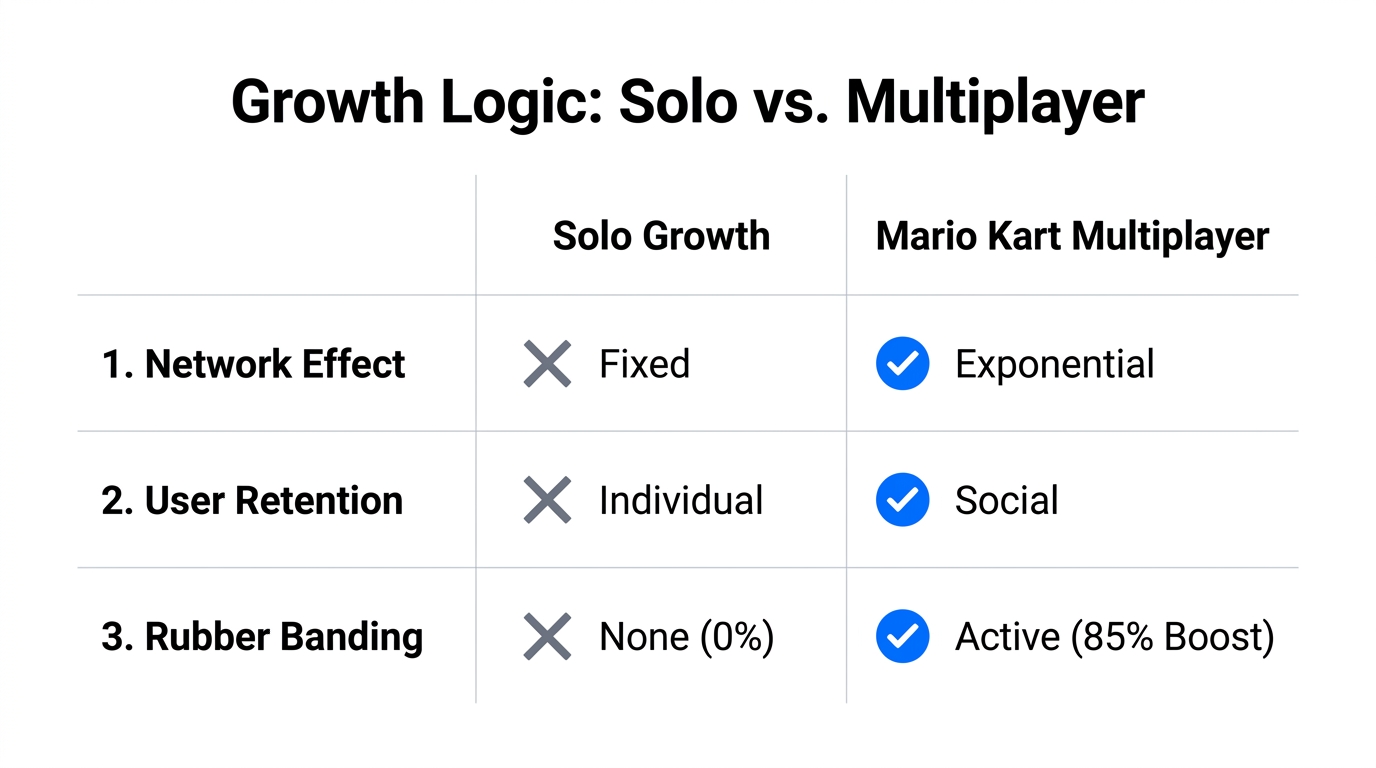
The core of the Mario Kart Theory is simple: Mario Kart is significantly better with friends. In the software world, this means building tools that are multiplayer by default. We saw the first wave of this with enterprise giants like Figma, Notion, and Airtable. These platforms didn't just digitize workflows; they made them real-time and collaborative, creating a substrate where work becomes a shared social experience.
Most AI today remains isolated. You have a conversation with an LLM, and the "exhaust" of that interaction—the prompts, the failures, the breakthroughs—disappears. The Mario Kart Theory argues that this is a "travesty of siloed AI." By keeping interactions private, platforms miss out on the viral distribution hacks that fueled the social web. In 2026, creator economy retention loops are built on seeing what others are doing in real-time. If you can't see how someone else is using the "stick to get the ants," you're doomed to keep poking the tree alone.
"AI is not just a product; it is a distribution unlock. The cost of work has dropped so dramatically that we can now sell the proof of the finished result rather than the promise of a service."
Case Study: Midjourney and the Power of Social Proof
 15:07
15:07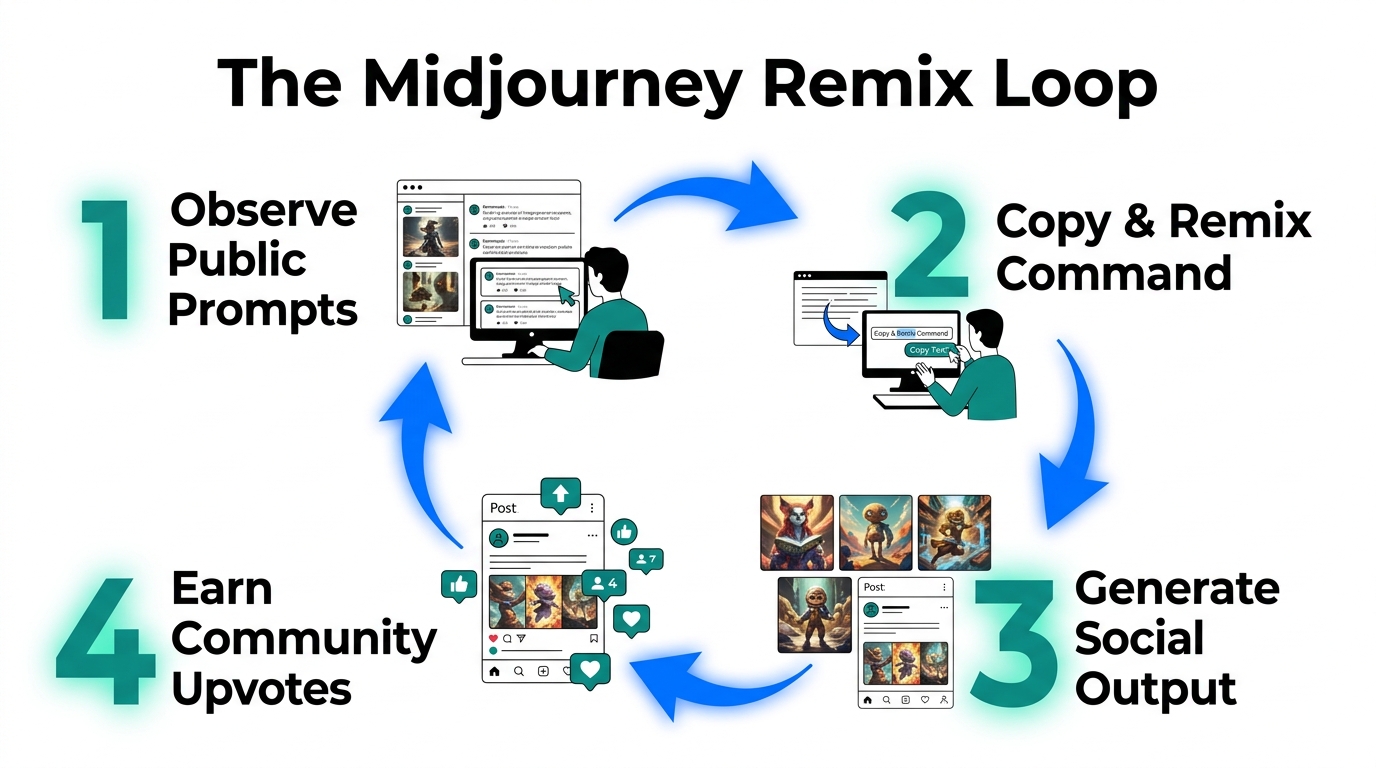
The Midjourney marketing strategy is perhaps the greatest modern example of "bad is better" product design. In its early days, Midjourney didn't have a slick web interface. Instead, it forced users into Discord channels filled with thousands of strangers. While this seemed chaotic, it was actually a masterclass in social AI distribution.
| Feature | Siloed AI (Old Guard) | Social AI (Midjourney/Stormy) |
|---|---|---|
| Learning Curve | Manual prompting / Tutorials | Observational learning from others |
| Discovery | Private search | Public feed / Community remixes |
| Retention | Utility-based | Community-driven inspiration |
When you entered a Midjourney Discord channel, you saw a flood of images being generated. You saw a user try to design a t-shirt, fail, tweak their prompt, and eventually succeed. You didn't just use the tool; you watched a learning loop in action. This is the "ant lollipop" effect—an analogy for how social learning spreads among bonobos. One ape figures out how to use a stick to get ants, and the others, seeing the success, immediately replicate it. In 2026, Discord community growth is driven by this transparent process of "forking" ideas and workflows.
Designing Social Proof: The 2026 'Ant Lollipop'
18:44To scale a creator community this year, you must design for social proof. Seeing a high-quality output from a peer is the strongest trigger for a new user. This is why platforms that allow for "remixing" are dominating. When a creator sees a prompt or a workflow that works, their first instinct is to fork it and apply it to their own niche.
For brands and app developers, this means moving away from traditional sales pitches. Instead of asking, "Would you like to hire me?" the modern GTM (go-to-market) is "Check out what I already made for you." Whether it's using vision models to redesign a prospect's home or generating a custom UGC video for a mobile app campaign, the goal is to deliver the value upfront. Modern platforms like Stormy AI facilitate this by allowing brands to discover creators and automate the personalized outreach that proves the concept before the first meeting even happens.
"In a world of infinite AI content, taste is the only remaining scarcity. But taste is in the eye of the customer, and the algorithm is the ultimate arbiter of what people actually want."
The 'Soft Autumn' Style: Building Niche Community Commerce
1:03One of the most exciting applications of the Mario Kart Theory is in niche commerce. Take the concept of "color theory"—an old-school stylist technique that has been revitalized by AI. By training vision models to act as color theorists, users can identify their specific palette, such as "Soft Autumn" or "Dark Winter."
But the real growth happens when this becomes social. Imagine a Discord channel exclusively for "Soft Autumn" stylists. When one member finds a specific brand or capsule collection that fits their palette, the entire community benefits. This social tagging creates a highly qualified commerce engine. In 2026, we are seeing brands leverage this by building dedicated communities where AI-driven style agents help users shop together. This isn't just a store; it's a multiplayer shopping experience where your success triggers my inspiration.
The Agentic Future: The Best Employees Work for Millions
51:23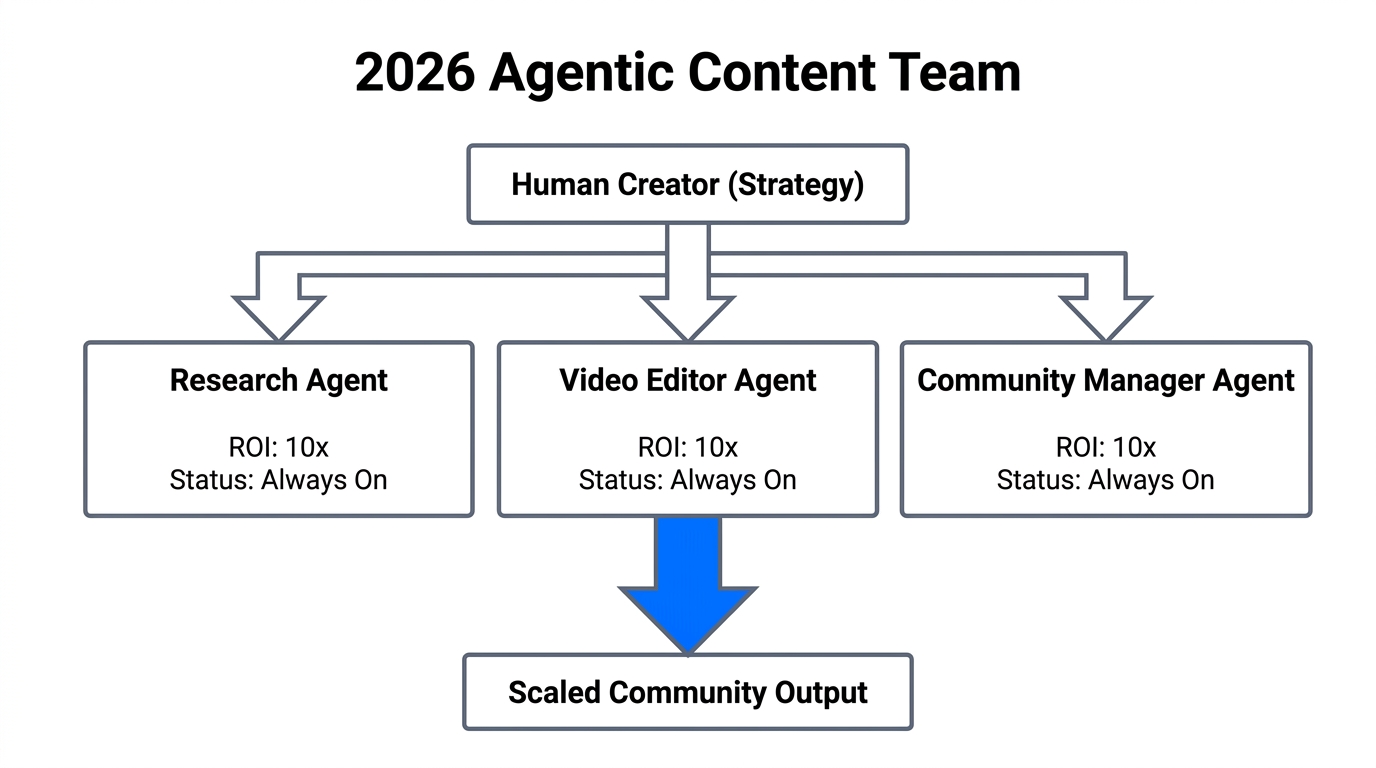
As we look toward the latter half of 2026, the focus is shifting from simple tools to agentic platforms. We are seeing geniuses in niche fields—like logistics, travel planning, or engineering—productize their own "dark gifts" into AI agents. Tools like Replit have already shown that the barrier between an "idea guy" and a "builder" is vanishing.
Just as the internet allowed the best teachers to have millions of students via Instagram or YouTube, AI agents allow the best employees to work for millions of companies. An agent programmed by the world's best logistics expert can now manage the supply chain for 10,000 SMBs simultaneously. This is the ultimate scale of the creator economy: the transition from creating content to creating autonomous value-generating agents.
Conclusion: Scaling Your Creator Community
The lesson of 2026 is clear: Multiplayer products win. Whether you are building a SaaS tool or a fashion brand, you must find ways to bake social interactions natively into the product. Stop building silos and start building playgrounds. By leveraging the Mario Kart Theory, you create a community that isn't just a customer base, but a self-sustaining engine of growth and innovation.
For brands looking to tap into this ecosystem, the first step is finding the right creators who already embody these social-first values. Using Stormy AI to discover, vet, and outreach to these creators allows you to scale your community with the speed of AI and the authenticity of human connection. The future is multiplayer—are you ready to play?