Scaling AI Marketing Agency ROI in 2026 with AdMagica.ai Autonomous Agents
Discover how AI marketing agency ROI is surging in 2026. Learn to use AdMagica.ai autonomous agents to reduce overhead by 37% and deliver 300% ROI for clients.
In 2026, the digital marketing landscape has moved past the era of simple automation and into the age of operational orchestration. Agencies are no longer judged by the size of their headcount, but by the sophistication of their autonomous agent stacks. As the global AI in marketing sector reaches a staggering $46.49 billion this year, the divide between traditional firms and AI-native agencies has become a chasm. For agency owners, the goal is no longer just to "use AI," but to deploy autonomous ad agents that can manage multi-channel campaigns with surgical precision and minimal human intervention.
The 2026 ROI Reality: Why Autonomous Agents are Mandatory
The numbers don't lie: 92% of marketers are now using AI in their daily operations, and 88% of organizations have integrated AI into at least one core business function. However, the real story lies in the performance benchmarks. AI-powered agencies are delivering between 25% and 45% higher ROI than traditional firms for data-structured campaigns, while reducing digital agency operational costs by an average of 37%. This efficiency allows agencies to scale faster than ever before, with content production speeds increasing by a factor of 4.7x according to Digital Agency Network research.
| Feature | AI-First Agency | Traditional Agency | In-House Team |
|---|---|---|---|
| Execution Speed | Same-day / 48 hours | 2–6 weeks | Medium (Team-dependent) |
| Cost | 30-50% lower base | High monthly retainer | High (Salaries + Tech) |
| Strategy Depth | Data-driven / Algorithmic | High-concept / Creative | Deep brand immersion |
| Scalability | Near-infinite | Limited by headcount | Limited by hiring cycles |
While traditional models are stagnating, AI-native agencies are seeing an average 300% ROI within the first six months of deployment for mid-market clients, as noted by Zigment.ai. The shift is clear: agencies that rely on manual media buying are being out-competed by those utilizing platforms like AdMagica.ai to handle the heavy lifting of campaign optimization.
"Marketers are playing checkers while data companies are playing chess. The winners in 2026 are connecting data, not just collecting it."
From Manual Media Buying to Autonomous Task Execution
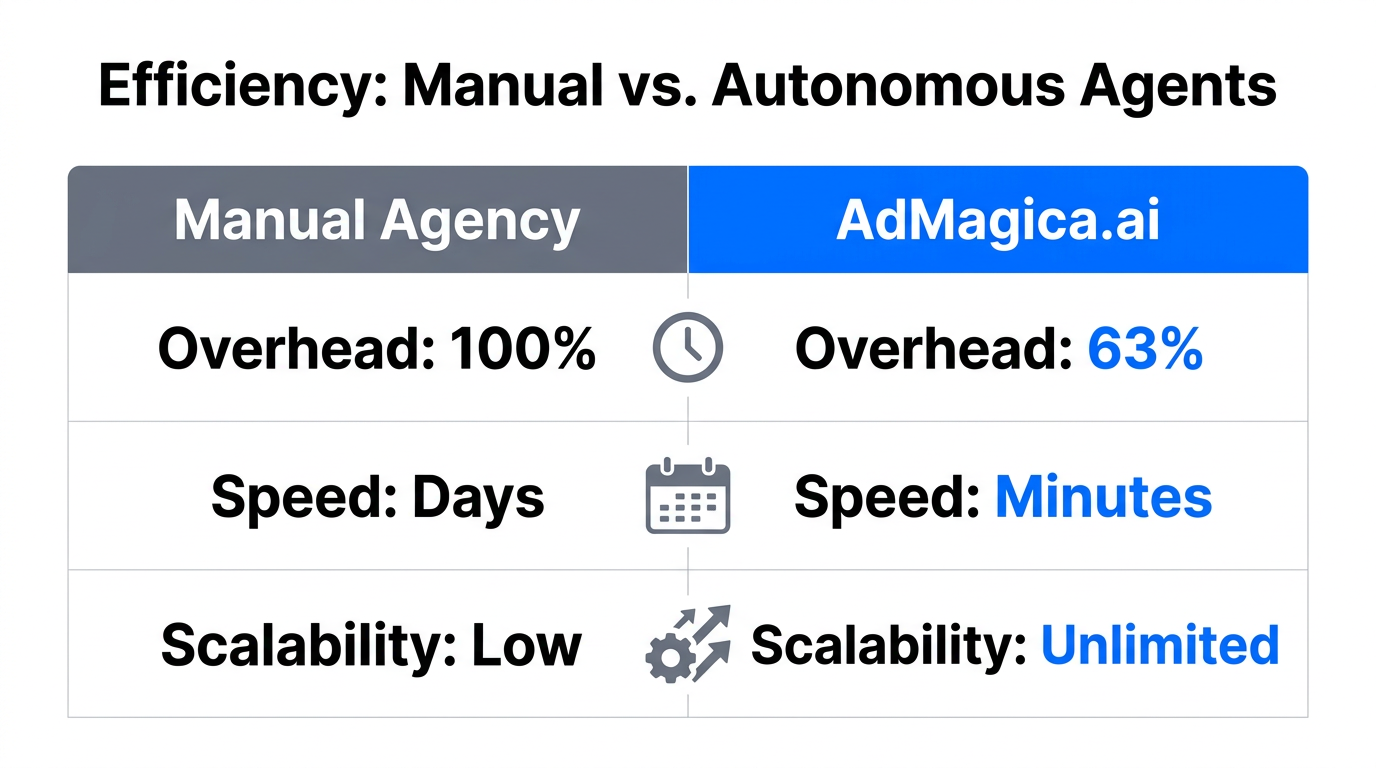
In the old world, a junior media buyer spent 80% of their time adjusting bids, refreshing creative, and pulling reports. In 2026, tools like AdMagica.ai have replaced these manual tasks with autonomous agents. These agents can audit a Google Ads account, rewrite the copy based on real-time performance, and adjust budgets across Meta and TikTok without a human ever typing a prompt. AdMagica.ai reviews in 2026 highlight its ability to replace junior roles with "AI Architects" who oversee the system rather than doing the work themselves.
This shift to autonomy isn't just about efficiency; it's about real-time relevance. For instance, GrowthSpree and other top agencies are leveraging these agents to manage hyper-segmented workflows that were previously impossible to maintain manually. When combined with creator discovery tools like Stormy AI, agencies can instantly source high-performing UGC (User-Generated Content) and feed it directly into an autonomous testing loop.
The Hybrid-Orchestration Model: Taste vs. Tech
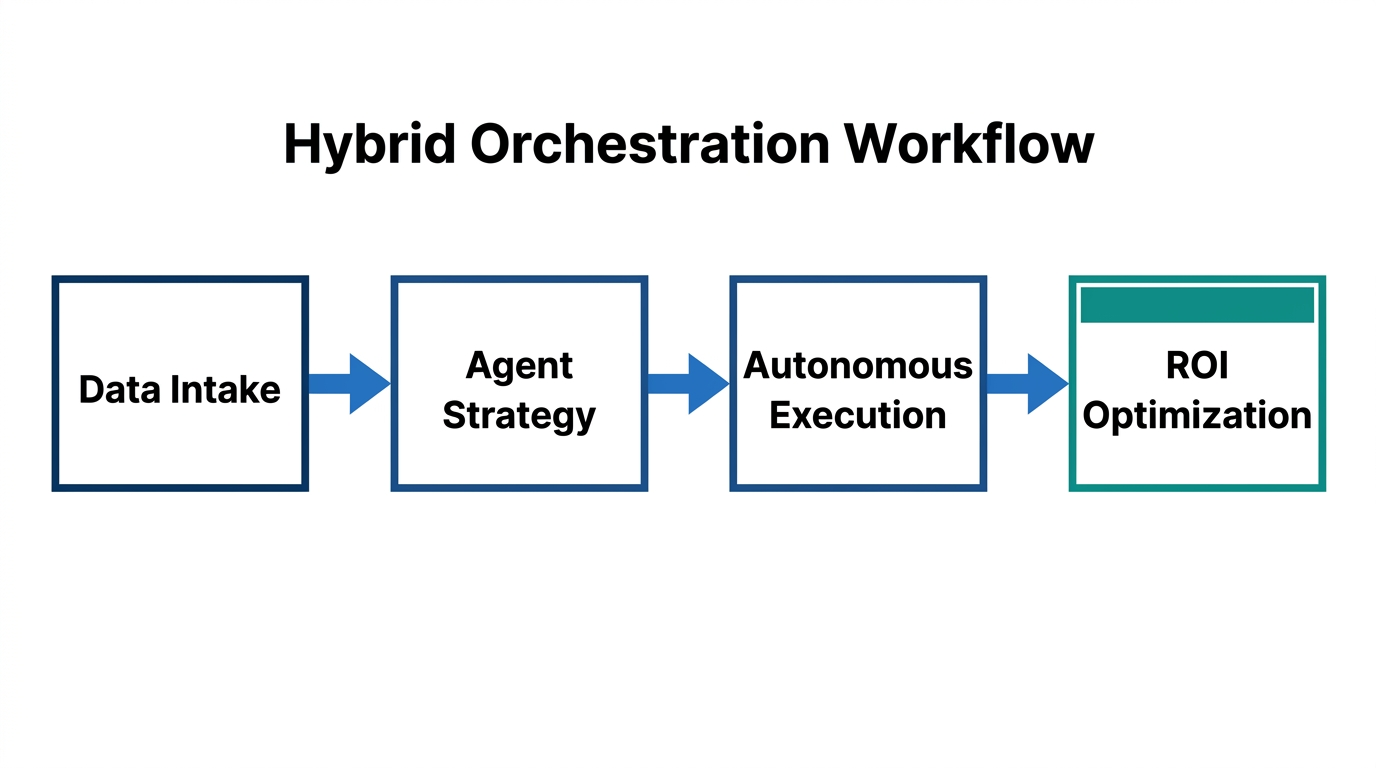
The biggest risk in 2026 is the "Uncanny Valley" of marketing. We've seen a 34.5% CTR decrease for brands that over-automate without human oversight, leading to what the industry calls "AI Slop." To combat this, elite agencies have adopted the Hybrid-Orchestration model.
This model prioritizes high-end human taste at the strategic level while delegating 100% of the execution to AI agents. It follows a strict four-step playbook:
- Data Ingestion: Use tools like n8n or Zapier Central to feed first-party customer data into a private LLM.
- Creative Extraction: Record client strategy calls using Fathom to extract the specific "Voice of the Customer."
- Core Asset Generation: A human strategist creates one "pillar" piece of content (e.g., a technical whitepaper or high-spec video).
- Agentic Distribution: AI agents split that pillar into 50+ derivatives—TikTok scripts, LinkedIn posts, and ad variations—for automated publishing on platforms like Shopify or social channels.
"The middle is disappearing. Content is merging to look identical, so the advantage shifts back to high-end 'taste' and 'selection'—knowing which 9 out of 10 AI ideas to delete."
Expert Taryn Crouthers, CEO of Spcshp, emphasizes that the strategist's role is now about selection. If the brief is bad, the AI just produces a bad campaign ten times faster. Agencies like NoGood and Single Grain excel because they focus on this Human-in-the-loop creative direction while letting agents handle the volume.
The Unit Economics of 2026: Credits vs. Seats

One of the most significant shifts in AI marketing agency ROI this year is the death of the traditional seat-based pricing model. Leading platforms have transitioned to credit-based usage models. For example, enterprise-grade tools like Salesforce Marketing Cloud and modern AI orchestration layers now function on a system where 1,000 credits cost roughly $10. A single autonomous customer agent conversation might cost 100 credits ($1.00), while data enrichment tasks cost 10 credits per record.
This change forces agencies to become Efficiency Architects. You are no longer paying for a software license; you are paying for the computational work the AI performs. Agencies that optimize their agent workflows can maintain 70%+ profit margins, while those with "messy data" see their budgets drained by inefficient AI loops. In fact, 80% of marketers report that fragmented data is the primary barrier to AI success in 2026.
Case Study: Replacing Junior Buyers with AI Architects
A recent transformation in the mid-market SaaS space perfectly illustrates the new ROI paradigm. A scaling software company replaced their 3-person content and media buying team with a single AI Architect using Copy.ai workflows and AdMagica.ai agents. By generating 2.3 million unique email variations monthly, they increased email-attributed revenue by 452% over eight months, as reported by SendXmail.
This isn't just happening in SaaS. Global giants like Coca-Cola, working with WPP’s Studio X, used generative AI to produce 70,000 video clips in just 30 days. This led to a 5-20% month-over-month sales increase across 1,000 outlets. Similarly, Starbucks saw a 30% higher ROI through their "Deep Brew" AI system, which handles personalized offers and inventory management autonomously (Source: RZLT.io).
The Death of SEO: Generative Engine Optimization (GEO)
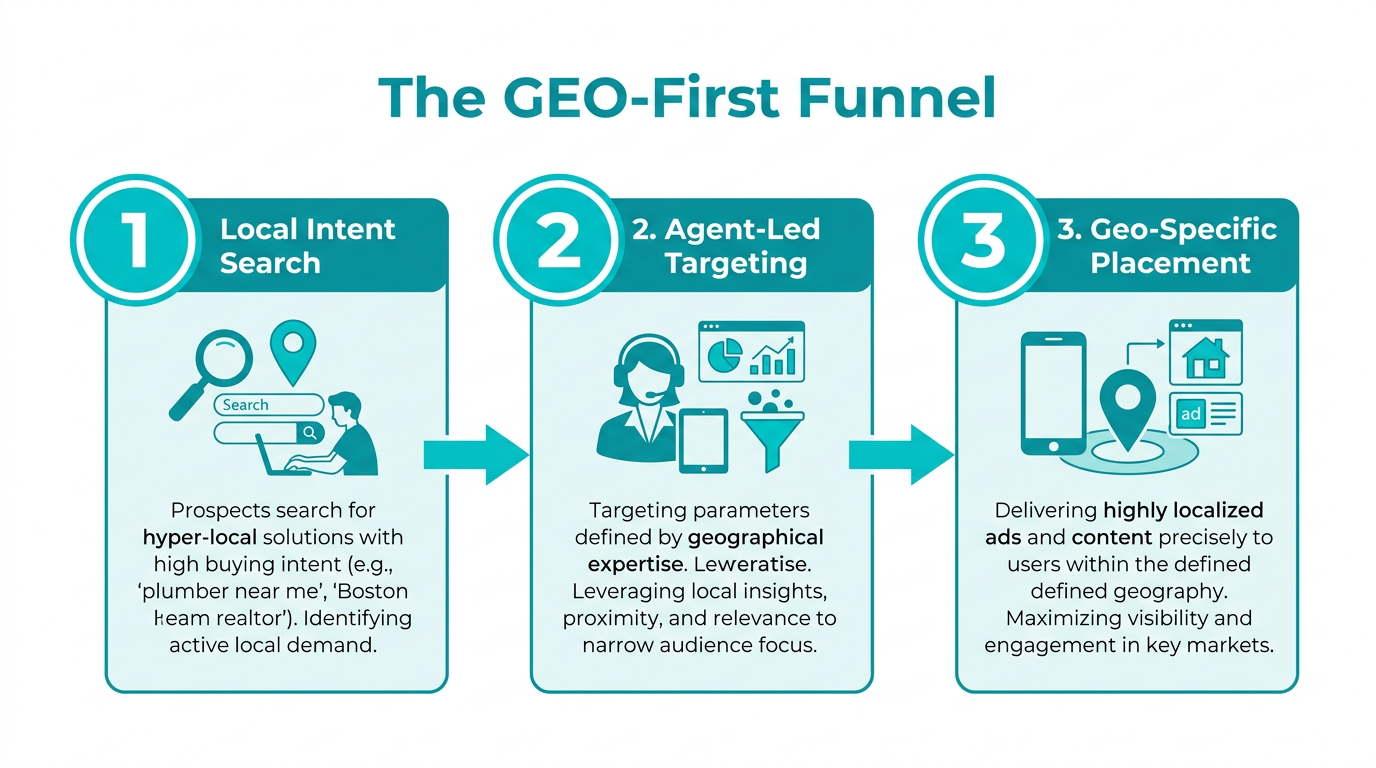
In 2026, the traditional search engine results page (SERP) is dying. 58–60% of Google searches now end without a single click because the AI Overview (AIO) provides the answer directly. Modern agencies have shifted their focus from "Keyword Research" to "Entity Research."
The goal is now to appear in ChatGPT Search, Perplexity, and Google AI Overviews. This requires a strategy focused on Brand Mention Frequency and Entity Authority. AI systems prioritize brands that users search for by name. Therefore, high-performing agencies are using creator-led strategies to drive Branded Search Volume, which has become a top-tier ranking factor for generative engines, according to Almcorp.com.
"Marketers must realize that in 2026, we are marketing to other AIs. If your product data APIs aren't optimized, a consumer's personal AI assistant will never even show your brand as an option."
Conclusion: Building Your Agency's AI Moat
Scaling a marketing agency in 2026 requires more than just a subscription to ChatGPT. It requires a dedicated tech stack centered around autonomous execution and high-level human taste. By implementing tools like AdMagica.ai for media buying and Stormy AI for creator-led brand authority, you can effectively reduce digital agency operational costs while delivering the 300% ROI that modern clients demand.
The agencies that will survive the next decade are those that move from being "service providers" to "orchestrators." Start by auditing your data fragmentation, setting up your first autonomous agent guardrails, and shifting your KPIs from clicks to AI Visibility Share. The future belongs to the architects, not the executors.