The transition from traditional Software-as-a-Service (SaaS) to Agent-as-a-Service (AaaS) is redefining performance marketing in 2025. For the modern agency owner, the days of manual dashboard diving are numbered. The manual era of clicking through the Meta Business Help Center for troubleshooting or spending hours in Ads Manager is being replaced by autonomous agents. At the center of this revolution is OpenClaw, an open-source AI agent framework that allows advertisers to move beyond simple automation rules into autonomous, reasoning campaign management. This guide explores how marketing agency automation is evolving and how you can reclaim 13+ hours per week per account using agentic workflows.
The Death of the Dashboard: Why Manual Meta Ads Management is Failing
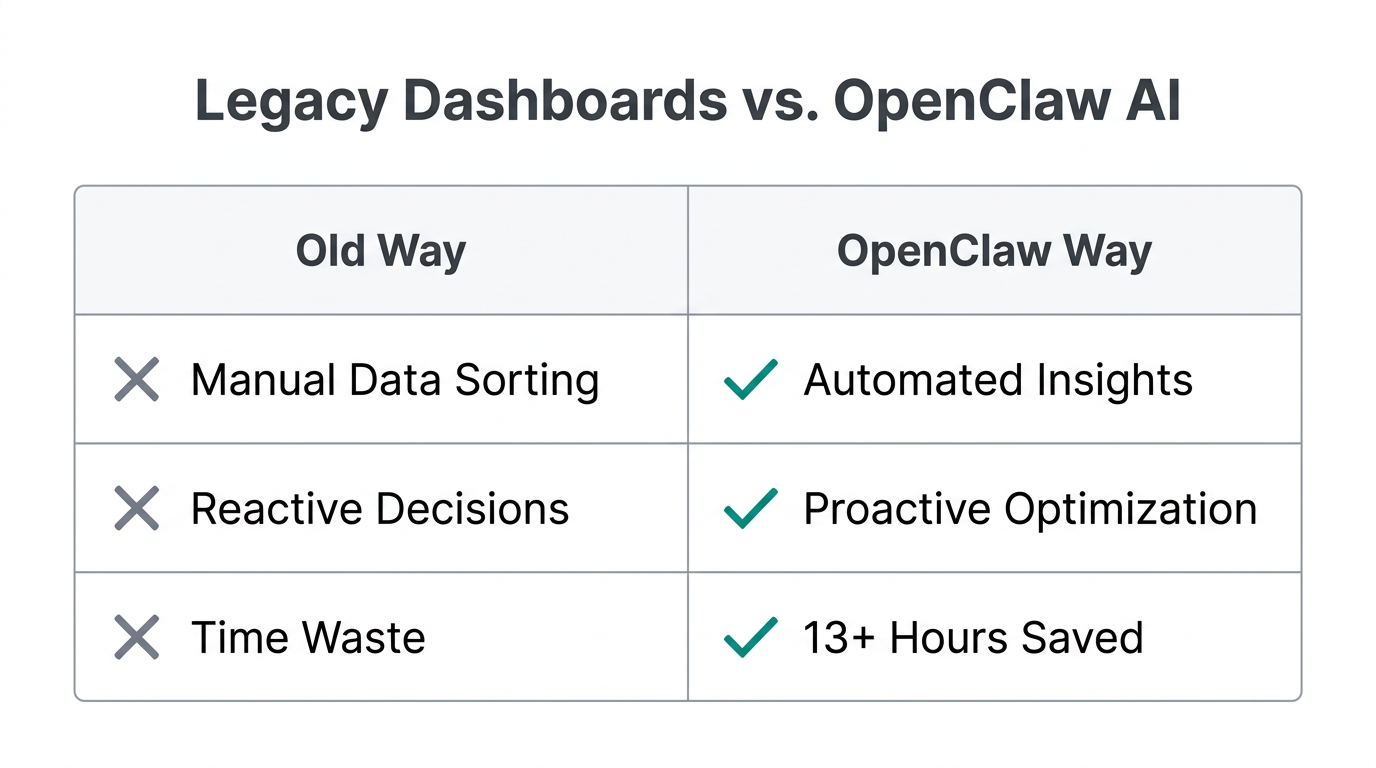
In the current landscape, 75% of PPC professionals now utilize some form of AI for campaign optimization, with automated bidding adoption increasing 340% year-over-year. Agencies that cling to manual workflows are not just losing time; they are losing performance. According to Meta’s 2024 performance reports, advertisers using AI-driven tools saw an average 22% improvement in Return on Ad Spend (ROAS), yielding approximately $4.52 in revenue for every $1 spent. If your team is still manually adjusting bids at 2 AM, you are effectively handicapping your client’s growth.
"The transition from SaaS to Agent-as-a-Service marks the point where software stops being a tool and starts being a teammate."This shift is driven by the sheer volume of data. AI-driven content recommendations have increased time spent on Instagram by 6% and on Threads by 35%, creating more inventory but also more complexity for advertisers. Managing this manually is no longer a viable performance marketing efficiency strategy. Instead, agencies are turning to AI for digital agencies to handle the heavy lifting of data analysis and execution.
What is OpenClaw? The Open-Source Agent Advantage
OpenClaw is not just another Meta Ads management software; it is a framework for building autonomous agents that can "reason" through marketing problems. Unlike traditional automation (like Meta’s built-in rules) which follow "If-Then" logic, OpenClaw agents use Large Language Models (LLMs) like Claude 3.5 or GPT-4o to analyze accounts. They can identify creative fatigue by analyzing CTR decay over 7, 14, and 30-day windows and suggest structural changes via natural language. To bridge the gap between these models and the actual data, OpenClaw utilizes the Model Context Protocol (MCP), creating a seamless connection to the Meta Ads API.
The 'Local-First' AI Advantage for Agencies
One of the biggest hurdles for agencies adopting AI is data privacy. With GDPR and CCPA regulations, sending sensitive client data to third-party cloud servers is a risk. OpenClaw offers a Local-First approach. By hosting the agent on a local Mac Mini or a private AWS Lightsail instance, agencies can keep first-party data off external servers. This level of security is a major selling point when pitching high-ticket clients who demand strict GDPR compliance.
| Feature | Traditional SaaS Automation | OpenClaw Agentic AI |
|---|---|---|
| Decision Logic | Hard-coded If/Then rules | Reasoning and Context-Aware |
| Data Privacy | Cloud-only, third-party storage | Local-first, agency-owned |
| Interface | Complex Dashboards | Mobile (Telegram/WhatsApp) |
| Customization | Limited to platform UI | Infinite via Markdown Skills |
The 4-Step Playbook for Agency Automation
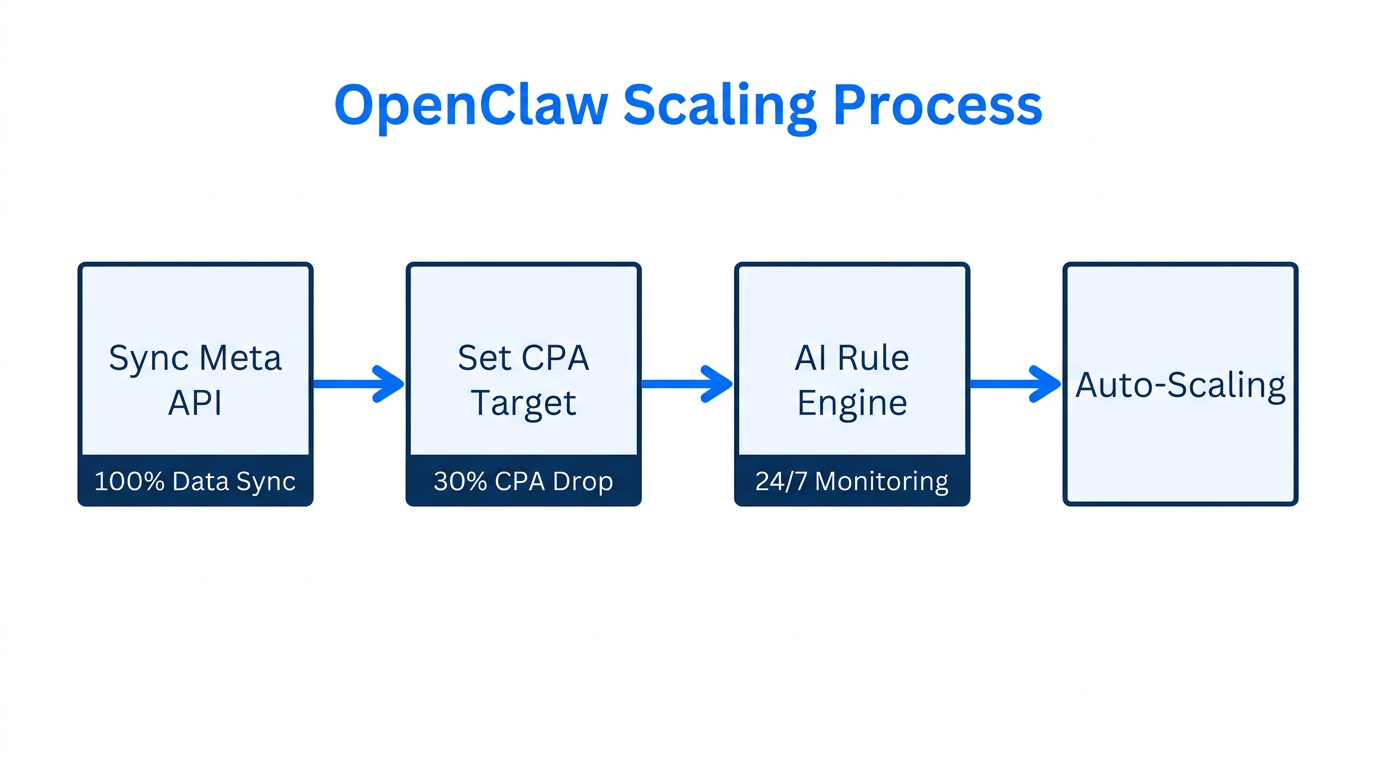
Scaling your agency requires a repeatable system. Use this OpenClaw playbook to transition your accounts from manual to autonomous management.
Step 1: Establish Your AI Infrastructure
Don't run your agents on a laptop that you close at 5 PM. For 24/7 execution, host OpenClaw on a dedicated Mac Mini or a VPS like AWS Lightsail. This ensures the agent is always monitoring for budget leaks or sudden performance drops. Connect your infrastructure to your chosen LLM and ensure the Model Context Protocol (MCP) is active to allow the agent to read and write to the Meta Ads API.
Step 2: Deploy the "Core Four" Skills
OpenClaw operates via modular instruction sets called "Skills." To maximize performance marketing efficiency, you must deploy these four essential skills:
- Performance Auditor: This skill constantly scans for budget leaks and ranks issues by revenue impact.
- Creative Analyst: It tracks asset performance via Meta's creative tools and flags fatigue before ROAS drops.
- Bid & Budget Manager: This autonomously scales winning ad sets (e.g., "Increase budget by 20% if ROAS > 3.0") and trims laggards.
- Audience Architect: This detects overlap between prospecting and retargeting funnels to prevent internal competition.
Step 3: Messaging as Your Mobile Command Center
Connecting OpenClaw to Telegram or WhatsApp Business transforms your phone into a mobile command center. Instead of logging into a laggy dashboard, you receive a daily morning brief. You can issue commands like "Scale the retargeting ad set by $500" directly from your chat app while you’re at the gym or in a meeting.
Step 4: The "Read-Only" Safety Phase
Trust must be earned. Start your agent in Read-Only mode for the first 14 days. Let it suggest changes via Telegram and review its reasoning. Once the agent proves its logic is sound, grant it "Write" access to execute spend-related tasks autonomously. This marketing agency automation strategy minimizes risk while maximizing long-term efficiency.
"The future of agency growth isn't more headcount; it's more efficient agents managed by fewer, higher-level strategists."Real-World Results: Agencies Saving 13+ Hours per Week
The impact of agentic workflows is tangible. Managed implementations of OpenClaw, such as those provided by Ryze AI, have shown that digital agencies save an average of 13 hours per week on routine reporting and bid adjustments. This is time that can be reinvested into strategy, client relationship building, or acquisition.
Consider the case of a B2B SaaS founder who maintained a 1.8x ROAS while traveling, using nothing but OpenClaw via Telegram. With zero manual dashboard intervention, the agent managed budgets, paused underperforming ads, and alerted the founder only when human intervention was absolutely necessary. Similarly, for those focusing on organic and paid synergy, Ryze AI agents have helped creators generate 2 million views in two weeks by automating content testing and cross-platform distribution.
While OpenClaw handles the paid media execution, agencies are also looking for ways to automate the top of the funnel. For example, platforms like Stormy AI streamline creator sourcing and outreach, allowing agencies to find the perfect UGC creators to feed the OpenClaw creative analyst. By combining AI for digital agencies across both influencer discovery and ad management, you create a truly autonomous marketing machine.
Common Mistakes to Avoid in AI Ad Management
Even with advanced OpenClaw agents, human oversight remains vital. Avoid these four common pitfalls:
- The "Set and Forget" Trap: Over-automation without monitoring can lead to "model degradation," where the AI optimizes for low-cost but poor-quality leads. Always review the "reasoning" behind the agent's actions.
- Poor Data Foundation: AI is only as good as its inputs. If you haven't properly set up the Meta Conversions API (CAPI), you are feeding the AI bad signals, which will lead to wasted spend.
- Ignoring Brand Voice: Generic AI-generated copy can alienate your audience. Tools like Canva or a Brand Kit skill in OpenClaw can ensure the agent maintains a consistent tone across all ad copy.
- Security Risks: Running AI agents with shell access is powerful but risky. Always follow the Least Privilege Principle—only give the agent the specific permissions it needs to manage ads in Meta Ads Manager.
Conclusion: The Future of the AI-Powered Agency
Scaling a marketing agency in 2025 requires more than just talent; it requires leverage. By moving away from manual Meta Ads management software and adopting agentic frameworks like OpenClaw, agencies can dramatically reduce overhead while improving client results. Whether you build your own framework or use a managed service like Ryze AI, the goal is the same: to stop being a "clicker" and start being a strategist. As you automate your paid media, don't forget to look at your creator workflows. Tools like Stormy AI can help you discover and manage the influencers who provide the high-quality assets your AI agents need to succeed. The era of the autonomous agency is here—it's time to build yours.