Scaling Customer Acquisition: Using Claude Code to Build Autonomous Outreach Engines in 2026
Learn how to use Claude Code to build autonomous lead generation engines, automate competitor analysis, and scale customer acquisition in 2026 with agentic AI.
In the rapid-fire digital economy of 2026, the traditional marketing funnel has officially been retired. Growth is no longer about linear stages of awareness and consideration; it is about autonomous growth loops that operate at a velocity humans simply cannot match. As we navigate this year, the most successful brands have pivoted from manual campaign management to agentic commerce, where AI agents research, compare, and even execute interactions on behalf of both brands and consumers. At the heart of this revolution is Claude Code, Anthropic’s terminal-based agentic coding environment that allows growth engineers to build, test, and deploy entire acquisition engines with minimal manual intervention.
The 1,247% Lift: Why Outreach Velocity Defines 2026
Why is everyone talking about autonomous lead generation 2026? The data tells a staggering story. Conversions from AI-driven referrals and automated outreach sequences increased by a massive 1,247% over the last twelve months, according to research by Signifyd. This isn’t just a minor optimization; it’s a fundamental shift in how markets function. In an era where Neuralens AI reports that over 85% of online revenue is influenced by AI-powered recommendations, the brands that win are those that can inject their value proposition into the AI decision-making loop at scale.
This shift toward autonomous lead generation means moving away from broad-spectrum ads and toward hyper-personalized, high-intent outreach. By leveraging Reforge Growth Engineering frameworks, companies are now using Claude Code to close the gap between identifying a prospect and delivering a personalized offer. The old world of "funnels" is being replaced by loops that autonomously generate content, drive acquisition, and refine their own targeting parameters based on real-world performance.
"AI agents aren't just a future interface; they're a new operating layer for commerce in 2026, enabling machine-to-machine transactions that bypass traditional search altogether."
Step 1: Automated Competitor Analysis and Pain Point Scraping
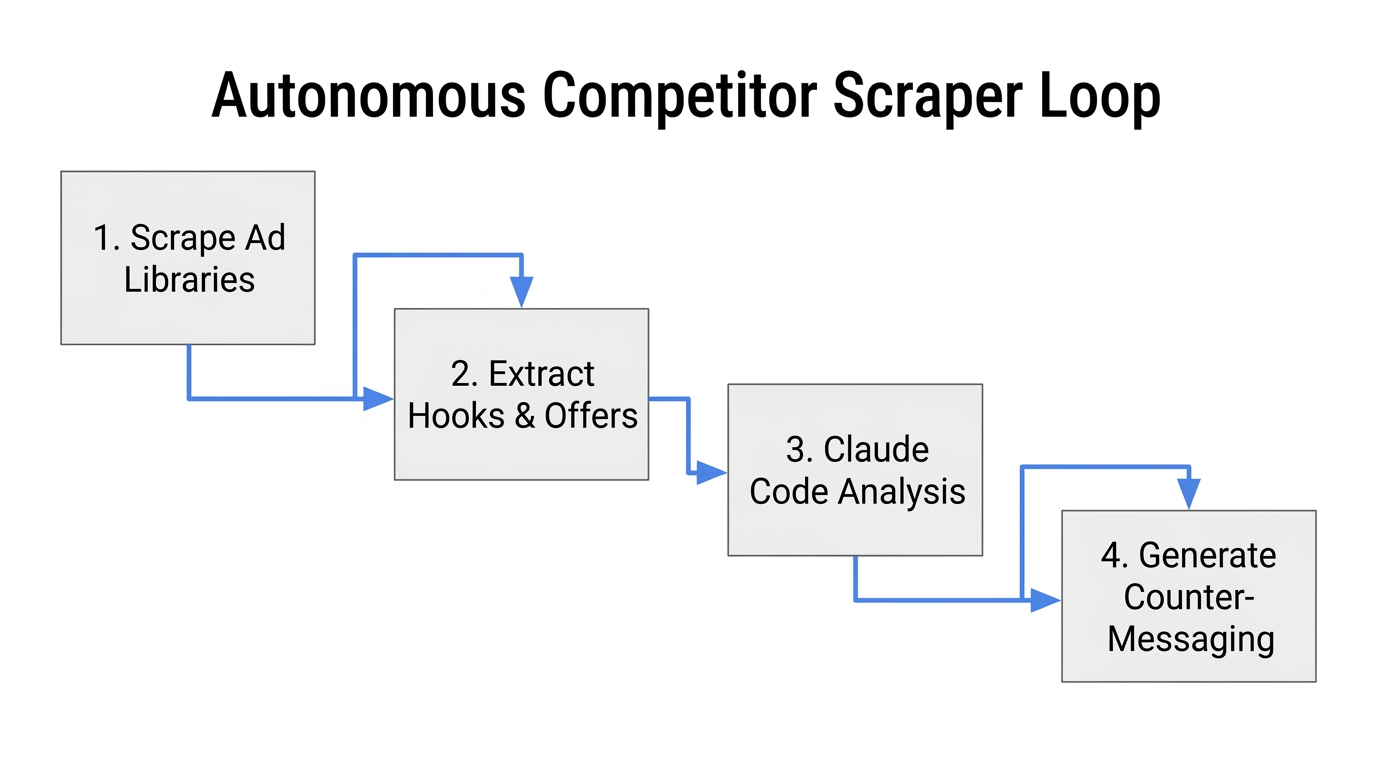
The foundation of any high-converting outreach engine is contextual relevance. You cannot sell a solution if you do not understand the prospect’s specific pain. In 2026, we use Claude Code to build custom, agentic scrapers that don’t just pull data—they interpret it. Unlike legacy scraping tools, an agentic loop can navigate complex sites, handle dynamic content, and perform sentiment analysis on the fly.
Building the "Competitor Agony" Scraper
Using Claude Code, growth engineers can autonomously write and deploy scripts that target review platforms like Trustpilot or social sentiment on X and Reddit. The goal is to identify specific, recurring complaints about your competitors. For example, if users are consistently complaining about a competitor's "slow shipping" or "clunky UI," Claude Code can index these pain points and categorize them by user demographic.
- Step A: Initialize a Claude Code process to crawl specified competitor review URLs.
- Step B: Use natural language processing to extract the specific "reason for churn."
- Step C: Map these pain points to your product’s unique features (e.g., "Competitor A has slow shipping; our product offers 2-day guaranteed delivery").
By automating this automated competitor analysis, you move from generic marketing to "surgical strikes." You are no longer saying "we are better"; you are saying "we solve the specific technical debt that made you hate your previous provider."
| Old Way (2024-2025) | The 2026 Agentic Way | Primary Benefit |
|---|---|---|
| Manual review monitoring | Autonomous sentiment scrapers | Real-time pain point discovery |
| Broad value propositions | Dynamic framing per segment | 47% higher reply rates |
| Human-led outreach planning | Claude Code agentic loops | 60% more PRs/Experiments shipped |
Step 2: Automating the Value Proposition Shift
Once you have the data, you need to test how to present your solution. This is where Claude Code for sales automation becomes a powerhouse. In 2026, we no longer A/B test a single subject line; we test entire narrative clusters. Using agentic loops, you can instruct Claude to generate and deploy 10 different messaging frames across email and influencer outreach channels simultaneously.
As noted in a recent MarketBetter case study, brands using AI to test value proposition framing—rather than just surface-level copy—saw a 47% cumulative improvement in engagement. The AI identifies which angle (cost-saving, efficiency, status, or security) resonates best with specific niche audiences.
"In 2026, the 'vibe coding' shift means engineers describe the outcome—like 'find 500 high-intent app developers'—and the AI handles the boilerplate infrastructure to get it done."
For brands targeting social platforms, this is where sourcing the right creators becomes vital. Platforms like Stormy AI allow you to discover influencers who already command the attention of your target segments, while Claude Code handles the back-end logic of managing these outreach sequences. By combining AI customer acquisition with high-quality creator discovery, brands can build a closed-loop system that finds, vets, and contacts leads while the marketing team sleeps.
The 2026 Integration Guide: Building Your Growth Stack
Building an autonomous outreach engine requires a modular, high-performance tech stack. You cannot scale on messy data. In fact, research reports that 68% of AI projects fail because of poor data hygiene. To succeed in growth engineering outreach, you must integrate your agentic coding tools with robust verification and delivery platforms.
The Growth Engineering Stack for 2026:
- Agentic Core: Claude Code for autonomous planning and script execution.
- Email Verification: MillionVerifier to ensure 99% deliverability and protect domain reputation.
- Influencer & Creator Sourcing: Stormy AI for finding niche creators and automating personalized outreach to social leads.
- Sending Infrastructure: Instantly.ai for managing high-volume email sequences with AI-driven warmups.
- Data Infrastructure: NeonDB for serverless database support that scales with your scraping volume.
By connecting these tools, you create a system where Claude Code identifies a lead, Stormy AI provides the social context and creator alignment, MillionVerifier cleans the contact info, and Instantly triggers the sequence. This is the definition of a modern autonomous lead generation system.
Security and Technical Debt: The Founder’s Checklist
With great power comes great risk. The rise of agentic coding has led to a phenomenon known as "Shadow Engineering," where AI-generated code is deployed without proper audit. According to Fast Company, AI-assisted developers are shipping 10x more security vulnerabilities when they bypass traditional review processes. Furthermore, adding too many AI widgets can lead to the Performance Paradox; Yottaa research shows that a single second of mobile load time delay can decrease conversions by 20%.
To avoid these risks, founders should follow this Growth Engineering Audit Checklist:
- Audit AI Scripts: Use tools like Cursor to visually inspect the React components or Node scripts Claude Code generates.
- Monitor Page Weight: Ensure that your autonomous acquisition widgets aren't bloating your front-end and killing your mobile conversion rates.
- Centralize Logic: Use dbt to transform your scraped data into a clean, structured format before it hits your AI models.
- Credential Safety: Ensure all API keys for email and scraping tools are stored in secure environment variables, never hard-coded into AI prompts.
Conclusion: The Era of Intent-Based Growth
The transition to autonomous lead generation 2026 is not just a trend; it is a survival requirement. The sheer volume of data and the speed of consumer shifts mean that manual outreach is now obsolete. By leveraging Claude Code to build autonomous engines, you aren't just saving time—you are increasing your experimental velocity. As the DX Report highlights, engineers using agentic tools ship 60% more PRs, allowing growth teams to find winning acquisition channels faster than ever before.
As you scale your acquisition this year, remember that the goal is to create a proprietary growth loop. Combine the raw technical power of agentic coding with the specialized search capabilities of platforms like Stormy AI to find creators and leads that fit your brand DNA. The future of marketing is no longer about who has the biggest budget—it is about who has the most efficient, autonomous engine for discovering and capturing intent.