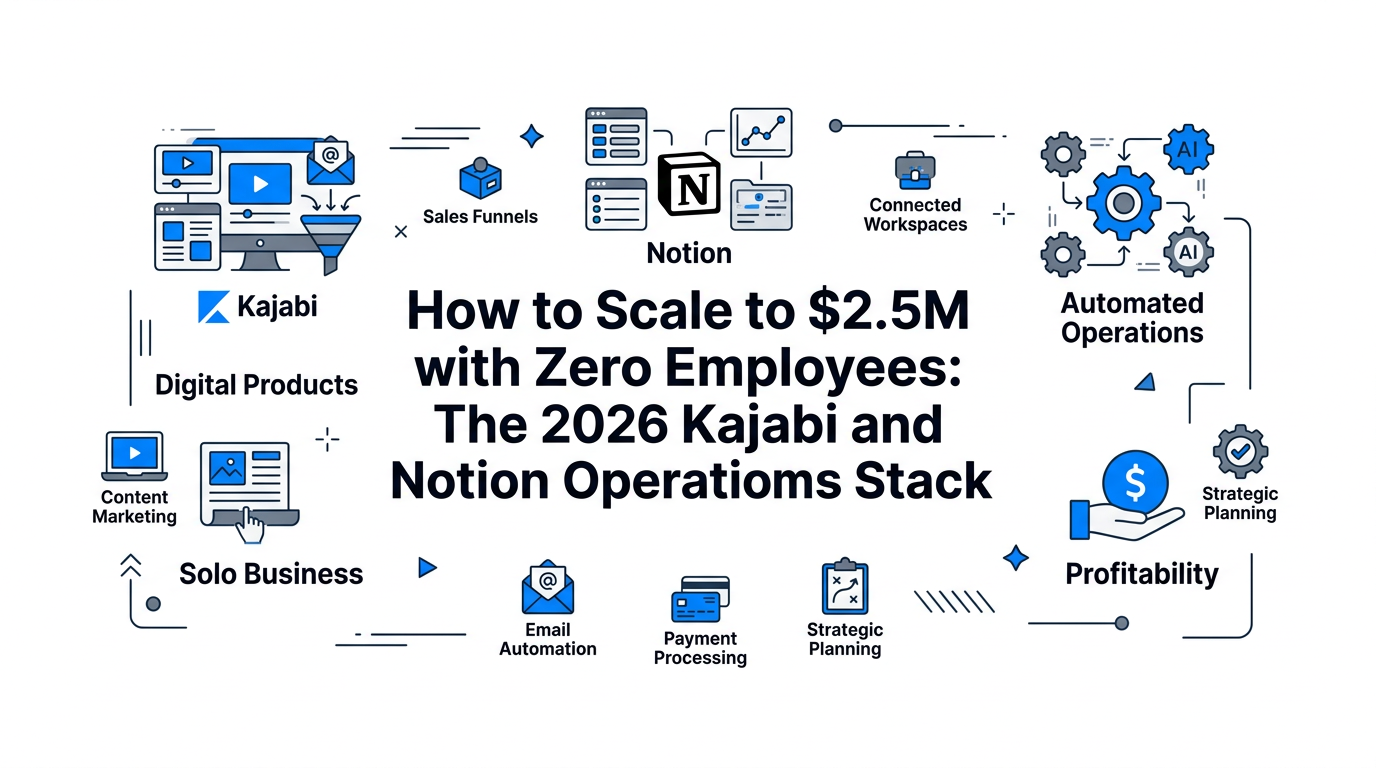
In 2026, the dream of the "one-person unicorn" is no longer a myth—it is a repeatable operational blueprint. Justin, a former tech executive who traded 10 years of high-anxiety board meetings for a $1.7 million solo business, is living proof. This year, he is on track to hit $2.5 million in revenue with zero employees. His secret isn't a massive team or a venture capital infusion; it is a hyper-lean, Kajabi-powered infrastructure and a ruthless commitment to software-driven automation.
By leveraging a $620/month tech stack, Justin manages 100,000+ newsletter subscribers, multiple high-ticket courses, and a massive social presence while working only five hours a day. This article breaks down the 2026 playbook for Notion for business systems, the specific tools required for lean business operations, and how you can transition from an "exhausted operator" to a "knowledge entrepreneur."
The Pivot from Burnout to Knowledge Entrepreneurship
Justin shares the intense burnout experience that led him to rethink his entire career path.
Justin’s journey didn't start with a clean spreadsheet. It started with a massive panic attack in December 2018. After a decade of scaling tech companies like Zocdoc to $50 million in recurring revenue, the stress culminated in a physical collapse. "I was on all fours, screaming, crying, hallucinating," he recalls. This moment marked the end of his traditional corporate career and the beginning of his solopreneur tech stack 2026 evolution.
Today, Justin identifies as a "knowledge entrepreneur." He doesn't sell physical goods or services that require fulfillment teams. Instead, he sells systems, expertise, and digital products. This model is built for the 2026 economy where low overhead and high margins are the ultimate competitive advantages. By focusing on Kajabi for solopreneurs, he has centralized his entire revenue engine into a single dashboard.
"Starting will teach you a hundred times more than reading my story... All advice is contextual. Start, learn, try."Centralizing Revenue with Kajabi for Solopreneurs
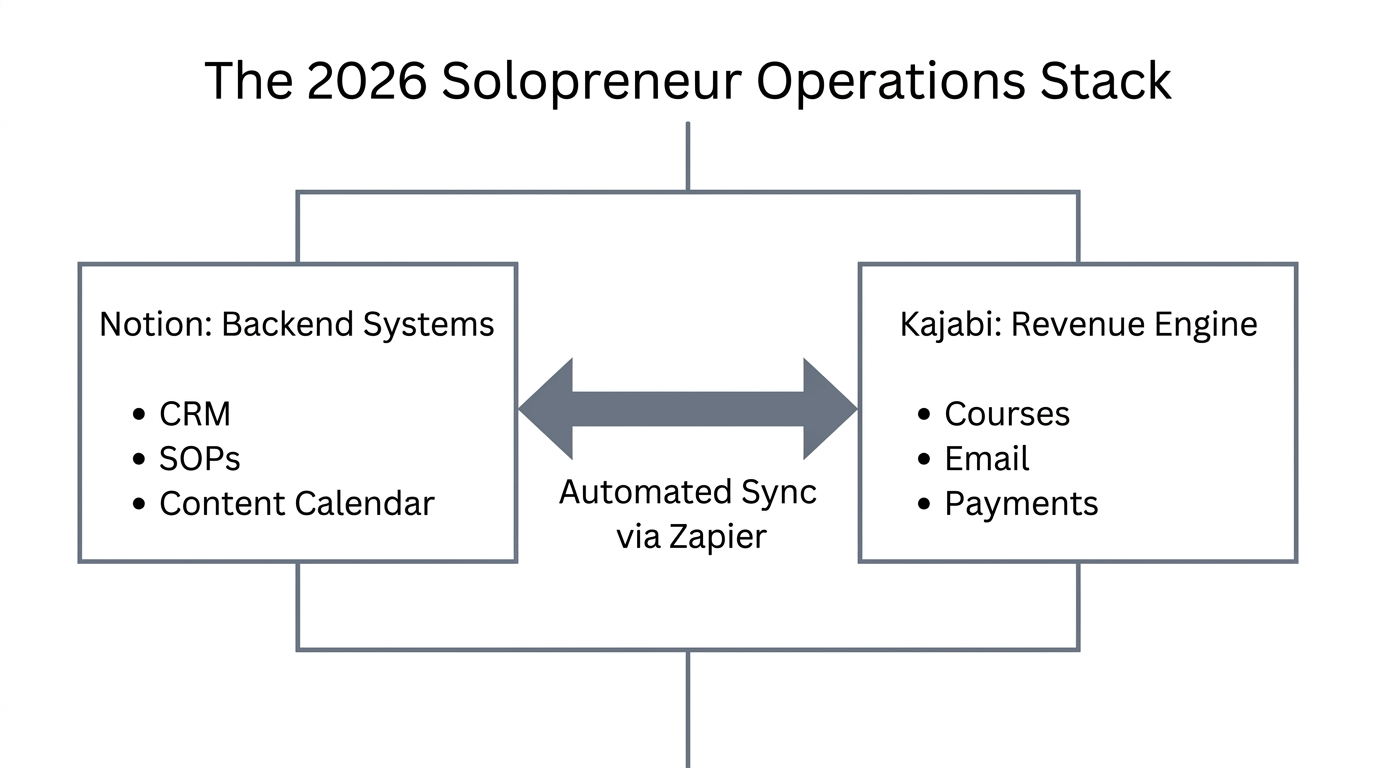
The core of Justin’s $2.5M operation is Kajabi. While many creators cobble together a dozen different plugins, Justin pays $399 per month to have his website, courses, email marketing, and subscriptions in one place. This centralization is the cornerstone of his lean business operations.
Why Kajabi is the 2026 Choice for Scaling
- Course Hosting: Manages two primary information products—one on LinkedIn business building and another on content systems.
- Subscription Management: Handles a monthly subscription email that provides copywriting techniques to thousands of recurring members.
- Seamless Checkout: Eliminates the need for complex integrations between Stripe and a separate CMS.
By using Kajabi for solopreneurs, Justin avoids the "integration tax"—the time and money spent fixing broken connections between disparate tools. This allows him to focus entirely on content creation and hypothesis testing rather than technical troubleshooting.
Notion for Business Systems: The Second Brain
If Kajabi is the engine, Notion is the cockpit. Justin uses Notion for business systems to organize a newsletter approaching 100,000 subscribers and a content pipeline that produces 2–3 posts per day on multiple platforms. Without a project manager, Justin relies on Notion to ensure he knows exactly what he is doing every morning.
His system is built on capturing ideation in real-time. "Ideation is around you at all times," Justin notes. Using Notion, he catalogs ideas from podcasts, walks, and YouTube channels. He specifically looks at popular videos on YouTube and puts his own unique spin on those trending topics to ensure resonance with his audience.
| Function | Tool of Choice | Monthly Cost (Approx) |
|---|---|---|
| Core Infrastructure | Kajabi | $399 |
| Operations/Planning | Notion | $10 |
| Social Proof/UGC | Testimonial.to | $50 |
| LinkedIn Growth | Taplio | $59 |
| X (Twitter) Scheduling | Hypefury | $49 |
The Discovery-to-Trust Funnel Marketing Strategy
Explore the top-of-funnel discovery strategies that bring thousands of new leads into the business.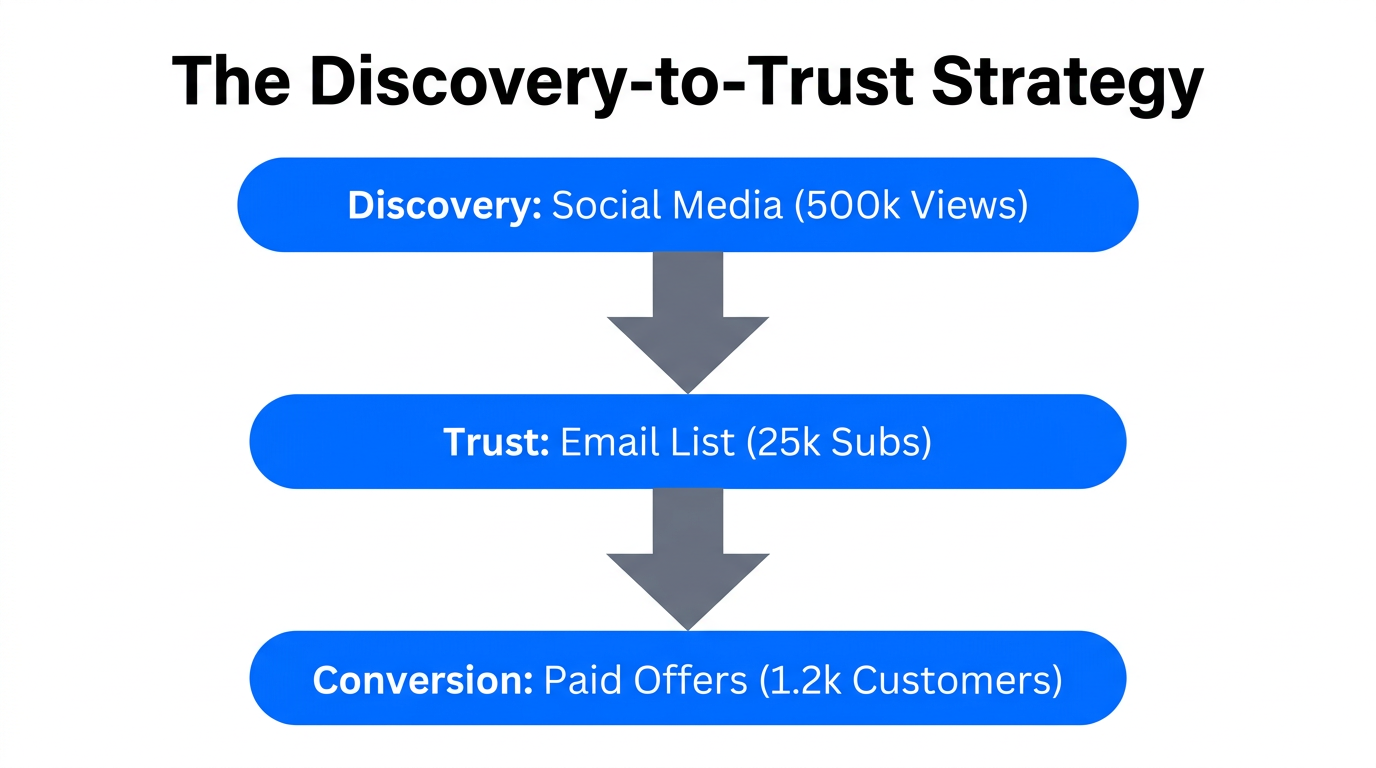
Justin’s marketing strategy is content-driven rather than ad-driven. He has never run a paid ad. Instead, he follows a three-step cycle: Discovery, Trust, and Offer. This is a masterclass in automation for creators who want to build authority without a sales team.
Step 1: Discovery on Social Media
Every morning at 8:15 AM Eastern, Justin’s content goes live on LinkedIn and Twitter (X). He uses tools like Taplio and Hypefury to schedule these posts, ensuring a consistent presence even when he is at the gym. For modern founders, tools like Stormy AI can further streamline this by helping discover top-performing creator trends and managing outreach for potential collaborations.
Step 2: Building Trust with Long-Form Content
Once a user discovers Justin, the goal is to move them to his weekly newsletter hosted on his website. This is where he shows "how his brain works." Long-form content builds expertise and authority that a 280-character post cannot achieve. By the time a reader sees an offer, they already trust his methodology.
Step 3: The Low-Friction Offer
Because the trust is so high, the "ask" is simple. Justin presents his courses as affordable solutions to the problems he has already discussed in his free content. There is no aggressive urgency—just a presentation of value.
"If you have a million followers and 1% or 2% buy a product at a few hundred dollars, suddenly this becomes relatively possible."Automating Social Proof with Testimonial.to
In a zero-employee model, you cannot spend hours chasing clients for reviews. Justin uses Testimonial.to to automate the collection of user-generated content (UGC). This tool allows him to collect video and text testimonials that he can instantly embed on his Kajabi sales pages.
This automation for creators turns satisfied customers into a 24/7 sales force. In the world of lean business operations, social proof is the most effective form of marketing because it requires zero manual effort once the system is live. User-generated content is the currency of trust in 2026, and Justin’s stack is optimized to mint it daily.
A Typical Day in the Life of a $2.5M Solopreneur
See what a typical week looks like for an entrepreneur managing a massive digital business.Justin’s schedule is regimented and lifestyle-first. He doesn't believe in the 14-hour hustle culture that led to his initial burnout. Instead, he uses his solopreneur tech stack 2026 to protect his time.
- 05:30 AM - 08:15 AM: Routine and prep.
- 08:15 AM: Content goes live; 45 minutes of active engagement with the audience.
- 09:30 AM - 11:30 AM: Gym and lunch with his wife (The "Non-Negotiable").
- 12:00 PM - 04:00 PM: Intense creative work. Mondays are for newsletters, Tuesdays through Thursdays for content creation, and Fridays for strategic projects like building new products.
By automating the distribution and administrative tasks, Justin ensures that his limited working hours are spent on high-leverage activities that directly impact revenue. This is the ultimate goal of lean business operations: spending more time on the "creative" and less on the "clerical."
The Hypothesis-Driven Growth Model
Learn how to use a hypothesis-driven growth model to scale your business operations effectively.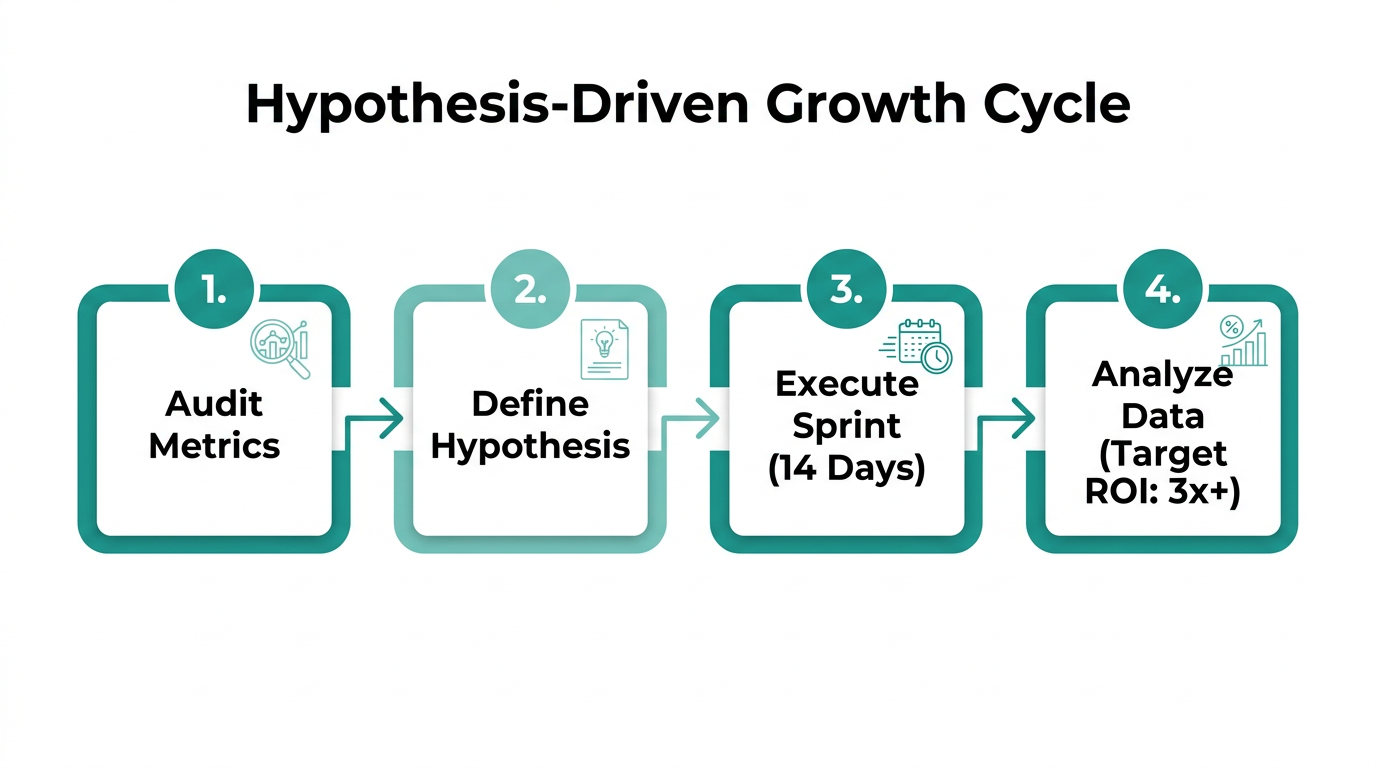
How does he continue to level up without a team? Justin treats his business like a lab. He is a hypothesis-driven creator. He makes a hypothesis (e.g., "A thread about Notion for business systems will perform better than a listicle"), tests it, and analyzes the data. If it works, he does it five times more. If it fails, he eliminates it immediately.
This scientific approach to growth is what allowed him to scale from $1.7M to a projected $2.5M in a single year. He isn't guessing; he is iterating based on what the market tells him through engagement and sales data. For those looking to find creators to partner with for similar growth experiments, Stormy AI offers the AI-powered search and vetting tools necessary to find the perfect collaborators in seconds.
Conclusion: Building Your Own Lean Machine
Scaling to $2.5 million with zero employees isn't about being a superhuman; it’s about being a systems architect. By centralizing on Kajabi for solopreneurs, organizing with Notion for business systems, and automating social proof with Testimonial.to, you can build a business that serves your life rather than consumes it.
Justin’s story is a reminder that in 2026, the most successful businesses are often the leanest. Stop looking for your next hire and start looking for your next automation. As Justin says, "Starting will teach you a hundred times more than reading my story." Pick your stack, define your system, and start building your knowledge empire today.