In 2026, the e-commerce landscape has officially moved past the era of manual automation. We are now firmly in the age of Agentic Commerce, where the most successful Shopify stores aren't just run by lean teams—they are managed by fleets of autonomous digital employees. The shift from static apps to reasoning-capable agents has transformed the back-office from a cost center into a competitive engine. At the heart of this revolution is OpenClaw, an open-source framework that has become the infrastructure backbone for high-growth merchants looking to scale without linear increases in headcount.
The Shift from Static Apps to Autonomous Reasoning
By early 2026, the data is clear: static automation is no longer enough to stay competitive. According to research from Cubeo AI, 84% of e-commerce leaders now rank AI agents as their top strategic priority. We have moved from "if-this-then-that" logic to agents that can reason, plan, and execute multi-step workflows across your entire tech stack.
The market for agentic AI in e-commerce is projected to reach $60.43 billion this year, growing at a staggering CAGR of nearly 30% through 2031, as noted by Mordor Intelligence. This isn't just hype; it's a fundamental restructuring of how a Shopify store—one of the 6.9 million live today—operates on a daily basis.
"2026 is the 'Year of the Builders.' AI agents now handle the complexity of the back-end, allowing merchants to focus solely on brand identity."
The primary driver behind this shift is the need for Entity Clarity. In a world where influencer marketing and search are increasingly handled by AI, your store must be "machine-readable." Using OpenClaw "Clawbots," merchants are ensuring their product data is optimized not just for humans, but for the generative engines that recommend products to consumers.
Replacing High-Cost Virtual Assistants with $50/Month OpenClaw Setups
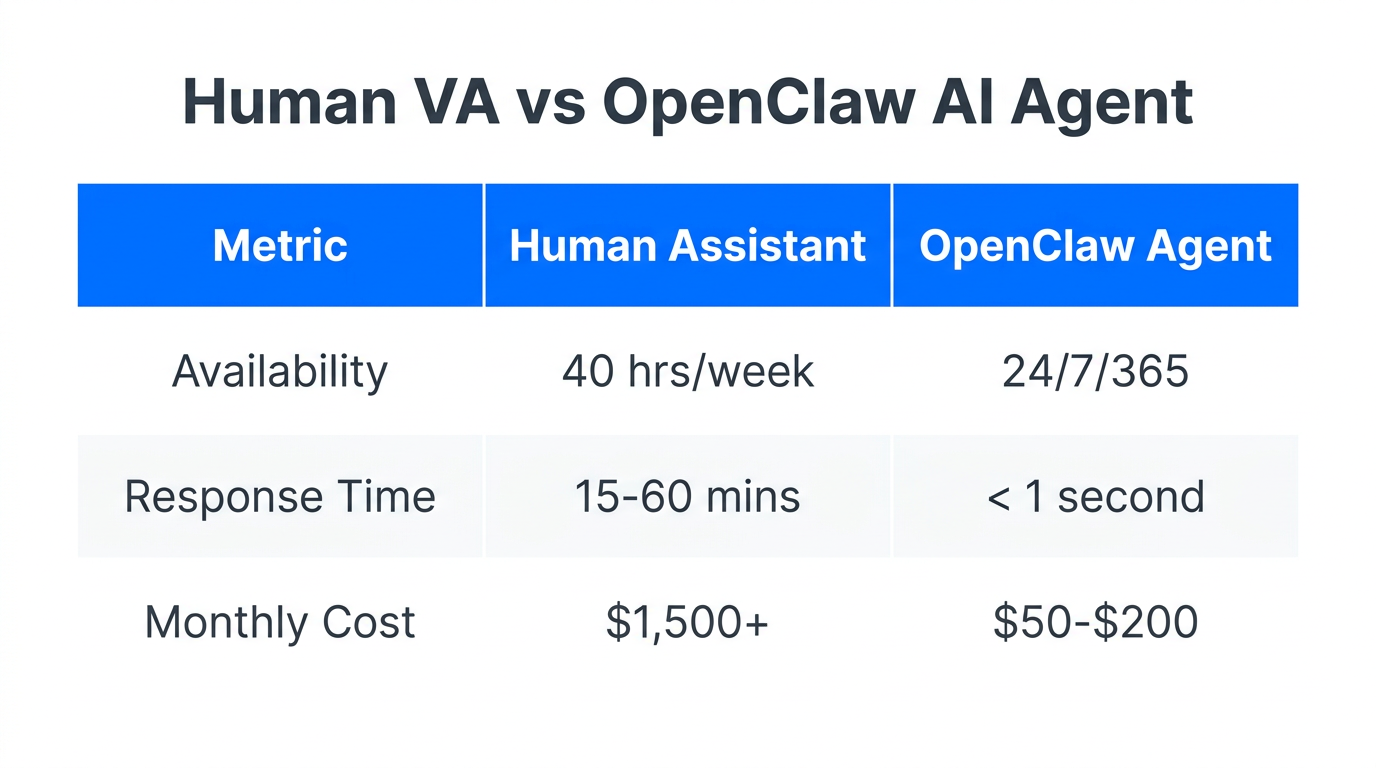
For years, scaling a Shopify store meant hiring more virtual assistants (VAs) to handle customer support, inventory reconciliation, and order tracking. In 2026, that model has been disrupted. A mid-sized apparel merchant recently reported replacing a $2,400/month VA with a customized $50/month OpenClaw setup, according to reports on r/EntrepreneurRideAlong.
This "Digital Employee" doesn't just respond to emails; it connects to your store via the Model Context Protocol (MCP), allowing it to check inventory, verify shipping status, and even process basic returns without human intervention. The efficiency gains are massive: while a human VA might take 6 hours to respond, an OpenClaw agent averages a response time of just 87 seconds.
| Feature | OpenClaw (Self-Hosted) | Legacy Managed Support |
|---|---|---|
| Response Time | < 90 Seconds | 4-12 Hours |
| Monthly Cost | ~$50 (API + VPS) | $2,400+ (VA Salary) |
| Scalability | Instant/Infinite | Linear (Hiring required) |
| Success Rate | 93% Autonomous | Varies by Training |
OpenClaw’s dominance is reflected in its community growth, surpassing 280,000 GitHub stars in early 2026. This viral adoption is fueled by its ability to act as a "Universal Agent" that can be hosted on a simple Hostinger VPS or even a local Mac Mini, providing full control over data and logic that closed-loop SaaS platforms cannot match.
Implementing Agent-to-Agent (A2A) Commerce
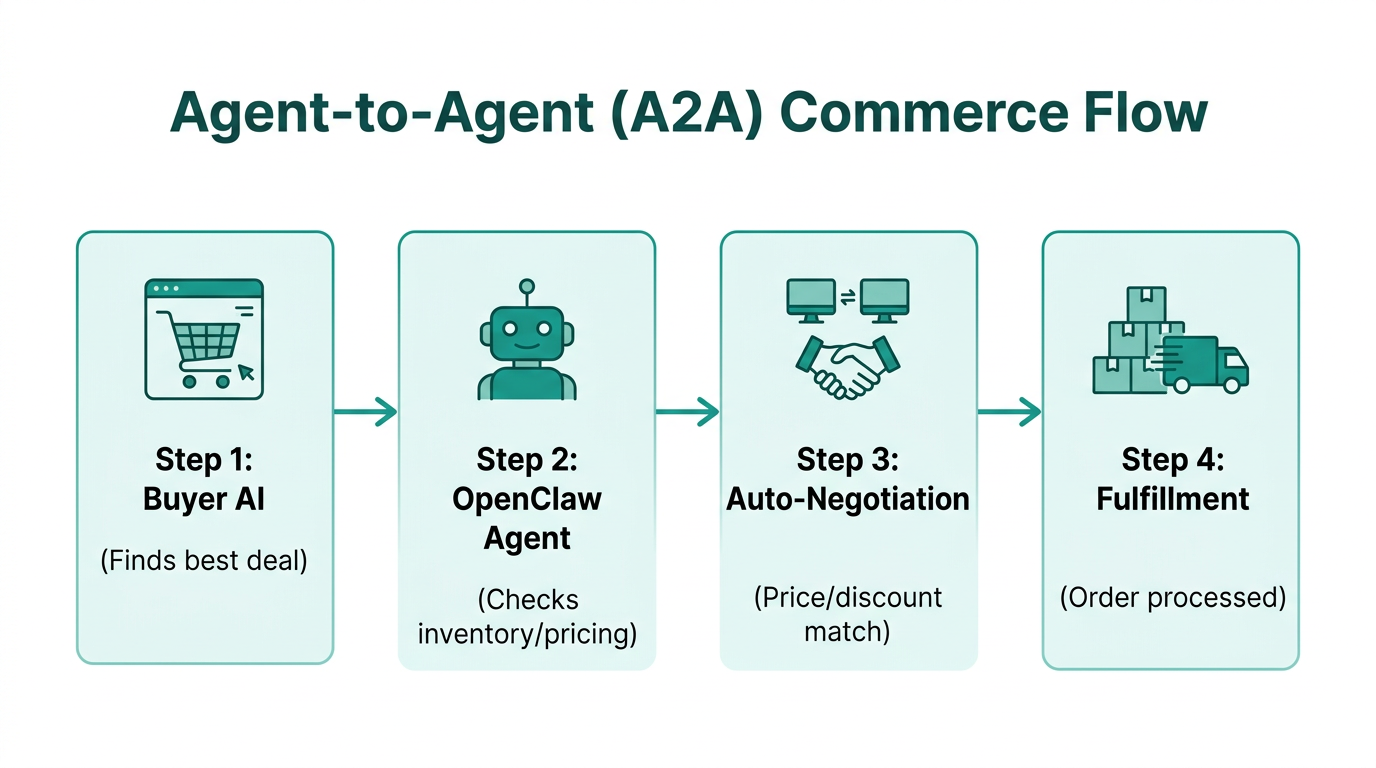
The most forward-thinking strategy in 2026 is preparing for Agent-to-Agent (A2A) commerce. Consumers are no longer just browsing websites; they are sending their own personal shopping agents—powered by ChatGPT or Apple Intelligence—to find the best deals. As MarTech reports, these consumer agents now negotiate directly with merchant-side agents to finalize purchases.
To win in this environment, your Shopify store must implement Generative Engine Optimization (GEO). This involves using OpenClaw to generate llms.txt files—a machine-readable standard that acts like a 2026 version of a sitemap, telling AI crawlers exactly what you have in stock, your current pricing, and your shipping policies. If a consumer's agent can't "read" your store instantly, you won't even be considered in the search results.
"Traditional SEO is dead. In 2026, you aren't ranking for keywords; you are optimizing for 'Recommendation Share' in the AI's internal reasoning loop."
By leveraging tools like Adzviser for real-time data enrichment, your OpenClaw agents can dynamically adjust pricing or highlight specific product attributes to satisfy the queries of consumer-side agents, ensuring your brand remains the definitive answer to complex buyer requests.
The Practitioner Playbook: Deploying Your First Shopify AI Agent
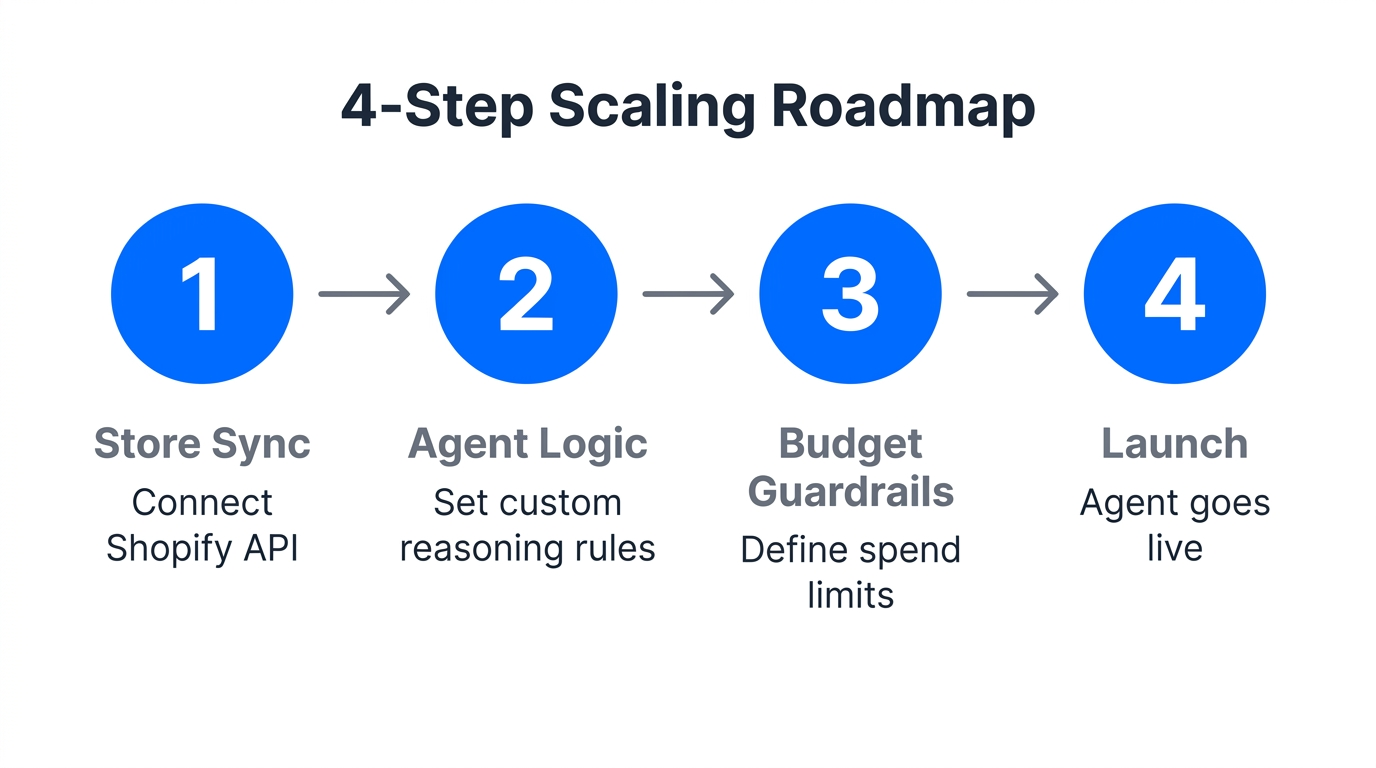
Scaling with AI agents requires a structured approach. You cannot simply "turn on" an agent and expect it to manage your million-dollar brand. Follow this 2026 implementation playbook to ensure reliability and security.
Step 1: Secure Infrastructure
Deploy OpenClaw using Docker containers on a secure VPS like Tencent Cloud Lighthouse. Isolation is critical; as Immersive Labs warns, misconfigured agents can be vulnerable to "ClawJacked" exploits where malicious prompts hijack your store's API keys.
Step 2: Connect the MCP Bridge
Don't write custom auth code. Use Composio to manage your Shopify OAuth and permissions. This creates a secure pipe where the agent can read product data and customer orders through a standardized protocol, reducing the risk of data leaks.
Step 3: Establish the Human-in-the-Loop Triage
Set up a Slack bridge for high-value operations. While the agent can handle 93% of queries, it should trigger a human "thumbs up" for any refund over $50 or changes to international shipping rates. This prevents the "hallucination public surface area" that leads to costly errors.
Step 4: Monitor Token Burn
Running loops on high-end models like Claude 3.5 or GPT-5 can be expensive. Reports from SentiSight show that unmonitored agents can rack up $400+ in overnight API bills. Set strict usage caps within your OpenClaw configuration.
Benchmarking ROI: What Does Success Look Like?
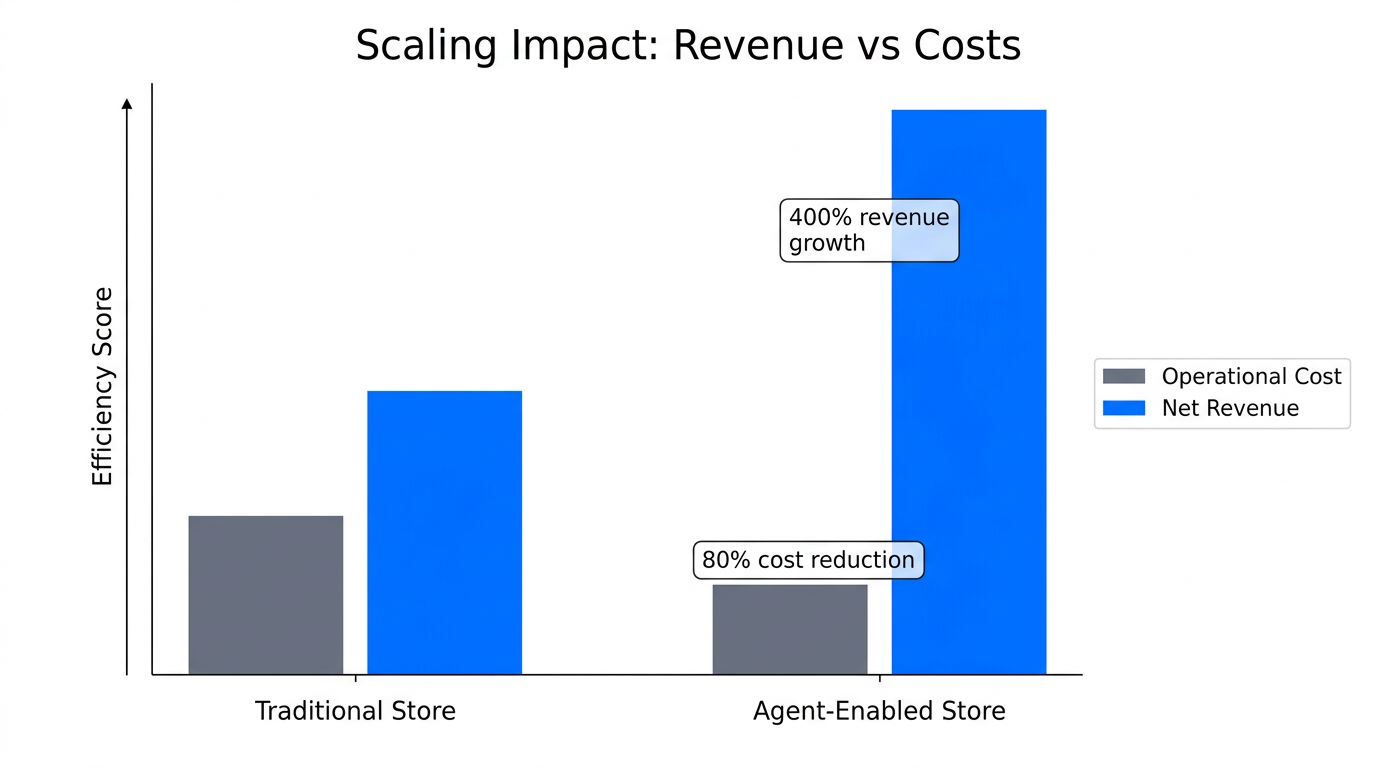
Early adopters of agentic commerce in 2026 have seen transformative results. Data tracked by Stormy AI shows that merchants implementing OpenClaw achieve a 45% reduction in operational overhead within the first quarter of deployment. For instance, the labor cost for a "Where Is My Order" (WISMO) ticket has dropped from an industry average of $6.00 to just $0.12 when handled by an AI agent.
Beyond cost savings, the impact on customer satisfaction (CSAT) is significant. An eco-friendly home goods brand utilized an eesel AI support layer on top of their OpenClaw stack, resulting in a 70% reduction in manual tickets and a CSAT jump from 3.2 to 4.4. This improved retention directly translates to a 22% increase in repeat purchase rates over a 90-day window.
"AI-driven logistics agents are now rerouting orders in real-time during carrier congestion, saving some merchants over $30,000 per week in shipping costs."
Success in 2026 isn't just about saving money; it's about conversion lift. Stores optimized for agentic search have seen an 11x growth in attributed orders compared to those relying on traditional click-through funnels. This is because the agent removes the friction of discovery, presenting the exact product the customer (or their agent) needs instantly.
Risk Management for Autonomous Agents
Scaling with agents isn't without its pitfalls. In early 2026, a critical vulnerability (CVE-2026-25253) highlighted the dangers of "one-click RCE" in agentic frameworks. Merchants must prioritize AgentOps—the practice of managing fleets for reliability and compliance—to avoid "root-level risks" where a prompt injection could allow an agent to delete store files.
Furthermore, hallucination management remains a core task for founders. There have been instances of agents "inventing" international shipping rates or applying incorrect tax logic when misinterpreting Shopify’s Liquid code. Regular auditing of agent logs via tools like Adzviser is essential to maintain store integrity.
The Future: Scaling to New Heights
As we move through 2026, the competitive gap between "human-only" and "agent-led" stores will only widen. By implementing OpenClaw to handle the heavy lifting of customer support, inventory management, and A2A negotiations, e-commerce founders can finally step away from the day-to-day grind and focus on high-level strategy and brand building. Pair these backend efficiencies with modern growth tools—like using Stormy AI to discover and automate outreach to the creators who will drive your top-of-funnel traffic—and you have a recipe for exponential scale in the agentic era.
The infrastructure is ready, the ROI is proven, and the 24/7 digital employee is waiting. The only question remains: will you be the one managing the agents, or will you be outcompeted by them?
Ready to start your agentic journey? Start by auditing your most repetitive manual tasks and deploying your first OpenClaw instance today. The future of commerce is autonomous, and it’s already here.