In 2026, the term "solopreneur" has undergone a radical transformation. We no longer live in the era where a one-person business means a founder drowning in a sea of manual tasks, from fulfillment emails to ad copy tweaks. Today, scaling a Shopify store as a single individual is about moving from task-execution to agentic orchestration. The 2026 landscape is defined by the emergence of Agentic Commerce, where your primary role is no longer to "do the work," but to direct a fleet of AI agents that manage the messy back office for you.
The market has reached a critical scaling inflection point. As of early 2026, the global AI in e-commerce market is valued at $10.5 billion, and while 89% of retailers have adopted AI in some form, only 7% have fully integrated it across their operations. This creates a massive competitive gap for the efficient solo operator. By utilizing a "Unified Intelligence" stack, a single founder can now outperform traditional teams of 15-20 people while keeping overhead at a fraction of the cost.
The Shift to Agentic Commerce: Orchestrator vs. Executor
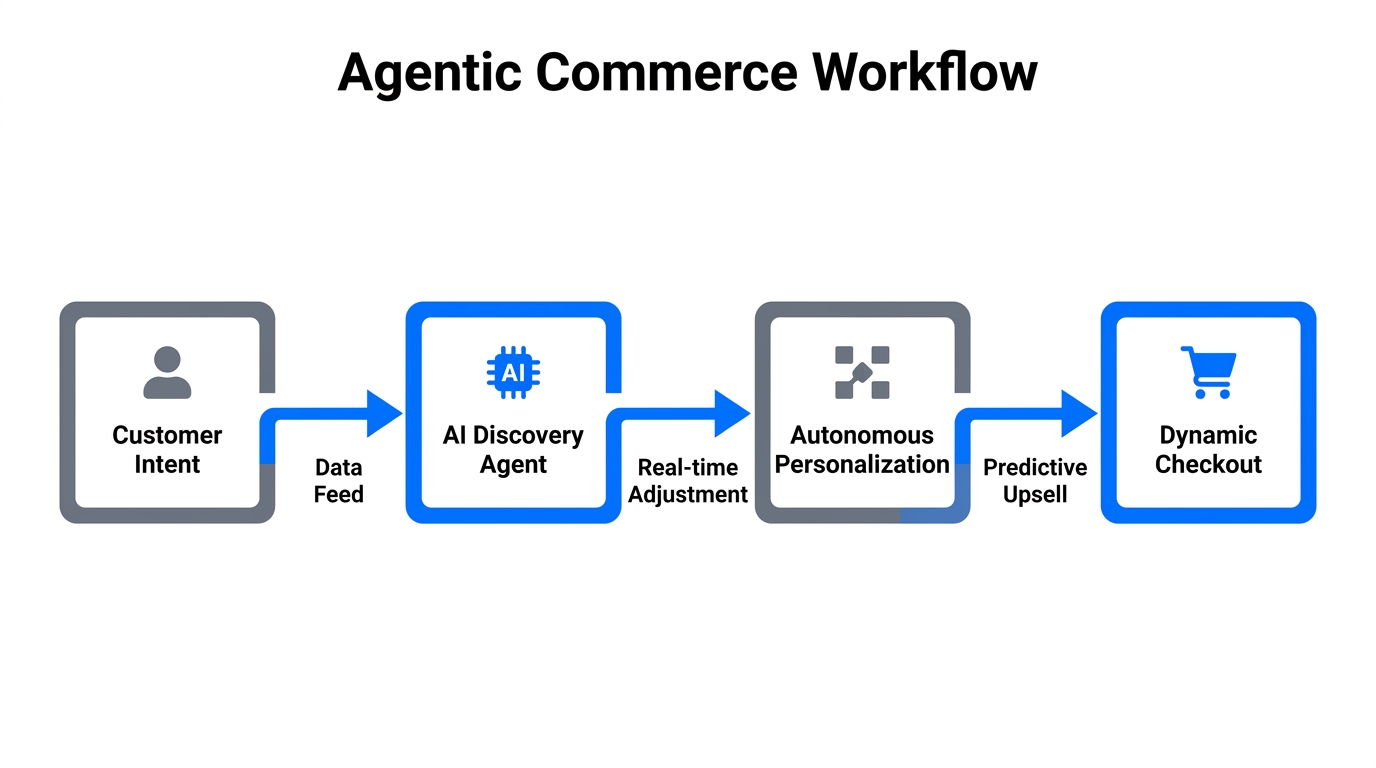
In the legacy e-commerce model, scaling meant hiring. You needed a media buyer for Meta, a VA for customer support, and an operations manager to track inventory. In 2026, that model is dead. According to data from SQ Magazine, orders coming to Shopify stores from AI-powered search engines like Perplexity or ChatGPT Search have increased 15x since January 2025. This shift means your store must be readable not just by humans, but by autonomous AI agents acting as personal shoppers.
"The AI era has reached commerce. Orders from AI search are up 15x... it’s like having a personal shopper in every customer's pocket." — Harley Finkelstein, Shopify President
The 2026 solo founder acts as the CEO of a digital workforce. You aren't writing the emails; you are setting the strategy for Klaviyo AI to personalize segments. You aren't monitoring shipments; you're letting an AI ecommerce employee like Stormy AI handle supplier follow-ups and inventory tracking in the background. This shift allows for infinite scalability without headcount growth, effectively decoupling revenue from human hours worked.
The 2026 Solo Scaling Stack: Your Unified Intelligence Layer
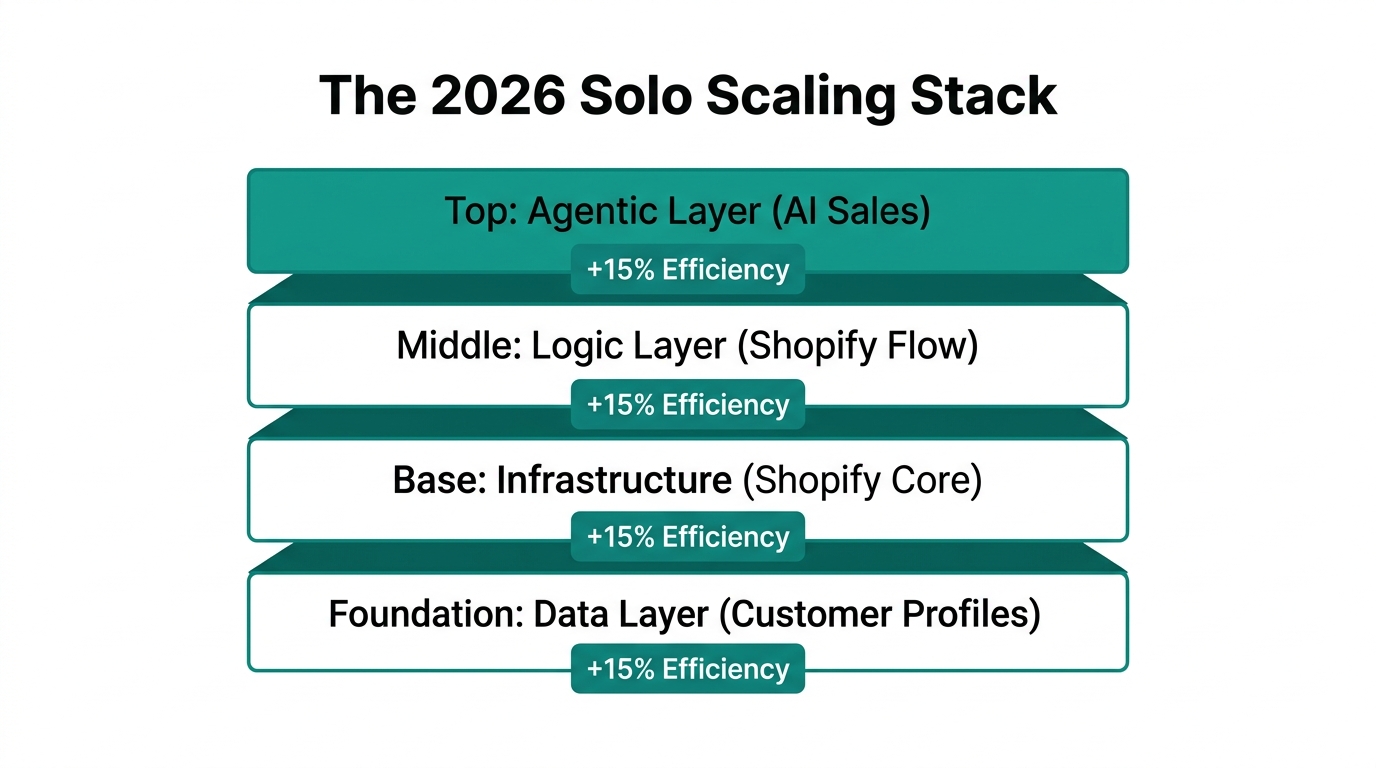
Successful solo scaling in 2026 requires a "Unified Intelligence" layer—tools that reason across finance, marketing, and operations rather than a fragmented 20-app stack. Instead of paying for a dozen disconnected point solutions, the modern stack centers on 3-4 core agents that "talk" to each other.
| Category | Winning Tool | Key Function | Est. Monthly Cost |
|---|---|---|---|
| Unified Intelligence | Luca AI | Cross-departmental reasoning & capital access | €200 |
| Operations & Follow-up | Stormy AI | AI Ecommerce Employee: CRM, supplier/creator follow-up | $150+ |
| Marketing Automation | Klaviyo AI | Predictive segments & autonomous email flows | $20+ |
| Creative Production | Creatify AI | URL-to-Video UGC style ads | $19 |
| Data & Analytics | Triple Whale | Moby AI assistant for cross-platform attribution | $129 |
This stack costs roughly $500–$800 per month but provides the output of a $150,000 annual human team. As noted by NoimosAI, the 95% cost reduction is the primary driver for the current "Gold Rush" of one-person billion-dollar business attempts. Tools like Stormy AI bridge the gap by handling the "human" parts of the workflow—like emailing a creator who hasn't posted yet or escalating a supplier delay—without you ever opening your inbox.
Phase 1: Foundation (The One-Hour Store Build)
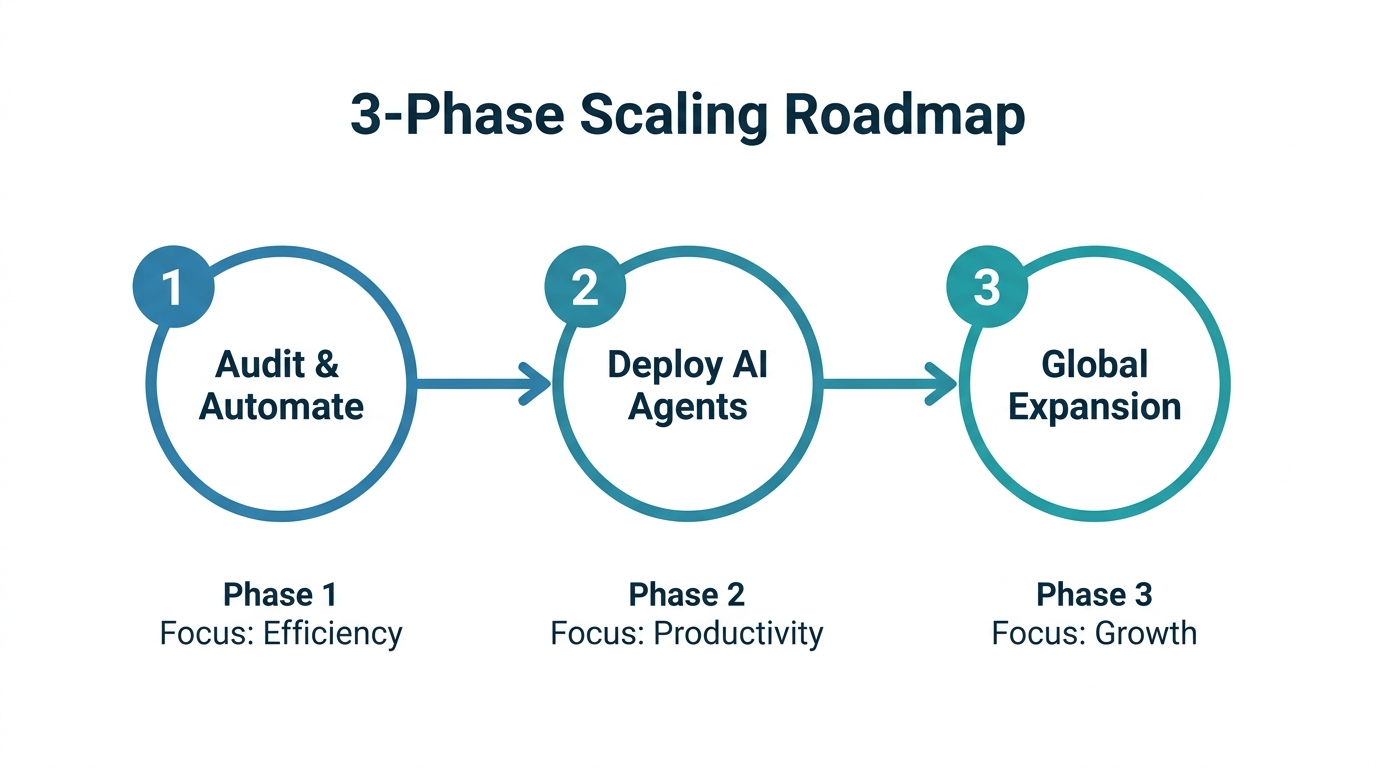
In 2026, the barrier to entry has vanished. You can now move from idea to first customer in a single morning using what industry experts call the "One-Hour Company Stack."
- Market Research: Use Stormy AI to scrape niche forums and identify customer frustrations. Stormy can browse the web, summarize competitor reviews, and drop a gap analysis directly into a spreadsheet for you.
- Store Generation: Use Shopify combined with an AI builder like Storebuild.ai. These tools generate branded storefronts, including high-converting layouts and initial product sets, in under 60 minutes.
- SEO & Metadata: Don't write product descriptions manually. Connect Jasper AI to your catalog to generate 500+ SEO-optimized descriptions that are specifically tuned for Generative Engine Optimization (GEO).
Phase 2: Operational Automation (The Middle Game)
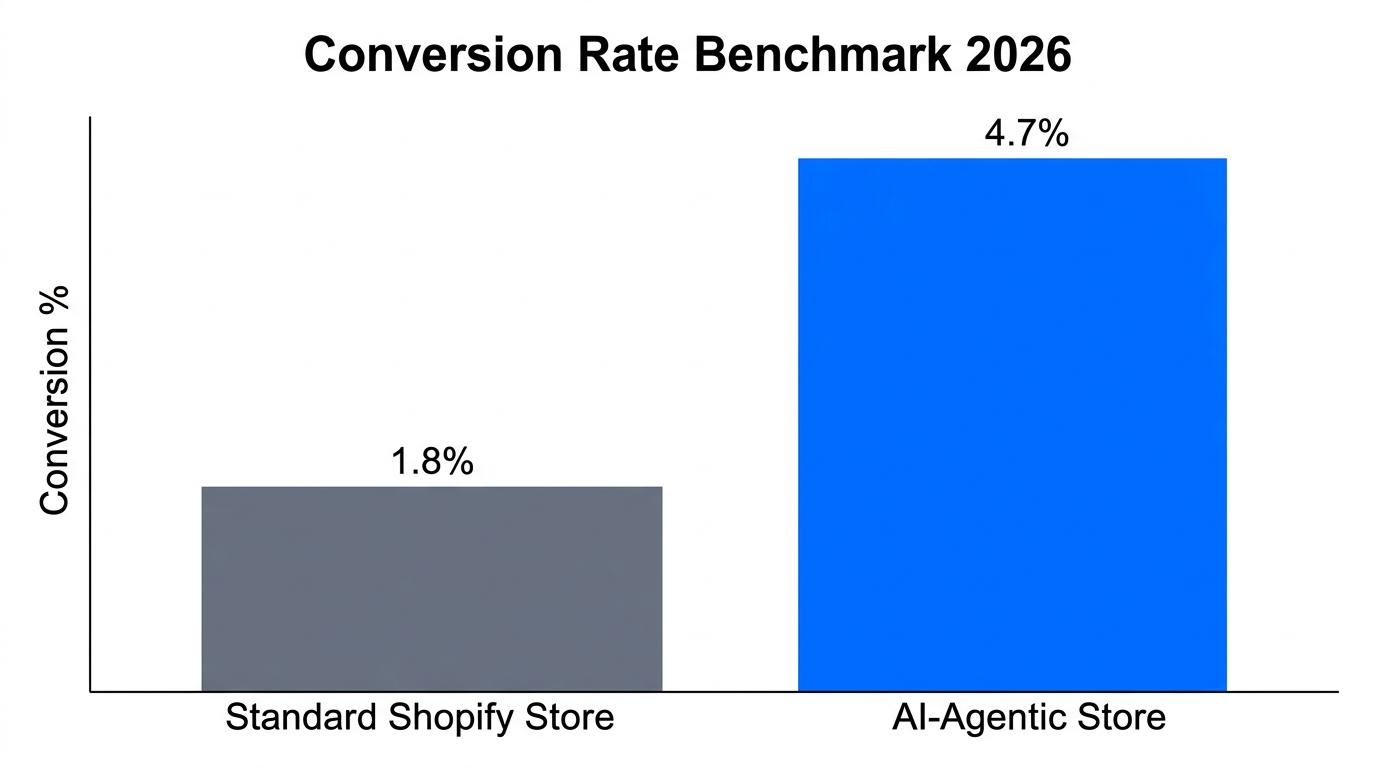
Once the store is live, the focus shifts to removing the founder from the daily loop. This is where Shopify AI automation shines. The goal is to reach the benchmark of top 10% stores, which currently see 4.7%+ conversion rates compared to the industry average of 1.5%.
Automating Customer Support
Support is often the first bottleneck for solo founders. By deploying Tidio (Lyro), you can handle 70-80% of support queries—including order tracking and returns—autonomously. This isn't just a chatbot; it's a natural language processor that understands intent and context, preventing the "uncanny valley" feeling often associated with legacy support tools.
Intelligent Inventory & Logistics
Stockouts are the silent killer of scaling. Tools like Prediko use AI demand forecasting to predict viral peaks before they happen. When stock runs low, your AI employee, Stormy AI, can automatically draft and send purchase orders to suppliers, tracking the conversation in your spreadsheet until the tracking number is received. This ensures you never go out of stock during a scaling phase.
"AI shifts from assisting marketers to actually operating growth systems—automating creative testing, spend allocation, and personalization." — Andrés, Founder of ITTD
Phase 3: Automated Media Buying & Creative
Scaling to 7 and 8 figures requires an aggressive creative cycle. In 2026, Meta and TikTok algorithms reward "Creative Diversity" over bidding strategy. As a solo founder, you cannot film 20 videos a week—but your AI can.
The URL-to-Video Playbook
Using Creatify AI, you can turn a product URL into a dozen high-performing UGC-style video ads in minutes. These are then fed into AdCreative.ai, which scores them for conversion potential before you even spend a dollar. To manage the spend, use the Shopify Sidekick tutorial method: set "Budget Guardrails" in Sidekick to automatically scale daily spend by 20% only when your Triple Whale ROAS exceeds your target (e.g., 3.5x).
Tactical Configuration: Optimizing for "Share of Model"
The most critical SEO shift in 2026 is moving from Google keywords to Share of Model (SoM). You want LLMs to cite your brand when users ask for recommendations. This requires specific technical steps:
- JSON-LD Structured Data: Ensure every product has perfect schema. AI agents use this as a "semantic database" to verify your pricing and stock levels instantly.
- Shopify Flow v4: Utilize the new multi-branch logic in Shopify Flow (now free on all plans) to create custom automations, such as: "If a customer's LTV > $500, ask Stormy AI to send a personalized outreach email to invite them to our affiliate program."
- LTV-Driven Bidding: Stop bidding on last-click ROAS. Use ITTD's predictive bidding logic to reallocate budgets hourly based on the projected 6-month payback period of a customer cohort.
The Contrarian View: Avoiding the "AI Trap"
While automation is powerful, over-automation can lead to "generic brand syndrome." Data from Rising Above the Noise suggests that changing your brand messaging too frequently via AI can cause LLMs to lose "confidence" in your data, leading to a 40-60% decay in AI mentions.
Furthermore, 44% of consumers report feeling "uncomfortable" with overly perfect AI-generated lifestyle photos. The winning strategy in 2026 is the 80/20 Rule: Let the AI handle the first 80% (drafts, logistics, data sorting) and spend your human 20% on sharpening the brand voice and creative strategy. This is where Stormy AI is particularly useful; it handles the "grunt work" of updating rows and following up with people, giving you the mental space to focus on the "soul" of your brand.
"The key to the one-person billion-dollar business isn't better prompts; it's building a serverless org chart where agents hire other agents to solve sub-tasks."
Conclusion: Your Path to $20k+ Revenue in 90 Days
Scaling a Shopify store as a one-person team in 2026 is no longer a pipe dream—it is a repeatable playbook. By transitioning from an executor to an orchestrator, you can leverage a stack of AI employees to handle the complexity that used to require a full-time staff.
Start by setting up your foundation with Stormy AI for research and Shopify for storefront generation. Automate your support with Lyro, your creative with Creatify, and your back-office follow-ups with Stormy. In this new era, your success is limited only by your ability to integrate these systems. The tools are here; the lights are on. It's time to open the door to your autonomous e-commerce empire.