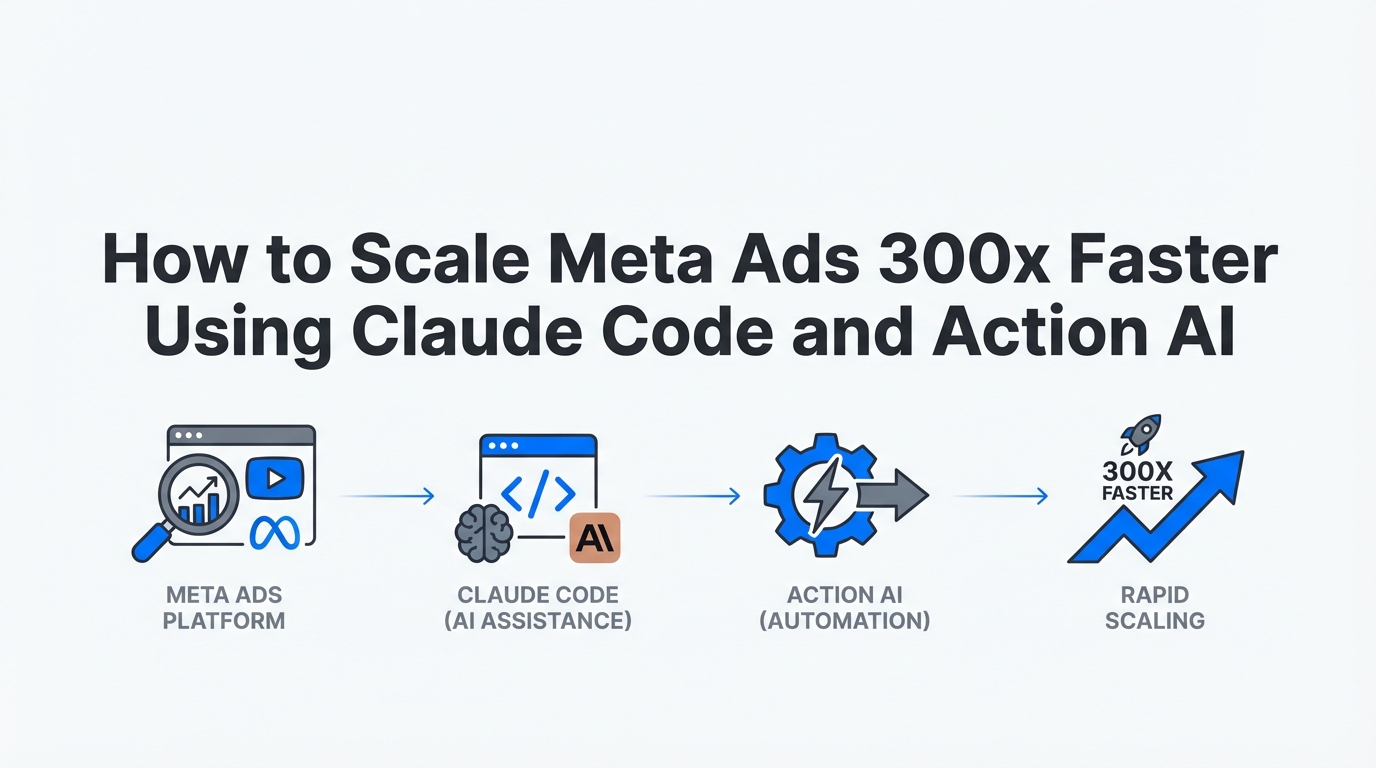
The era of treating AI as a glorified copywriter is over. For years, growth leads and founders have used Large Language Models (LLMs) to brainstorm headlines or rewrite product descriptions, but the execution remained a manual, grueling process of toggling switches in Meta Ads Manager. As we move into 2026, the paradigm has shifted from "Chat AI" to Action AI. This transition, powered by tools like Claude Code, allows marketers to move beyond conversation and into autonomous execution. By leveraging agentic workflows, lean teams are now scaling Meta Ads at a velocity previously reserved for massive agencies, achieving execution speeds up to 300x faster than traditional methods.
The Evolution: From Generative AI to Agentic Action AI
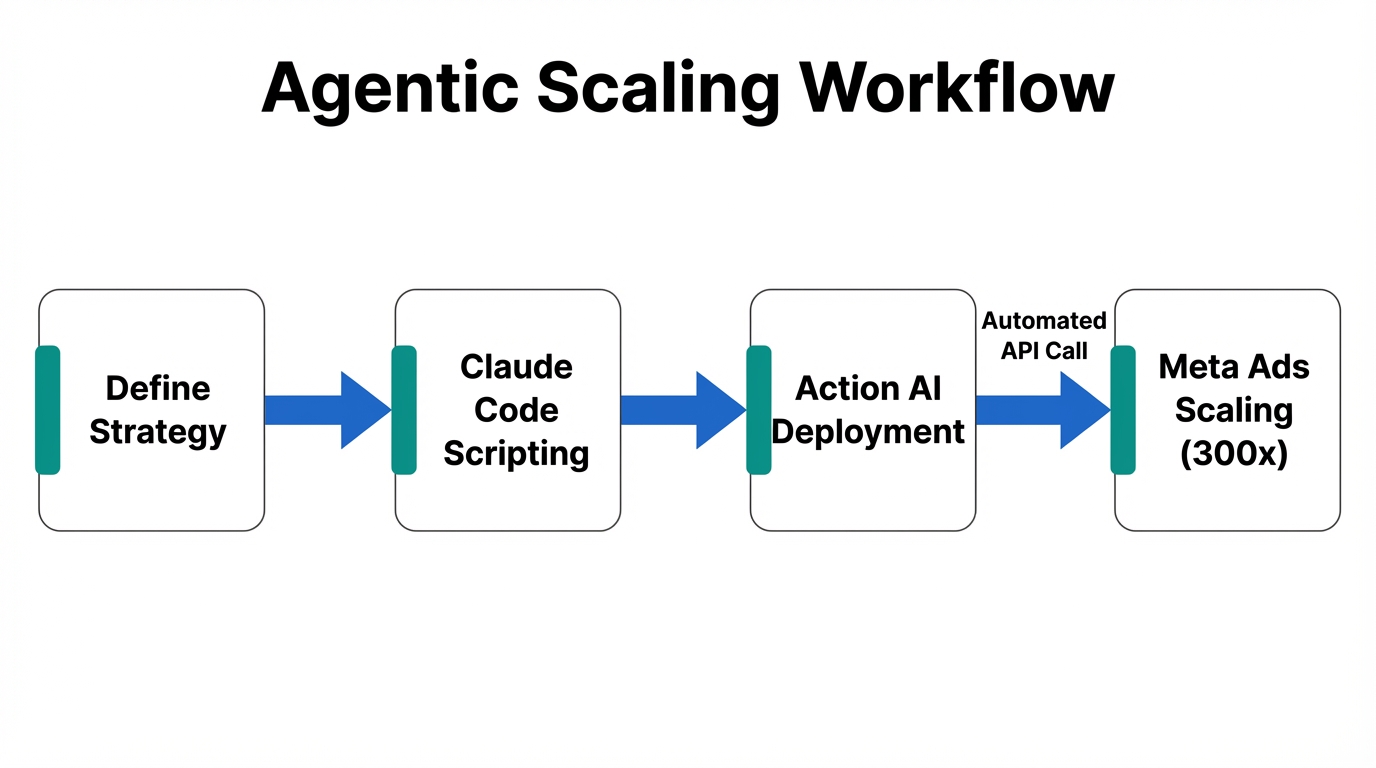
To understand why Meta Ads automation is undergoing a revolution, we must first define the shift in technology. For the past two years, marketers have relied on generative AI to produce assets. You would ask a chatbot for a script, copy it into a document, and manually upload it to Meta Ads Manager. This is what industry experts call the "Human-in-the-Loop" bottleneck.
Enter Claude Code. Unlike its web-based predecessor, Claude Code is an agentic CLI (Command Line Interface) tool that doesn't just suggest code—it executes it. It can interact with your local files, your codebase, and—most importantly—external APIs. In the context of AI marketing automation 2026, this means Claude can now interact directly with the Meta Marketing API to launch, manage, and optimize campaigns without a human ever clicking a button in the browser.
Statistical Breakdown: Why AI-Enabled Ads are Winning
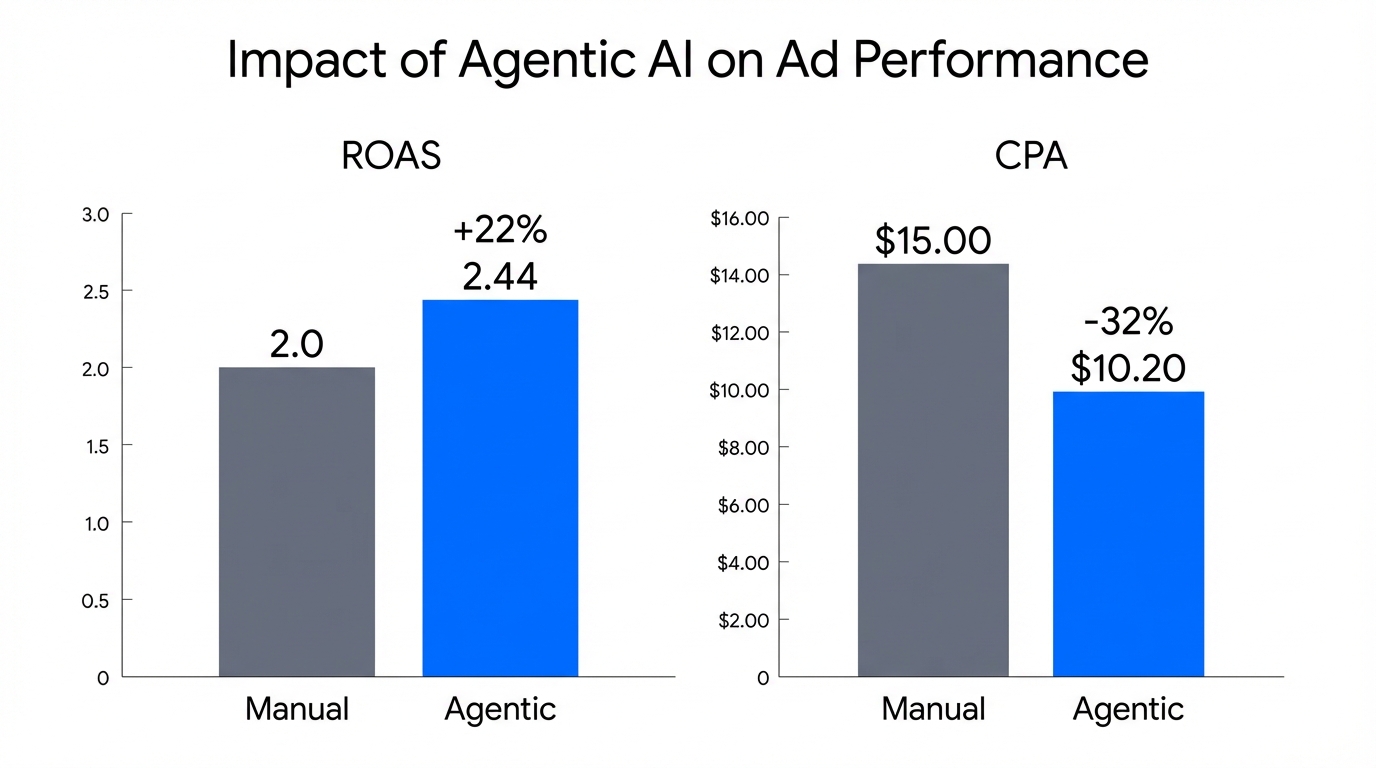
The transition to Action AI isn't just about speed; it's about measurable performance. Data from early 2026 shows a clear divergence between manual buyers and those utilizing agentic workflows. Advertisers using Meta’s AI-enabled tools, such as Advantage+, are seeing an average of $4.52 for every $1 spent, representing a 22% higher return on ad spend (ROAS) compared to manual campaigns.
Furthermore, internal studies have highlighted a 32% drop in Cost Per Acquisition (CPA) when brands integrate full automation suites. This efficiency is why roughly 70% of Fortune 100 companies have integrated tools like Claude into their marketing and development stacks as of early 2026, according to recent industry reports from Stormy AI.
| Metric | Manual Management | AI-Agentic Management |
|---|---|---|
| Average ROAS | $3.70 | $4.52 |
| Average CPA | Baseline | 32% Lower |
| Creative Testing Velocity | 3-5 ads/week | 50-100+ ads/week |
| Management Hours | 10-20 hours/week | <1 hour/week |
Model Context Protocol (MCP): The Real-Time Connector
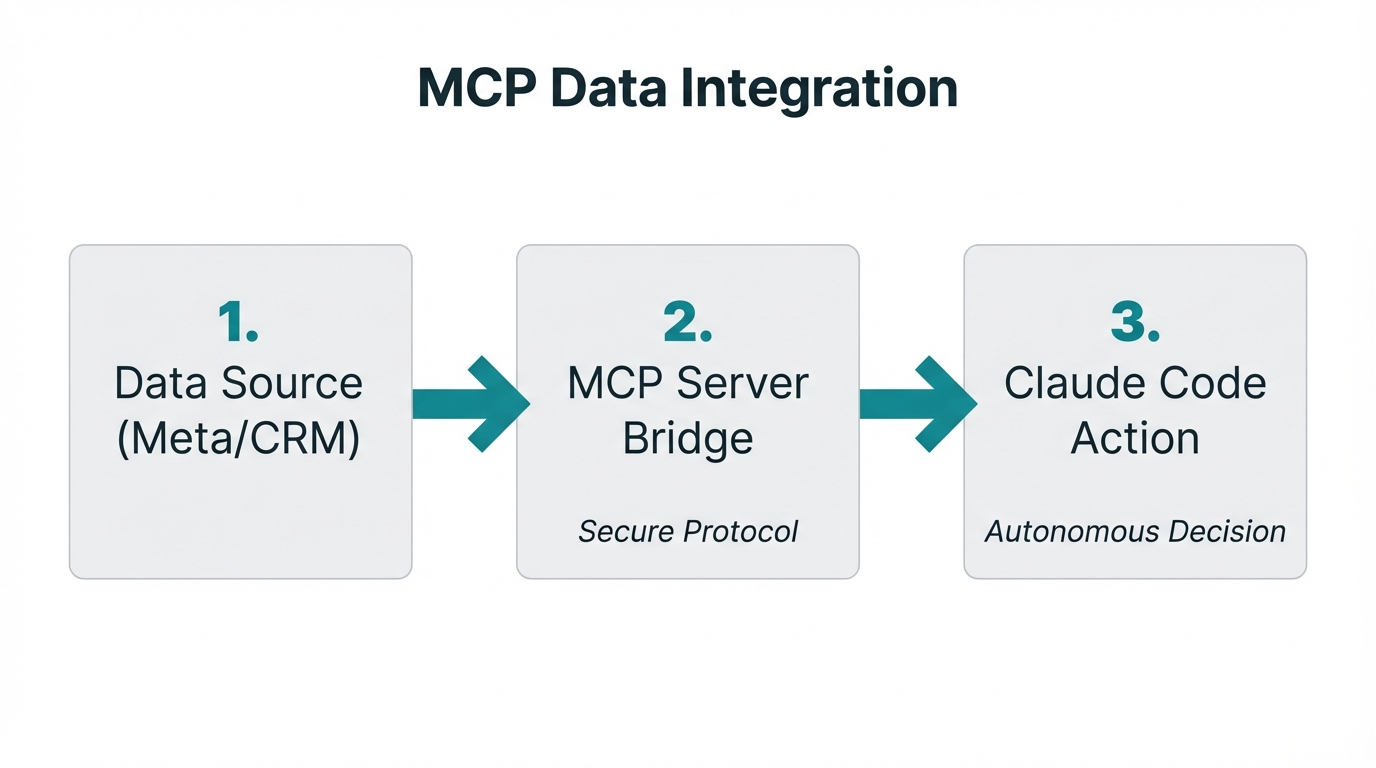
One of the biggest hurdles in scaling Meta Ads with AI has been the "knowledge cutoff." AI models historically didn't know what happened five minutes ago in your Shopify store or your Meta account. The Model Context Protocol (MCP) has effectively solved this problem. MCP acts as a standardized "plug" that allows Claude to connect to live data sources in real-time.
By using an MCP server for Meta Ads, Claude can query your actual ad performance data. It can see which specific creatives are fatiguing and which ones are hitting their targets. This live connection allows for Action AI in marketing to make decisions based on what is happening now, rather than outdated CSV exports. This technology allows Claude to bridge the gap between platforms like Shopify and Meta, ensuring that if a product goes out of stock, the corresponding ad is paused automatically.
"MCP is the 'secret sauce' for 2026. It eliminates the knowledge cutoff, allowing AI to act on live performance data across your entire tech stack." — Ryze AI
The 'Vibe Marketing' Playbook for Lean Teams
"Vibe Marketing" is a term coined by lean growth teams who use terminal-based AI agents to build entire marketing ecosystems in under an hour. Instead of spending weeks on research, copywriting, and landing page design, they use Claude Code for marketers to generate the entire funnel programmatically. Here is how you can implement this 300x faster workflow.
Step 1: Contextual Research and ICP Discovery
Start by having Claude analyze your product's core code or landing page. Use the terminal to point Claude to your `index.html` or `App.tsx` file. Ask it to identify your product's Unique Value Propositions (UVPs). This ensures that the generated ads have a perfect "Message Match" with your site, which significantly lowers bounce rates.
Step 2: Automated Creative Generation
Instead of writing one ad at a time, use Claude to analyze your top 5 performing headlines from a CSV export. Using the `/code` mode in the Claude Code CLI, you can script a Python tool that generates 50 variations of these headlines and pushes them directly to the Meta Ads Manager. This allows for massive programmatic creative testing.
Step 3: Scaling with UGC and AI-Powered Discovery
Creative is the variable of success in 2026. To feed the AI engine, you need high-quality User-Generated Content (UGC). Platforms like Stormy AI streamline creator sourcing and outreach, allowing you to discover creators and manage the process via AI agents. By finding creators who fit your niche, you can generate a constant stream of raw footage that Claude can then use to iterate on different ad hooks and angles.
Real-Time 'Ad-Eater' Detection
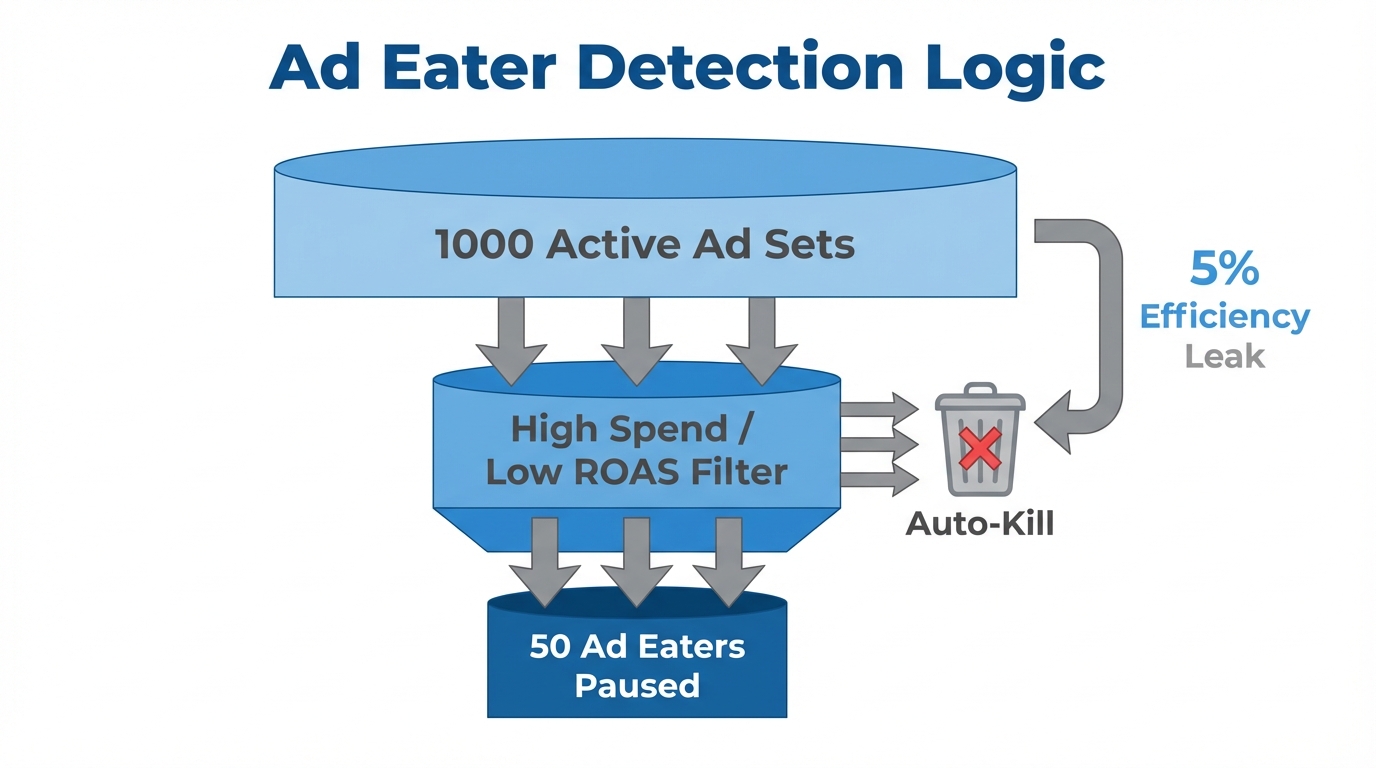
One of the most valuable workflows for a growth lead is the automated audit. "Vampire" ads are those that consume the majority of your budget without delivering conversions. Manual auditing is slow and prone to human error. Using the Meta Ads MCP, you can prompt Claude to perform a 48-hour audit:
"Analyze my Meta Ads spend from the last 48 hours. Identify any ad sets where spend is >$50 but CPA is 20% above target. Draft the command to pause them."
This level of Meta Ads automation ensures that your budget is always flowing toward high-performers, even while you sleep. Some marketers have even experimented with giving Claude full access to their accounts, combining it with image generation APIs to handle the entire lifecycle from ICP research to budget scaling, as documented by growth experimenters in the space.
"The goal is for businesses to simply provide an objective and a budget, and the AI handles the rest. Claude Code is the 'bridge' tool that lets you customize this automation."
Why the 'Why' Matters More Than the 'How'
As Action AI takes over the execution (the "how"), the role of the marketer shifts toward strategy (the "why"). Growth experts warn that over-optimizing for short-term AI signals can be dangerous. If you optimize purely for Top-of-Funnel trials, the AI may bring in low-quality traffic that doesn't convert to long-term revenue.
As noted on RevenueCat, maintaining a focus on high-intent users and long-term LTV is something AI cannot yet do without human guidance. You must provide the AI with the right guardrails and objectives. If the machine is 300x faster, it can also drive you into a ditch 300x faster if the direction is wrong.
Common Pitfalls to Avoid in 2026
- Ignoring the Learning Phase: Meta’s algorithm requires 48–72 hours of stable data. If your Claude agent is making hourly budget tweaks, you will keep your campaign in "Learning Limited" status indefinitely.
- Accepting 'AI Slop': Relying on Claude’s first-draft copy without feeding it "Brand Voice" files leads to generic, low-performing creative. Always provide context files to maintain a "stop-the-scroll" quality.
- The 'Set and Forget' Trap: Agentic workflows are not error-proof. Even with Claude Code, human oversight is required to ensure the creative spirit aligns with the brand's long-term vision.
Conclusion: Building Your Autonomous Marketing Engine
The transition to AI marketing automation 2026 is not about replacing the marketer; it is about amplifying the growth lead. By moving from Chat AI to Action AI, you can eliminate the manual friction of ad management and focus on the high-level creative strategy that actually moves the needle. Whether you are using Ryze AI to enhance Claude's marketing skills or leveraging Stormy AI to source the UGC that powers your campaigns, the tools for exponential growth are now within reach. Start by moving one workflow into the terminal today, and watch your execution speed transform.