Most startup founders spend months — and thousands of dollars — obsessing over their website. They tweak the hex codes, debate the hero imagery, and polish the 'About Us' page until it shines. But here is the cold, hard truth: for the vast majority of businesses, a traditional website is a leaky bucket. According to conversion rate benchmarks, while you are admiring your clean UI, 98% of your traffic is quietly slipping out the back door without ever leaving an email address or booking a call. This is the fundamental struggle of the sales funnel vs website debate, and choosing the wrong side is likely killing your growth.
Defining the 'Shadow Funnel': Why Your Website is Just a Digital Brochure
In the world of high-performance marketing, a traditional website is what experts call a shadow funnel. It exists primarily for brand validation. When a potential client hears about you, they check your site to make sure you are a real company with real employees and a legitimate pulse. It’s like a brochure in a grocery store; it’s a place for browsing, but it doesn’t tell the customer exactly what to do next.
As Jonathan Courtney of AJ&Smart points out, a website is often a "place for just kind of getting a feel for a company," but it lacks the focus required to turn a stranger into a paying customer. Many founders make the mistake of assuming that because they have a professional site on Shopify or Notion, the sales will follow. In reality, the website is often a façade. The real money is made in the dedicated, single-purpose funnels that live on separate URLs, hidden away from the main site navigation.
The 1-3% Conversion Trap: Why Traditional Sites Leak 98% of Traffic
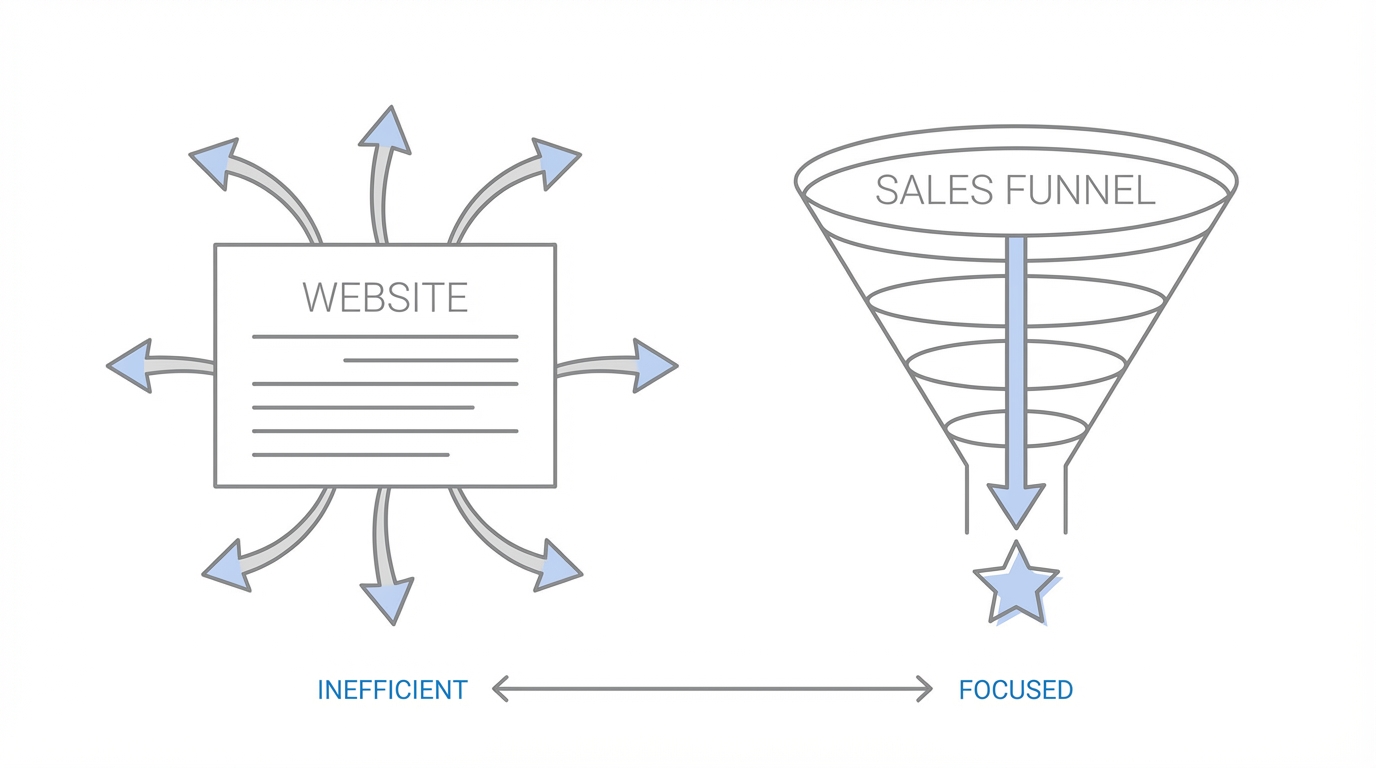
If you look at your Google Analytics data, you will likely see a depressing statistic: a conversion rate hovering between 1% and 3%. This is the standard industry benchmark for a "good" website, but it means that for every 100 people you pay to reach via Google Ads, 97 of them leave without taking action. This is the most leaky ship on the planet.
Contrast this with a dedicated sales funnel. A well-optimized funnel can easily convert at 10%, 15%, or even 25%. By moving away from a general website and toward a focused landing page strategy, you can essentially 10x your conversion rate overnight. This shift is critical for lead generation for startups that are operating on limited budgets and cannot afford to waste ad spend on a "brochure" site that doesn't close the deal.
Focus over Features: Removing Decision Fatigue
The primary reason websites fail to convert is decision fatigue. When a user lands on a homepage, they are greeted with a navigation menu, social media icons, blog links, and multiple product categories. Every link is an exit ramp. In contrast, a funnel uses a single-purpose URL with one call to action (CTA).
Successful funnels often utilize a Video Sales Letter (VSL). This is a single page containing an educational video that builds trust and demonstrates expertise. For example, AJ&Smart uses a VSL funnel that has been running since 2020. It features a long-form training video that explains their process in depth. There are no other tabs to click, no "About" page to get lost in, and no distractions. The only choice for the user is to watch the video and then book a call via Calendly or leave. This extreme focus is what drives high-ticket sales, even for programs costing upwards of $14,000.
The ROI of Funnels: The $20 Million Case Study
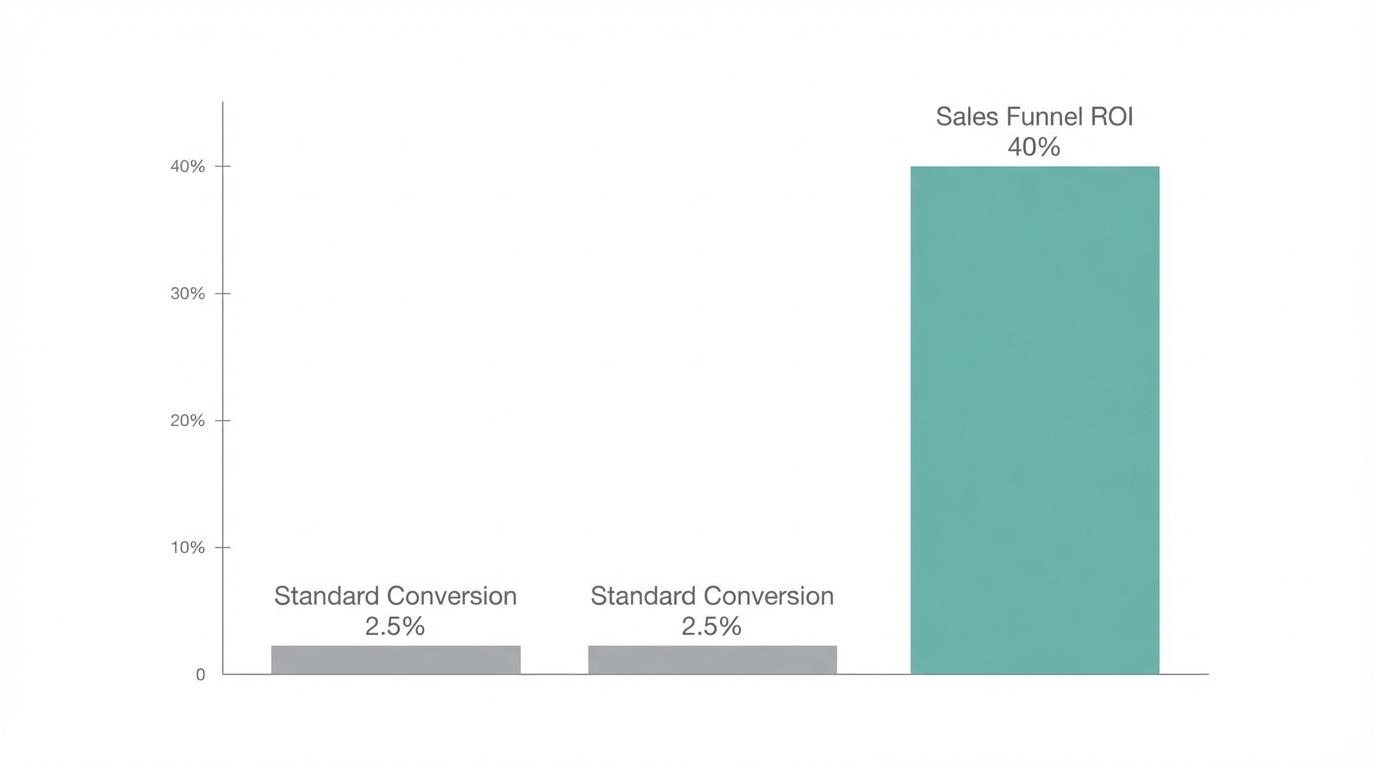
Many designers and brand purists argue that funnels are "ugly" or "cheesy." However, data suggests a different story. Jonathan Courtney reveals that his most successful funnel — which has generated over $20 million in revenue — is objectively "shitty looking" by traditional design standards. It is packed with long-form copy, large buttons, and a scrappy aesthetic.
The lesson for conversion rate optimization is clear: Copy outweighs design. Research from the Nielsen Norman Group shows that users scan for information, and when you prioritize a polished, minimalist brand over persuasive direct-response copywriting, you almost always see a drop in conversions. High-growth companies like ClickFunnels have built entire empires on this principle. They understand that a customer needs enough information to make a decision, and a "clean" website often leaves too many questions unanswered. If you aren't slightly embarrassed by the amount of text on your landing page, you probably aren't selling hard enough.
Advanced Tactics: MIFGE and Urgency

To truly 10x your results, you must look beyond the simple landing page and incorporate advanced lead generation for startups tactics. One of the most powerful is the MIFGE — the Most Incredible Free Gift Ever. This concept involves stacking one-time free gifts onto an offer to dramatically increase the perceived value.
You see this used by top-tier brands all the time. For instance, AG1 (Athletic Greens) doesn't just sell a subscription; they stack a welcome kit, travel pouches, and vitamin D3/K2 as free gifts for new customers. This creates a "no-brainer" offer that makes the initial purchase decision easy. Similarly, using a tool like Typeform to add friction can actually improve the quality of your leads. By asking qualifying questions before allowing a user to book a call, you ensure your sales team only speaks with high-intent prospects, maximizing your ROI.
In the modern creator economy, traffic is the lifeblood of these funnels. Brands often use User-Generated Content (UGC) and influencer partnerships to drive targeted visitors into these high-converting paths. For teams looking to scale this process, platforms like Stormy AI can help source and manage UGC creators at scale, ensuring a steady stream of traffic for your VSL or lead magnet funnels.
Action Plan: How to Deploy Your First Dedicated Funnel
If you are ready to stop leaking traffic and start generating real ROI, follow this landing page strategy playbook to transition from a brochure site to a conversion machine.
Step 1: Identify Your One Goal
Stop trying to make your website do everything. Pick one specific product or service and one specific goal (e.g., booking a demo, selling a $47 ebook, or getting a newsletter signup). Everything on your funnel page must serve this single objective.
Step 2: Create a High-Value Lead Magnet
Strangers don't buy from strangers. You need to provide value upfront. This could be a Video Sales Letter (VSL), a free physical book, or a detailed PDF template. As seen on YouTube marketing campaigns, educational content is the most effective way to warm up a cold audience before asking for a sale.
Step 3: Build a Scrappy Landing Page
Use a tool like ClickFunnels to build a page that is focused entirely on the copy. Don't worry about it matching your main website's navigation or aesthetic perfectly. Focus on headlines, pain points, and social proof. Include a MIFGE if possible to push the customer over the edge.
Step 4: Drive Targeted Traffic
Don't just wait for SEO. Use Meta Ads Manager to target users based on their interests or the books they read. If you find your internal team is struggling to manage the volume of creator outreach required to feed these funnels, using an AI-powered creator discovery tool like Stormy AI can automate the discovery and vetting process, allowing you to focus on the funnel strategy itself.
Step 5: Add Retargeting and Drip Sequences
Most people won't buy on the first visit. Use a Facebook Pixel to retarget visitors who landed on your funnel but didn't convert. Set up an automated email sequence that provides more value and repeatedly points them back to the CTA. This is where the "24/7 automated salesman" aspect of a funnel really shines.
Conclusion: Move from Validation to Conversion
The choice between a sales funnel vs website isn't an either/or proposition — you need both. Your website is your home base; it's where people go to verify you are a legitimate business. But your funnels are your front-line soldiers. They are the ones out in the trenches of Google Ads and social media, doing the hard work of turning strangers into customers.
If you are currently seeing a 1% conversion rate, don't assume you have a product problem. You likely have a structure problem. Stop sending paid traffic to your "digital brochure" and start building focused, high-conversion funnels. By removing decision fatigue, stacking value with free gifts, and using single-purpose landing pages, you can transform your startup from a leaky bucket into a high-growth engine. For more insights on scaling your outreach and creator management, explore the tools available at Stormy AI and start optimizing your growth today.