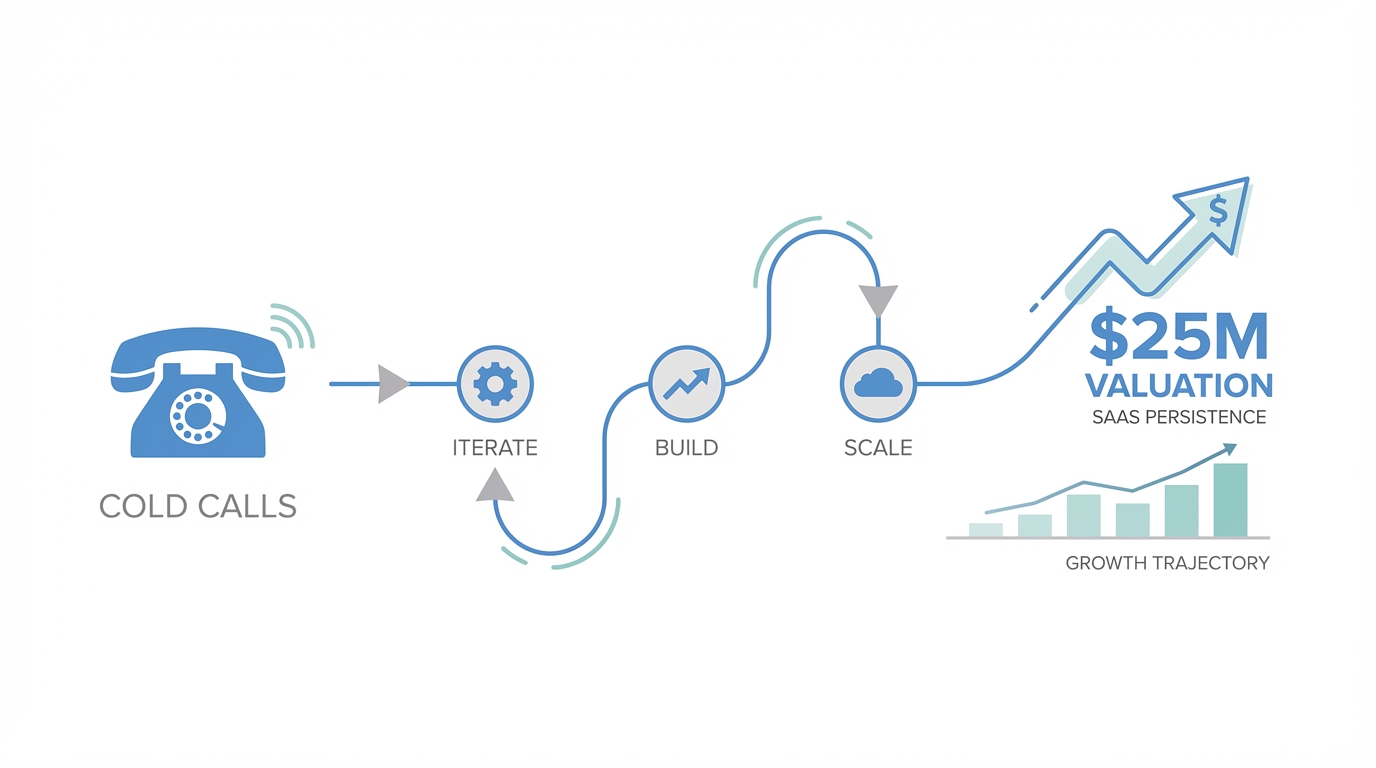
The story of most successful startups isn’t a straight line; it is a jagged series of failures, pivots, and near-death experiences. For David Park, the founder of Jenni AI, reaching a $25 million valuation wasn't the result of a single brilliant moment, but rather the culmination of a decade of failing spectacularly. Most founders see the shiny MRR (Monthly Recurring Revenue) milestones on social media, but they rarely see the years of living in a parent’s bedroom, grinding through eight-hour days of brutal rejection. This guide breaks down the blueprint of how David navigated the 'decade of failure' to build one of the most successful AI writing assistants in the market.
The Reality of the "10-year Overnight Success"

In the world of tech, we are obsessed with youth and speed. However, David Park’s journey began at age 16 with a clothing brand that failed. By the time he hit his stride with Jenni AI, he was 27. That is nine years of gut punches and ventures that went nowhere. If you are learning how to start an AI company, the first lesson is that persistence is your only true moat. David and his co-founder Henry went through nearly ten failed startups together before finding product-market fit.
The spark for Jenni AI actually came from a moment of humor with GPT-2. While experimenting with the technology, the AI produced a bizarrely profound line: "Nothing is darker than a butthole." While it sounds like a joke, it convinced the founders of the potential for AI to generate creative, human-like content. But having an idea and having a business are two different things. Transitioning from a funny AI output to a SaaS startup growth engine required a level of sales grit that most founders shy away from.
Mastering Cold Calling for Startups
In the early days of Jenni AI, there were no viral marketing loops or VC checks. There was only David, in his parents' house, cold calling agencies for eight hours a day. This is the unglamorous reality of cold calling for startups. David faced a 99% rejection rate, with people constantly hanging up on him. The goal was simple but painful: get the first few users and the first dollar. During this period, founder mental health is often at its lowest; David describes the humiliation of having to ask his mother for her credit card just to buy lunch at Chipotle.
To move past this stage, David realized he had to stop pitching and start listening. Instead of asking "Why do you like my product?", he began asking difficult questions: "What do you dislike?" and "How does this fit into your actual workflow?" This shift is critical for any early-stage founder. If you are struggling to find your first 100 customers, leveraging modern tools like Stormy’s AI search can help you identify high-intent prospects and niches across TikTok, Instagram, and LinkedIn faster than manual searching, allowing you to focus your energy on quality conversations rather than just volume.

Securing Your First $100k: Raising Seed Funding
For many SaaS founders, raising seed funding feels like an impossible hurdle. David’s breakthrough didn't come from a polished pitch deck sent to a thousand VCs. It came from a random appearance on a niche podcast. Despite the podcast having few listeners, a scout for legendary angel investor Jason Calacanis heard it. This led to a $100,000 investment from the LAUNCH Accelerator that changed everything. It proves that visibility, even in small communities, can lead to massive opportunities.
Once you have that initial capital, the pressure mounts. David didn't use the money to rent a flashy office in San Francisco. Instead, he and his co-founder moved to Malaysia. This strategic move allowed them to cut their burn rate by 75%, effectively quadrupling their runway. For any founder with limited funding, geographical arbitrage is a powerful tool to extend your life as a company while you figure out SaaS startup growth strategies.
Scaling with Viral Marketing and UGC
The jump from $2,000 to $10,000 MRR happened almost overnight when a viral Twitter thread by Zane Kahn featured Jenni AI. While virality is often seen as luck, David realized it could be engineered and scaled. He brought on a dedicated team to focus on TikTok and Instagram Reels, treating short-form video as a primary growth channel.
Their tactic was clear: find a creative format that works, turn it into a series, and then multiply the accounts. They paid creators a baseline salary plus performance incentives based on views and conversions. This is where Stormy’s AI email outreach and post tracking become indispensable. Managing dozens of creators and tracking which videos are actually driving sign-ups is impossible to do manually at scale. By automating the discovery and tracking process, Jenni AI was able to push past $80,000 MRR and eventually cross the $3 million ARR mark.
Founder Mental Health and Strategic Decision Making
At the height of Jenni AI’s growth, David faced a personal crisis: a thyroid cancer diagnosis. This is the ultimate test of a founder's resolve. When your personal life and health are at risk, the temptation to sell is high. David actually explored the idea of an acquisition, realizing that without him, the business might stagnate. However, he ultimately decided to double down. He felt in his gut that throwing his cards in early would be a mistake.
Managing founder mental health during a health crisis requires a shift in how you run your company. David focused on hiring leadership on the marketing and growth side, moving the company into "scaling mode." This transition from "founder-led everything" to a systems-based approach is what allowed Jenni AI to double its business in just six months following his surgery. Having a robust Stormy AI creator CRM helped ensure that the marketing engine kept humming even when the founder had to step away for recovery.

The Blueprint for Persistence
Building a company to a $25 million valuation is rarely about having a better algorithm than the competition. It is about outlasting the competition. David Park’s journey highlights that the difference between failure and a $3M ARR success is often just six months of refusing to quit. By mastering the "boring stuff"—talking to users, managing burn rate, and scaling proven marketing channels—you can turn a decade of failure into a life-changing success.
If you're ready to start your own SaaS startup growth journey, focus on building systems early. Whether it’s using how to start an AI company frameworks or leveraging Stormy AI’s autonomous agents to handle your outreach while you sleep, the goal is to keep the momentum moving forward, no matter what obstacles life throws at you. Success isn't guaranteed, but as David’s story shows, persistence gives you a fighting chance.