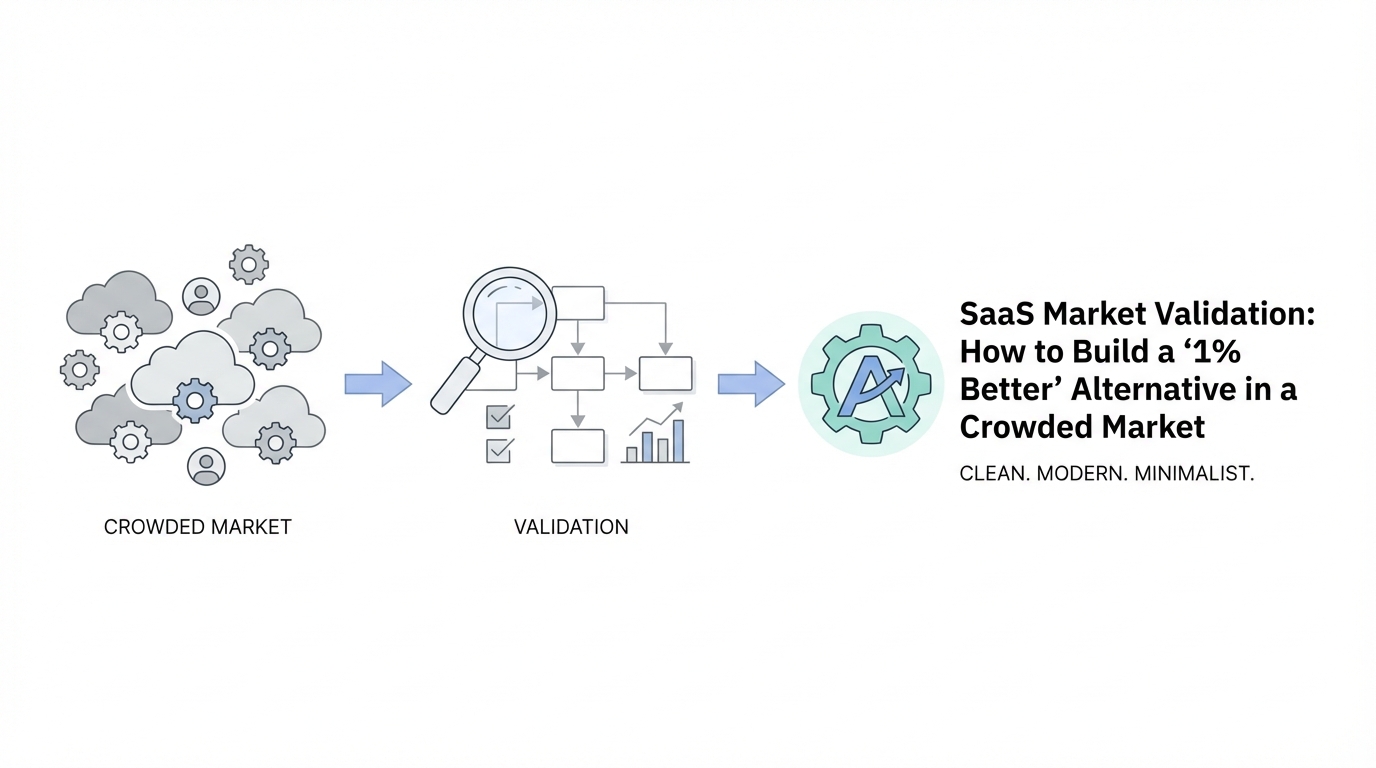
The graveyard of Silicon Valley is filled with founders who tried to be 'first.' There is a romanticized notion in the startup world that to build a billion-dollar company, you must invent a brand-new category or solve a problem that no one has ever heard of. But for the modern indie hacker or bootstrapped founder, this path is often the most dangerous. Building something entirely new requires 'educating the market'—a process that is notoriously expensive, time-consuming, and prone to failure. Instead, the most successful recent SaaS stories follow a different playbook: SaaS market validation through the lens of existing competition. By entering a validated market and offering a product that is just 1% better in a specific, high-value flow, you can bypass the uncertainty of category creation and tap into an existing stream of paying customers.
The 'Don't Educate the Market' Rule: Why Validated Markets Win

One of the most critical lessons for any founder is that demand is more important than innovation. If people are already spending money on a solution, you don't have to convince them that the problem exists. According to research from Starter Story, many successful founders now actively avoid 'blue oceans' in favor of crowded markets. When a market is crowded, it means there is a massive amount of revenue circulating. Your job isn't to create new demand; it's to capture a small slice of the existing demand by being slightly more aligned with user needs. This approach significantly reduces founder risk because the hardest part of business—finding people willing to pay—is already solved.
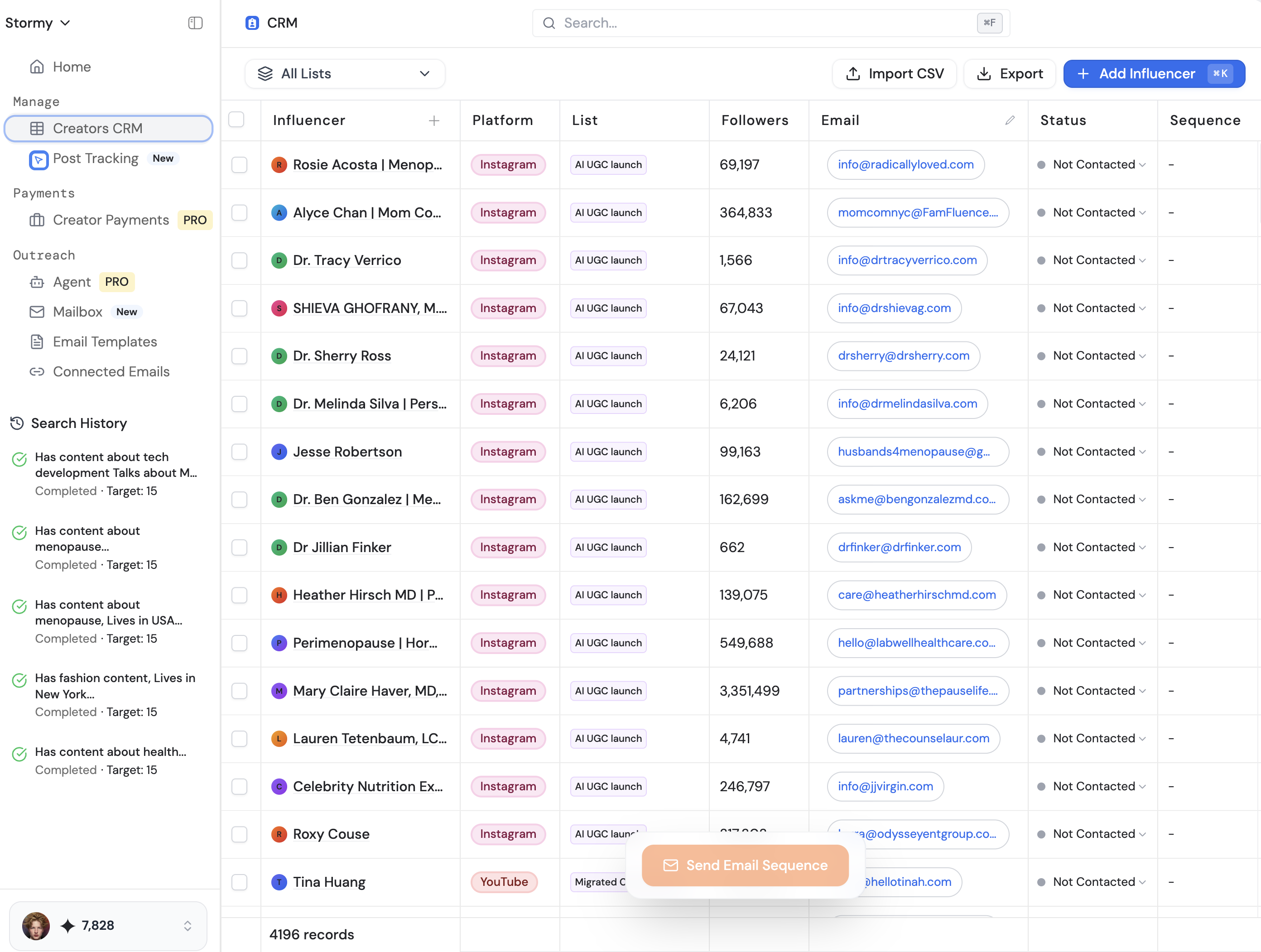
Take the example of Deven, the co-founder of Supergrow. After failing at previous startups, he stopped trying to be unique and started looking for what was already working. He found that the LinkedIn personal branding space was exploding, with tools like Taplio and ContentIn generating significant revenue. However, by using these tools himself, he identified a specific gap: the content creation experience felt clunky and didn't capture the user's authentic voice. This is the essence of competitor analysis for startups. You aren't looking to copy; you are looking for the 'UX friction' that legacy tools have ignored because they grew too large to pivot quickly. If you're looking to enter a niche like the creator economy, you can use Stormy's AI search to discover influencers across TikTok, YouTube, and LinkedIn that fit your campaign criteria instantly.
The Competitor Teardown: How to Identify Core Flow Weaknesses

To build a '1% better' product, you must become a power user of your competitors. This goes beyond looking at their pricing page. You need to sign up for their most expensive plans and use the product 'day in and day out,' as Deven suggests. Your goal is to map out the 'core flow'—the primary action the user takes to get value—and find where it breaks. For LinkedIn tools, the core flow is: Idea → Draft → Post. If that flow takes 10 minutes and feels robotic, there is an opportunity for a tool that makes it take 2 minutes and feels human.
When conducting competitor analysis for startups, look for common complaints in community forums or reviews on sites like Product Hunt. Are users complaining about the mobile experience? Is the AI-generated content too generic? For Deven, the realization was that even though tools like Taplio were market leaders, the demand was so high that even a slightly better content creation piece could steal market share. Once you've identified these gaps, you can use Stormy AI for influencer vetting and fake follower detection to ensure the creators you are analyzing have high-quality, authentic audiences before you build tools specifically for them.
Leveraging AI to Create a Unique Value Proposition (UVP)
In the current tech landscape, AI product development is the fastest way to achieve that 1% improvement. Legacy SaaS tools often have 'bolted-on' AI features that feel like an afterthought. A modern 'AI-native' alternative can build the entire user experience around the capabilities of models like GPT-4. Deven's breakthrough for Supergrow came from realizing that GPT-3 (at the time) was incredibly good at mimicking writing styles. By focusing his MVP on the single feature of converting raw, messy thoughts into high-quality LinkedIn posts, he solved a problem his competitors were solving with generic templates.
This is where the '1% better' strategy becomes powerful. You don't need to build a better CRM, a better analytics dashboard, and a better scheduler all at once. You only need to build a better content generator. For brands looking to scale their outreach, this level of personalization is a game-changer. Just as Supergrow personalizes LinkedIn posts, Stormy's AI outreach allows brands to generate hyper-personalized emails for thousands of creators at once and even set up auto-follow-ups, ensuring that the message doesn't feel like a spammy template. This focus on the 'personal touch' through AI is often the winning UVP in a market full of automated, robotic competitors.
The Weekend MVP: Focusing on the 'Super-Feature'
One of the biggest mistakes in how to build a better SaaS is over-engineering the first version. If you are building in a validated market, you don't need a full feature set to compete. You need one 'super-feature' that works better than the equivalent feature in the market leader's app. Deven built his first version over a single weekend. It didn't have a complex backend; it just focused on the core value of transforming raw thoughts into LinkedIn-worthy content. This allowed him to validate the idea immediately with his own workflow.
When building your MVP, consider this checklist:
- Identify the 'High-Frequency' Action: What is the one thing users do every single day in this category?
- Strip Everything Else: Remove the settings, the fancy dashboards, and the multi-user permissions for now.
- Optimize for 'Time to Value': How quickly can a new user experience the 'Aha!' moment?
The Lifetime Deal Strategy: Validation and Cash Infusion

Once you have a functional super-feature, the next hurdle is distribution. For founders without a large following, a Lifetime Deal (LTD) can be a 'cheat code.' Deven launched Supergrow on RocketHub, a platform dedicated to LTDs, and generated $65,000 in just three days. While platforms like these take a significant cut (sometimes up to 40%), the benefits often outweigh the costs for a new SaaS. The $40,000 Deven took home was a massive cash infusion for a bootstrapped founder, but more importantly, it provided instant validation.
However, LTDs are not just about the money. They are about 'brutal feedback.' Unlike free users who might ghost you if a feature doesn't work, LTD buyers have skin in the game. They will tell you exactly what is broken, often quite bluntly. Deven used Intercom to handle the flood of support queries, spending hours every day talking to these early customers. This feedback loop is essential for finding product market fit. These 250+ initial users helped shape the roadmap, identifying which features were actually necessary and which were just noise.
To ensure your LTD doesn't kill your long-term growth, you must limit the scope. Deven limited his launch to just three days and a set number of users. This creates a sense of FOMO (fear of missing out) that a standard annual plan cannot match. If you are tracking the performance of these early launch campaigns, Stormy's post tracking and analytics can help you monitor views and engagement across platforms like TikTok and YouTube to see which influencer shout-outs drive the most traffic.
From LTD to Subscription: Scaling the '1% Better' Product
The final stage of the '1% better' playbook is transitioning from a one-time payment model to a recurring subscription business. After the LTD launch, Deven didn't stop. He used the feedback from his most active LTD users—the 'power users' who actually used the tool weekly—to refine the product for a wider audience. He then launched on Product Hunt, where his happy LTD customers acted as brand ambassadors, helping him become 'Product of the Week.'
Scaling a SaaS today requires a robust tech stack. Supergrow uses Stripe for payments, Mixpanel for product analytics, and Microsoft Clarity for session recordings to see exactly where users are clicking. Today, Supergrow generates over $19,000 per month in recurring revenue with a 60-70% profit margin. This success didn't come from reinventing the wheel; it came from finding a wheel that was slightly squeaky and applying the right amount of AI-powered oil.
Key Takeaways for SaaS Founders
Building a successful SaaS in a crowded market isn't about being the most innovative person in the room—it's about being the most observant. By following the strategy of SaaS market validation through competitor teardowns and the weekend MVP, you can build a sustainable business with significantly less risk than traditional category creation. Remember that your competitors' size is their weakness; they cannot move as fast as a founder with a weekend and a GPT-4 API key.
If you are ready to start your journey, focus on a validated market, find the 1% improvement that users are begging for, and don't be afraid to use an LTD launch to kickstart your cash flow and feedback loop. And as you scale, leverage Stormy AI to set up an autonomous AI agent that discovers, outreaches, and follows up with creators on a daily schedule while you sleep. The era of manual, 'big box' SaaS is over—the era of the AI-native, '1% better' alternative is here.