Building a successful software business in 2025 doesn't require a Silicon Valley pitch deck or a 100-person engineering team. In fact, some of the most profitable niche business ideas are being built by solo founders who focus on a specific, data-driven saas ideation framework. Take Andy Cloke, for example. As the founder of Data Fetcher, a micro-SaaS built on top of the Airtable ecosystem, Andy has successfully scaled his business to $23,000 per month in recurring revenue. His journey proves that by solving a single, acute pain point for an existing user base, you can build a life-changing business without reinventing the wheel.
The secret lies in moving away from the "shower thought" method of brainstorming and moving toward a rigorous market validation for saas. Instead of hoping people need your product, you find people who are already crying out for a solution in micro saas opportunities 2025 platforms. By leveraging established ecosystems like Airtable or Notion, founders can tap into a stream of pre-qualified leads. In this guide, we will break down the exact six-step how to find saas ideas methodology that turned a side project into a $275k/year solo venture.
Step 1: Find a High-Growth Platform


The foundation of a modern micro-SaaS is the platform it lives on. According to research from Starter Story, choosing a platform that is already growing rapidly provides an automatic distribution engine. You aren't just building a tool; you're building a solution for an audience that is already expanding. To find these micro saas opportunities 2025, you should look for tools that have recently launched a marketplace or an public API. This indicates the platform is maturing and ready for third-party extensions.
One of the best ways to identify these trends early is using Exploding Topics to track rising search interest in specific software categories. When a platform like Figma or Shopify sees a surge in users, it inevitably creates gaps in functionality. For instance, if you are targeting the marketing niche, you can use Stormy's AI search to discover which platforms creators and influencers are flocking to across TikTok, YouTube, and Instagram. If you see thousands of creators moving to a new platform like TikTok Shop, that is a clear signal that there is space for automated management tools.
Step 2: Mine Forums for Specific Pain Points

Once you’ve identified a growing platform, you need to find out what is actually frustrating its users. This is where market validation for saas becomes tangible. You should spend hours in the platform's official support forums, on Reddit, and monitoring Twitter (X). Look for phrases like "how do I," "is there a way to," or "it’s so annoying that [Platform] doesn't do X." These are the seeds of your profitable niche business ideas.
For Andy Cloke, the realization came while trying to manage financial data in Airtable. He noticed that pulling data from external APIs was a manual, repetitive chore for many users. By identifying this specific friction point through community discussions, he validated the need before writing a single line of code. If your target market involves influencer marketing, you might use Stormy AI for influencer vetting and fake follower detection to see the common complaints brands have about vetting creators manually—which could lead to a SaaS that automates that specific workflow.
Step 3: The 'Borrow and Adapt' Method
You don't need a completely original idea to build a successful saas ideation framework. In fact, some of the best micro saas opportunities 2025 come from taking a proven pattern on one platform and porting it to a newer one. Andy noticed that the Google Sheets Marketplace had a wildly successful tool called API Connector with over 100,000 users. He simply asked: "Does this exist for Airtable?" When the answer was no, he had his business idea.
This "unbundling" or "platform-jumping" strategy is highly effective. Look at tools that are essential for Google Ads reporting and ask if they exist for TikTok Ads. Look at CRM features in legacy platforms like Salesforce and ask if they can be adapted for a more niche ecosystem. The key is to borrow the proven user experience (UX) and adapt it to feel native to the new platform. If you're building a tool for mobile app developers who need UGC, you could build a simplified bridge between Stormy's creator CRM and an app's internal dashboard to streamline content delivery.
Step 4: Check Integration Feasibility
Before committing to a build, you must perform a technical sanity check. Does the platform actually allow you to build what you want? You need to dive into the developer documentation. For Andy, this meant checking Airtable's Extension SDK and public APIs. If the platform is walled off, your SaaS will die before it starts. You need to confirm there is a public API, a marketplace for distribution, and a clear path for user authentication.
This step is also about assessing how easy it is for your target users to connect. If the integration requires complex coding, your TAM (Total Addressable Market) shrinks. Tools like Data Fetcher succeeded because they made a technical process—API calls—accessible to no-code users. When vetting how to find saas ideas, always prioritize platforms that have a robust and well-documented developer experience. This reduces your engineering risk and allows you to focus on the product features.
Step 5: Performing 'Napkin Math' Validation

A great idea is only a business if the numbers work. To perform market validation for saas, you need to estimate your potential revenue using "napkin math." Start by looking at the platform's total user base. If a platform has 10 million users and only 1% of them have the problem you're solving, that's 100,000 potential leads. Next, look at the pricing of similar tools on other platforms. If the Google Sheets equivalent costs $20/month, you can safely assume a similar price point on Airtable.
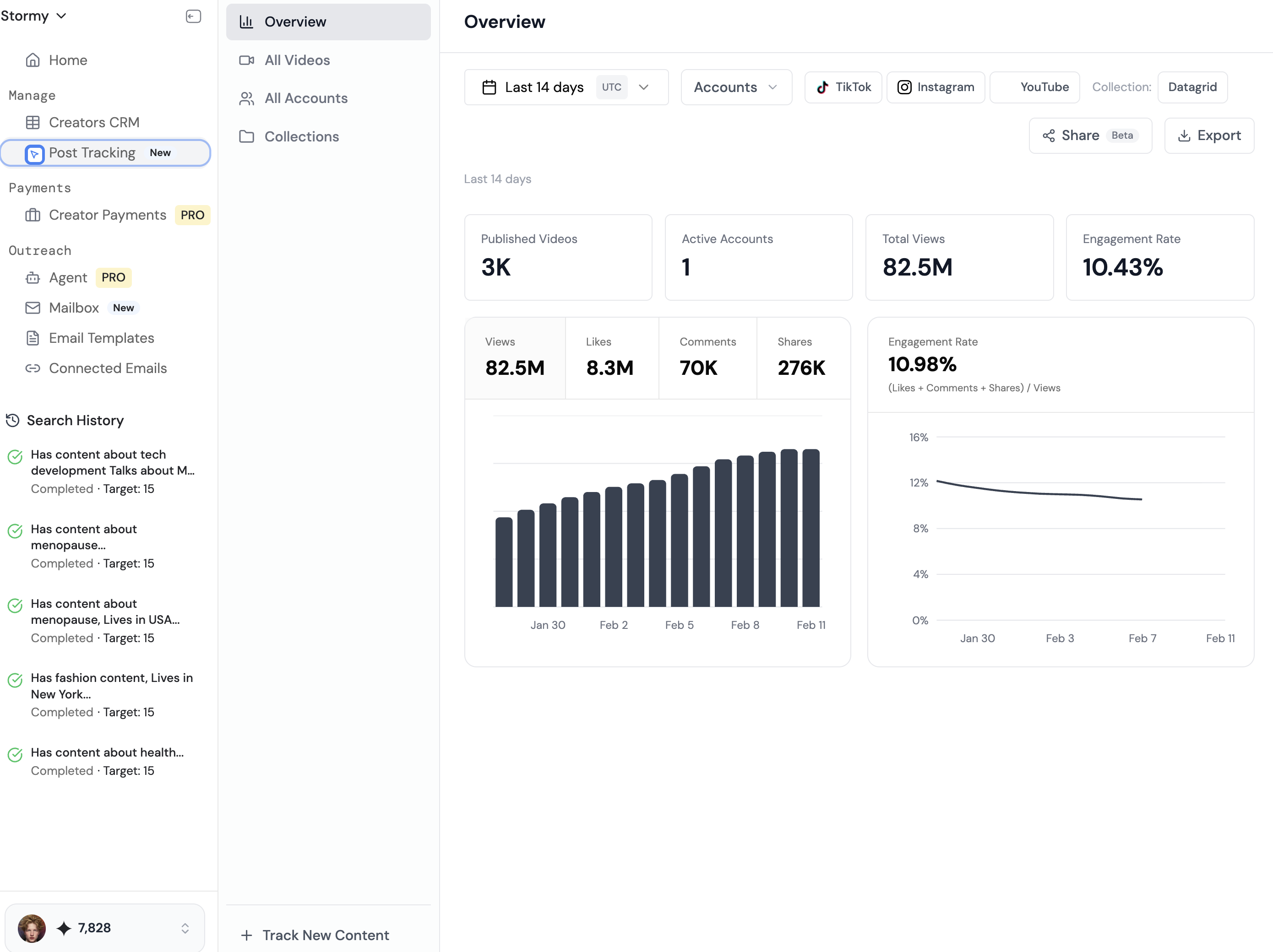
For example, if you aim for 600 paying customers at an average of $38/month, you are looking at a $23,000 MRR business. Use tools like ChartMogul to understand SaaS benchmarks for churn and expansion. If the math doesn't suggest at least a $5k-$10k monthly potential, it might be a hobby, not a business. For those building in the marketing space, you can use Stormy's post tracking and campaign analytics to gauge the volume of activity in a niche, which helps estimate the number of potential users who would need your analytics tool.
Step 6: The Platform Risk Assessment
The final step in the saas ideation framework is evaluating the "Sherlock risk"—the possibility that the platform will build your feature natively and crush you. To avoid this, you must analyze the platform's roadmap and listen to the "noises" coming from their support team. Are they signaling that they want to stay as a "thin" horizontal layer, or are they moving vertically into your space? You should also check for similar features on Notion's roadmap or Airtable's official announcements.
The best way to mitigate this risk is to build something that is too flexible or too niche for the platform to care about. Platforms like Airtable want to serve everyone; they are unlikely to build a highly specialized API connector that handles hundreds of different edge cases. By sitting in the "sweet spot" between basic native features and complex custom scripting, you create a defensible moat. You can even automate your market intelligence by using Stormy's AI outreach to regularly interview power users about what they think the platform is missing.
Micro SaaS Opportunities for 2025
Where should you look for micro saas opportunities 2025? While ChatGPT and Claude are seeing massive growth, the competition there is extremely high. Instead of building "yet another AI wrapper," use AI to superpower tools on other platforms. Notion is still growing rapidly, and its API is relatively fresh, leaving massive gaps for automation and reporting tools. Figma is another goldmine, specifically for tools that bridge the gap between design and development, such as exporting designs to Webflow or Framer.
Additionally, the rise of UGC (User-Generated Content) for mobile app marketing presents a unique opportunity. App developers are spending billions on Meta Ads Manager and need better ways to track the performance of individual creator assets. A SaaS that integrates creator data from Stormy's post tracking directly into a developer's attribution dashboard could be a high-ticket B2B winner. The goal is to find where the money is flowing—currently mobile ads and design systems—and build the plumbing.
Scaling to $23K/Month: Focus and Content

Finding the idea is only half the battle. To scale, you must resist "shiny object syndrome." Andy Cloke admits that he wasted months trying to launch side businesses when growth slowed, only to realize that focus was his greatest asset. He even uses Claude as a business coach to keep him focused on Data Fetcher. Once you have your SaaS, the most effective growth lever is content marketing—writing blog posts and creating YouTube tutorials for every specific use case your tool solves.
For every new integration he added, Andy created a dedicated landing page. This "long-tail" SEO strategy ensures that when someone searches for "how to connect Facebook Ads to Airtable," they find his solution. If you're building a tool in the creator economy, you can use Stormy's AI outreach to automatically follow up and partner with influencers who can demonstrate your tool to their audience, creating a compounding growth loop. By keeping your operations lean—using low-cost hosting like Hetzner and hosting platforms like Heroku—you can maintain profit margins as high as 85%.
The Path to a Profitable Niche Business
Building a profitable niche business idea isn't about luck; it's about following a saas ideation framework that prioritizes data over intuition. By finding a growing platform, identifying a painful gap, and validating the math, you can build a sustainable business that provides both financial freedom and professional fulfillment. Whether you are building on Airtable, Notion, or Figma, the principles remain the same: solve a real problem, talk to your customers early through Help Scout or direct interviews, and never stop focusing on the core value proposition.
Ready to start your own SaaS journey? The first step is discovery. Use Stormy AI to identify the creators and platforms that are leading the market today via its autonomous AI agent, and find the pain points that are waiting for your solution. With the right framework and a commitment to focus, your $20,000 per month business is closer than you think.