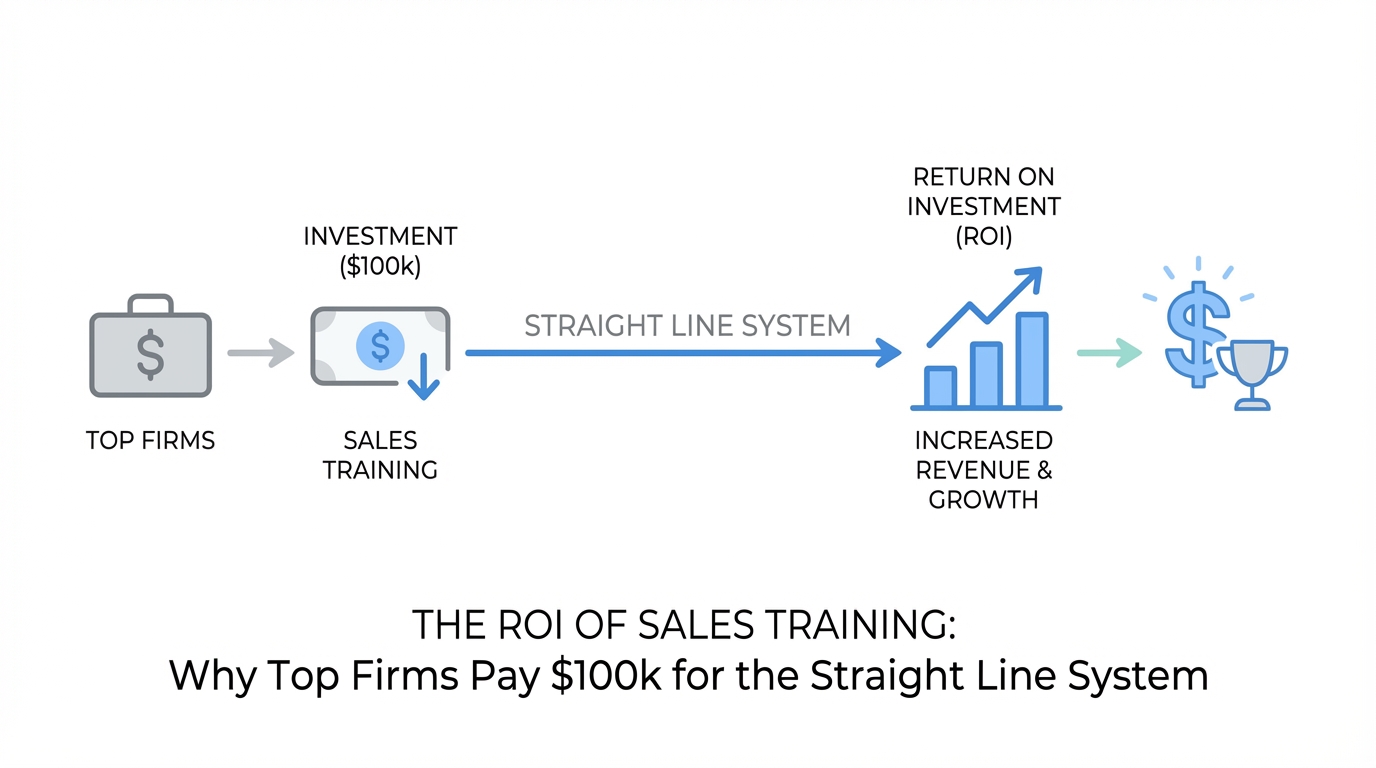
In the high-stakes world of corporate growth, the difference between a record-breaking quarter and a stagnant one often comes down to the quality of the sales force. While many organizations view professional development as a discretionary expense, market leaders treat it as a high-yield investment. The numbers bear this out: high-quality sales training ROI averages a staggering 353% according to recent industry data. This massive return is exactly why Fortune 500 companies and tech giants are willing to pay upwards of $100,000 for elite frameworks like Jordan Belfort’s Straight Line Selling System (SLS).
The Financial Impact of Structured Sales Training

When analyzing sales performance statistics, the most compelling figure is the direct correlation between structured methodology and revenue growth. Organizations that implement a formal sales methodology for teams typically see a 20% boost in individual representative performance. For a mid-sized enterprise with a 50-person sales team, a 20% lift doesn't just pay for the training—it fundamentally alters the company's valuation.
However, the investment isn't just about chasing upside; it's about mitigating the cost of incompetence. Research shows a startling "preparedness gap" in the modern market. According to Hyperbound (2025), only 18% of buyers believe that the salespeople they interact with are well-prepared for their conversations. This lack of professionalism creates a trust vacuum that structured systems are designed to fill.
Understanding the Straight Line System: The Three Tens
The Straight Line Selling System (SLS) is built on the mathematical principle of certainty. Jordan Belfort, the architect of the system, argues that a sale only happens when a prospect reaches a state of "absolute certainty" (a 10 out of 10) in three specific areas. These are known as the Three Tens, and they form the bedrock of corporate sales coaching programs that utilize this framework.
- The Product: The prospect must believe your solution is the absolute best option available for their specific problem.
- The Salesperson: The prospect must perceive you as sharp, enthusiastic, and a definitive expert in your field.
- The Company: There must be trust in the institution standing behind the product.
If a prospect is at a 10 on the product but only a 3 on the salesperson, the deal will stall. Structured frameworks teach reps how to move these three needles simultaneously. By sifting through leads rather than trying to force a sale on everyone, the system ensures that high ticket sales training focuses on efficiency rather than just volume. Detailed breakdowns of this syntax can be found via Shortform’s analysis of Jordan Belfort, which highlights how the system creates a predictable path from open to close.
The Power of Tonality: The Secret Weapon in Virtual Sales
In 2024 and 2025, the challenge of remote selling has become more acute. Data from Rain Sales Training indicates that 91% of sellers find it challenging to maintain buyer attention during virtual meetings. To combat "Zoom fatigue," top-tier training focuses heavily on tonality—the non-verbal cues that signal authority and empathy.
The SLS identifies 10 Core Tonalities that are essential for influencing the prospect's internal narrative. These include tones like "The Reasonable Man"—a calm, level pitch that makes a request sound fair—and the "Money Aside" tone, a disarming, higher-pitched tone used to isolate objections. By mastering these, sales reps can build rapport faster and keep prospects engaged even when they aren't in the same room. As virtual selling becomes the norm, the ability to project expertise through voice alone is no longer a luxury; it is a core requirement for modern teams.
The Economics of High-Ticket Coaching

Why do companies like Verizon partners and Fortune 500 giants pay $75,000 to $200,000 for a single keynote or a multi-day training engagement? According to booking data from The Sales Collective and various speaker bureaus, the investment is justified by the speed of implementation. A unified sales methodology for teams allows for faster onboarding and more effective management.
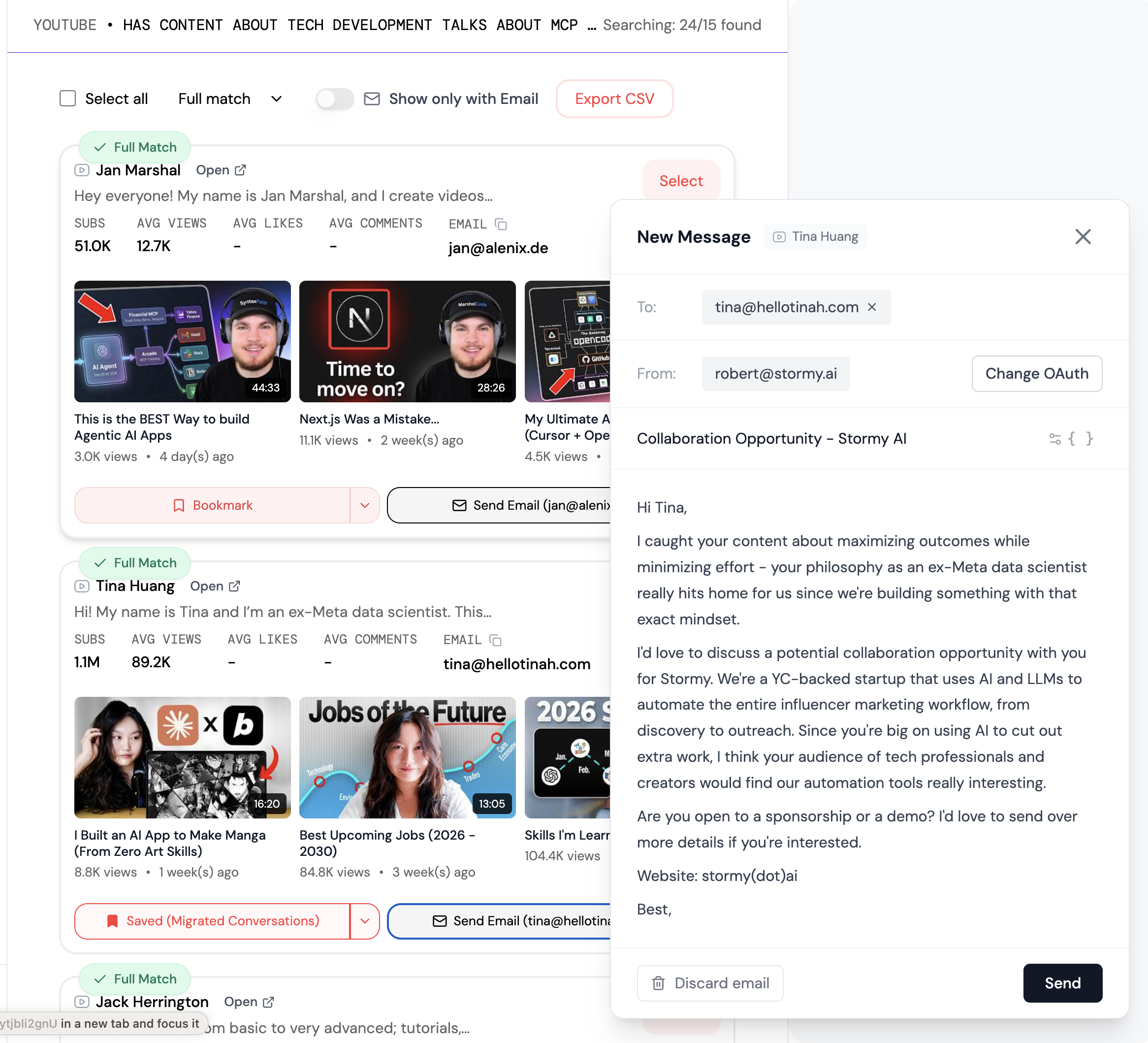
When every representative follows the same "syntax," managers can diagnose exactly where a deal went off the rails. Did the rep fail to build certainty in the product? Did they use the wrong tonality during the intelligence-gathering phase? This level of granularity makes coaching scalable. For brands looking to scale their outreach and creator relationships further, platforms like Stormy AI can help source and manage high-quality UGC creators at scale, ensuring that the sales assets being used are as sharp as the reps themselves.
The Syntax of the Sale: A Playbook for Teams
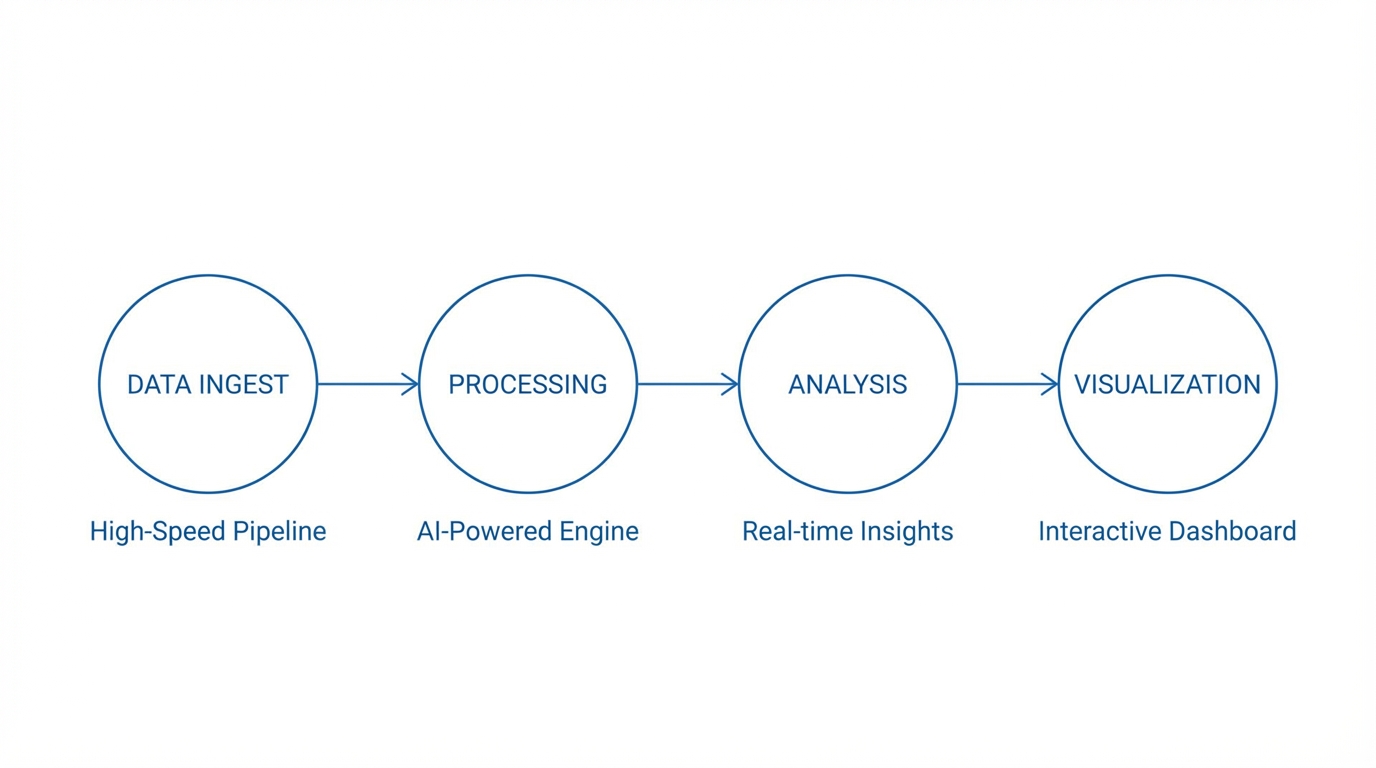
Successful corporate sales coaching emphasizes that a sale is a process, not an event. The Straight Line System provides a rigid order of operations, or syntax, that reps must follow to maintain control of the conversation:
Step 1: The First 4 Seconds
In the opening moments, a rep must establish themselves as Sharp as a Tack, Enthusiastic as Hell, and an Expert in their Field. This immediately addresses the lack of trust noted in Hyperbound's statistics about buyer skepticism. If trust isn't established here, the prospect will likely shut down during discovery.
Step 2: Intelligence Gathering
Instead of just pitching features, reps are trained to ask "invasive" questions that uncover the prospect's true pain points. This is done using a rapport-building tonality to ensure the prospect feels like they are being consulted, not interrogated.
Step 3: Looping and Objections
When a prospect gives a standard objection like "I need to think about it," the trained rep doesn't argue. Instead, they "loop" back. They use a transition to resell the product, then themselves, and then the company, steadily raising the prospect's certainty levels. This process, often called sifting, allows the rep to find the buyers who are ready to move forward while politely exiting conversations with those who are not a fit.
Common Mistakes in Sales Methodology
Despite the high sales training ROI, many teams fail to see results because they fall into common traps. One of the most frequent errors is skipping the script. Jordan Belfort and other elite trainers insist on 100% script adherence. When reps "wing it," they lose control of the "Straight Line" and often end up following the prospect's lead instead of leading the prospect to a close.
Another mistake is closing too early. Attempting to finalize a deal when a prospect is only at a 5 or 6 on the certainty scale leads to buyer's remorse and high churn rates. Platforms like Jordan Belfort’s Sales School emphasize that the close is the natural conclusion of a certainty-building process, not a high-pressure tactic applied at the end.
Conclusion: The Long-Term Value of Sales Expertise
Investing in high ticket sales training is not about buying a set of "tricks"; it is about installing a repeatable, scientific framework for revenue generation. With a 353% ROI on the line, the question for most sales leaders isn't whether they can afford elite coaching, but whether they can afford to leave their team's performance to chance. By focusing on certainty, mastering tonality, and adhering to a strict syntax, organizations can transform their sales departments into predictable engines of growth. In an era where sales performance statistics show buyers are more skeptical than ever, using tools like Stormy AI to automate creator discovery alongside structured sales systems ensures that teams stay ahead of the curve. The teams that invest in professionalism and structure are the ones that will dominate the market.