For decades, marketing was a game of logic, features, and slow-burn persuasion. You built a product, listed its benefits, and spent six months producing a high-gloss TV commercial. But in 2025, the script has flipped. Consumers are no longer buying features; they are buying feelings. This shift, known as "vibe marketing," is no longer just a niche trend—it is a data-backed revolution. With searches for the term surging by 686% in the last year, according to DemandSage, brands are scrambling to trade their 50-page brand books for aesthetic intuition and cultural velocity.
The Shift to Vibe Marketing: Why Logic is Losing to Aesthetics
Traditional marketing relies on structured cycles that often take 4 to 12 weeks from concept to launch. In a world where cultural trends expire in 72 hours, this lag is fatal. Traditional methods focus on functional benefits and price points, but 2025 data shows that only 8% of consumers actually trust marketers. This massive trust gap, highlighted by research from the American Marketing Association, has forced a pivot toward "vibe-led" strategies that prioritize emotional resonance and real-time cultural participation over technical specs.
| Feature | Traditional Marketing | Vibe Marketing |
|---|---|---|
| Core Focus | Functional benefits & Price | Emotional resonance & Aesthetics |
| Launch Speed | 4–12 weeks | Hours or days (Real-time) |
| Team Size | Large (12–18 specialists) | Lean (2–4 AI-augmented creators) |
| Success Metric | CPA & Conversion Rate | Sentiment & Community "Vibe" |
Vibe marketing treats a brand not as a single linear story, but as a "mosaic" of aesthetic moments and memes. Think of Liquid Death; they don't market the pH level or mineral content of their water. Instead, they sell a rebellious, punk-rock vibe. This approach allows them to move at the speed of culture, often ignoring product features entirely to participate in the latest internet trend on TikTok. As noted by industry analysts, the goal is no longer just storytelling; it is building a consistent, uncopyable mood.
"The competitive edge in 2025 is no longer what you say, but the velocity at which you can respond to culture."
Analyzing Vibe Marketing ROI: The 82% Efficiency Gap
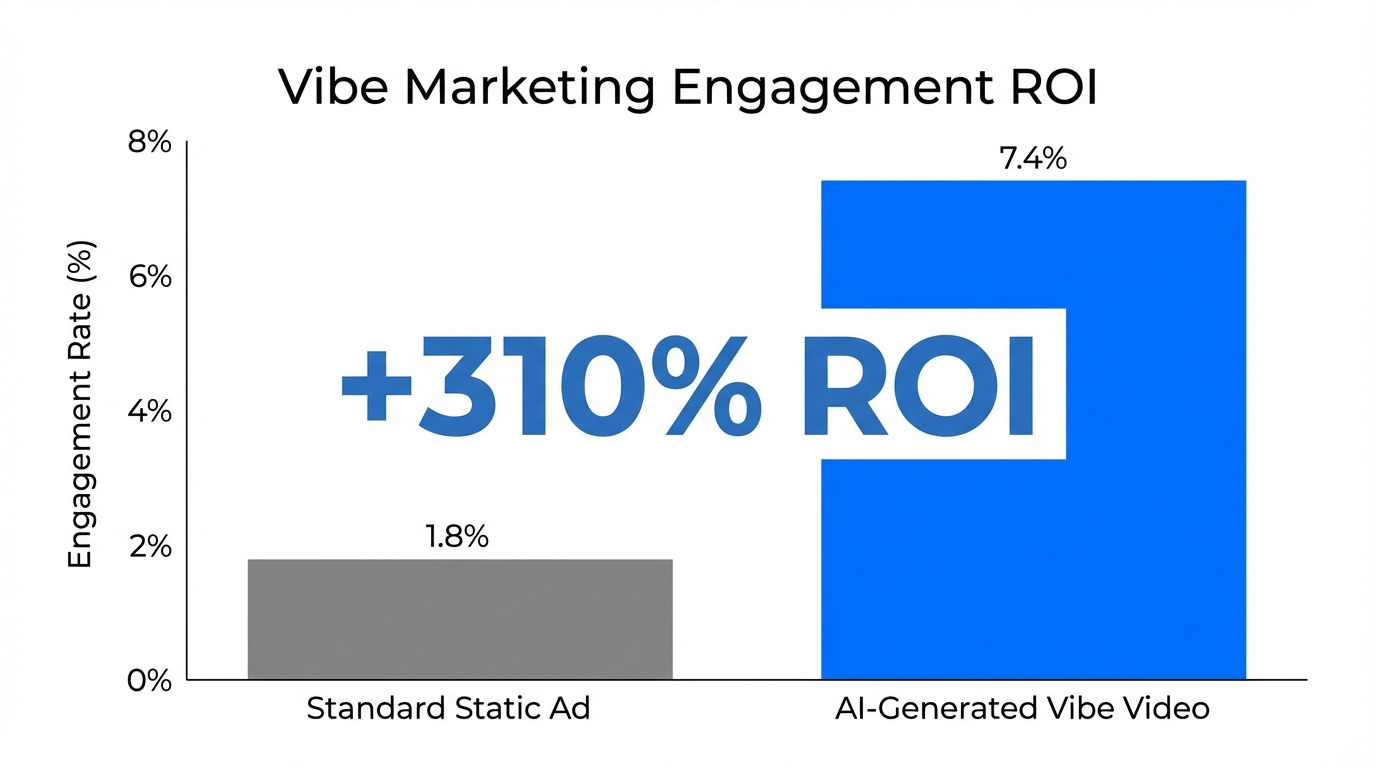
The most compelling argument for this shift isn't just "coolness"—it's the bottom line. Research indicates that AI-driven video campaigns show an 82% higher ROI compared to traditional video production. Why? Because the cost of failure is virtually zero. When you can produce a high-quality video for less than $100 using tools like OpenAI Sora, you can afford to test twenty different "vibes" to see which one resonates. Traditional production, costing between $5k and $20k per asset, requires a high success rate that stifles creativity.
According to emerging reports on Marketing AI Institute, the efficiency stems from collapsing the production timeline from weeks to literally 24 hours. This allows brands to achieve marketing automation efficiency that was previously impossible. When you combine this with the fact that 47% of Fortune 500 companies have already integrated "vibe" elements into their 2025 strategies, the ROI gap becomes a matter of survival rather than just optimization.
AI Content Production Costs: Breaking the $100 Barrier
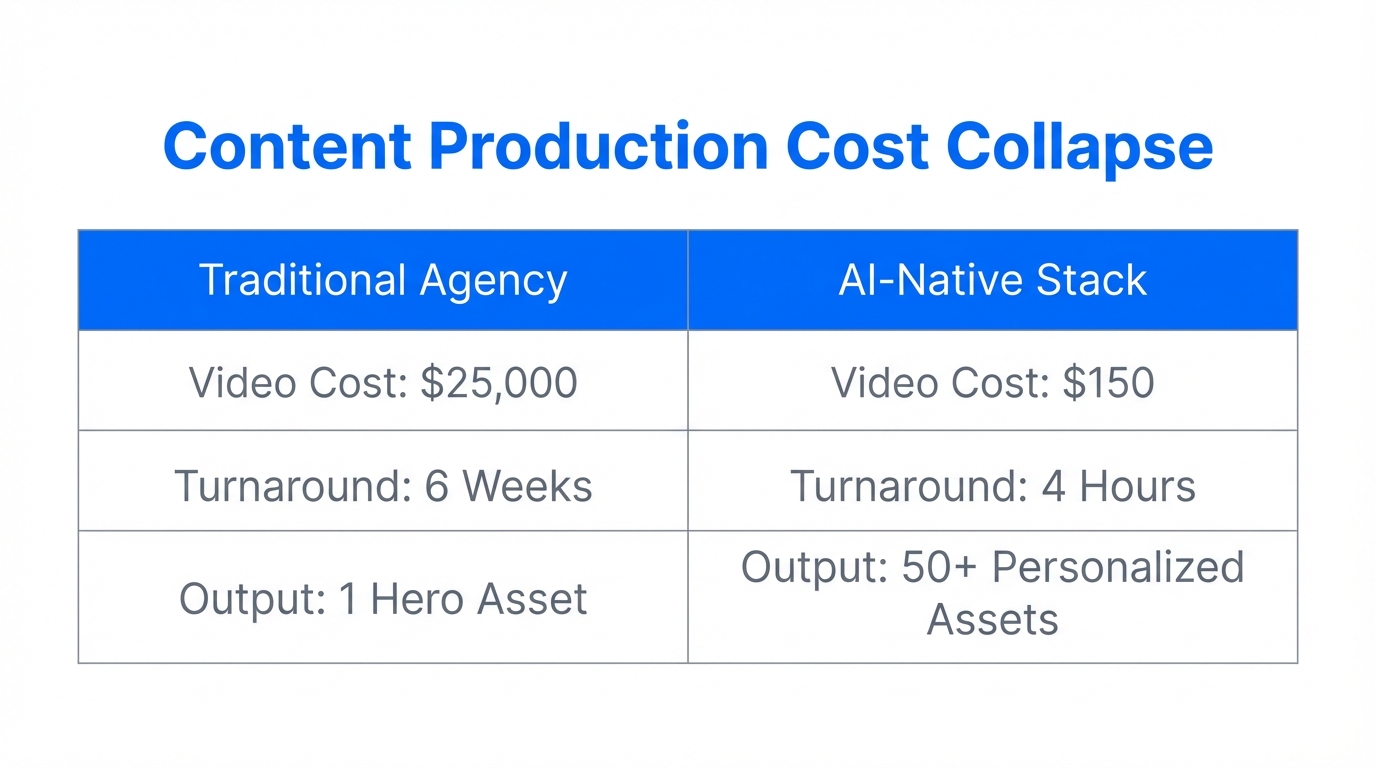
In the traditional model, a single professional brand shoot involves photographers, lighting crews, editors, and location fees. In the AI-augmented model, the human acts as the "Centaur"—a human strategist providing the intent (the vibe) while AI handles the technical execution. This concept, popularized by AI researcher Andrej Karpathy, allows for Midjourney brand design that is indistinguishable from professional studio work at a fraction of the price.
By leveraging an AI execution stack, production costs for a high-fidelity social campaign look like this:
- Visual Assets: Midjourney Subscription (~$30/mo)
- Motion/Video: OpenAI Sora or Runway Gen-3 (~$20-$95/mo)
- Distribution: Descript (~$20/mo)
Total cost per campaign: Under $100. This is compared to the $5,000 baseline for even a "budget" professional video shoot. When Heinz used DALL-E to prove that AI thinks "Ketchup" means "Heinz," they didn't just save on production; they created a viral moment that boosted sales by 15%. They didn't sell a product; they sold a vibe that reinforced their market dominance through cultural proof.
The Playbook for an AI Execution Stack
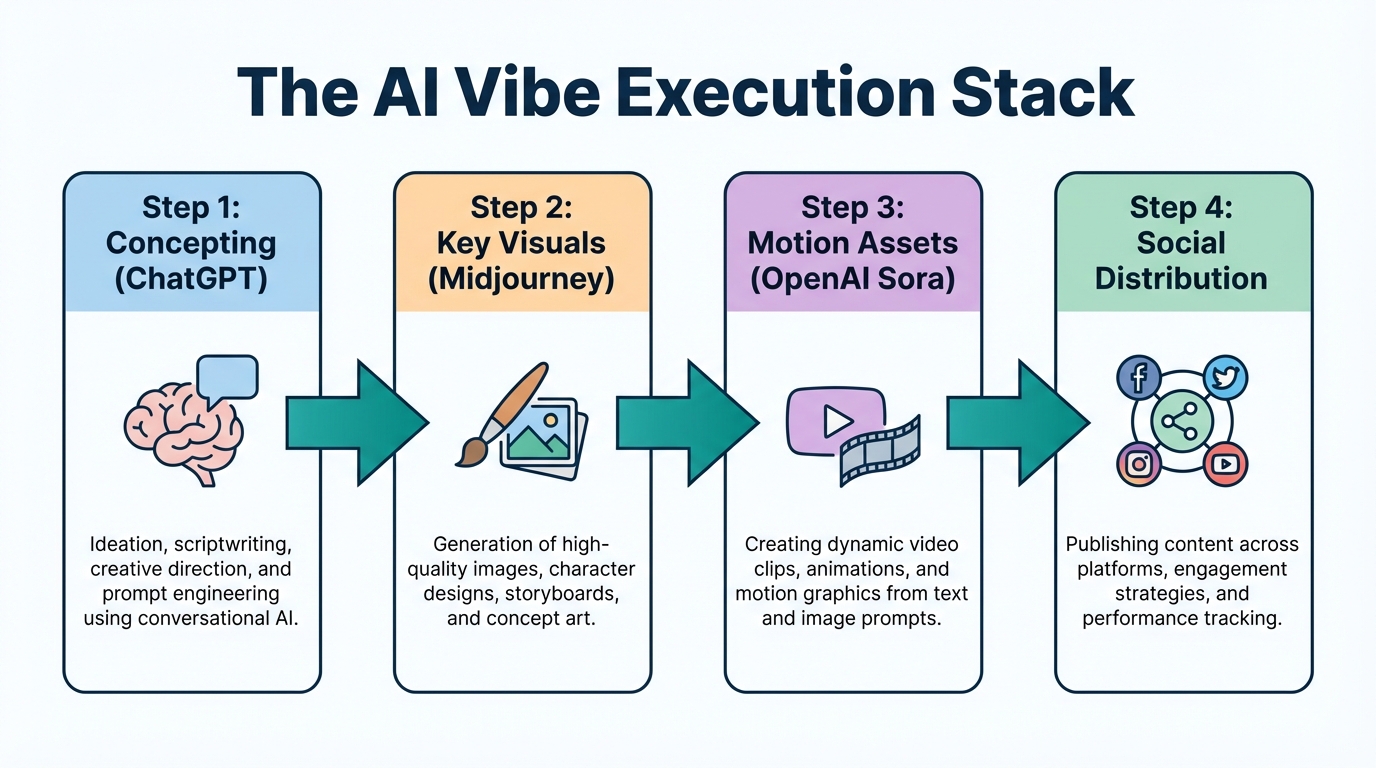
Building a vibe-led brand requires a specific workflow to avoid the "Wasteland Effect"—the trap of flooding the internet with soulless, generic AI content. To succeed, marketers must follow a structured playbook that balances automation with human taste.
Step 1: Define Your Core Vibe Profile
Instead of a 50-page brand book, create a "Vibe Sheet." This should include one dominant mood (e.g., "Nostalgic") and two supporting ones (e.g., "Dreamy" and "Irreverent"). This becomes the "unfakeable" identity that guides your AI prompts. Without this, your AI-generated content will look like everyone else's.
Step 2: Generate Visual Foundations with Midjourney
Use Midjourney brand design to create a library of 100+ consistent aesthetic images. These serve as the visual DNA of your campaign. By using consistent style references, you ensure that even as the AI generates new content, the "vibe" remains cohesive. For those looking to scale their aesthetic reach, integrating these designs into platforms like Canva is critical for maintaining brand equity in the age of generative media.
Step 3: Animate with OpenAI Sora or Runway
Transform your static vibes into cinematic motion. OpenAI Sora for marketing allows brands to create high-end video that mimics 35mm film or high-budget CGI in seconds. If you need more granular control, tools like Runway offer professional motion tools that allow for precision editing. This is where vibe marketing ROI truly scales, as you can generate hours of content for what used to be the price of a single frame.
Step 4: Distribute and Fragment with OpusClip
One long-form "vibe" video should be fragmented into dozens of short-form pieces for TikTok, Instagram Reels, and YouTube Shorts. Tools like OpusClip use AI to identify the most "viral" moments within a video and automatically caption and reframe them. This ensures your content is "boundaryless" and works natively across all platforms, a key pillar of the VIBE framework.
"In 2025, the brand with the most 'aesthetic surface area' wins. Volume is the new quality."
Scaling Hyper-Personalization: Beyond 'Hi [Name]'
The final frontier of marketing automation efficiency is hyper-personalization at scale. We are moving past simple email tags into AI-generated mood-tailored landing pages. Imagine a user clicking an ad and arriving at a page where the background, music, and copy are generated in real-time to match their current "vibe."
However, AI visuals alone aren't enough to build lasting trust. To ground these high-concept AI vibes in reality, leading brands are pairing their AI production with authentic creator voices. Platforms like Stormy AI enable marketers to source and manage UGC creators who naturally embody the specific "vibe" the AI is projecting. By using an AI-powered CRM to manage these human relationships, brands can maintain the "soul" of their campaign while the AI execution layer handles the heavy lifting of production. This hybrid approach ensures that the "vibe" feels authentic rather than manufactured.
Managing the 'Wasteland Effect': Taste as the Final Moat
The danger of AI content production costs dropping to zero is the temptation to over-automate. "Vibe-washing"—adopting a cool aesthetic that contradicts the actual product experience—is a fast track to destroying brand equity. Removing the human element from community management or customer service kills the vibe instantly. The "Wasteland Effect" happens when consumers feel they are talking to a machine in a desert of generic pixels.
To avoid this, maintain a 73% preference for hybrid models: traditional strategy for the brand foundation and product logistics, combined with vibe marketing for tactical social execution. This balance ensures you don't ignore the functional foundations of your business while chasing the hype. Your product must still work, and your shipping must still be on time via Shopify, even if your marketing is a chaotic TikTok meme.
Conclusion: The Future is Vibe-First
The transition from traditional marketing to AI-augmented vibe marketing is not just a change in tools; it is a change in philosophy. By prioritizing Velocity, Identity, Boundaryless content, and Emotions (the VIBE framework), brands can achieve an 82% higher ROI and 45% lower development costs. Using OpenAI Sora and Midjourney to collapse the production wall allows marketers to focus on what actually matters: curating the soul of the brand and building deep connections with their community. The era of the 12-week campaign cycle is over. The era of the cultural "Centaur" marketer has begun.
Ready to start sourcing the human creators that will anchor your AI vibes? Platforms like Stormy AI can help you discover and manage the perfect influencers to bring your aesthetic vision to life with authentic, human-led UGC.