In the rapidly shifting landscape of digital marketing, the transition from manual optimization to algorithmic automation is no longer a choice—it is a survival mechanism. By 2025, Meta aims for full-funnel automation, a reality where advertisers provide a URL, a product image, and a budget, leaving the heavy lifting of targeting and delivery to machine learning. However, as many performance marketers have discovered, AI is not a magic wand; it is a high-performance engine that requires high-octane fuel in the form of clean data and strategic creative. To reduce Meta ads CPA effectively, brands must master the intersection of Meta’s newest automated tools and rigorous data hygiene.
According to recent industry analysis from Boko, the era of "button-pushing" media buying is being replaced by a sophisticated reliance on Meta’s AI-driven recommendation systems. This guide dives deep into how you can leverage Advantage+ Lead Campaigns, the Meta Conversions API (CAPI), and the "Human-in-the-Loop" framework to drive down acquisition costs and scale your lead generation efforts in a privacy-first world.
The Power of Advantage+ Lead Campaigns
For years, lead generation on Facebook and Instagram relied on complex layering of interest groups and lookalike audiences. Meta has fundamentally simplified this with Advantage+ Shopping and Lead Campaigns. These tools use machine learning to identify high-intent users across the entire Meta ecosystem, often finding conversions in audience segments that a human media buyer would never have thought to target.
The core of this success lies in the "Broad" approach. Instead of restricting the algorithm with narrow interest filters, advertisers are now encouraged to use Advantage+ Audience. This allows you to provide "Audience Suggestions" based on past buyers or high-value leads, but ultimately gives the AI the freedom to expand beyond those parameters. As noted by Omni Online, this shift allows the AI to prioritize actual conversion signals over static demographic profiles.
Leveraging the Meta 'Opportunity Score'
One of the most underutilized features in the Meta Ads Manager is the Opportunity Score. This metric, ranging from 0 to 100, provides a real-time assessment of how well your account is following Meta’s best practices for automation. It isn't just a vanity metric; it is a roadmap for efficiency. Research shows that advertisers who systematically implement recommendations from their Opportunity Score see a 5% median decrease in cost per result.
These recommendations often include:
- Consolidating fragmented ad sets to increase liquidity.
- Enabling Advantage+ placements to lower CPMs.
- Adding creative variations to combat fatigue.
- Implementing Meta ads CAPI to improve data match rates.
"The Opportunity Score is the algorithm's way of telling you where you are leaving money on the table. Ignoring it is effectively ignoring the roadmap to a lower CPA."
Meta Ads Data Hygiene: The Role of CAPI
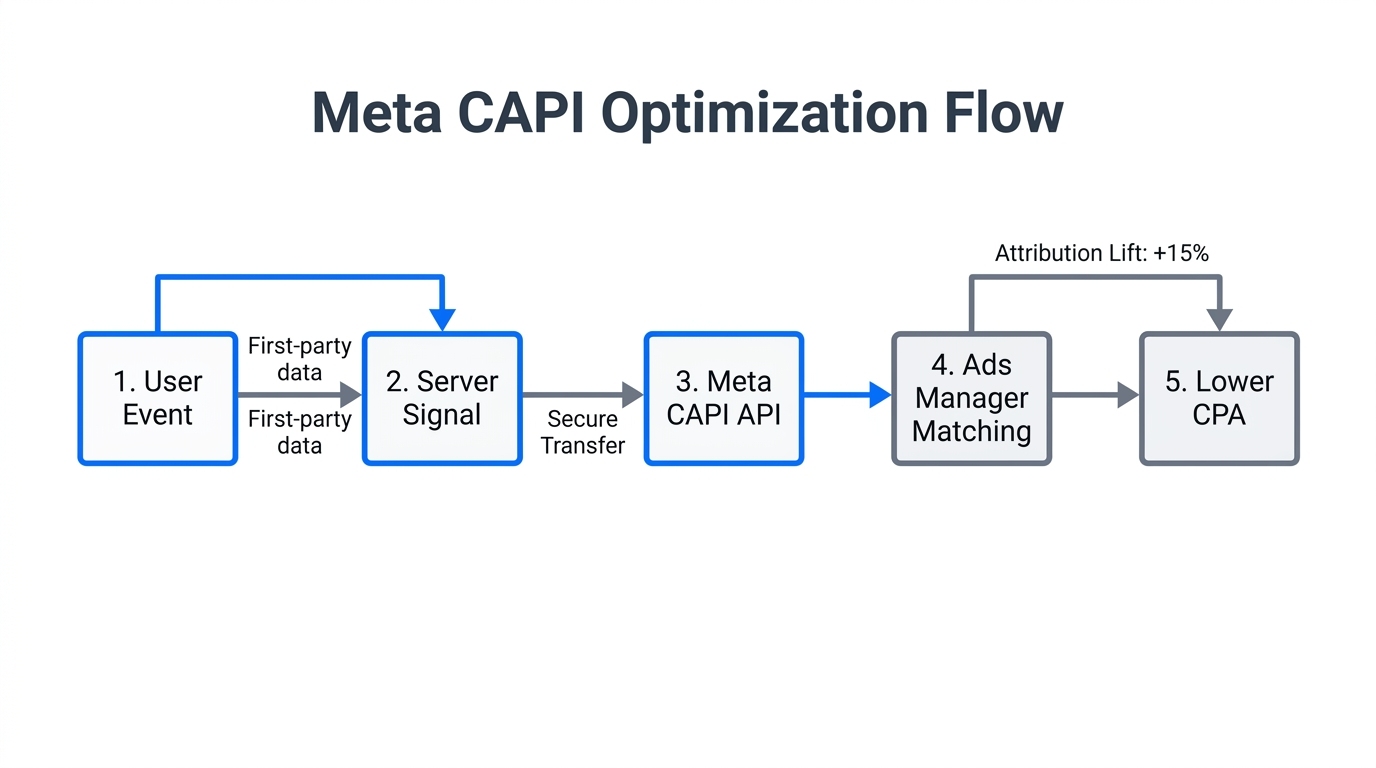
As third-party cookies continue to crumble, Meta ads data hygiene has become the single most important technical factor in campaign success. AI is only as good as the data it receives. If your pixel is missing 30% of conversions due to browser tracking preventions or ad blockers, the AI will optimize for the wrong patterns, inadvertently driving up your CPA.
This is where the Conversions API (CAPI) becomes critical. Unlike the standard browser-based pixel, CAPI creates a direct server-to-server connection between your marketing data (such as your Shopify store or CRM) and Meta. This ensures that the AI receives a complete picture of the customer journey, from initial lead submission to final sale. According to MarTech, server-side tracking is no longer optional for brands spending over $5,000 per month; it is a foundational requirement for maintaining automation accuracy.
Creative as Targeting: The New Paradigm
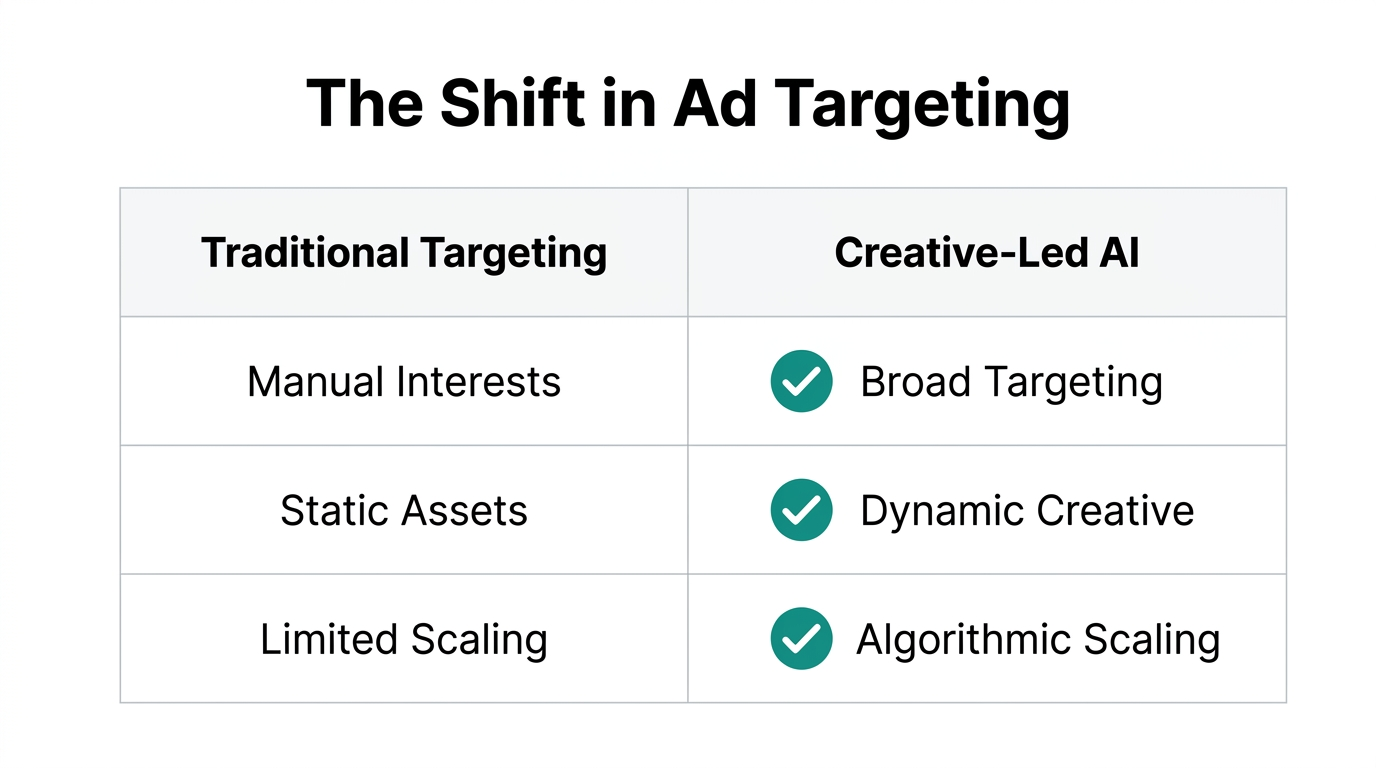
In the new AI-centric model, creative is the new targeting. Meta’s Lattice architecture now analyzes the visual and text elements of your ad to determine who is most likely to engage. If your ad features a young professional in a home office, the AI will naturally seek out similar users. This means the role of the media buyer is shifting toward creative direction.
Meta’s internal research indicates that using AI tools to optimize creative assets—such as generating background variations or text headlines—leads to a 22% boost in ROAS. However, this requires a massive volume of "raw material." Successful campaigns now launch with 20–50 creative variants. The AI needs these options to test different hooks and visual styles to find the winning combination for each sub-segment of your audience.
| Tool Category | Recommended Platform | Primary Use Case |
|---|---|---|
| Native AI | Meta Advantage+ | Targeting and budget liquidity. |
| Creative Gen | AdCreative.ai | Generating high-conversion banners at scale. |
| Video Automation | Creatify.ai | Turning product URLs into Reels. |
| Creator Sourcing | Stormy AI | Finding UGC creators for creative-led targeting. |
| Scaling Rules | Revealbot | Automated stop-loss and budget management. |
When scaling these creative efforts, platforms like Stormy AI can be invaluable for sourcing the high-quality User-Generated Content (UGC) that fuels the AI engine. By using AI to discover creators who align with your brand, you can maintain a constant stream of fresh creative, preventing the "Creative Fatigue" that often causes CPAs to spike after the initial launch phase.
The 'Human-in-the-Loop' Framework
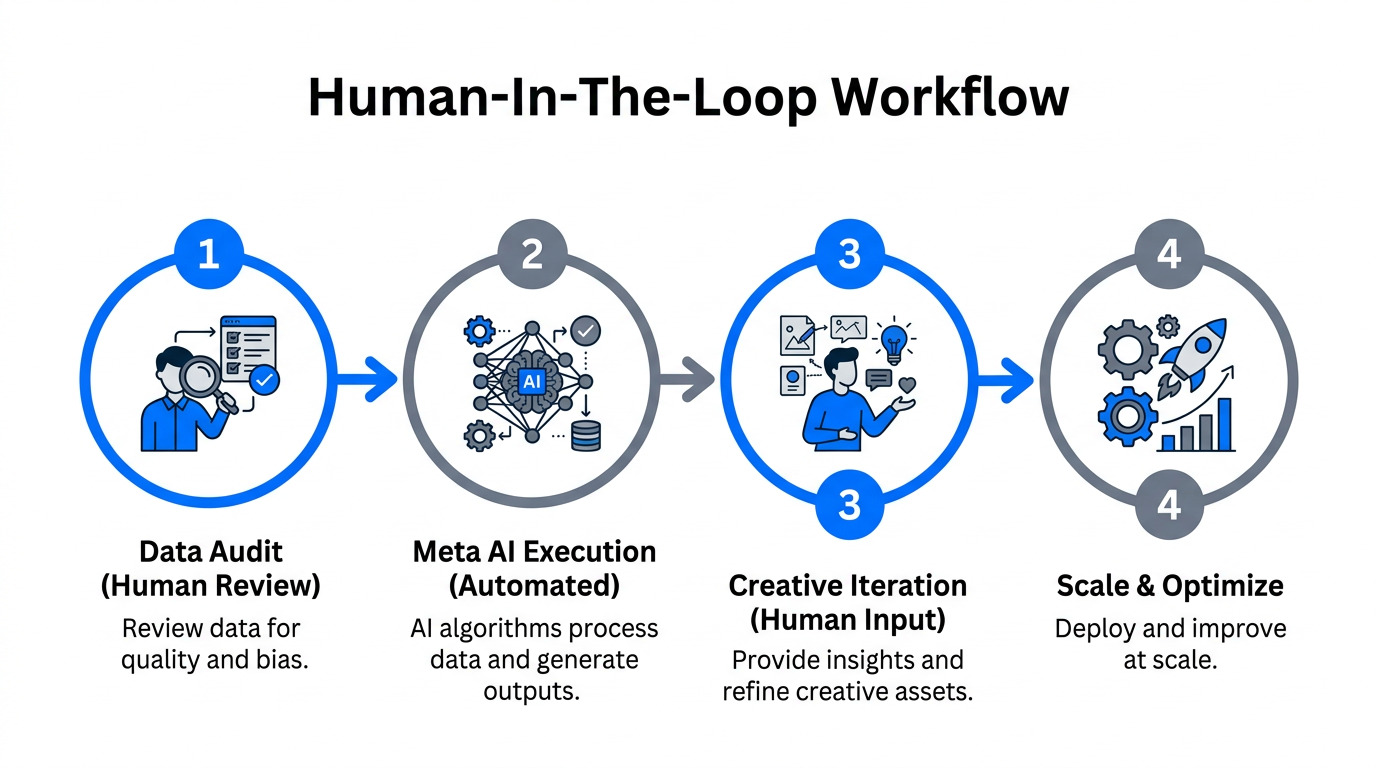
Despite the power of AI lead generation, a "set and forget" mentality is a recipe for disaster. 47% of advertisers using automation without proper oversight see a performance drop. This has led to the rise of the "Human-in-the-Loop" framework. Industry experts at the Forbes Agency Council argue that while AI handles 90% of the execution, the final 10% requires a human "Creative Director" to ensure brand safety and emotional resonance.
Mike Maynard of the Napier Partnership warns that AI can sometimes produce "hallucinated" or brand-unsafe creative if left entirely unchecked. The human role is now to:
- Define the high-level strategy and brand voice.
- Audit AI-generated copy for accuracy and emotional impact.
- Monitor for "Creative Fatigue" and refresh assets when CTRs dip.
- Analyze Meta ads data hygiene and ensure technical integrations like CAPI are firing correctly.
"Treat AI like a brilliant but occasionally erratic junior intern. It can do the work of a hundred people, but it needs a supervisor to make sure it doesn't wander off track."
Case Studies: 30% CPA Reductions
The results of integrating AI with robust data hygiene are evident in recent case studies. A healthcare marketing agency recently utilized Koast.ai to personalize ads based on real-time user behavior signals. By combining this predictive personalization with Meta’s automated bidding, they achieved a 30% decrease in CPA within three months. This success was predicated on having a clean data loop that allowed the AI to distinguish between a casual browser and a high-intent patient.
Similarly, ecommerce giants like Nutella have used AI to scale personalization to an unprecedented degree. During a recent campaign, they generated 7 million unique labels for digital ads, matching the physical product's personalized feel. This level of creative diversity, managed by AI, allowed them to maintain high engagement rates even at massive scale, proving that AI lead generation and brand building can go hand-in-hand. This strategy is frequently highlighted in Meta's business success stories.
The Playbook for Reducing Meta Ads CPA
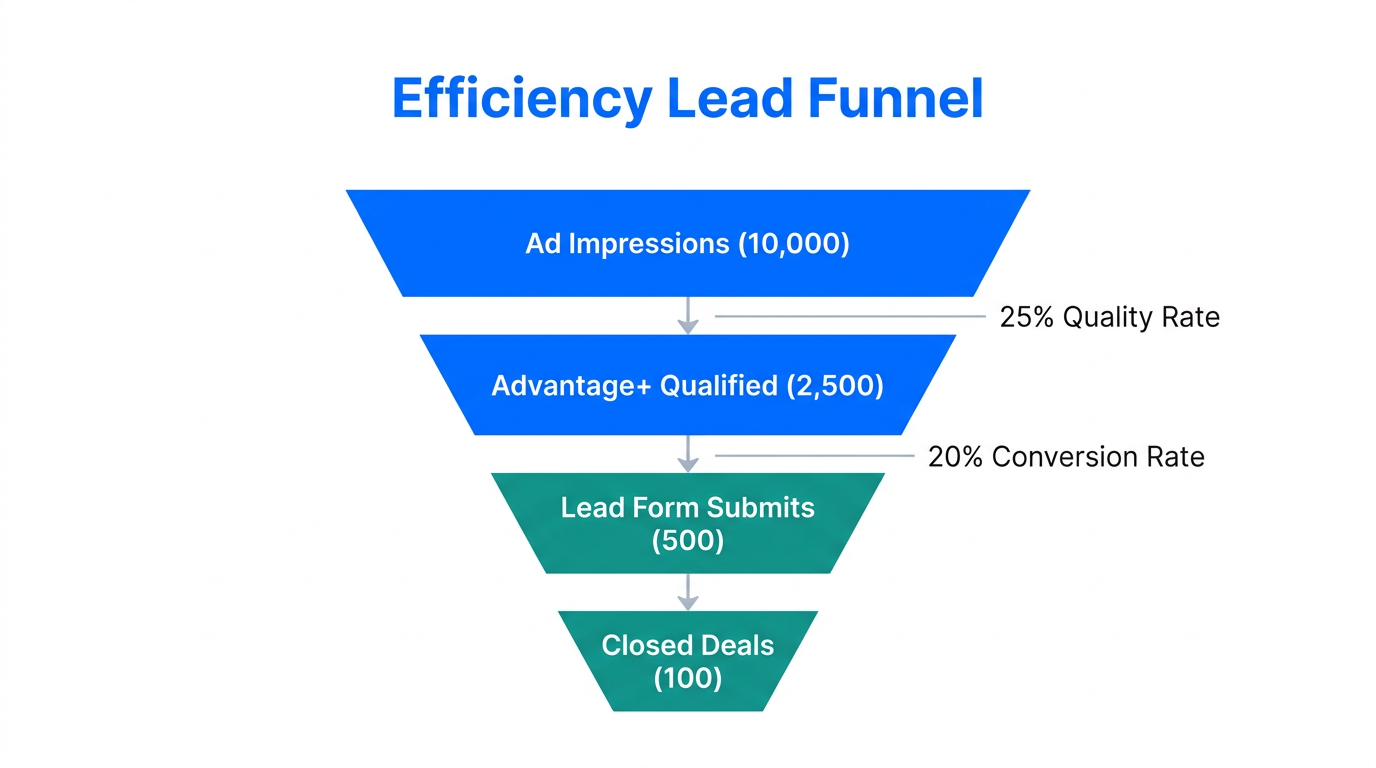
If you are looking to revitalize your Meta ads strategy, follow this step-by-step playbook to leverage automation while maintaining control.
Step 1: Audit Your Data Pipeline
Before launching a single new ad, ensure your Meta ads CAPI is fully functional. Use tools like Coupler.io or native integrations in HubSpot to sync your offline conversions back to Meta. Without this, your AI is flying blind.
Step 2: Consolidate for Liquidity
Stop splitting your budget across dozens of tiny ad sets. Consolidate into Advantage+ Shopping or Lead campaigns. The algorithm needs at least 50 conversions per ad set per week to exit the "Learning Phase." If you constantly tweak your budget by more than 20%, you reset this phase and waste money.
Step 3: Diversify Your Creative Assets
Upload at least 5 different videos and 10 different images. Use AI tools like AdAmigo.ai or Smartly.io to forecast which visual elements will perform best. Remember: creative is your targeting mechanism.
Step 4: Implement a "Stop-Loss" Strategy
Use rule-based scaling tools like Revealbot to automatically pause underperforming creative variants. This prevents the AI from spending budget on ads that have high reach but low conversion rates, effectively reducing Meta ads CPA by pruning the "tail" of your campaign.
Conclusion: The Future of Performance
The path to reducing Meta ads CPA in 2025 is built on a foundation of Meta ads data hygiene and a willingness to trust the algorithm—with strings attached. By embracing Advantage+ Lead Campaigns and securing your data via CAPI, you provide the Meta AI with the tools it needs to succeed. However, the ultimate winner in this new era will be the marketer who balances this automation with high-level creative strategy and rigorous technical oversight. Don't just set your ads and walk away; feed the machine, watch the data, and refine the creative. That is the only way to scale profitably in an AI-driven world.