Raymond 8210 Low Battery: Lift Interrupt, Brake Release, and the Evidence to Capture
How to distinguish lift questions from documented low-battery electric brake release on the Raymond 8210 walkie pallet truck, avoid unverified battery condemnation, and record dispatch evidence.
STORMY Editorial · · 8 min read
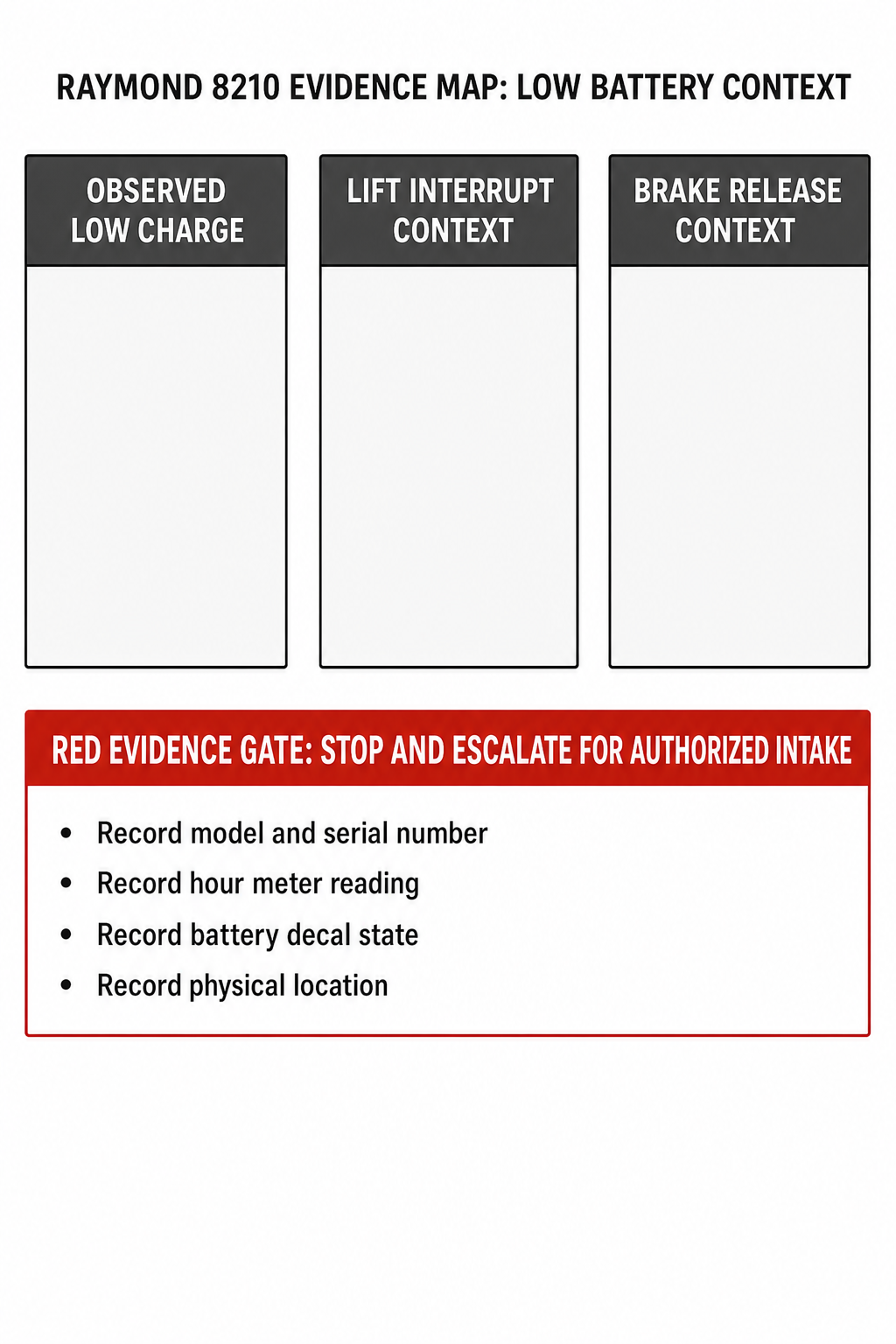
Sparse three-state evidence intake map separating observed low charge, lift-interrupt context, and brake-release context behind a stop and escalate gate on the Raymond 8210 walkie pallet truck.
When an electric walkie pallet truck exhibits low-battery indications or questions arise regarding lift function and machine relocation, facility personnel often make assumptions about battery condition or attempt unauthorized movement. On the Raymond 8210 Walkie Pallet Truck, manufacturer literature documents specific low-battery electric brake-release capabilities alongside battery monitoring provisions. Understanding what official literature verifies—and what remains unauthorized without professional service evaluation—prevents ungrounded battery condemnation, avoids improper equipment movement, and ensures an accurate intake record for factory-authorized service dispatch.
1
Step 1: Check Battery State-of-Charge Decal and Visual Indicators
Inspect the battery state-of-charge decal and control display before touching any controls. Record the visible indicator reading and document whether the equipment was in standard operation, opportunity charging, or cold-storage environment use.
2
Step 2: Note Load Condition and Operating Position
Document whether forks are laden or unladen and verify the physical floor grade. Note if the equipment is positioned on level warehouse flooring, dock staging areas, or transit aisles without attempting unauthorized movement.
3
Step 3: Document Low-Battery Brake-Release Context Without Cover Removal
Record any observed operating symptoms or relocation questions. Note that Raymond literature specifies electric brake release during low-battery conditions without having to remove truck covers, retaining braking ability when the handle is in the brake position. Do not remove covers or force movement.
4
Step 4: Tag Out Equipment and Compile Service Intake Telemetry
Apply standard lockout/tagout procedures to secure the truck. Record the truck model, serial number from the data plate, hour meter reading, exact indicator display, and battery pack type for authorized Raymond service center intake.
Comparison of Low-Battery Evidence States on Raymond 8210 Walkie Pallet Truck
Record indicator reading and battery type. Do not assume battery cell failure without authorized testing.
Lift Function Question / Inquiry
Hydraulic lift observations under low charge require documentation rather than unverified component assumptions.
Record observed lift symptom. Do not remove covers, alter wiring, or attempt unverified field repairs.
Electric Brake Release Context
Releases electric brake during low-battery conditions without cover removal; retains braking ability when handle is in brake position.
Document relocation question and floor context. Do not push, tow, or release brakes on slopes or under load.
Manufacturer Documentation: Low Battery & Electric Brake Release
Official literature for the Raymond 8210 Walkie Pallet Truck documents specific engineering features designed for low-battery conditions. Product documentation highlights an electric brake release engineered to release the electric brake during low-battery conditions without having to remove truck covers.
The same documentation confirms that the design retains braking ability when the control handle is positioned in the brake position. These documented provisions address equipment status under low charge and emphasize maintaining operator control, rather than authorizing unverified field modifications or mechanical tampering.
Electric brake release operates during low-battery conditions without cover removal.
Handle position retains braking ability when placed in the brake position.
Battery state-of-charge decal assists operators in monitoring recharge timing.
Operational Evidence Boundaries in Service Intake
Observing a low battery indicator or facing questions about lift operation does not establish a root-cause diagnosis or prove that a battery pack requires replacement. Battery voltage under load varies with temperature, duty cycle, and operating conditions. Treating a low-charge symptom as a definitive component defect leads to unnecessary replacement costs and diagnostic error.
Furthermore, documented low-battery brake release does not grant blanket permission to tow, push, or relocate equipment without verifying site safety. Moving an unpowered industrial truck without authorized procedures creates collision risks and potential mechanical strain on driveline assemblies.
Compiling the Authorized Service Intake Packet
When equipment remains inoperable following standard scheduled charging, dispatching an authorized technician ensures proper evaluation. Factory-trained Raymond technicians utilize certified testing tools to evaluate battery capacity, electrical circuits, and operating parameters.
To prepare an actionable dispatch dossier, facility personnel should capture key operational telemetry: exact truck model (8210 Walkie Pallet Truck), serial number, recorded operating hours, battery configuration (standard wet cell vs thin-plate maintenance-free pack), and observed indicator states. This evidence allows authorized service centers to deploy appropriate tooling and genuine OEM parts.
This technical reference applies strictly to the Raymond 8210 Walkie Pallet Truck. Operational features, brake release mechanics, and battery management provisions vary by manufacturer and model family. Consult the specific truck data plate and official operating manual for authorized service.