The story of Qualtrics is not your typical Silicon Valley fairytale. It doesn’t begin in a Harvard dorm room with a grand, world-changing vision; it begins in a basement in Utah with a father facing a terminal cancer diagnosis and a son who had recently dropped out of high school with a 1.9 GPA. Ryan Smith, the co-founder of Qualtrics, didn’t have a fancy pedigree, but he had something more valuable: an obsessive focus on customer-led growth. By pioneering the transition from paper-and-pencil surveys to a real-time distribution strategy powered by marketing analytics, Qualtrics didn’t just build software—they built a new category of business intelligence. Today, modern marketers can look at the Qualtrics playbook to understand how customer feedback loops serve as the ultimate competitive advantage in an increasingly crowded SaaS landscape.
The Evolution of Feedback: From Paper to Real-Time Data Cadence
Before the rise of platforms like Qualtrics, the concept of customer satisfaction was a static, academic exercise. Companies would hire consultants to conduct massive, once-a-year research projects using paper-and-pencil methods. By the time the data reached the executive suite, it was already months out of date. Ryan Smith and his father, a research professor, realized that for feedback to be actionable, it had to move at the speed of business. They envisioned a world where companies could ‘put the customer at the table’ for every single decision. This shift from intermittent surveys to a continuous data cadence is what allows high-growth companies to outmaneuver their competitors. Instead of guessing what the market wants, they use real-time marketing analytics to validate every product feature and marketing message before it even hits the ground.
In the early 2000s, collecting research online wasn’t just novel; it was largely mistrusted. The Qualtrics team had to educate the market that digital feedback was not only faster but more accurate. They focused on high-stakes environments where accuracy mattered most: academic institutions. By winning over the top researchers at schools like the Kellogg School of Management, they created a trickle-down effect where students entered the workforce already trained on their platform. This bottom-up distribution strategy ensured that Qualtrics became the standard for data-driven organizations long before the term ‘Product-Led Growth’ was coined.
"Everyone else is guessing, and you'll have this massive propensity of being correct all the time because you have the data."The Outside-In Framework: Eliminating Marketing Blind Spots
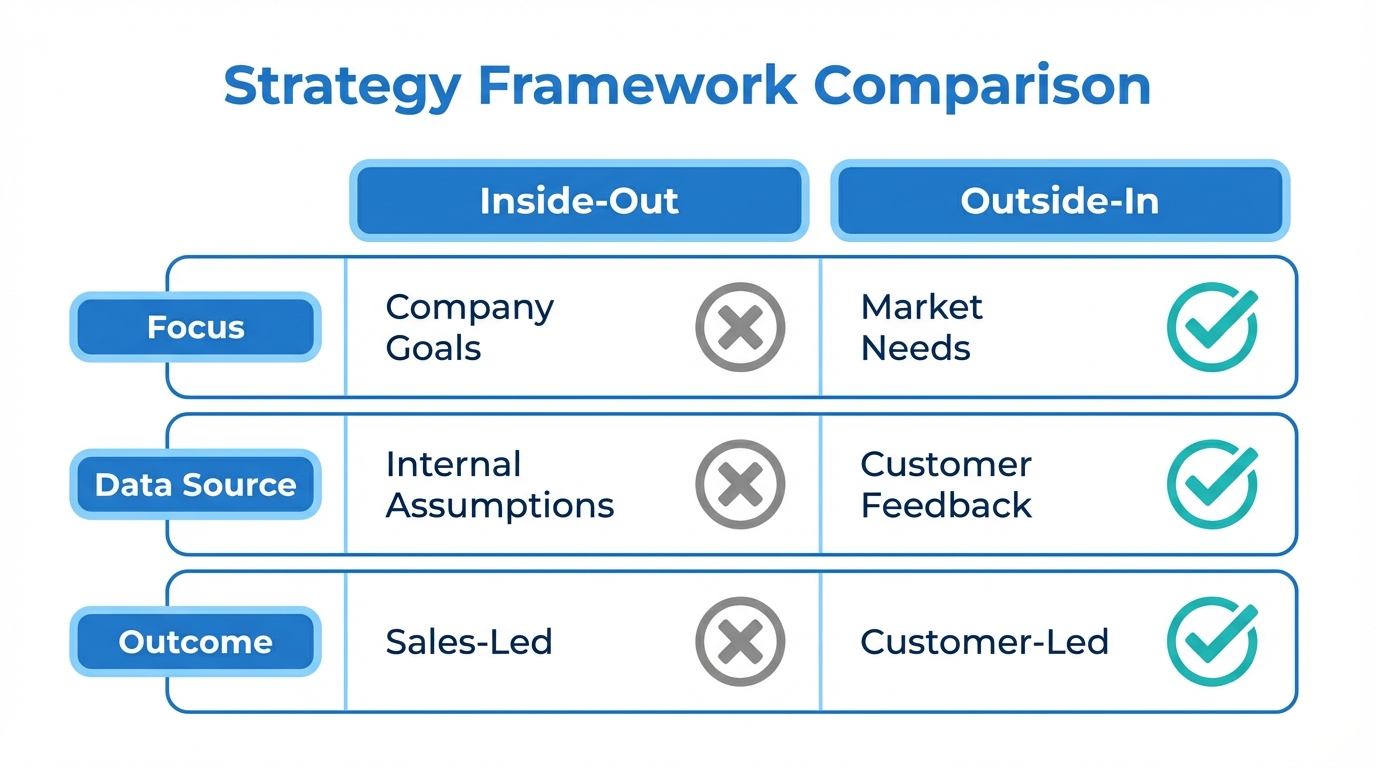
One of the most powerful concepts in the Qualtrics playbook is the ‘Inside-Out vs. Outside-In’ framework. Most companies operate from the inside out; they look at their internal goals, their product roadmap, and their sales targets, and then they try to force those onto the market. In contrast, customer-led growth requires an outside-in approach. This means starting with the customer’s pain points, their feedback, and their experience, and letting that data dictate the internal strategy. When you operate from the outside in, you eliminate the ‘blind spots’ that lead to churn and failed product launches. This is particularly critical when managing complex ad platforms like Meta Ads Manager or Google Ads, where creative fatigue can set in if you aren't listening to how the audience reacts to your messaging.
| Framework | Primary Focus | Growth Lever | Risk Level |
|---|---|---|---|
| Inside-Out | Internal Roadmap | Sales Pressure | High (Market Misalignment) |
| Outside-In | Customer Sentiment | Feedback Loops | Low (Data-Validated) |
To implement an outside-in strategy, marketers must treat feedback as a core part of their tech stack, right alongside their CRM and email automation tools. For instance, pairing your feedback data with a tool like HubSpot allows you to trigger specific sales or success workflows based on customer sentiment. If a user provides a low NPS score, the system should automatically alert a customer success manager before the user even considers churning. This proactive approach turns a potential disaster into a retention opportunity, which is the hallmark of a mature customer-led growth model.
Selling Certainty: Building a Competitive Advantage
In the early days of Qualtrics, Ryan Smith often found himself competing against better-funded companies with cheaper products. His competitors had raised $40 million while Qualtrics was still being run out of a basement. How did they win? By selling certainty rather than just software features. In a world of marketing noise, executives are desperate for the assurance that they are making the right moves. Qualtrics positioned its marketing analytics as the ‘insurance policy’ for big decisions. They weren’t just selling a survey tool; they were selling the ability to be correct. This psychological shift is what allowed them to maintain premium pricing even when ‘free’ alternatives were flooding the market.
"Sales is the generous act of letting the right person know that you might have a solution to their problem."Modern growth teams can apply this by focusing their distribution strategy on the outcome of the data, not the mechanics of the tool. Whether you are using Klaviyo for email sequences or Canva for creative assets, the value isn’t in the pixels or the code—it’s in the certainty of performance. For companies looking to source authentic user-generated content (UGC), platforms like Stormy AI streamline creator sourcing and outreach, ensuring that the creative used in app install campaigns is validated by the real-world preferences of the target audience. By sourcing creators through an AI-powered discovery engine, you reduce the risk of creative failure and increase the certainty of your marketing analytics.
The Power of Extreme Focus: The University Playbook
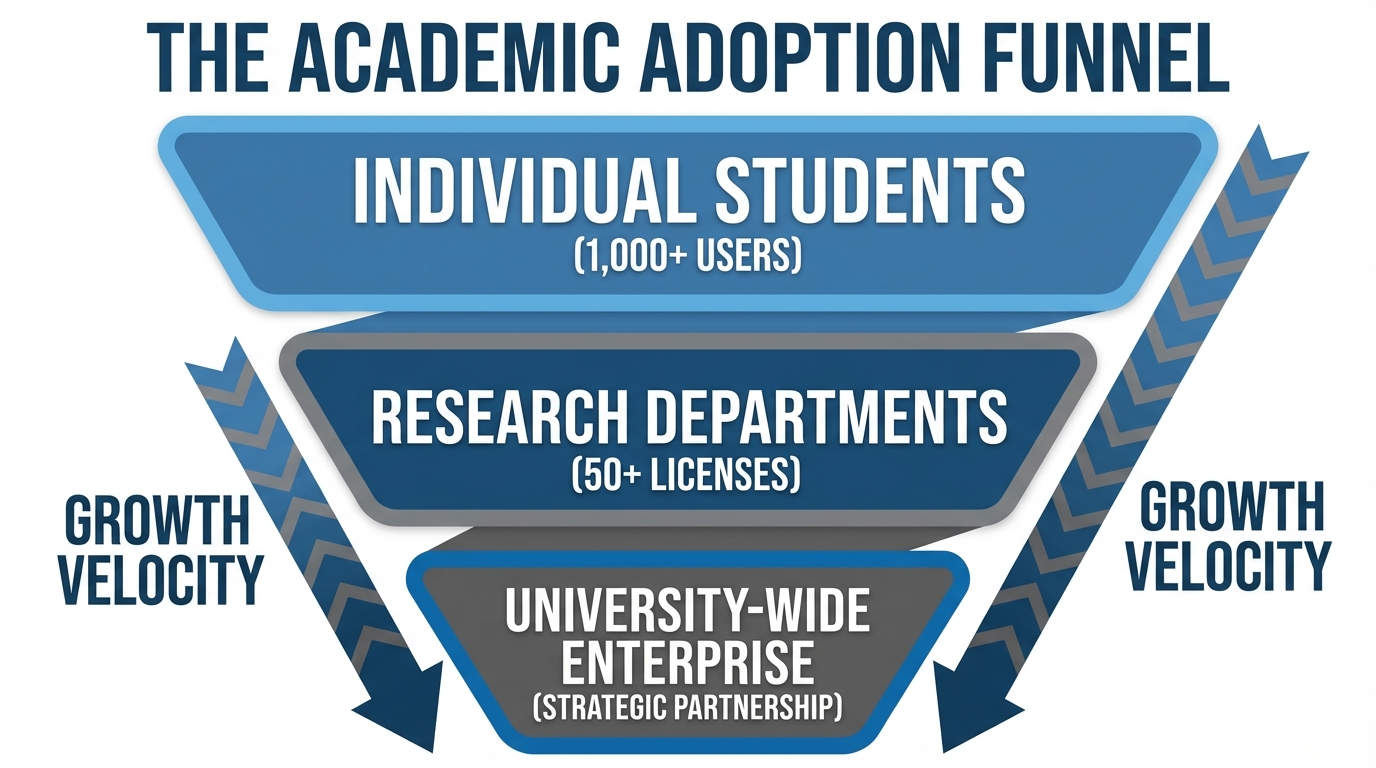
A critical lesson from the Qualtrics journey is the importance of a narrow distribution strategy. In 2006, Ryan’s brother Jared joined the company from Google. He brought a ‘religious’ focus to the business, famously telling the team that unless they were talking about the top 250 universities in the world, he didn’t want to hear it. This forcing function was vital. By dominating a specific niche, they built a walled garden that competitors couldn’t penetrate. They became the ‘gold standard’ in academia, which then served as a massive social proof engine when they eventually moved into the enterprise market.
- Step 1: Identify your high-gravity niche. Find the market segment that has the highest influence on others.
- Step 2: Eliminate distractions. Say no to ‘believable ideas’ that don’t serve the core niche.
- Step 3: Build the standard. Ensure your product is so deeply embedded in the niche's workflow that switching costs become prohibitive.
- Step 4: Scale via ecosystem. Use the graduates (or users) of that niche to carry the product into new industries.
This level of focus is often missing in modern startups that try to be everything to everyone. Instead, using tools like Notion or Asana to track a strictly defined set of target accounts ensures the entire team is pulling in the same direction. When you focus on a single ‘wave,’ you can ride it much further than if you are constantly paddling between small ripples. Qualtrics spent ten years in relative obscurity, perfecting their model in universities, before they ever took outside funding. This long-game mentality is what eventually led to their $8 billion exit.
Implementing Feedback Loops that Inform Product-Led Growth
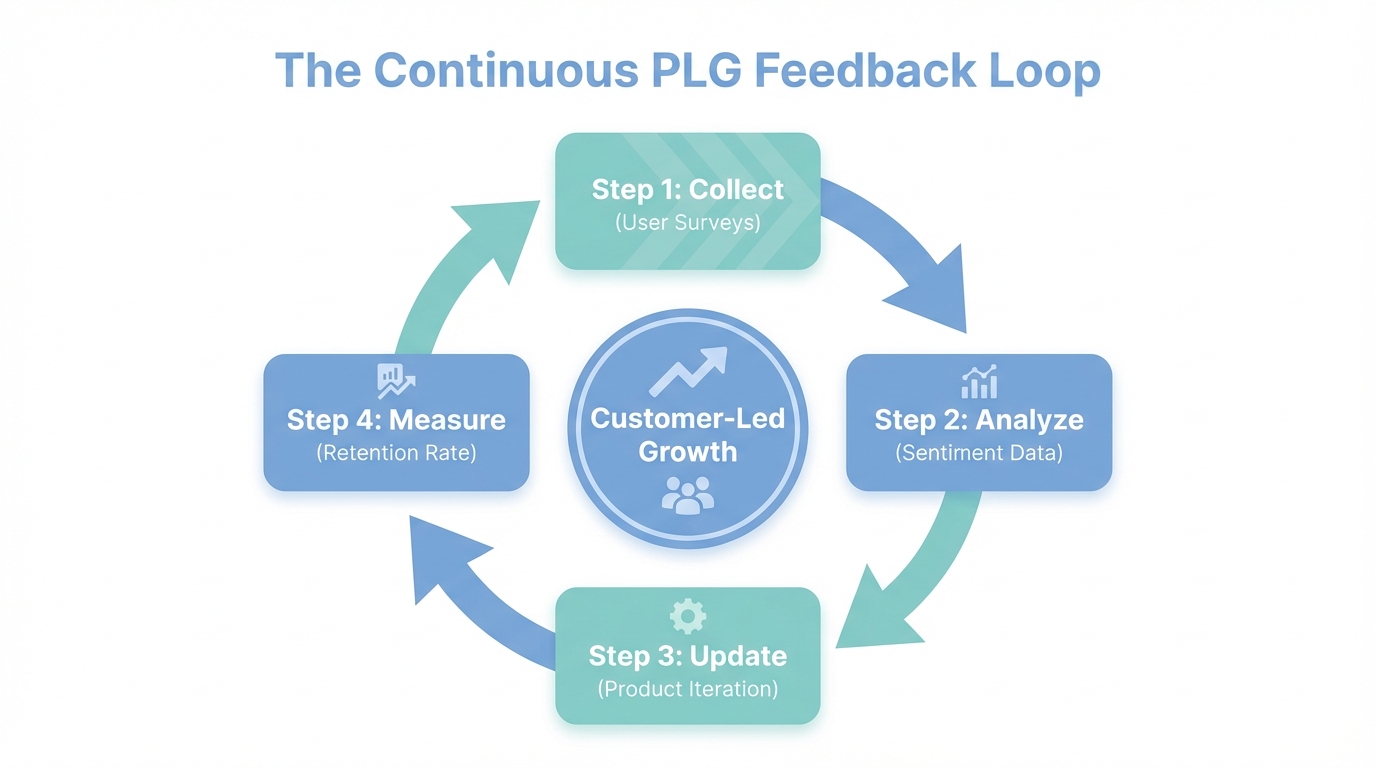
To reduce churn and fuel product-led growth (PLG), feedback loops must be integrated into the product experience itself. It isn’t enough to send an email survey; the feedback mechanism should be native to the user journey. For mobile app developers, this might mean using marketing analytics to identify ‘aha moments’ and then prompting for feedback immediately after that success. This data should then flow directly into your product development cycle. For example, using Zapier to connect your feedback tool to your engineering backlog ensures that customer pain points are addressed in real-time.
Managing the creator side of a brand's strategy follows the same logic. Sourcing UGC creators is an essential part of a modern distribution strategy, especially for mobile apps aiming for high install rates. An AI-powered creator platform like Stormy AI allows brands to not only discover these creators but also manage the entire relationship and payment flow in one place. By keeping the creator management process streamlined, brands can quickly iterate on creative based on the feedback loops they’ve established with their actual users on platforms like TikTok Ads Manager.
The Working Backwards Mindset: Charting the Path to Dominance
Ryan Smith famously used a ‘working backwards’ exercise to drive the company’s valuation. He would envision the next major headline he wanted to see in the press—for instance, "The company that turned down $500 million just raised at a $1 billion valuation"—and then determine exactly what metrics and milestones were required to make that headline true. This isn’t just visualization; it’s reverse-engineering success. For a marketing team, this might mean working backwards from a target CAC or a specific market share percentage and building the distribution strategy that supports those numbers.
| Phase | Goal Headline | Required Metric |
|---|---|---|
| Foundational | "Dominating the University Market" | 90% Market Penetration (Top 250) |
| Expansion | "The Billion-Dollar Unicorn" | 100% YoY Revenue Growth |
| Dominance | "The $8 Billion Exit" | Multi-Product Enterprise Integration |
This mindset requires ‘tuning out the noise’ and playing the long game. Smith didn’t do side hustles, he didn’t sit on boards, and he didn’t angel invest for 20 years. He was all-in on Qualtrics. For modern entrepreneurs, the lesson is clear: intensity and focus, combined with a customer-led growth strategy, are the only ways to build a truly generational company. Whether you are running a small startup or a massive enterprise, the customer is the only one who truly knows where the market is going next. If you put them at the table, they will tell you exactly how to win with the help of strategic acquisitions and data integrity.
Conclusion: Putting the Playbook into Action
The Qualtrics journey from a basement to an NBA team ownership is a testament to the power of customer feedback loops. To dominate your market, you must move beyond the ‘inside-out’ mentality and embrace an ‘outside-in’ strategy that prioritizes marketing analytics and customer-led insights. Start by identifying your ‘high-gravity’ niche, selling certainty rather than features, and building a feedback cadence that informs every level of your distribution strategy. In an era where attention is the scarcest resource, the companies that listen best are the ones that grow fastest. It’s time to stop guessing and start knowing.