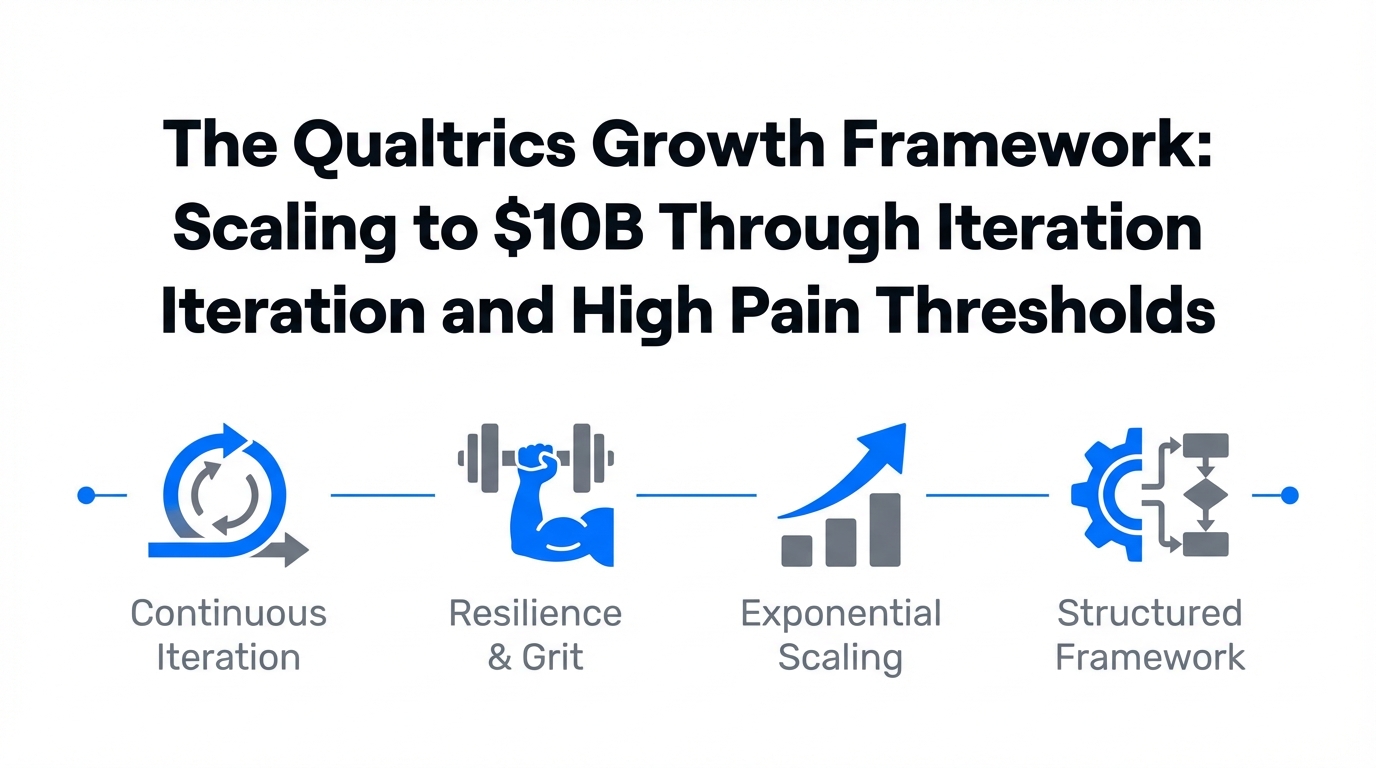
In the high-speed world of Silicon Valley, the standard narrative for a go-to-market strategy usually involves a flashy seed round, a rapid series of venture-backed escalations, and a desperate race toward an exit before the burn rate catches up. Ryan Smith, the founder of Qualtrics, took a diametrically opposite approach. He spent ten years in his father’s basement in Provo, Utah, building what would eventually become a $10 billion category leader in experience management. His journey wasn't defined by a lack of opportunity for investment, but by a deliberate choice to prioritize entrepreneurial grit and foundational strength over easy capital.
The Pain Threshold Metric: The Secret to Market Endurance
During a recent deep-dive into his daily routine, Ryan Smith noted a fundamental truth that separates unicorn founders from the rest: Your success is directly correlated with your pain threshold. In the early stages of bootstrapping a startup, pain isn't just about long hours; it's about the psychological friction of being told "no," the technical debt that accumulates when you can't hire 50 engineers, and the discipline to stay the course when competitors are raising massive rounds.
For Qualtrics, this pain manifested as a decade of grinding without external validation. While other SaaS companies were using Meta Ads Manager to buy growth at any cost, Smith and his team focused on building a product that academics—the most critical and demanding survey users—couldn't live without. This forced a level of product excellence that money simply cannot buy.
"The key insight isn't that you should suffer for the sake of suffering; it's that your ability to handle long-term market friction allows you to outlast better-funded rivals who fold when the 'easy' money disappears."
Bootstrapping vs. Early VC: The Qualtrics Business Model
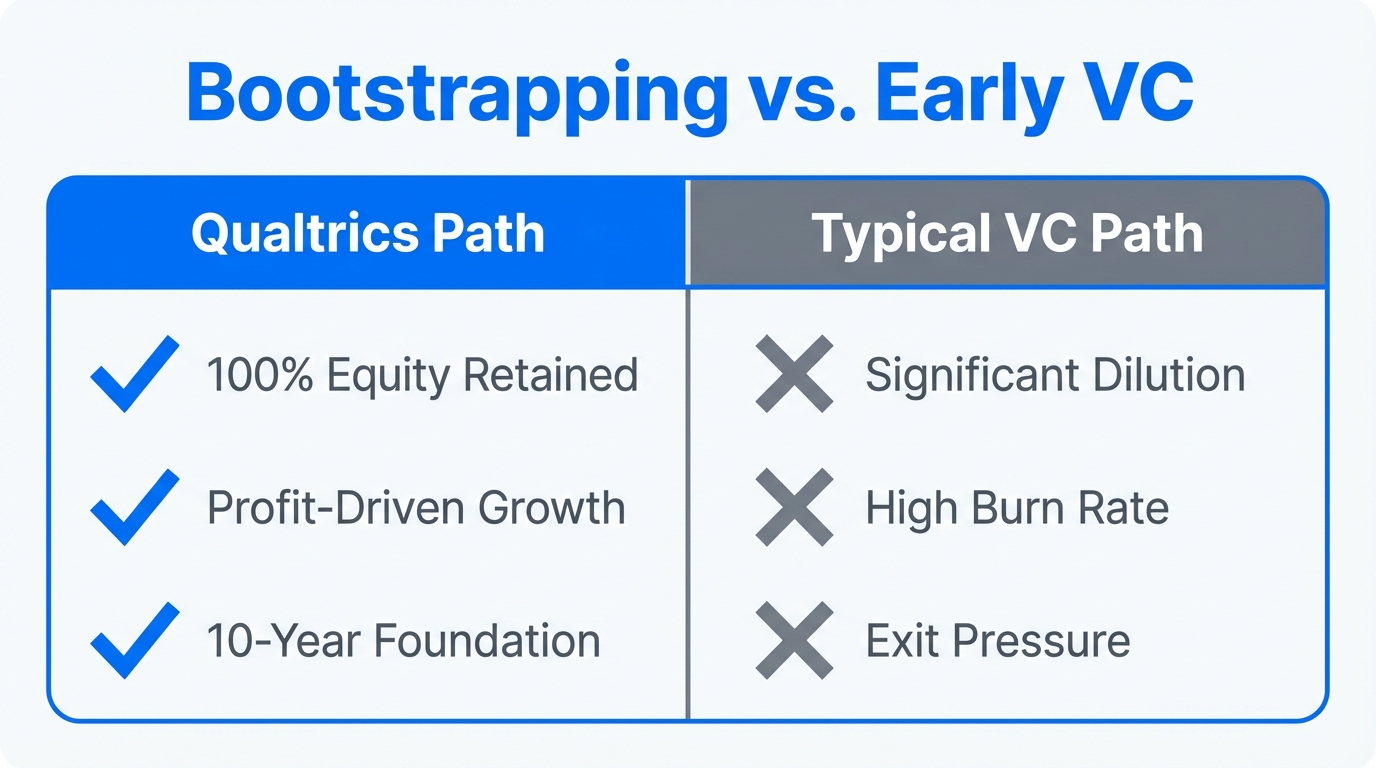
The Qualtrics business model was built on a foundation of profitability from day one. By bootstrapping a startup for ten years, Smith ensured that every feature developed and every hire made was strictly tied to revenue. This created a culture of efficiency that is often lost in VC-backed companies where growth at all costs is the primary metric. When you use your own cash to fund experiments in Google Ads or TikTok Ads Manager, you tend to optimize those campaigns much more aggressively.
| Feature | The VC-Backed Approach | The Qualtrics (Bootstrapped) Approach |
|---|---|---|
| Growth Velocity | Artificially inflated by capital | Organic and customer-funded |
| Product Focus | Broad, trying to capture total market | Niche-down (Academics first) |
| Burn Rate | High, dependent on next round | Zero or Negative (Profitable) |
| Company Culture | Hired for scale | Hired for grit and mission-alignment |
By the time Qualtrics finally took venture capital, they didn't need it for survival. They used it as fuel for an already roaring fire. This gave them immense leverage during negotiations. They weren't looking for a lifeline; they were looking for a partnership to define a new category: Experience Management (XM). This is a masterclass in SaaS growth strategies—control your destiny by controlling your cap table for as long as possible.
The Iteration Loop: Moving Faster on Product-Market Fit
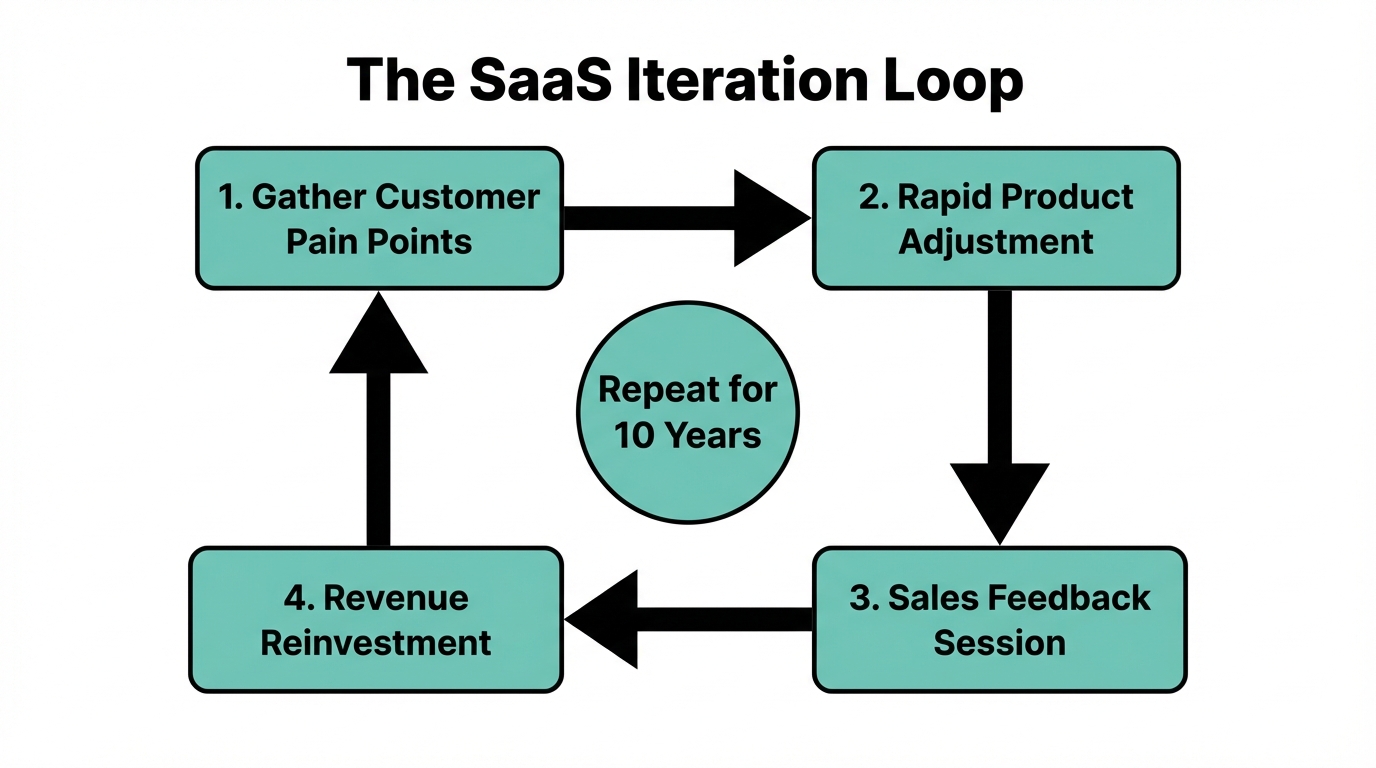
Smith often mentions that "everything that happened in my life was pretty much wrong at first." This humble admission highlights the Iteration Loop. In business, being right isn't the goal; being less wrong every day is. Qualtrics succeeded because they could iterate faster than their well-funded rivals. Without the bureaucratic overhead of a massive board or the pressure to hit arbitrary quarterly targets from investors, they could pivot their product features based on direct user feedback.
This iteration extends beyond product into marketing and sales. For example, modern growth teams often find that their go-to-market strategy requires a mix of performance ads and authentic content. When sourcing creators for these campaigns, tools like Stormy AI can help source and manage UGC creators at scale, allowing brands to test different creative angles without the high overhead of traditional agencies. This allows for the same "rapid iteration" that Qualtrics used to dominate the survey space.
"We are in the business of constant iteration. If you aren't changing your approach based on what the data tells you, you're just standing still in a moving market."
Turning Geographic Isolation Into a Culture Moat
Building a tech giant in Provo, Utah, in the early 2000s was seen as a disadvantage. There was no established "Silicon Slopes" ecosystem. However, Smith turned this geographic isolation into a recruitment and culture-building moat. Instead of fighting for the same over-recruited engineers in San Francisco who jump ship every 12 months, Qualtrics built a loyal workforce in Utah that shared their entrepreneurial grit.
They leveraged the local talent pool, often hiring people who were overlooked by the coastal tech giants. This created a culture of "proving the world wrong." To manage this growing team, they didn't rely on flashy perks; they relied on clear communication and robust systems. Modern companies can replicate this by using general CRM tools like HubSpot to track relationships or Asana for project management, but the core remains the same: Hire for character and train for skill.
Playing the Long Game: Resisting the Short-Term Exit
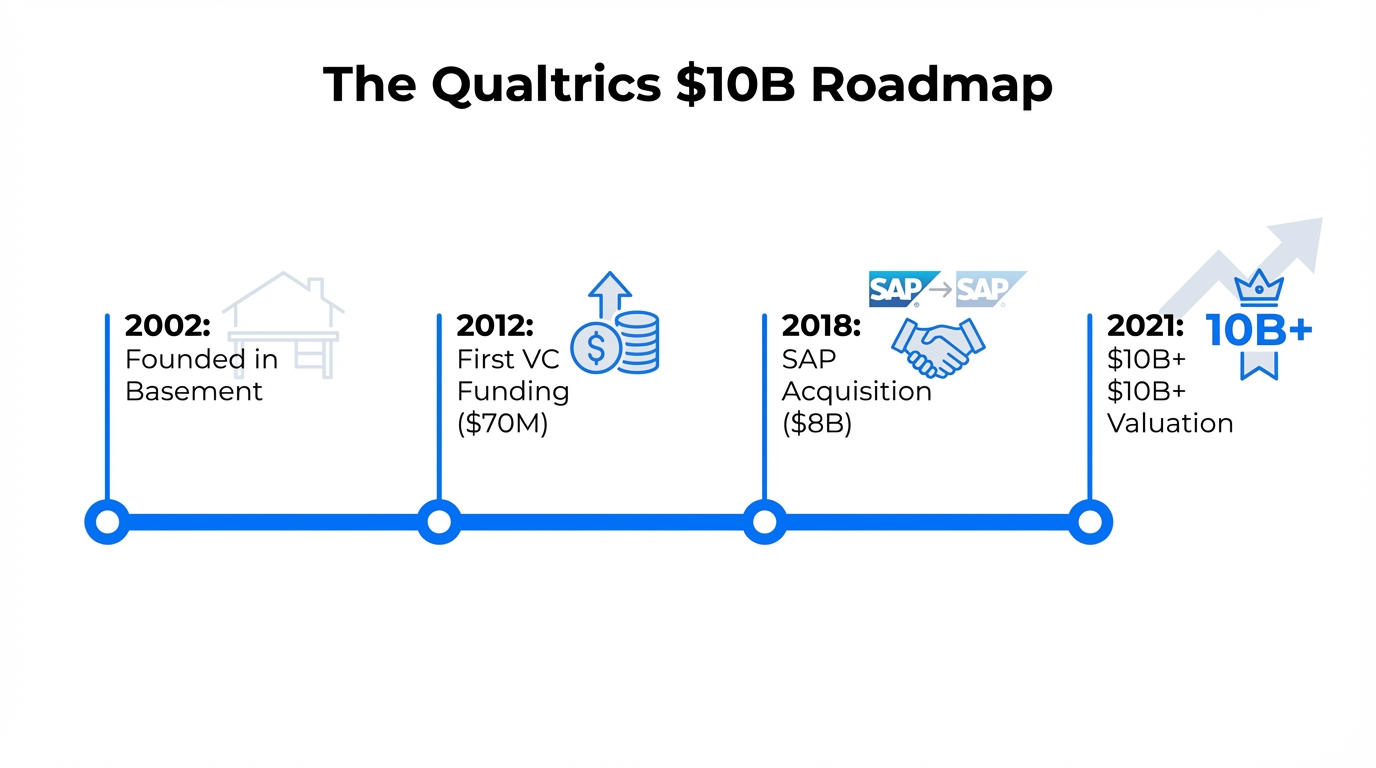
One of the hardest moments for any founder is when the first acquisition offer hits the table. For Ryan Smith, those offers came early and often. Resisting a $500 million or $1 billion exit takes a level of entrepreneurial grit that most cannot fathom. But Qualtrics was playing a different game. They weren't building a tool; they were building a category.
This "long game" mentality allowed them to eventually sell to SAP for $8 billion—and then go public later at an even higher valuation. To sustain this, they had to constantly reinvent themselves. Smith emphasizes that you must become an expert in every business you are a part of. Whether it's payments, security, or even media, a SaaS growth strategy must evolve as the company scales.
For modern brands, this long game often involves building a community and a "creator ecosystem." By using an AI-powered creator discovery platform like Stormy AI, companies can find influencers who aren't just looking for a one-off paycheck but are willing to grow with the brand over years, mirroring the loyalty Qualtrics built with its early academic users.
"Tune out the noise. Play the long game. The biggest rewards go to those who can resist the urge to cash out before the mission is complete."
Conclusion: Applying the Qualtrics Framework to Your Startup
The success of Qualtrics isn't a fluke; it's a blueprint for anyone interested in SaaS growth strategies that prioritize sustainability over hype. By focusing on a high pain threshold, embracing the slow burn of bootstrapping a startup, and iterating relentlessly on product-market fit, Ryan Smith built a legacy that transcends software.
Whether you are managing a team of developers in Linear or coordinating a global marketing campaign across TikTok and Apple Search Ads, the principles remain: Master your metrics, hire for grit, and never stop iterating. The path to a $10B valuation isn't paved with venture capital; it's paved with the resilience to stay in the basement until you've earned the right to own the stadium.