In the world of SaaS, the prevailing wisdom is often to "go big or go home." Founders are coached to chase the largest Total Addressable Market (TAM) possible from day one, fearing that narrowing their focus will lead to stagnation. Ryan Smith, the founder of Qualtrics, did the exact opposite. He took a startup from his family's basement and turned it into an $8 billion exit by doing something most entrepreneurs find terrifying: he ignored the mass market for years to dominate a tiny, specific niche of 250 universities.
The Qualtrics story isn't a typical Silicon Valley tale of a Harvard dropout with a grand vision. It is a gritty, 20-year masterclass in the B2B sales playbook. Ryan Smith started with a 1.9 GPA and a history of not finishing what he started, yet he built one of the most successful enterprise software companies in history. His secret? A radical go-to-market strategy built on the concept of a "forcing function"—a set of constraints that made success inevitable by removing the possibility of distraction.
Why Narrowing Your TAM Accelerates Early-Stage Growth
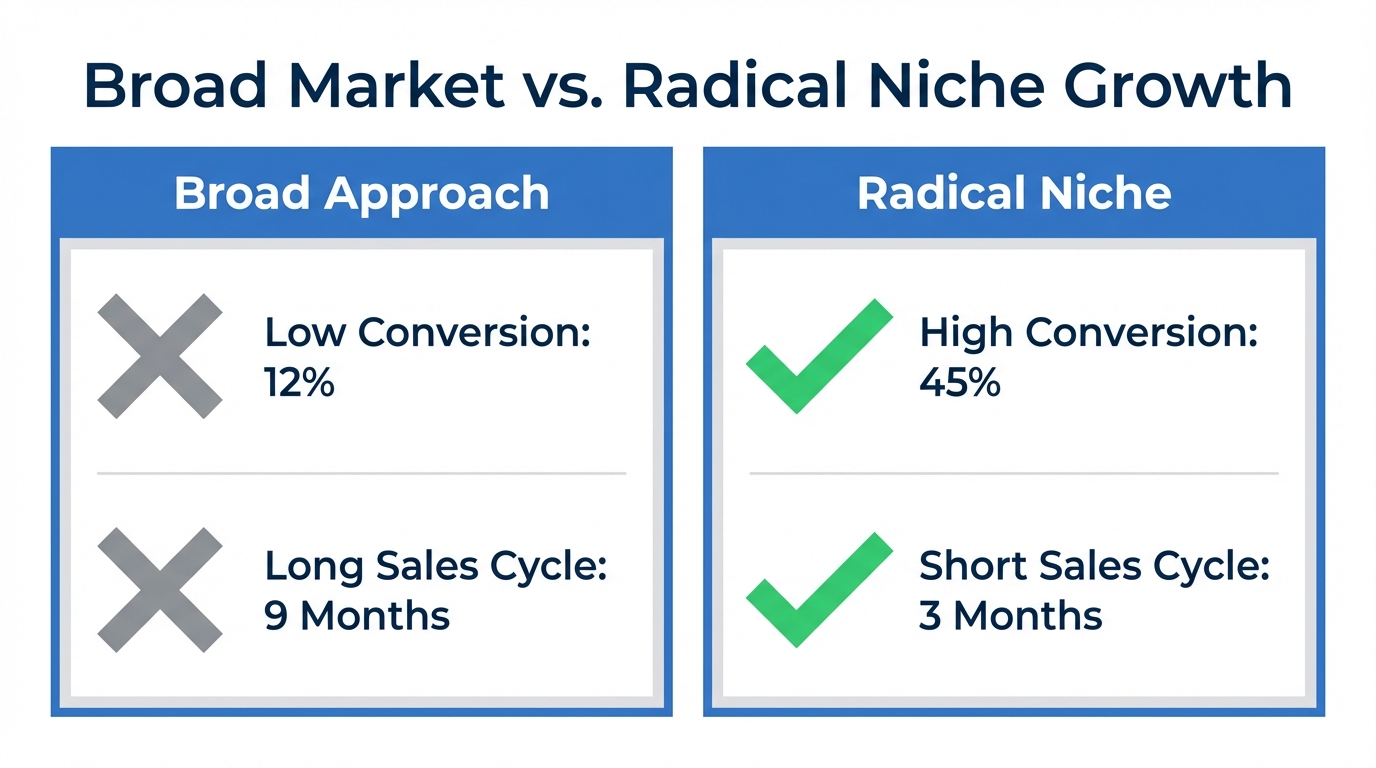
Most companies fail because they try to be everything to everyone. When Qualtrics started in 2002, the market for online research was non-existent. Companies were still using paper and pencil for customer satisfaction surveys, or they weren't doing them at all. Instead of trying to convince the entire Fortune 500 to change their ways, Smith focused exclusively on academic researchers.
By targeting 250 specific universities, Qualtrics wasn't just selling software; they were embedding themselves into the ecosystem of future decision-makers. Smith realized that if every MBA student at the Kellogg School of Management used Qualtrics for their thesis, they would eventually take that tool with them into the corporate world. This is the ultimate long-game customer acquisition strategy.
| Strategy Component | Mass Market Approach | Qualtrics Niche Approach |
|---|---|---|
| Initial Target | Any business with a website | Top 250 Research Universities |
| Sales Cycle | Long, fragmented, high churn | Predictable, repeatable, high trust |
| Marketing Spend | High (Broad SEO/SEM) | Low (Direct outreach, cold calls) |
| Product Feedback | Conflicting and noisy | Unified and deep (Statistical rigor) |
As Smith notes, his father, a statistics professor, was his first technical co-founder. They didn't have a marketing budget or a fancy office. They had a basement and a list of professors. By dominating the academic space, they created a "moat" of credibility that no competitor with $40 million in VC funding could touch.
"Focus as an action word means saying no to a bunch of otherwise believable ideas."
The 'Forcing Function' Framework: Saying No to Revenue
In 2006, Ryan’s brother, Jared Smith, left an early leadership role at Google to join the family business. Jared brought a level of discipline that became the company's "forcing function." He famously told Ryan that unless a lead was one of the top 100 universities on their list, he didn't want to hear about it. He would literally hang up the phone if the conversation drifted toward distracting revenue opportunities.
This niche marketing strategy created a psychological shift in the team. When you are forbidden from chasing "easy" money outside your niche, you are forced to become the absolute best in the world at your specific target. You stop editing your pitch for the general public and start speaking the specialized language of your ideal customer.
This discipline is what allowed them to stay profitable and bootstrapped for the first decade. While competitors were burning cash to acquire low-value leads, Qualtrics was building a compounding engine of academic authority. They didn't take outside investment until 2012, ten years after founding, because their focused GTM strategy generated enough cash flow to self-fund their growth.
Ryan Smith's 2002 Cold-Calling Script: Demos in a Pre-Zoom Era
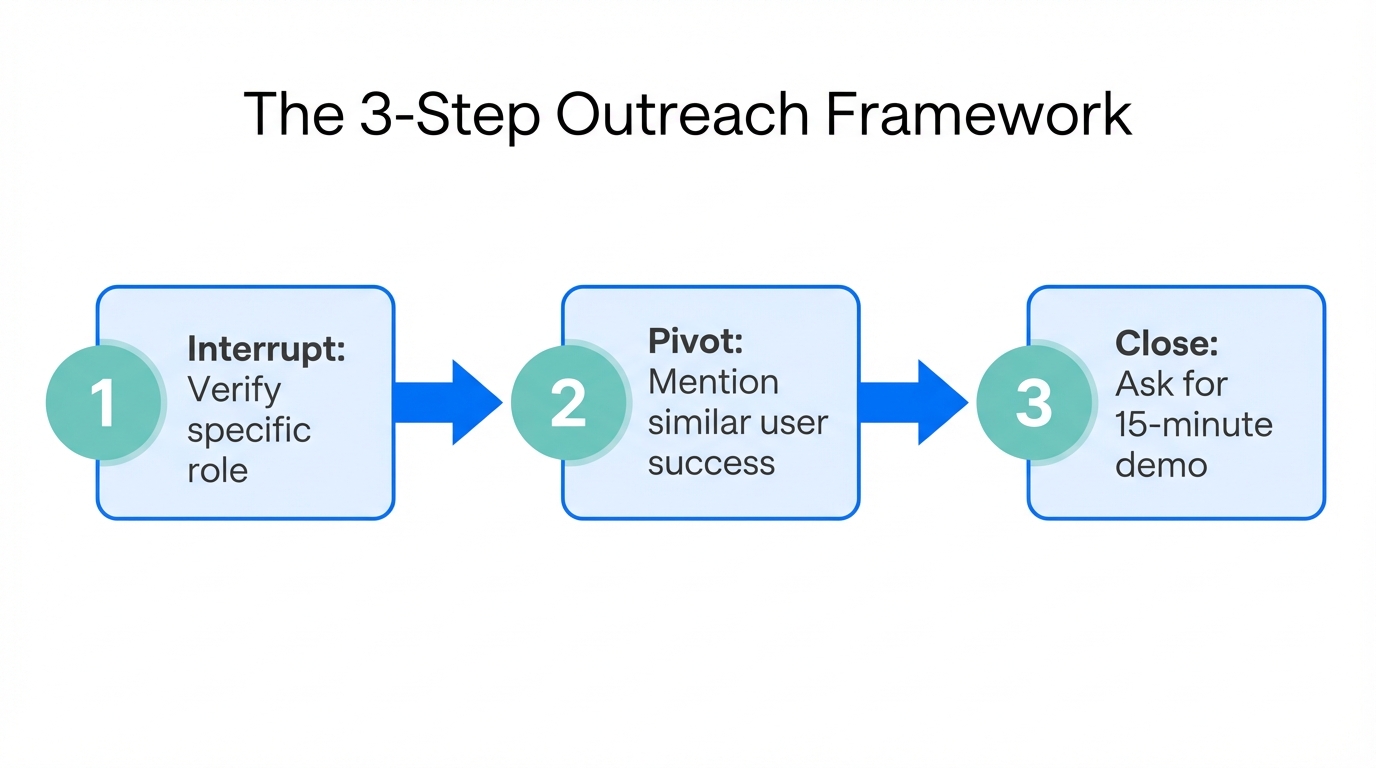
Before Zoom or Google Chrome were staples of the business world, Ryan Smith was running a high-velocity sales floor from a basement. His B2B sales playbook was simple: dial all day, every day. But his scripts weren't just about the product; they were about proximity and social proof.
If he was calling into a prospect in Dallas, he would mention he was part of the Dallas American Marketing Association. He would use the names of the top researchers in the world who were already using the platform. Because there was no screen-sharing software, Smith would send the prospect a link and walk them through the demo over the phone, blind. He knew the product so well he could describe every button and feature without looking at his own screen.
The "Generous Act" of Sales
Smith viewed sales not as a nuisance, but as a generous act of service. He believed that if a company operated using data from their customers and employees, they would win more. This belief made his outreach feel authentic rather than predatory. He wasn't just selling software; he was selling a way to eliminate "blind spots" in business. This mindset is critical for any customer acquisition strategy—you must believe that the prospect's life will be demonstrably better after the purchase.
"Sales is the generous act of letting the right person know that you might have a solution to their problem."
Transitioning from a Niche to a Global Enterprise Category Leader
How does a company go from selling to 250 universities to selling to the entire Fortune 500? For Qualtrics, the transition was organic but calculated. They used a "land and expand" model that relied on their academic dominance. As students graduated and entered the workforce, they became internal champions for Qualtrics at companies like HP and SAP.
By the time they decided to raise a Series A in 2012—led by Sequoia Capital and Accel—they were already the "biggest company no one had ever heard of." They had reached a $1 billion valuation by simply following their users from the classroom to the boardroom. Modern go-to-market strategy often overlooks this "alumni effect," but for Qualtrics, it was the bridge to enterprise scale.
At this stage, managing creator relationships and brand perception becomes vital. Just as Qualtrics used academic influencers to build trust, modern brands often leverage UGC (user-generated content) to drive adoption. Using a platform like Stormy AI can help growth teams discover the right creators and automate the outreach process, ensuring that the brand remains top-of-mind during a transition from niche to mass market.
Step-by-Step Guide to Building a 'Targeted Account' List
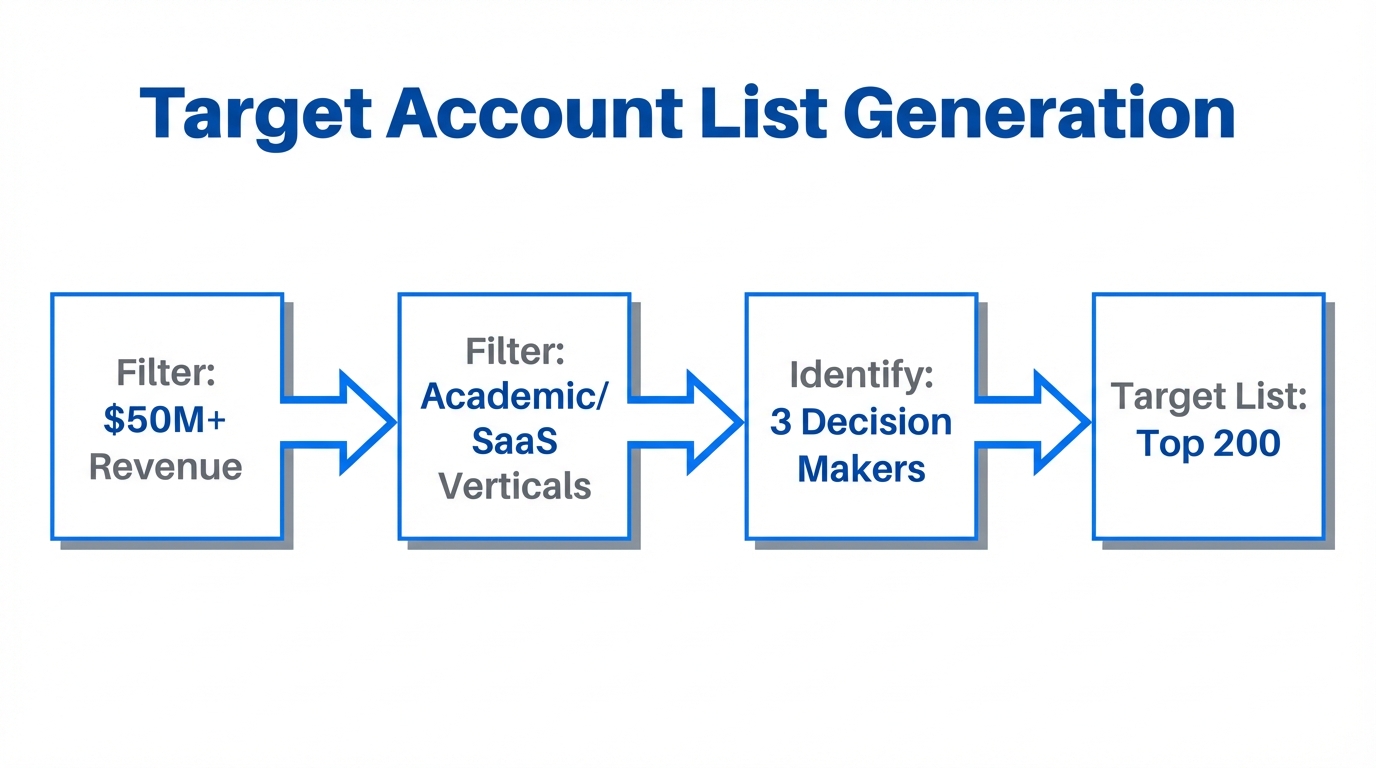
To replicate the Qualtrics success, you need a disciplined approach to your first 100 customers. You cannot simply blast emails to a generic list from legacy CRM platforms or LinkedIn. You need a B2B sales playbook that prioritizes quality over quantity.
Step 1: Identify Your "Academic" Equivalent
What is the one niche where your product solves a deep, technical pain point better than anyone else? It might not be the most profitable market, but it should be the most vocal. For Qualtrics, it was academic research. For your SaaS, it might be dev-ops for fintech or HR for remote-first startups.
Step 2: Apply the Forcing Function
Create a list of 100-250 accounts. Explicitly forbid your sales team (or yourself) from selling to anyone outside this list for 90 days. This radical focus forces you to understand the nuance of your target accounts. You'll stop talking about "features" and start talking about "industry standards."
Step 3: Leverage Social Proof and Proximity
Use every win to get the next one. In B2B, proximity is power. If you sign one university in the Big Ten, you use that to sign the next nine. Modern tools like Stormy AI allow you to find creators and influencers within these specific niches who can help carry your message to the right decision-makers autonomously.
Conclusion: Working Backwards to the Billion-Dollar Story
Ryan Smith’s final piece of advice for any founder is to work backwards from the story you want to tell. He used a series of media articles by journalist Julie Bort at Business Insider to track his progress. Each article was a milestone: from turning down a $500 million offer to raising at a $1 billion valuation, and eventually selling to SAP for $8 billion. He literally framed the articles on his wall before they were ever written.
The Qualtrics journey proves that niche marketing isn't about staying small; it's about building a foundation so strong that your eventual expansion is unstoppable. By saying no to the noise and focusing on a "forcing function" of discipline, you can build a customer acquisition strategy that doesn't just find leads—it creates a category.
"Tune out the noise, play the long game. Who is stopping you from doing everything you want to go do?"
Whether you are a solo founder in a basement or a marketing leader at a scaling startup, the Qualtrics GTM playbook remains the same: find your niche, dominate it with religious focus, and never stop dialing.