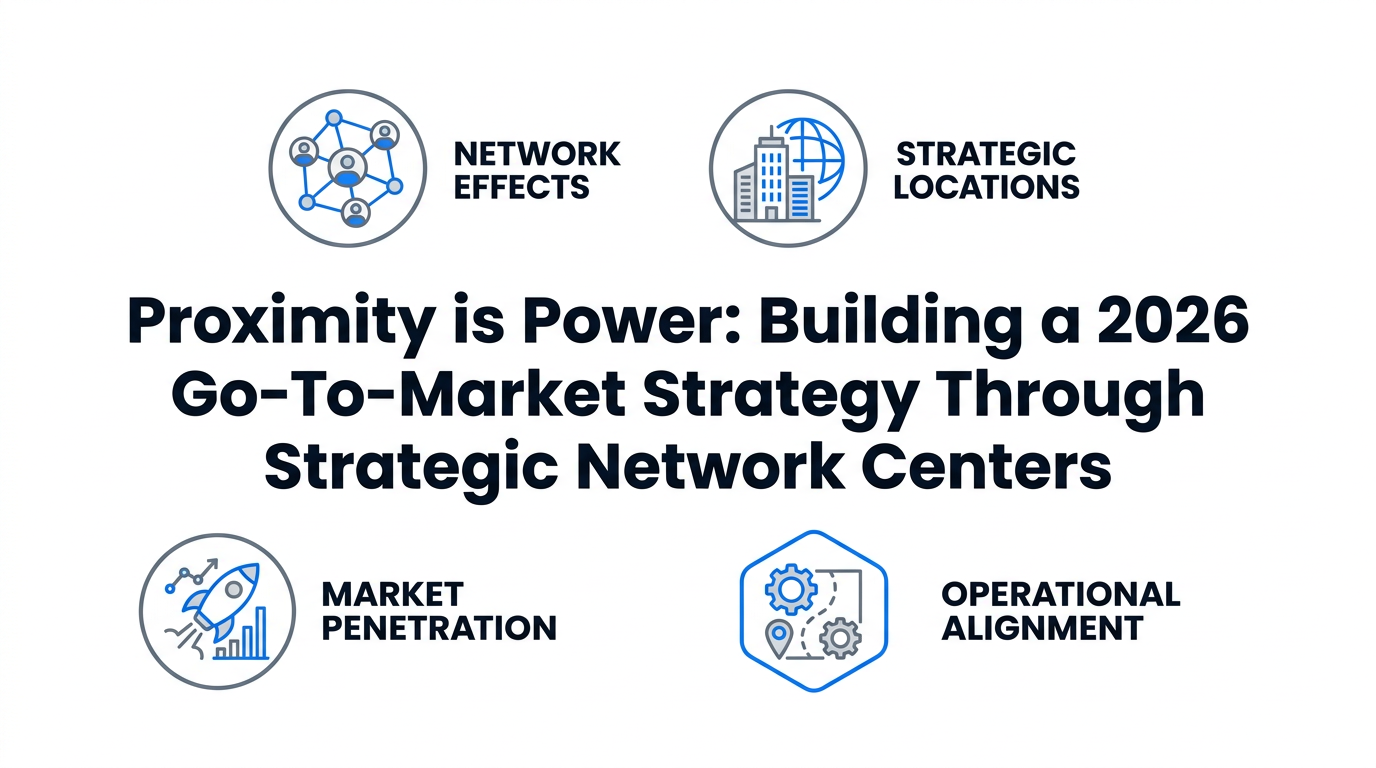
In the digital-first landscape of 2026, many founders fall into the trap of believing that physical location no longer matters. With the rise of advanced AI and seamless remote collaboration tools like Notion and Slack, the narrative suggests you can build a unicorn from a remote cabin in the woods. However, the data tells a different story. While you can work from anywhere, your speed of growth is still heavily dictated by your physical and digital proximity to 'White Hot Centers.' A modern go-to-market strategy 2026 requires more than just a great product; it requires strategic proximity to the capital, talent, and cultural momentum that only specific geographic hubs can provide.
Why Your Zip Code Still Dictates Your Business Growth Speed
As we navigate 2026, the concept of 'Luck Surface Area' has become a cornerstone of startup growth ecosystems. Luck isn't just a random occurrence; it is a mathematical function of how many people you know and how many of those people are in a position to help you. By moving to a strategic network center, you are effectively sticking your fork into a high-voltage outlet of opportunity. In a world where everyone is connected online, the value of the offline handshake has actually increased. Physical proximity creates serendipity—the kind that leads to a casual coffee turning into a multi-million dollar seed round.
When you are in the wrong room, you are fighting uphill. For example, if you are trying to build a cutting-edge SaaS platform while living in a region where the primary industry is manufacturing, you will struggle to find developers who understand your stack or investors who speak your language. You are essentially the smartest person in the room, which, as many successful founders note, is a dangerous place to be. To win, you must be in rooms where you are the least knowledgeable, forcing you to level up through a process of professional osmosis.
Identifying the 'White Hot Center' for Your Specific Niche
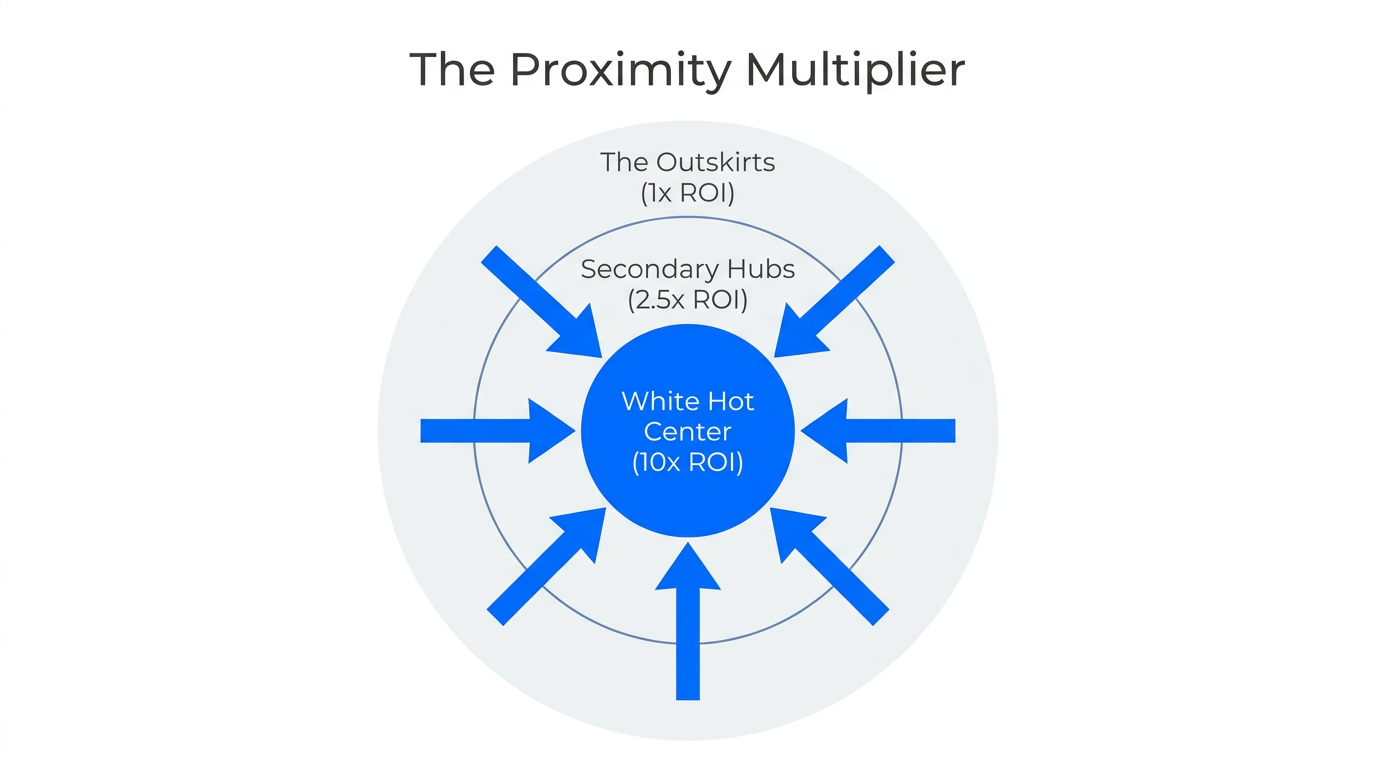
Not all hubs are created equal. A successful go-to-market strategy 2026 involves identifying where the highest concentration of decision-makers for your specific industry resides. For high-tech and AI-driven startups, San Francisco tech networking remains the undisputed heavyweight. Despite a decade of decentralization, the density of 'hunters'—those capable of spotting and funding the next big shift—is highest in the Bay Area. Conversely, if your business is built on distribution, influencers, and media, the white-hot center is Los Angeles.
| Industry Niche | Primary White Hot Center | Key Network Advantage |
|---|---|---|
| AI & Software | San Francisco / Silicon Valley | Density of technical talent & venture capital |
| Media & Influencer Marketing | Los Angeles | Concentration of UGC creators and talent agencies |
| FinTech & E-commerce | New York / London | Access to global banking and high-level retail partnerships |
| Hardware & Logistics | Shenzhen / Austin | Supply chain proximity and manufacturing expertise |
Choosing your center is about more than just finding a desk; it's about joining a tribe that speaks your dialect of business. If you are a maker building on platforms like Shopify, being in a hub where e-commerce experts congregate allows you to learn the nuances of conversion rate optimization that aren't shared in public forums. You gain access to 'whisper networks'—information that is too valuable or too fresh to be written down.
"If I'm the smartest guy in this room, I'm in the wrong room. Move to where the killers are, and you will level up by default."The 'Founder House' Model: Generating Luck Surface Area
Understand how the five people you spend the most time with shape your success.
One of the most effective ways to leverage strategic proximity in marketing and business is the 'Founder House' model. This isn't just about sharing rent; it's about radical immersion. By living with 5-6 other ambitious founders who are all chasing the same dream, you eliminate the friction of seeking out networking events. The 'networking' happens at 11:00 PM in the kitchen while you're both grabbing a snack. You share tools, you exchange TikTok Ads Manager strategies, and you introduce each other to your respective circles.
This environment creates what experts call a 'killer' mentality. When you are surrounded by people who are working until midnight and celebrating big wins, your baseline for what is 'normal' shifts. You no longer compare yourself to your high school friends who are working 9-to-5 jobs; you compare yourself to the person in the next room who just closed a $2M deal. This social pressure is one of the fastest ways to accelerate business networking for founders. It turns the long, lonely grind of entrepreneurship into a collective sprint.
The 2026 Rule: Own Equity, Don't Rent Your Time
Learn why renting out your time limits growth and how to pivot.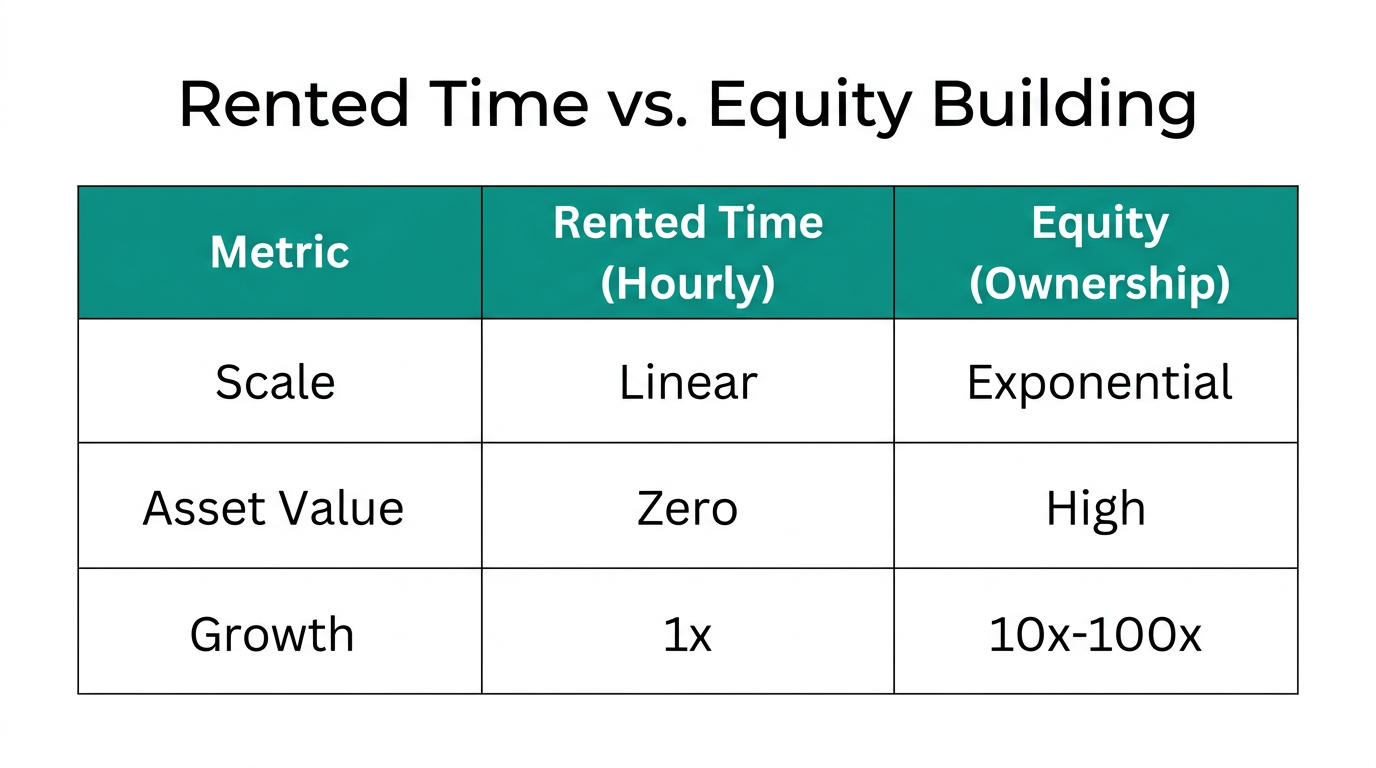
Proximity is the accelerator, but your business model is the engine. A core tenet of wealth in 2026 is moving away from the 'career trap' of trading hours for dollars. Even if you are a highly-paid consultant using Stormy AI's creator CRM to manage a pipeline of $500/hour clients, you are still on a treadmill. To build true wealth, you must own equity in a scalable asset—something that works while you sleep. This usually takes the form of Code, Content, or Capital.
- Code: Building a SaaS or an app that solves a problem once and sells it a thousand times.
- Content: Leveraging platforms like YouTube or beehiiv newsletters to build a distribution engine that you own.
- Capital: Using your 'hunting' skills to invest in assets like real estate or other startups.
By positioning yourself in a White Hot Center, you increase your chances of finding the right partners to build these assets. You might be a master of 'Selling' (marketing and closing), but you need a partner who is a master of 'Making' (engineering). These high-value matches rarely happen over a cold LinkedIn message; they happen in the trenches of a shared ecosystem.
Mastering the Four Money-Making Skills
Mastering specific money-making skills is the first step toward long-term professional success.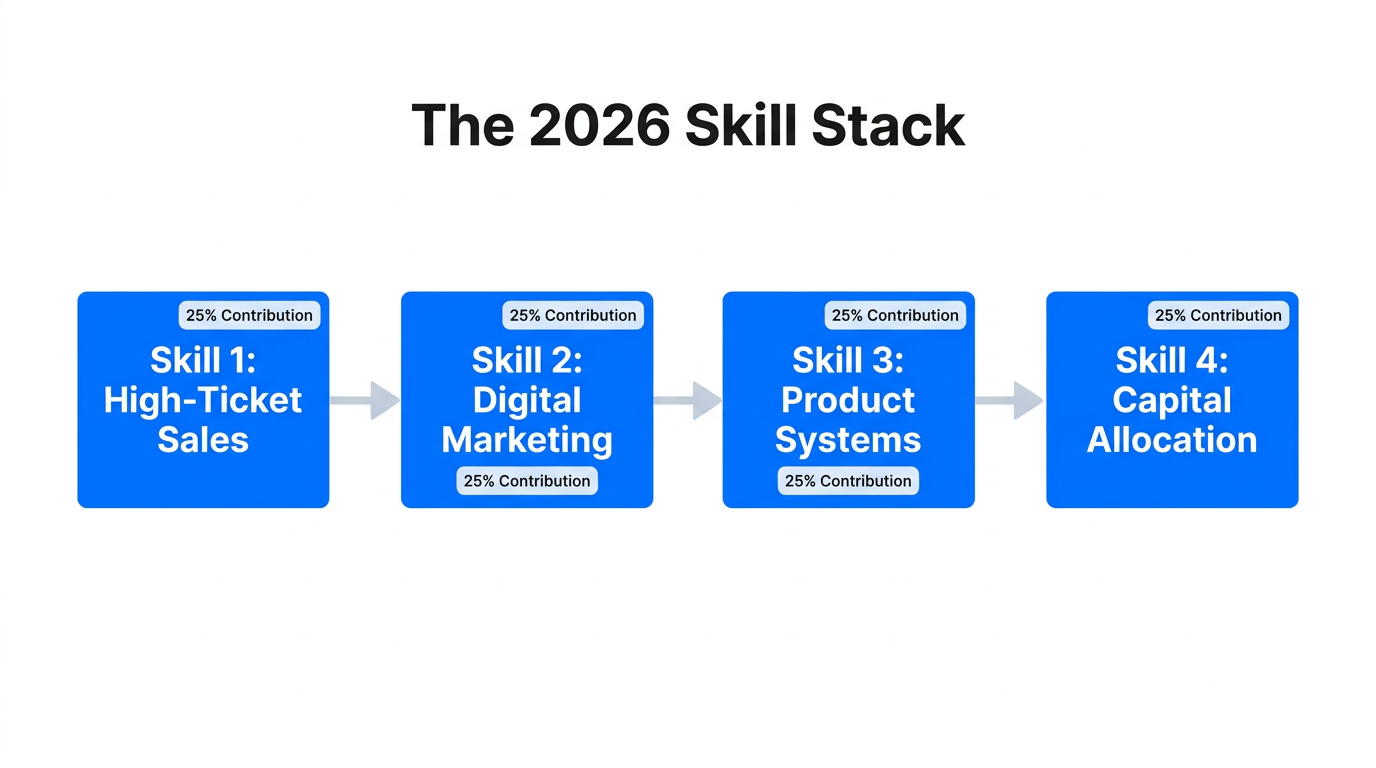
Before you can effectively network, you must have a 'money-making skill' that makes you valuable to the network. In the 2026 economy, these boil down to four categories: Selling, Making, Designing, and Hunting. Success comes from mastering one, but true wealth comes from combining two. An engineer (Maker) who understands marketing (Seller) is a unicorn. A designer who can spot undervalued assets (Hunter) is unstoppable.
"Mastering one skill is a path to millions. Mastering two is a path to billions. Don't be the best in the world; be in the top 20% of two rare, complementary fields."Once you've identified your skill, use your proximity to find a mentor who is already at the top. If you want to master sales, find the number one producer in your city, get a job at their firm, and double their input. If they make 100 calls on Close, you make 200. This is the 'practice rep' phase that many founders try to skip, but it is the foundation upon which your equity is built.
Strategic Distribution: Turning Proximity Into Results
Discover why balancing impatient action with patient results makes success almost inevitable.Once you have the skills and the network, the final piece of your go-to-market strategy 2026 is distribution. In the modern era, this means mastering influencer and creator partnerships. If you are in LA or SF, you aren't just looking for influencers; you are looking for long-term collaborators. Tools like Stormy AI can help you identify these creators with surgical precision, but the proximity you've built allows you to reach out with a level of personalization that a remote founder simply can't match.
By using Stormy AI to discover creators who align with your brand's 'White Hot' niche, you can automate the outreach process while maintaining the high-touch feel of a local connection. Imagine being able to say, "I'm a fellow founder in the SF AI scene, and I'd love to collaborate," and having the data-backed insights to know exactly which creators will drive the highest ROI for your campaign.
Building a successful business in 2026 isn't about working harder; it's about working smarter by placing yourself in the path of progress. By mastering a money-making skill, owning equity, and moving to the white-hot center of your industry, you flip the odds of success in your favor. As the legendary Steve Martin once suggested regarding the banjo, if you commit to the right actions over a long enough time horizon, becoming great is inevitable. Stop trying to win from the sidelines—change your zip code, join the killers, and build your empire from the center of the action.