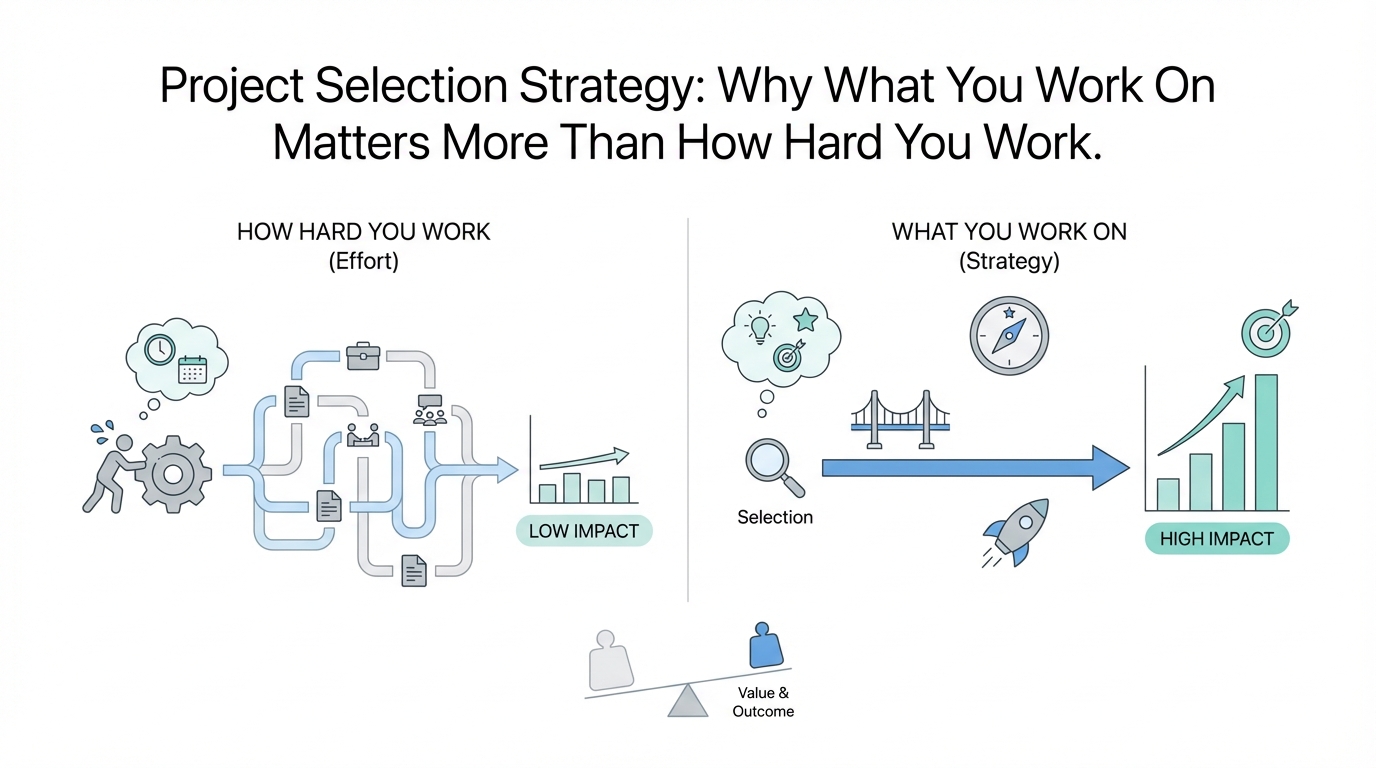
The biggest risk high-potential individuals face isn't failure; it is the silent, slow-motion disaster of spending a decade doing a really good job at the wrong thing. We are often taught that success is a direct result of grit, hustle, and the number of hours poured into a task. However, according to serial entrepreneur and podcast host Shaan Puri, hard work is likely only the fourth or fifth most important variable in the success equation. If you are rowing a boat in the wrong direction, it doesn’t matter how hard you pull the oars—you’re just getting to the wrong destination faster. To truly build a high-leverage career, you must master the art of project selection strategy and understand the critical difference between mediocrity and failure.
The Hidden Trap of Mediocrity and the Opportunity Cost of "Okay"
In the world of high-stakes business, mediocrity is more dangerous than an outright crash. When a project fails completely, the pain is acute but brief. It forces a clean break, allowing you to reclaim your most valuable asset: your time. As noted in research on the psychology of Tim Ferriss, most people would actually prefer to live in discomfort than in uncertainty. This leads them to stay in "okay" situations—jobs that pay well but offer no growth, or businesses that are profitable enough to survive but too stagnant to scale.
Shaan Puri argues that mediocrity saps your will, your resources, and your belief in yourself. When you are stuck in a project that is just "fine," you are incurring a massive opportunity cost in your career. For any sufficiently smart person, the biggest expense isn’t taxes or rent; it is the wealth and impact you aren't creating because your time is tied up in a low-leverage activity. If you aren't careful, you can wake up ten years later having mastered a niche that doesn't actually matter, effectively becoming a world-class expert at something nobody needs.
Project Selection Strategy: Why the Industry Determines the Ceiling


Consider the difference between a high-performing restaurant owner and a mediocre software developer. The restaurant owner may work 80 hours a week, manage complex logistics, and deal with thin margins. The software developer might work 40 hours a week with high margins and infinite scalability. Despite the restaurant owner working "harder," the project selection strategy—choosing the software industry over the restaurant industry—creates a significantly higher ceiling for the developer. Your daily hustle cannot compensate for a fundamentally flawed business model.
Shaan recalls a pivotal moment after graduating when he took a job paying $120,000 in a boring industry. Within a month, he realized it was a "lame choice." He chose to pivot to a sushi restaurant startup, even though it meant living on $8,000 a year. This period of being "strategically broke" allowed him to optimize for learning richness and time richness rather than immediate cash. By choosing a project with more unknowns but higher potential for skill acquisition, he was building a foundation for future leverage. During this time, he learned the foundational principles of building wealth, many of which are echoed in the Stormy AI methodology for building scalable, high-margin growth systems through creator partnerships.
Proximity is Power: Using Networks to Refine Your Taste
One of the most effective ways to improve your project selection is to change your environment. This is the principle of Proximity is Power, a concept often championed by Tony Robbins. If you hang out with five people who are obsessed with fitness, you will eventually start working out. If you hang out with five people obsessed with AI-powered app marketing, you will eventually find high-leverage opportunities in that space.
Shaan’s decision to move to San Francisco was a direct application of this. He noticed that every impressive founder he met eventually moved there. By moving to the "white-hot center" of the tech world, he was opting into a high-value network where the information diet and the common goals of the community naturally pulled him toward better projects. In today’s digital landscape, this often means finding the right creators and partners. For developers looking to scale, Stormy AI is an AI-powered search engine across TikTok, YouTube, and Instagram that provides the same kind of proximity to market trends and high-converting creator content that a physical move once provided.
The Four-Legged Stool: How to Pick a Business Partner
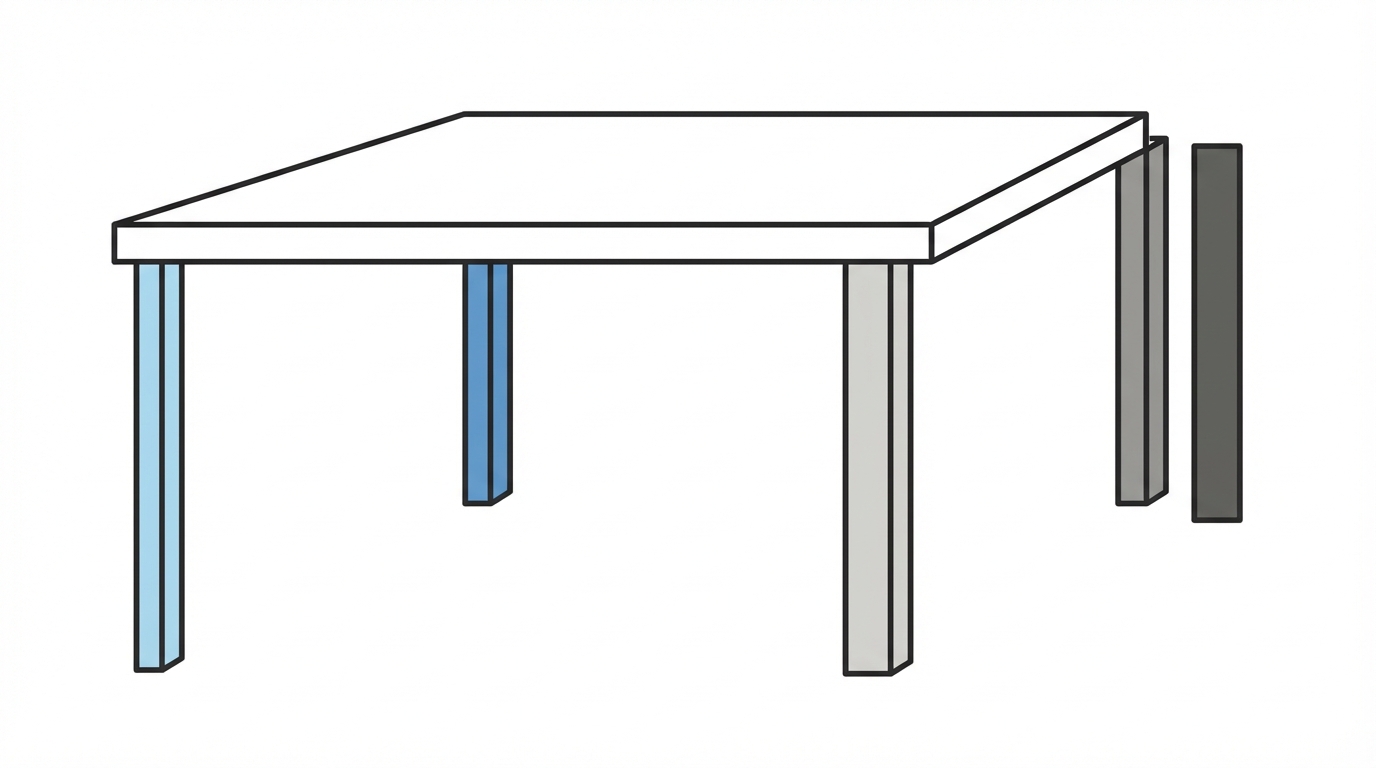
Choosing what to work on is the first step; choosing who to work with is the second. Most people rely on the Warren Buffett framework for partner selection, which focuses on three qualities: Intelligence, Energy, and Integrity. Without integrity, intelligence and energy just create a smart crook. However, Puri adds a critical fourth leg to the stool: The "Downness" Factor.
A partner who is "down" is someone who is willing to try half-baked ideas, buckle down through periods of intense grind, and choose the more interesting story over the safe path. Shaan points to his partnership with Ben, who left a profitable business to join a random side project simply because he was "down" for the adventure. This Shaan Puri partner framework suggests that compatibility in risk tolerance and curiosity is just as vital as raw talent. When you find someone who is intelligence-rich and adventurous, you create a multiplier effect on every project you touch.
The Inertia Audit: Breaking the Cycle of Stagnant Projects
Objects in motion stay in motion unless acted upon by an outside force. In business, this is called inertia. Many entrepreneurs continue working on a failing or mediocre project simply because they started it yesterday. To combat this, you must regularly perform an Inertia Audit.
The test is simple: If this project closed tomorrow, would I pick up the phone and restart it exactly as it is today? If the answer isn't a "hell yes," then you are only doing it because of inertia. Shaan recalls a casino-night intervention with a friend who asked him, "I don't get why you're working on something that's just okay." This forced him to realize that despite having a beautiful office and a private chef, he was working on the wrong thing. He decided to sell or end the company within 45 days, prioritizing a clean slate over a comfortable but uninspiring routine.
The Rule of 100: Building Skill Mass Through Volume


While project selection is the most important variable, you still need the skills to execute. Jimmy Donaldson, better known as MrBeast, advocates for the "Rule of 100." Most people want to be successful on YouTube, but few are willing to make 100 videos, improving one specific thing in every single one. By the time someone reaches their 100th video with this mindset, they no longer need advice—they have developed skill mass.
This applies to any pursuit, from coding to sales to finding creators and vetting profiles on Stormy AI for app growth. High volume with intentional improvement builds a "flywheel." By using Stormy’s AI-powered quality reports to instantly analyze audience demographics and detect fraud, you can iterate through hundreds of potential partners with high precision. As you get better, the work becomes more fun. Because it's fun, you do it more often. Because you do it more often, you get even better. This ensures that the work itself becomes the win, rather than some hypothetical future payoff.
The Work as the Win: Creating a Sustainable Flywheel
Sustainability in business comes from a lack of friction. If you are suffering today solely for a better future, you are at risk of burning out before the payoff arrives. However, if you choose projects based on natural interest and curiosity, the work provides the energy needed to sustain it. This aligns with the advice of Naval Ravikant, who suggests looking for things that feel like play to you but look like work to others.
Shaan’s personal 5-to-9 habits—like reading annual reports of Las Vegas casinos for fun—eventually fed into the success of his podcast. He had a "giant library in his head" because he was following his nerdier impulses without a rational business reason. When you lean into your oddities, you develop a unique leverage in business that cannot be easily replicated by competitors who are just "doing it for the money." According to Derek Sivers, skills are the only thing that can't be bought or inherited; they must be earned through this kind of obsessive curiosity.
Your Playbook for High-Leverage Career Choices
To move from a cycle of hard work to a strategy of high leverage, follow these steps:
Step 1: Identify Your Superpower
Ask friends and colleagues: "What do you seek from me that comes naturally to me but is hard for others?" This is often where your greatest leverage lies. As Jerry Seinfeld famously noted, the mastery of a specific skill is the ultimate key that unlocks infinite doors.
Step 2: Audit Your Info Diet
Are you consuming the same content as everyone else? If so, you will have the same thoughts as everyone else. Differentiate your inputs to differentiate your outputs. Follow thinkers like Paul Graham who advocate for "interestingness" as a primary filter for what to work on.
Step 3: Conduct a Misogi Challenge
Borrowed from Jesse Itzler, a Misogi is a single, daunting challenge you set for the year to ensure it doesn't blend into the next. Whether it's learning piano or launching a new app, it should be a year-defining event that builds a new skill or expands your network.
Step 4: Use the Right Tools for Discovery
Don't waste energy on manual processes that AI can handle. If your project involves growth, use platforms like Stormy AI to automate your outreach. Stormy’s AI agents can handle personalized email follow-ups automatically while you sleep, allowing you to focus on the high-level strategy while the tools handle the labor-intensive discovery phase.
Conclusion: Choose Your Oars Wisely
Success is not a reward for suffering; it is a byproduct of correct project selection and effective partnership. By refusing to tolerate mediocrity and ruthlessly auditing your own inertia, you can shift your energy toward projects where the ceiling is high and the work itself is a win. Remember that most people aren't serious—if you simply decide to be a serious person who values their own opinion and their own time, you are already ahead of 90% of the competition. Stop worrying about how hard you are rowing and start making sure you are in the right boat.