In the high-stakes world of digital growth, the window of opportunity for "trending" content is shrinking from days to mere hours. While traditional marketing teams are still debating headlines in a Slack channel, a new breed of growth hackers is leveraging programmatic social media to identify gaps, generate content, and distribute it across platforms before the competition even wakes up. This isn't just about scheduling posts; it's about moving from "Chat AI" to "Action AI."
By integrating Claude Code—Anthropic’s agentic command-line tool—with sophisticated web scraping and automation workflows, brands are achieving a level of velocity previously reserved for enterprise-grade engineering teams. According to Fortune Business Insights, the social media management market is projected to reach $124.63 billion by 2032, driven largely by this shift toward autonomous, agentic systems.
The Rise of Agentic Marketing and Actionable AI
We are currently witnessing a fundamental shift in how marketing technology is consumed. We are moving from the "Browser Era," where marketers manually interacted with dashboards, to the "Terminal Era," where agentic AI executes complex technical scripts through natural language. Gartner predicts that 40% of enterprise applications will integrate task-specific AI agents by the end of 2026, a massive leap from the 5% adoption rate seen in early 2025.
This productivity explosion is underpinned by the Model Context Protocol (MCP), which allows Claude Code to "talk" directly to local file systems, Google Search, and scheduling APIs. Instead of being trapped in a chat bubble, the AI becomes a functional member of your DevOps and marketing stack. For growth hackers, this means competitive intelligence AI is no longer a passive report you read on Monday—it's an active agent that reacts to the market in real-time.
"The shift from 'no-code' to 'trust-code' means we aren't just clicking buttons; we are engineering logic that the AI executes with 100% precision."
Competitive Scraping: Integrating Claude Code with Apify
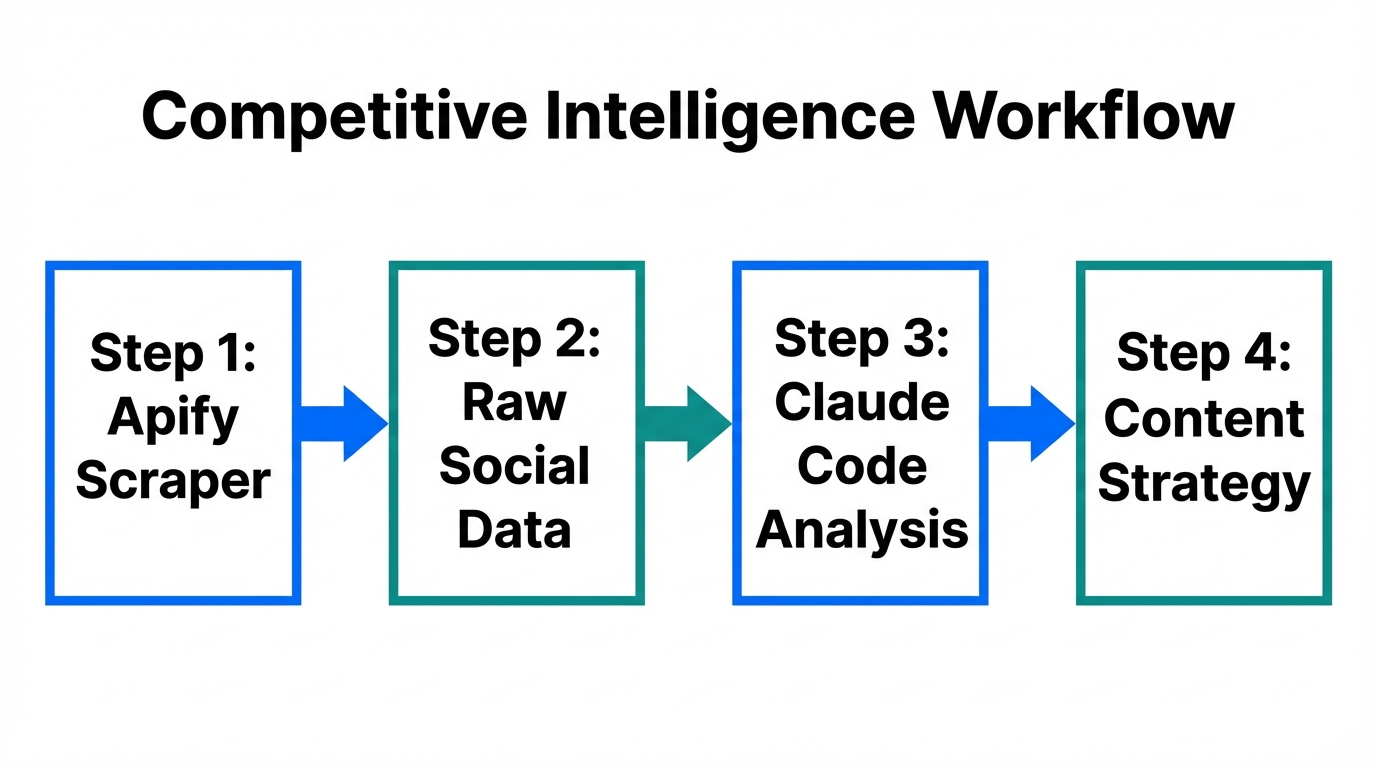
The first pillar of a programmatic social media strategy is competitive intelligence. You cannot outpace competitors if you don't know what they are doing. Traditional monitoring tools often provide delayed data. By using Apify in tandem with Claude Code, you can build a custom scraper that monitors competitor social activity and website updates every hour.
Using the Puppeteer MCP, you can instruct Claude Code to navigate to specific competitor URLs, extract their latest blog posts or social media hooks, and save them into a local JSON file. This data serves as the raw fuel for your content engine. This approach allows you to identify "content gaps"—topics your competitors are mentioning but failing to explain deeply—which you can then target with your own automated response strategy.
| Strategy Phase | Traditional Method | Programmatic Method |
|---|---|---|
| Discovery | Manual scrolling & spreadsheets | Automated scraping via Apify |
| Analysis | Subjective human review | Claude Code gap analysis |
| Execution | Writing & approval cycles (2-3 days) | Agentic generation (Minutes) |
| Distribution | Manual dashboard uploads | Zapier/Late API webhooks |
Automated Response Content: Writing at Scale
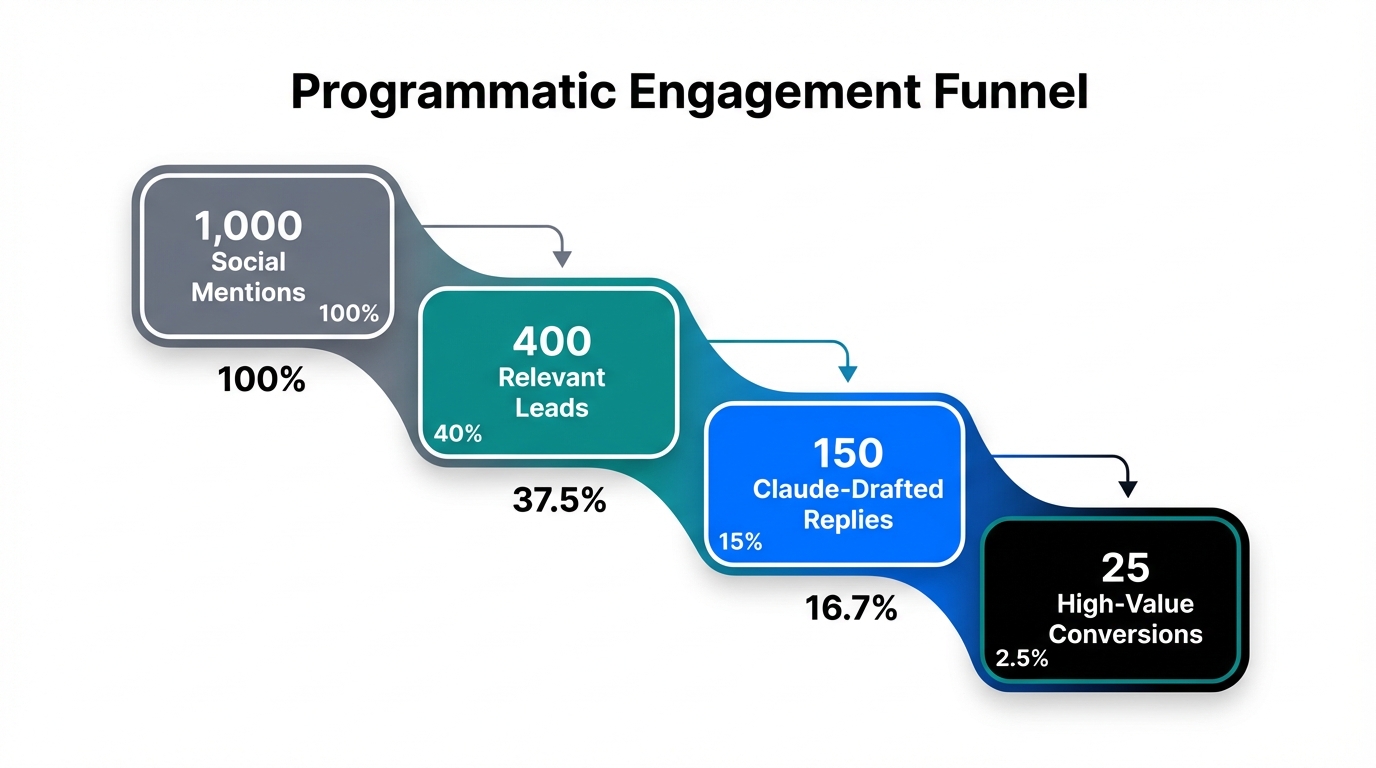
Once your scraping agents have identified a trend or a competitor's move, the next step is content generation. This is where most brands fail by producing generic, "AI-sounding" fluff. To avoid this, you must implement a CLAUDE.md file in your project root. This documentation file defines your brand voice, content pillars, and post constraints, ensuring that Claude Code stays "on-brand" even when working autonomously.
Before executing any scripts, growth hackers should leverage Plan Mode (accessed via Shift + Tab in the CLI). You can ask Claude to: "Design a multi-platform distribution plan for this trending topic, including X threads, LinkedIn articles, and YouTube scripts." This step is critical for reducing hallucinations and ensuring the AI understands the automated marketing workflow before it starts writing code or content.
When generating content, it is vital to avoid "platform blindness." 56% of marketers already use AI, according to SurveyMonkey, but many make the mistake of posting identical copy across all channels. Your Claude Code scripts should be instructed to modify structures—for example, removing hashtags for LinkedIn while generating punchy, high-engagement hooks for X (formerly Twitter). To find the right creators to model these hooks after, platforms like Stormy AI streamline creator sourcing and outreach, providing a library of high-performing content structures to feed into your AI.
"Marketing automation tools yield an average ROI of $5.44 for every $1 invested, but only if the content resonates with the specific nuances of each platform." [Source: Nucleus Research]
Building a Review Gate: The Human-in-the-Loop
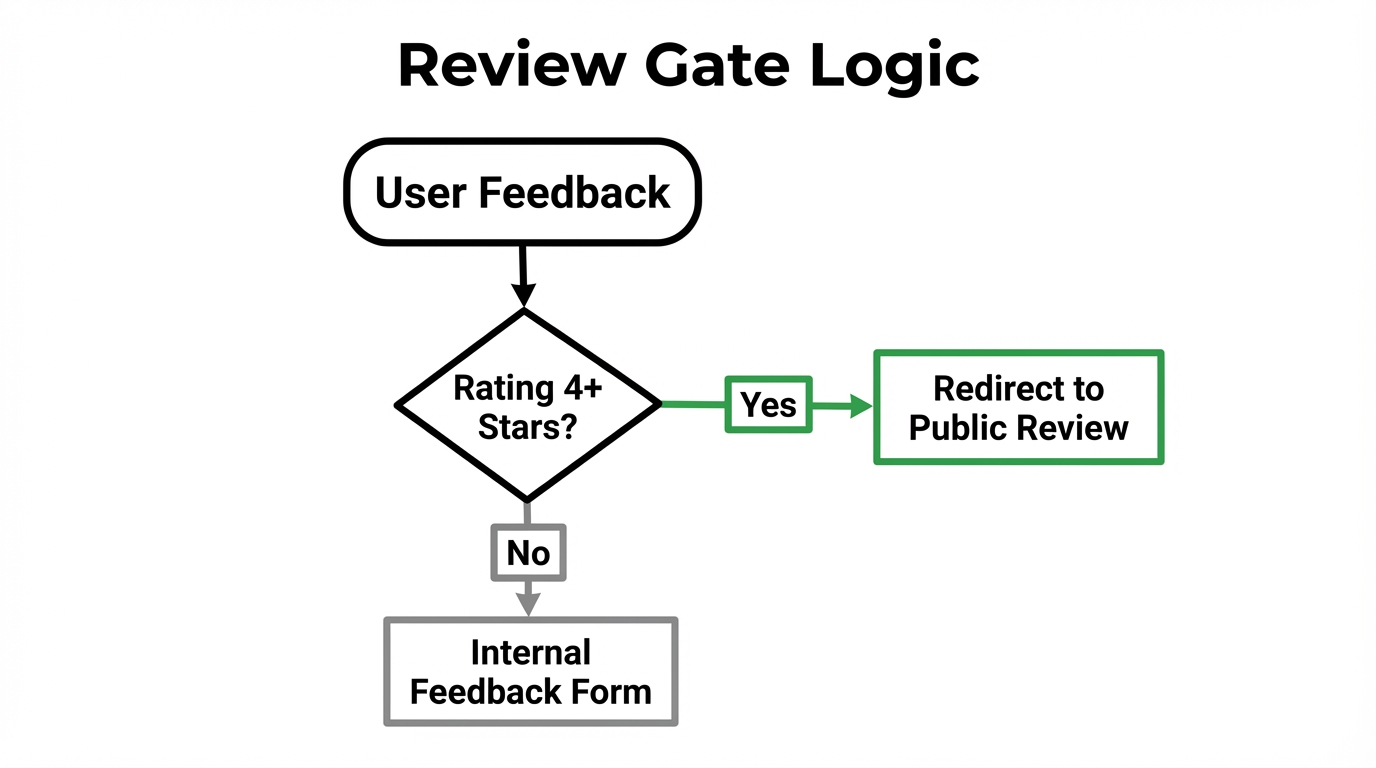
The biggest risk in programmatic social media is over-automation. A "set it and forget it" mentality leads to the dreaded "bot look," which can decimate brand trust. Experts suggest the 80/20 Rule: 80% automated distribution and 20% manual engagement. To enforce this, you need a Review Gate.
Instead of letting Claude Code post directly to social media, use n8n or Zapier to create a "Draft for Approval" workflow. When Claude finishes a batch of posts, it sends a payload to a Slack channel. A human team member reviews the copy, makes any necessary tweaks, and clicks a "Publish" button. This human-in-the-loop quality check ensures that while the volume is programmatic, the vibe remains human.
Workflow Automation: The Growth Hacker's Playbook
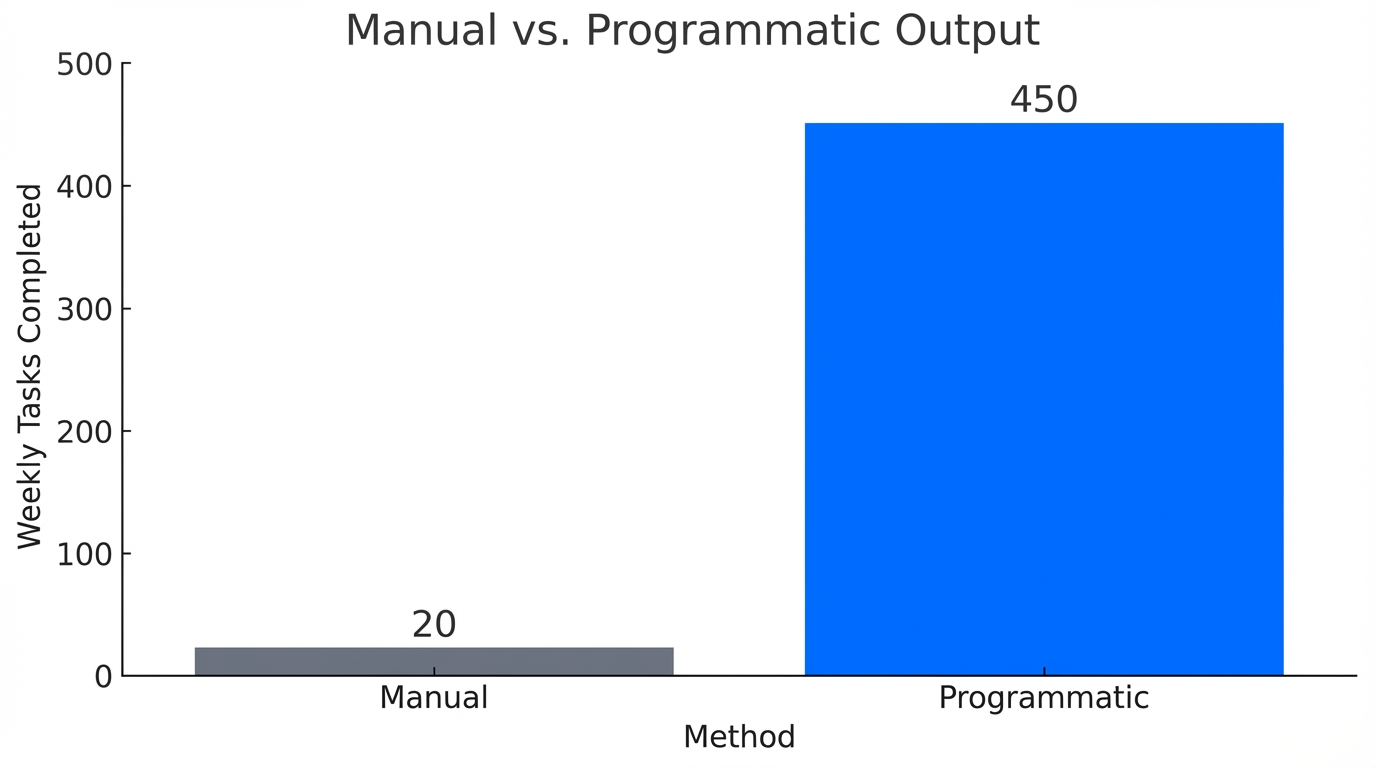
To move from theory to execution, follow this 4-step Claude Code integration playbook:
- Step 1: Trend Research via MCP: Use the Google Search MCP server to have Claude scan for hourly news in your niche.
- Step 2: Topic Cooldown Check: Instruct the AI to check your internal database to ensure you haven't posted about this topic in the last 72 hours.
- Step 3: Platform-Specific Generation: Generate content tailored for LinkedIn, X, and TikTok, using Templated for any automated image generation needs.
- Step 4: The Hands-Off Post: Send the finalized, approved content to the Late API. This serves as the "hands" for Claude, allowing it to hit "Schedule" on Instagram and LinkedIn without a human ever opening a dashboard.
For agencies looking to scale, platforms like Stormy AI provide the essential infrastructure to discover which influencers are already winning in these trending niches, allowing you to pair programmatic content with high-velocity UGC campaigns.
Scaling Growth: From 'No-Code' to 'Trust-Code'
Modern agencies are moving away from bloated no-code stacks that require constant manual maintenance. Instead, they are moving toward trust-code—where natural language executes complex technical scripts through tools like Claude 3.5 and 3.7 Sonnet. These models are consistently rated higher for bug-free code generation on Reddit /r/ClaudeAI, making them the preferred choice for building custom API connectors.
One workflow developed at the GenAI Skills Academy demonstrates the power of this shift: by pointing Claude Code at a YouTube transcript, marketers can automatically generate a full week of multi-platform content. What used to take 20+ hours of manual labor now takes 5-6 hours of initial setup and then runs autonomously.
Conclusion: The Future is Programmatic
The era of manual social media management is ending. To outpace competitors, growth hackers must embrace programmatic social media strategies that combine the speed of web scraping with the intelligence of agentic AI. By leveraging Claude Code integration and automated workflows, you can ensure your brand is always at the forefront of the conversation.
Success in 2025 and beyond requires a balance: use AI for the heavy lifting and high-velocity distribution, but keep a human hand on the tiller for brand integrity. Start by building your first CLAUDE.md file today and connecting your scraper to a review gate—the future of your growth depends on it.