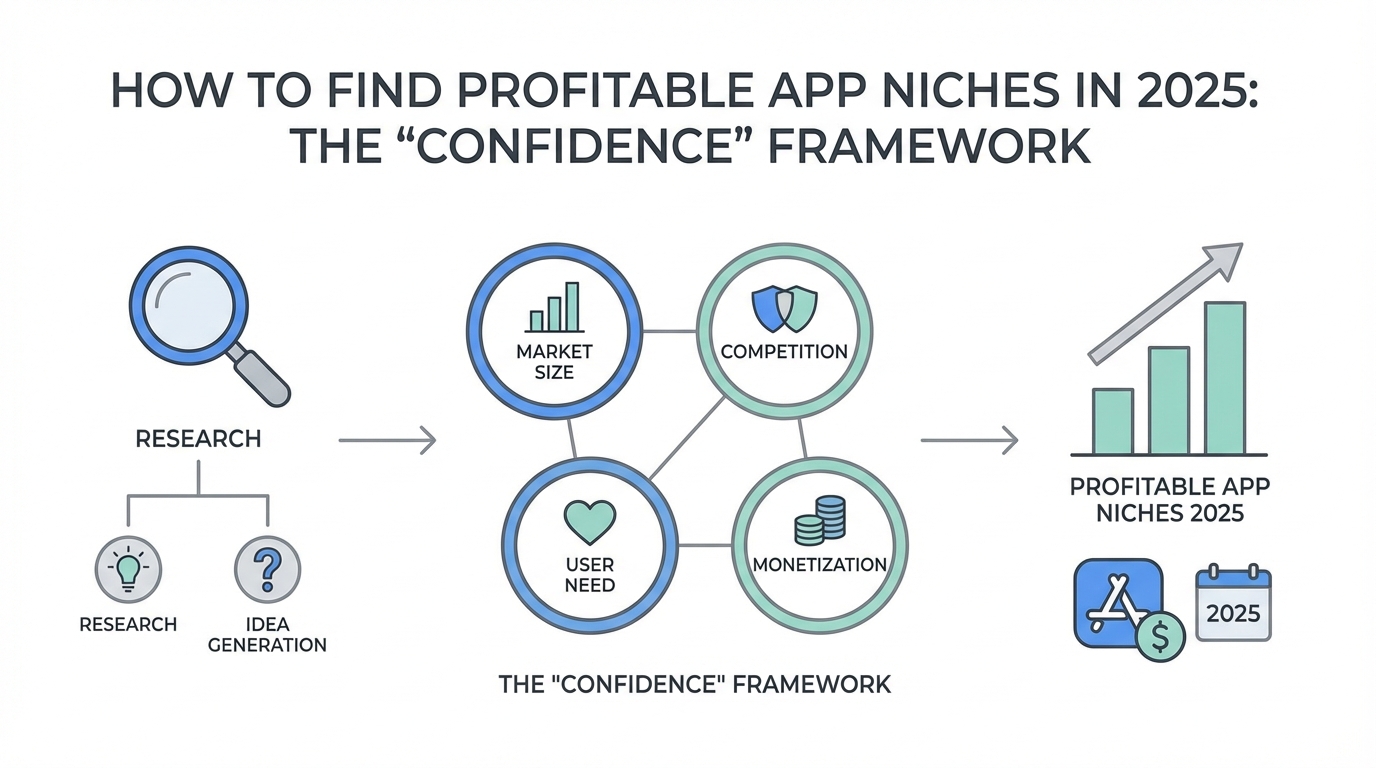
The mobile app landscape in 2025 is no longer about who can build the most complex tool; it is about who can solve the most deep-seated emotional needs through AI app development ideas. While many developers focus on features and technical specifications, a new generation of founders is generating millions in revenue by looking past the utility and focusing on the underlying emotional outcome. According to Statista, the AI market is projected to reach hundreds of billions by 2030, and builders are uncovering profitable app niches that were previously hidden in plain sight. In this guide, we will break down the 'Confidence' Framework—a methodology used by successful founders to build and scale apps to $1.5 million in revenue in less than a year.
The 'Selling Confidence' Concept: Moving Beyond Features

Most mobile app ideas 2025 fail because they focus on a logical utility rather than an emotional transformation. When performing app market research, the most successful founders use the "Extrapolation Method." This involves taking a basic feature and asking, "What is the ultimate purpose of this for the user?" For example, a calorie tracker isn't just a database of food; it’s a tool for body image. A social skills app isn't just a text generator; it’s a vehicle for social acceptance. Successful apps like Social Wizard, which generated over $60,000 in monthly recurring revenue (MRR) shortly after launch, succeeded because they targeted the user's lack of confidence in social situations.
When you use tools like Google Ads to research keywords, you'll find that people don't just search for "how to text a girl." They are searching for a way to feel more capable and less anxious. By positioning your app as a confidence-builder, you instantly differentiate yourself from thousands of utility-first competitors. This emotional resonance is what allows for weekly subscription models of $10 or more, because the value of confidence far outweighs the value of a simple text-generation script. Platforms like Stormy AI can help you identify creators who already speak to these emotional pain points, making your market entry much smoother. Stormy AI is an AI-powered platform for creator discovery, especially for mobile app marketing and UGC campaigns.

The 'Extrapolation Method' for Finding a Product's True Purpose
To find profitable app niches, you must look at a category like health and fitness and dig deeper. Take the app Clean Eats as an example. On the surface, it’s a barcode scanner for food. However, the app market research behind it revealed a specific segment of users: women aged 18 to 28 who were terrified that certain foods would cause acne or weight gain. By marketing the app as a tool to protect skin health, the founder tapped into a much more powerful motivator than general "health." This is the essence of the Extrapolation Method.
When evaluating AI app development ideas, ask yourself: what is the 10x version of this benefit? If you're building a productivity app, you're not selling a calendar; you're selling the freedom from overwhelm. If you are targeting the Meta Ads Manager audience for a finance app, you aren't selling a budget tool; you're selling financial security. This shift in positioning dictates everything from your App Store screenshots to your app monetization strategies. High-margin apps often boast profit margins over 90% because they solve problems that users are willing to pay for on a weekly or monthly recurring basis, as noted in recent Apptopia insights on mobile trends.
Analysis of 2025 Education and Health AI Opportunities
In 2025, the education niche is massively overlooked. While health and fitness are crowded, the application of AI to specific skill acquisition is a goldmine for mobile app ideas 2025. Think beyond traditional language learning. There is a massive demand for AI-powered coaching in physical skills like boxing, swimming, or even persuasion. According to reports by HolonIQ, the integration of AI into specialized education is accelerating rapidly. Users are looking for personalized feedback loops that traditional video courses cannot provide. By integrating LLMs (Large Language Models), you can create an interactive tutor that helps users master a craft, providing the emotional benefit of mastery.
The health niche is also evolving. We are moving away from general wellness and toward hyper-specific biological outcomes. AI apps that scan barcodes to predict skin reactions or hormone disruptions are the next wave of profitable app niches. You can validate these ideas by looking at Apple Search Ads to see which specific health terms have high intent but low app coverage. For instance, "gut health" or "skin-safe food" are keywords with growing volume that haven't been fully captured by a dominant AI player yet. Using Stormy AI to find UGC creators in these health sub-niches can give you an immediate distribution edge.
How to Use X (Twitter) and App Store Trends to Validate Ideas
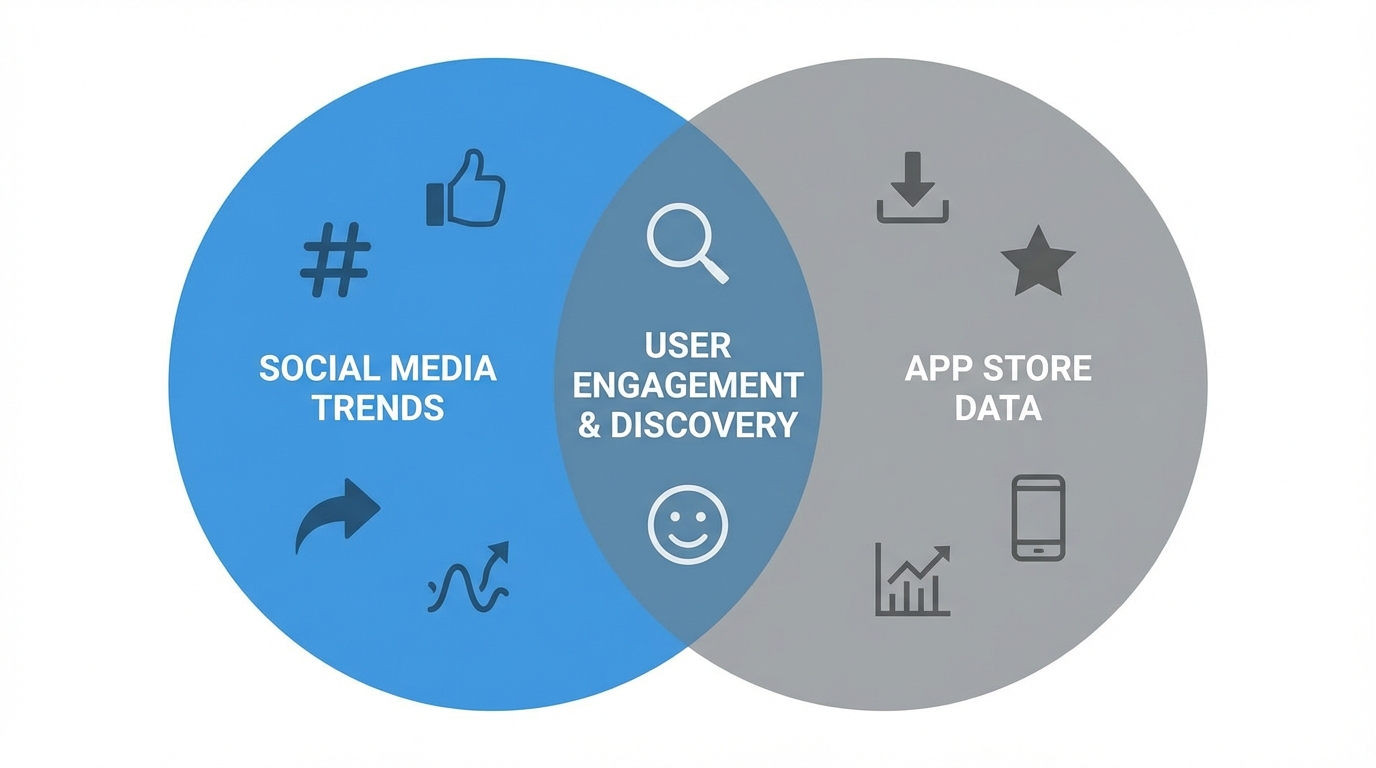
Before writing a single line of code in React Native or setting up a Firebase database, you must validate the demand. X (formerly Twitter) is a real-time laboratory for app market research. Look for individuals sharing their revenue milestones or complaining about existing tools. If a founder mentions they are making $1 million a month from a simple social app, it’s a signal that the market has massive depth. However, don't just copy them—find the underserved sub-demographic within that success story.
Next, dive into the App Store and search for broad terms like "advice" or "life coach." If the results are outdated or have poor UI/UX, you’ve found an opening. The goal is to find AI app development ideas where the demand is high but the current solutions are "low-tech." When a high school audience or a specific niche on X starts caring about a prototype you've built, you have found product-market fit. This was the case for Social Wizard; it began as a NestJS script for personal use before it was polished into a $1M+ app. Always prioritize distribution potential over technical complexity during this phase.
The Distribution-First Playbook: A Step-by-Step Guide
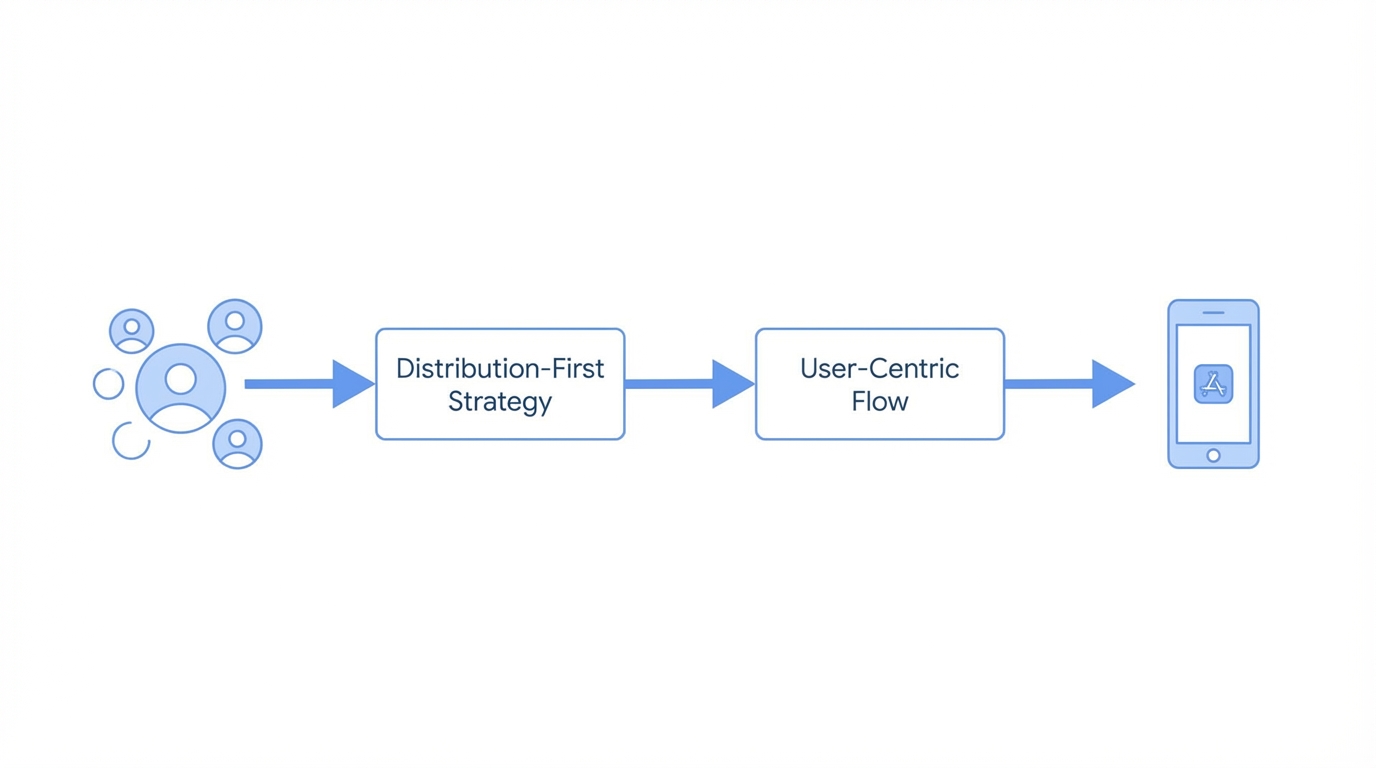
In the current market, product development is not enough. You must solve distribution before you even finish the product. The most successful app monetization strategies rely on organic virality and creator partnerships rather than heavy spend on paid ads. Here is the playbook for scaling your app using a volume-based distribution strategy.
Step 1: The Niche Content Audit
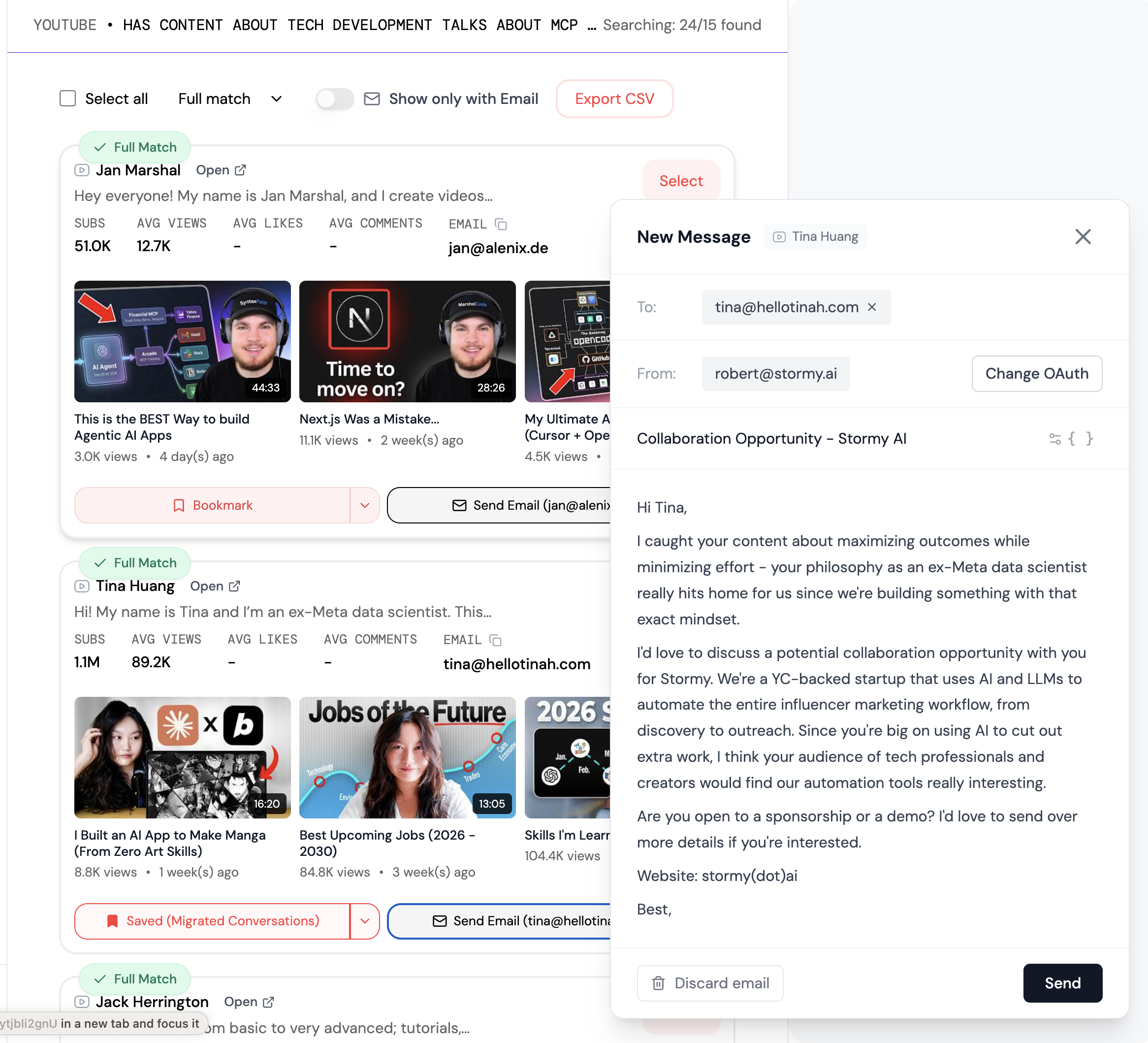
First, identify if your niche already has a high volume of content on platforms like TikTok and Instagram. If there is a large volume of content, your goal is to partner with mid-sized creators. If the niche is quiet, you must become the primary content creator yourself. Do not outsource this early phase; you need to learn the viral hooks that resonate with your target audience. Use Stormy AI to identify micro-streamers or creators who are hitting your target demographic but aren't yet saturated with brand deals.
Step 2: Produce High-Volume Content
Distribution is a volume game, not a luck game. Start by creating two accounts and posting three videos a day. The goal is to reach a volume where virality becomes deterministic. If you are putting out 100 videos a week across various creators and accounts, the chance of one hitting 2 million views increases exponentially. Focus on "Show, Don't Tell." Instead of explaining the app, show a screen recording of the app solving a relatable problem in real-time. For example, showing an AI generating a witty reply to a difficult DM is more effective than any voiceover advertisement.
Step 3: Scale Through Adjacent Creators
Once you find a format that works, scale it across adjacent niches. If you have a fitness app, don't just work with gym influencers; work with cooking creators or lifestyle streamers. These "degenerate" or micro-streamers often have highly engaged audiences that are overlooked by larger brands. For a small investment—sometimes as low as $120 per video—you can achieve a massive ROI that brings in tens of thousands of dollars in revenue. This hyper-efficient distribution—best managed through a modern tool like Stormy AI to track partnerships and performance—is the secret to maintaining 90% profit margins as a solopreneur.
Maximizing Profit: Tech Stack and Monetization
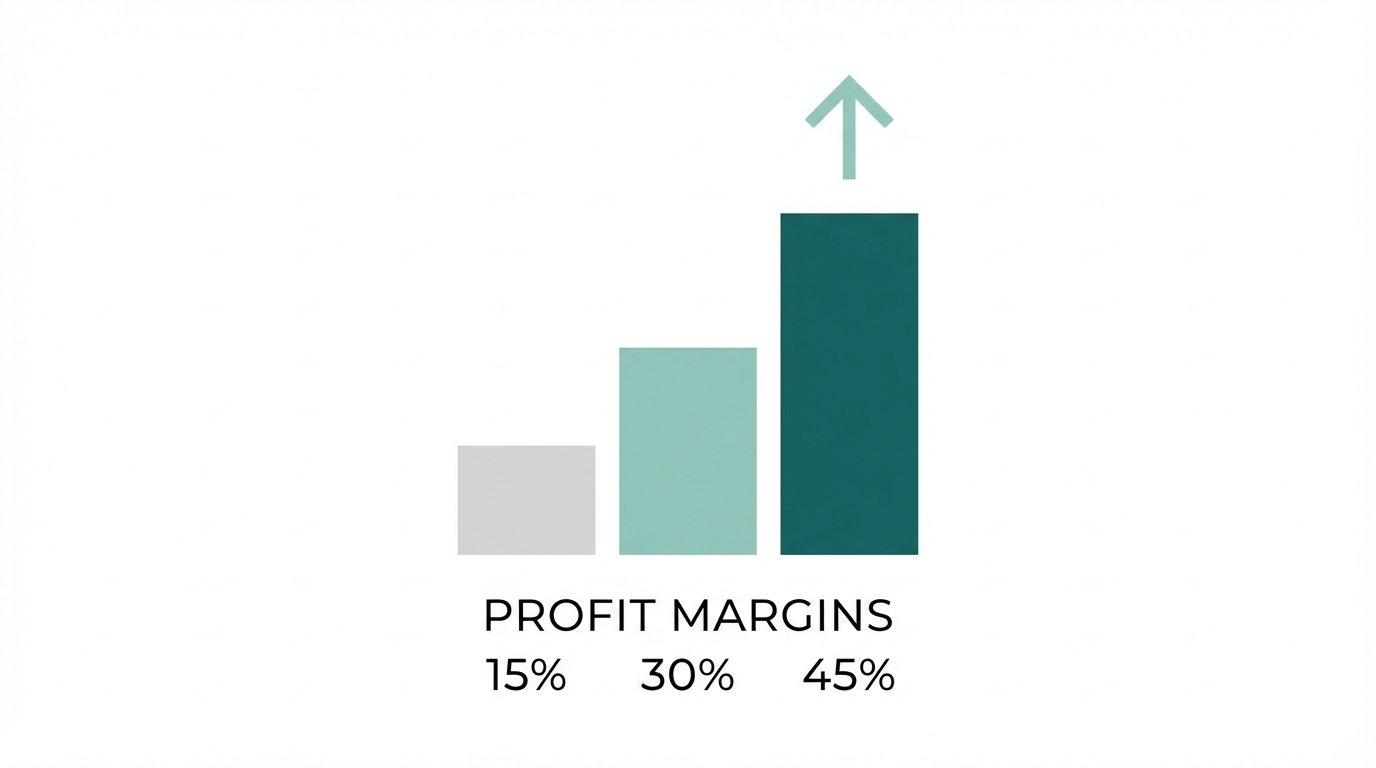
For AI app development ideas to be profitable, the overhead must be kept low. A lean tech stack like React Native for the frontend, NestJS for the backend, and Firebase for the database allows for rapid deployment and high scalability. By using Meta Ads Manager only sparingly and focusing on organic creator growth, you can keep your infrastructure costs as low as $1,000 to $2,000 per month, even while generating $60,000 in revenue.
Regarding app monetization strategies, the weekly subscription model is proving to be highly effective in 2025. Offering a $10 weekly sub alongside $20 monthly and $80 yearly options allows you to capture high-intent users who want an immediate solution to their problem. Analytics tools like Mixpanel are essential here to track where users drop off in the funnel, allowing you to optimize for the highest possible conversion rate from download to paid subscriber.
Conclusion: Building for Emotional Outcomes
Finding profitable app niches in 2025 requires a shift from being a developer to being an emotional architect. By using the 'Confidence' Framework, you can identify mobile app ideas 2025 that resonate on a primal level with users. Whether you are exploring the AI-driven education space or hyper-specific health sub-niches, remember that the most successful apps sell a transformation, not just a task. Prioritize distribution from day one, leverage the power of micro-streamers and UGC creators, and remain obsessed with the data. If you can show a user how to be more confident, healthier, or more skilled through a simple 15-second video, you have the foundation of a million-dollar business.