Predictive Churn Prevention: How to Set Up AI Customer Win-Back Email Flows on Shopify in 2026
Master predictive churn in 2026. Learn to set up Shopify AI win-back flows using exit signals, behavioral triggers, and automated sunsetting to boost retention.
In the hyper-competitive e-commerce landscape of 2026, waiting 90 days to send a "We Miss You" email is no longer a strategy—it is a eulogy for a lost customer relationship. The era of "blunt-force marketing" has been replaced by precision retention, where AI doesn't just react to a customer leaving, but predicts their departure weeks before it happens. For Shopify merchants, the ability to identify predictive churn signals and trigger automated, hyper-personalized win-back flows is the difference between a thriving brand and a declining storefront.
By shifting from static time-based triggers to behavior-driven predictive churn Shopify models, brands are seeing unprecedented results. According to research from Shopify, automated win-back emails now achieve 2,361% higher conversion rates compared to manual, scheduled campaigns. The technology has evolved from simple "if-then" logic to sophisticated neural networks that analyze individual purchase cycles, sentiment, and engagement velocity.
Identifying 'Exit Signals' in 2026: The Data Science of Retention
In 2026, customer churn signals are more nuanced than a simple lack of purchase. AI-driven platforms now monitor "exit signals"—subtle shifts in behavior that indicate a waning interest in the brand. These signals include declining email open rates, a reduction in site session frequency, and even the cessation of interactions with loyalty programs. If a customer who usually visits your store twice a week suddenly hasn't logged in for 10 days, the AI marks this as a red flag.
Instead of generic segments, tools like Klaviyo use "Segments AI" to isolate customers predicted to never purchase again. This allows marketers to create high-stakes "Hail Mary" flows for at-risk segments while maintaining a lighter touch for those just experiencing a temporary lull in their buying cycle.
"The secret to retention in 2026 isn't the size of the discount; it's the timing of the intervention. Triggering a flow at a 70% probability of churn beats a 20% discount sent too late."
Moving from Reactive to Proactive: The 70% Probability Rule
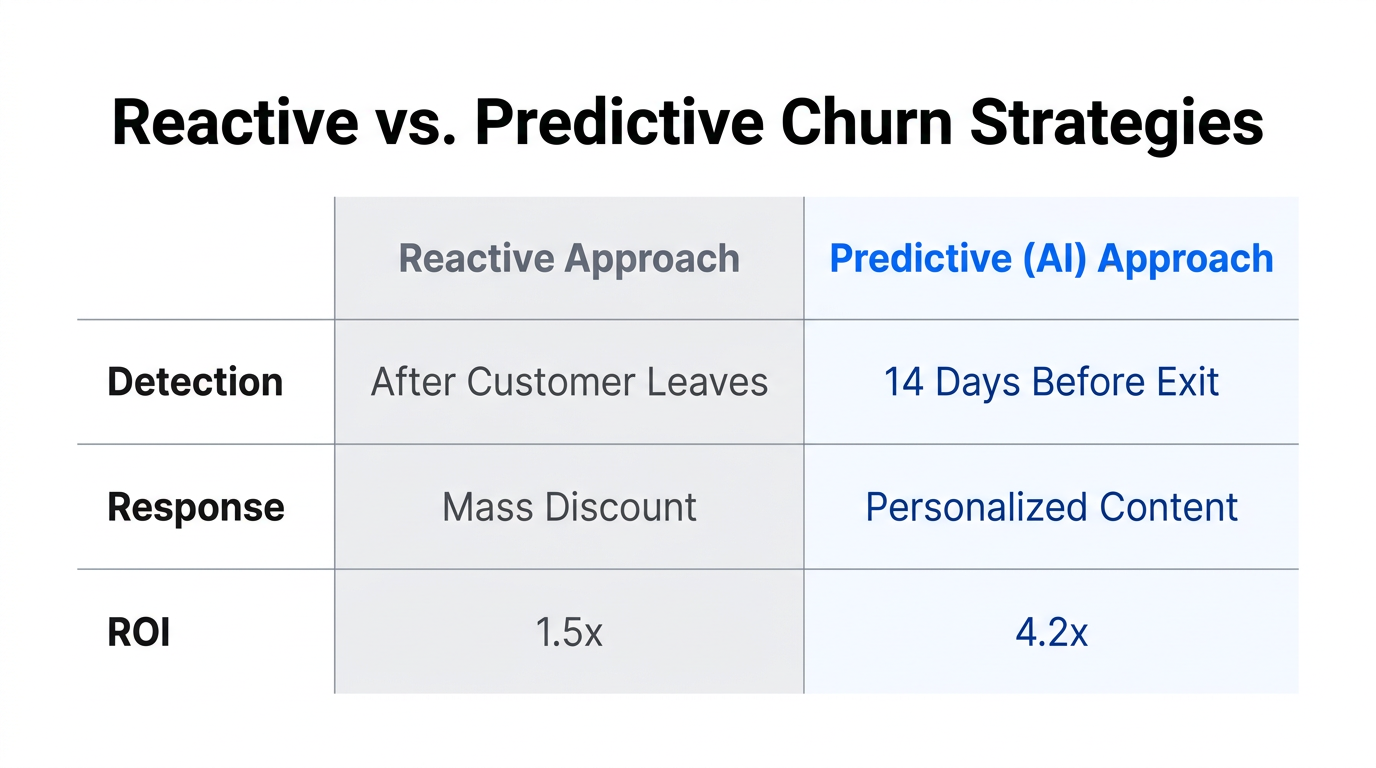
Traditional win-back strategies are reactive—they wait for the customer to become "inactive" before firing. AI retention marketing 2026 flips this script. By utilizing e-commerce predictive analytics, Shopify stores can trigger win-back flows when the AI detects a 70% probability of churn. This proactive approach ensures you are top-of-mind before the customer builds a new habit with a competitor.
| Feature | Reactive (Old School) | Proactive AI (2026) |
|---|---|---|
| Trigger | Static (e.g., 90 or 180 days) | Behavioral probability (70% churn risk) |
| Timing | Standard for all users | 1.5x individual Average Order Frequency |
| Content | Generic "We Miss You" | Dynamic product recommendations |
| Conversion Rate | Low/Baseline | Up to 2,361% higher |
To implement this, you must calculate your store’s Average Order Frequency (AOF). Experts suggest setting your AI trigger to 1.5x your AOF. For example, if your average customer buys every 30 days, your AI win-back should fire at 45 days of inactivity, rather than waiting for an arbitrary 90-day milestone. This ensures the re-engagement happens while the brand is still fresh in the consumer's memory.
The Role of AI Sunsetting: Protecting Your Sender Reputation
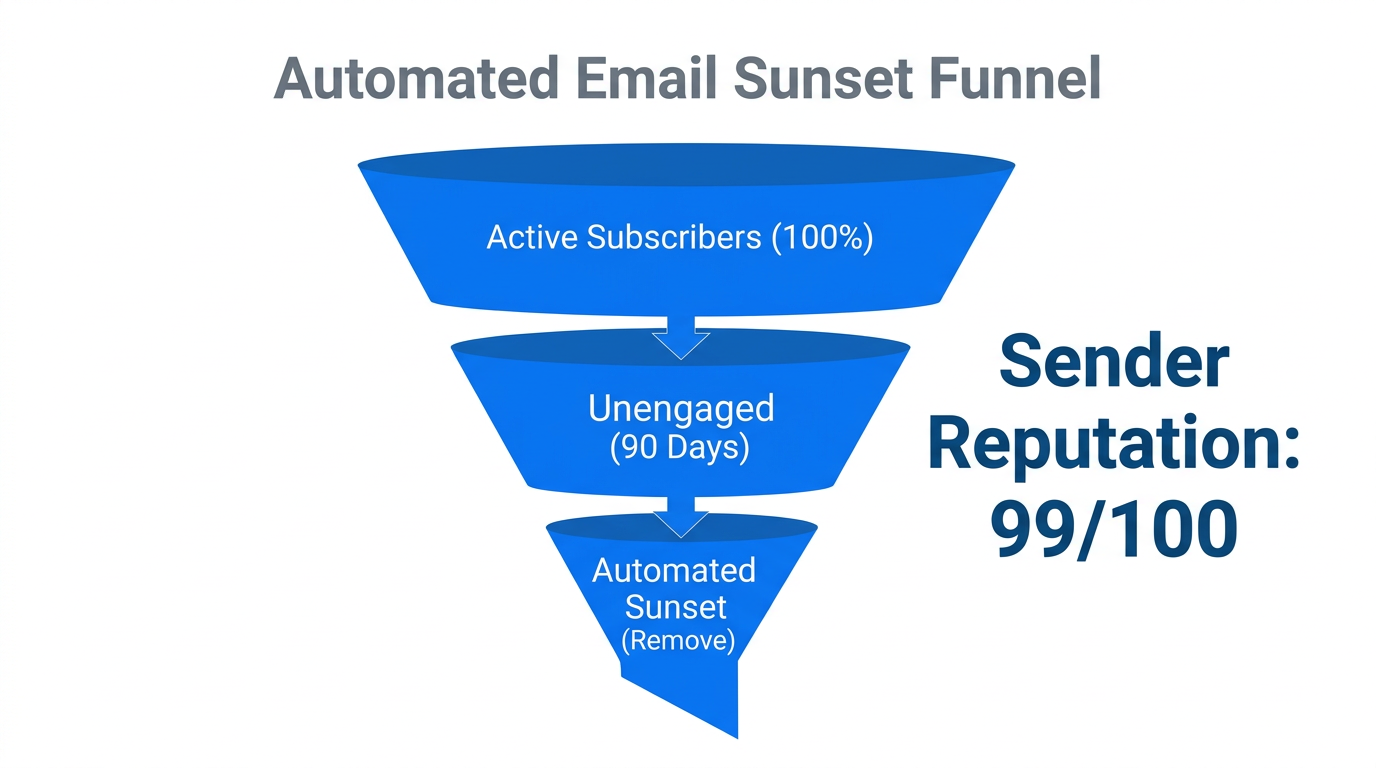
A critical but often overlooked component of Shopify AI automation is the "sunset flow." Sending win-back emails to "dead" accounts—users who haven't opened an email in over a year—is a fast track to the spam folder. AI sunsetting automatically suppresses unengaged contacts after 4–5 failed win-back attempts. This protects your sender reputation and ensures your emails actually reach the customers who are likely to buy.
Using Klaviyo or similar AI-powered ESPs, you can set up logic that identifies "unreachable" or "uninterested" segments. Instead of deleting them, the AI moves them to a lower-frequency list or attempts a final re-engagement via a different channel, such as personalized SMS via TxtCart. If these fail, the account is automatically suppressed to maintain high deliverability for your active core audience.
"Deliverability is the foundation of retention. If your win-back emails are landing in 'Promotions' or 'Spam,' your predictive models are worthless."
Case Study: Weather-Based Behavioral AI Triggers
One of the most impressive examples of AI retention marketing 2026 comes from the apparel industry. On Sportswear utilized behavioral AI to track the local weather conditions of their lapsed subscribers. When the AI detected rain in a churn-risk customer’s specific city, it triggered a win-back email featuring waterproof running gear and "rainy day" motivation.
The results were staggering: a 537% increase in Click-Through Rate (CTR). This level of 1:1 personalization makes the email feel like a helpful suggestion rather than an intrusive advertisement. By integrating external data points like weather, local events, or even influencer content discovered via Stormy AI into the win-back flow, brands can create a truly immersive customer experience.
The 3-Phase AI Win-Back Playbook
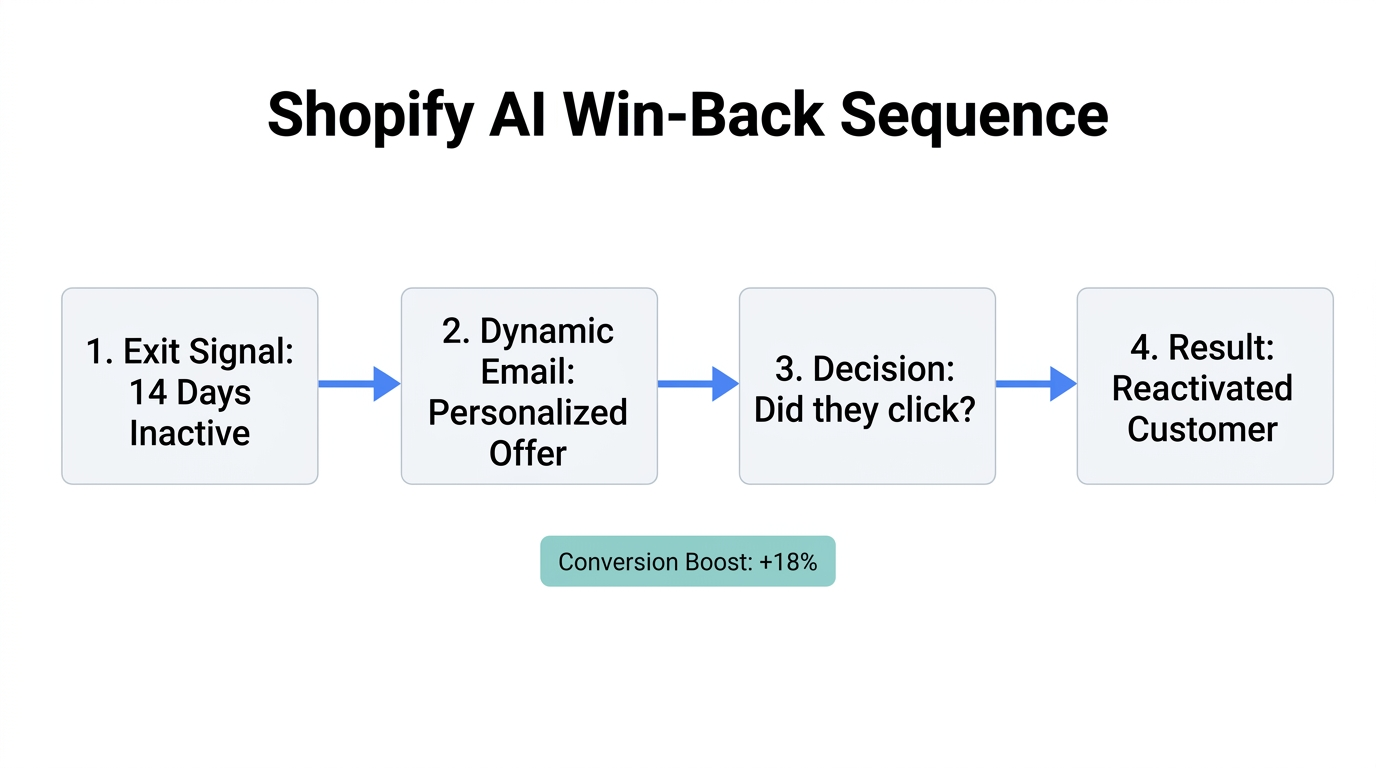
To build a high-performing flow in 2026, follow this structured AI logic. Each phase should be branched based on the customer's Lifetime Value (LTV) and previous support history found in tools like Gorgias.
- Phase 1: The "Soft" Check-In (Triggered at 70% Churn Risk)
Focus on storytelling or education. Avoid discounts here to prevent "training" customers to wait for sales. Share "What's New" or a "Did you know?" story about the brand's mission. - Phase 2: The Personalized Offer (7–14 Days Later)
The AI generates a dynamic unique discount code. High-LTV customers might receive a $20 gift card, while lower-value customers get free shipping or a 10% coupon. Use an AI product recommendation engine like SmartrMail to insert items based on their browsing history. - Phase 3: The Feedback Loop (Final Attempt)
If no purchase occurs, the AI sends a survey asking why they left. This data is fed back into your CRM and e-commerce predictive analytics engine to refine future segments and product development.
For brands looking to scale this outreach beyond email, integrating AI agents can be a game-changer. Just as Stormy AI uses autonomous agents to handle creator outreach, Shopify brands are using tools like Wiz AI to manage 24/7 customer re-engagement across multiple channels.
"In 2026, your win-back flow is your brand's second chance at a first impression. Make sure it's powered by data, not just dates."
Conclusion: Building a Resilient Retention Engine
Setting up predictive churn prevention on Shopify is no longer a luxury reserved for enterprise brands. By 2026, AI tools have become accessible enough for any merchant to implement behavior-based triggers and automated sunsetting. The key is to start with your data: understand your Average Order Frequency, identify your unique "exit signals," and deploy a multi-step flow that prioritizes value over discounts.
By integrating tools like Klaviyo for segmentation, Gorgias for customer sentiment, and even Stormy AI for sourcing fresh UGC to fuel your re-engagement creatives, you can build a retention engine that works while you sleep. Don't wait for your customers to leave—use AI to invite them back before they ever say goodbye.