In the hyper-competitive mobile ecosystem of 2025, the traditional methods of App Store Optimization (ASO) are no longer enough to guarantee visibility. We have moved past the era of static keyword lists and simple title tagging. Today, success is determined by a developer's ability to anticipate user behavior before the search query is even typed. Enter predictive ASO and agentic workflows. By leveraging advanced AI tools like Claude Code, marketers can now transition from reactive adjustments to proactive, automated growth strategies that capitalize on Answer Engine Optimization (AEO) and semantic intent.
The Evolution of App Discovery: From Keywords to Intent
The scale of the digital marketplace is staggering. As of early 2025, the Apple App Store hosts over 2.2 million apps, while Google Play boasts approximately 3.7 million. With such a massive volume of competition, the stakes for discovery are incredibly high. Data from Sensor Tower reveals that roughly 70% of all app installs originate directly from app store searches, making ASO the most critical pillar of any mobile marketing strategy.
However, the algorithms governing these searches have evolved. They no longer just look for exact keyword matches; they prioritize semantic intent. This means the stores are rewarding apps that satisfy a user's underlying need rather than those that simply repeat a high-volume term. High-converting creative assets driven by intent-aligned keywords can increase install rates by up to 95%, according to research by Dot Com Infoway. To compete, marketers must shift toward mobile marketing automation to manage these complex semantic clusters in real-time.
"The shift from keyword density to semantic intent means we are no longer optimizing for algorithms, but for the complex psychological triggers of the user."
Agentic ASO: The Power of Claude Code
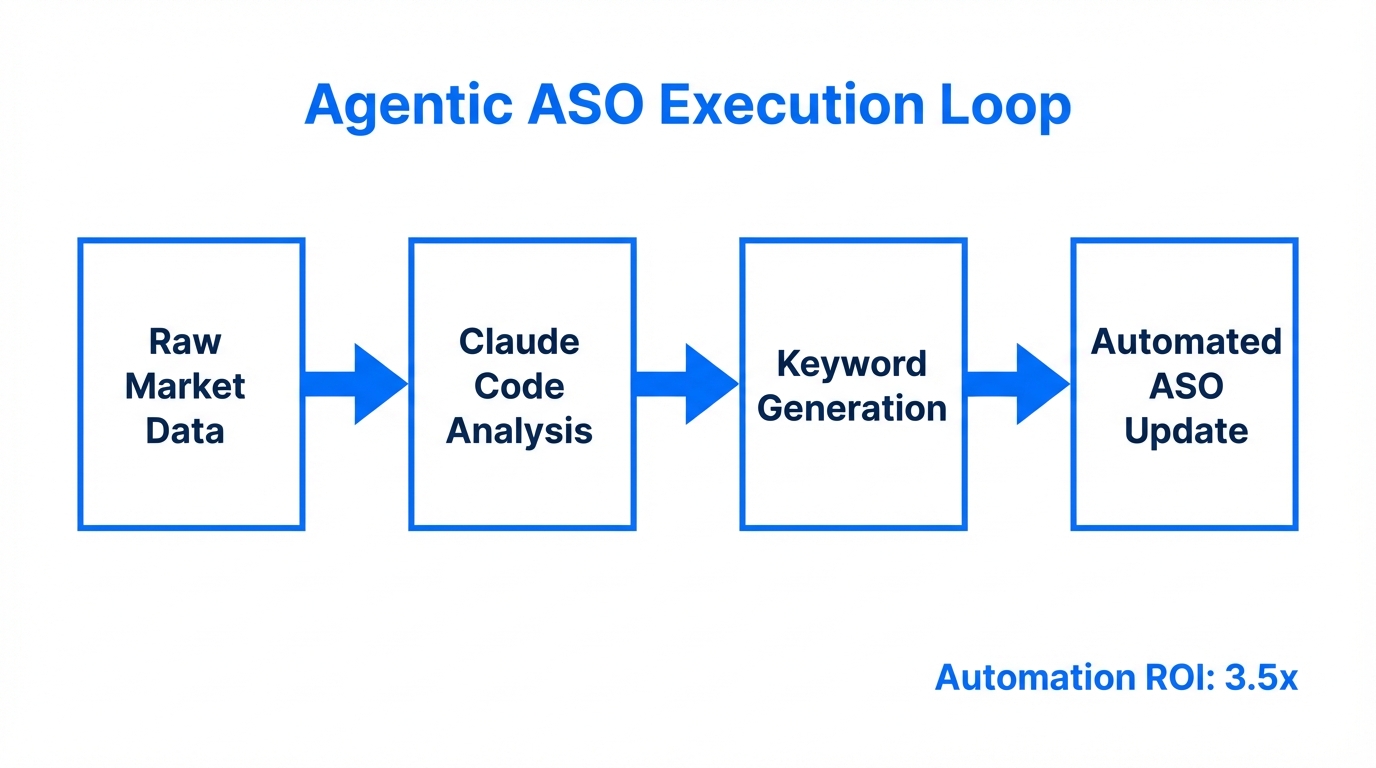
While standard LLMs like ChatGPT are useful for brainstorming, the next frontier is agentic AI. This refers to AI that doesn't just talk, but acts. Claude Code, Anthropic’s official CLI tool, is a prime example. Unlike a standard chatbot, Claude Code can execute terminal commands, edit your app's metadata files directly, and use the Model Context Protocol (MCP) to fetch live search data from the web.
This capability transforms ASO from a manual monthly chore into a continuous, automated process. Instead of spending days on competitor gap analysis, developers can use agentic tools to build an entire strategy in minutes. For instance, developers at NoCode SaaS utilized Claude Code to automate competitor research that previously took an entire week, completing it in just 20 minutes.
Setting Up Your Agentic ASO Environment
To begin using Claude Code for ASO, you must first install the CLI and equip it with the necessary "senses" to view live market data. Follow this professional setup guide to get started:
- Install the CLI: Run
to get the tool on your local machine via npm.npm install -g @anthropic-ai/claude-code - Add Live Data Capabilities: Connect to SerpAPI to allow Claude to pull live Google and App Store search results.
- Integrate ASO-Specific Tools: Use specialized servers like the ASO-MCP, which provides 13 distinct tools for keyword discovery and traffic scoring.
| Feature | Traditional ASO | Agentic ASO (Claude Code) |
|---|---|---|
| Keyword Discovery | Manual Search / Spreadsheets | Real-time API Scraping |
| Competitor Analysis | Static Monthly Reports | Continuous Delta Monitoring |
| Metadata Updates | Manual Console Entry | Automated File Generation |
| Trend Prediction | Historical Data Analysis | AI Predictive Modeling |
Predicting Interest Spikes with Social Data
One of the most powerful applications of predictive ASO is identifying "interest spikes" before they hit the app store. Often, a trend begins on social media—TikTok, Instagram, or YouTube—and results in a surge of app store searches hours or days later. By integrating social media trend data with app store queries, Practical Logix suggests that marketers can capture traffic that their competitors aren't even aware of yet.
This is where social intelligence meets ASO. For example, if a specific fitness challenge goes viral on TikTok, users will immediately head to the App Store searching for "30-day plank challenge app." A brand using Stormy AI to monitor creator trends and social mentions can feed that data into Claude Code. The AI agent can then automatically suggest metadata updates to include these emerging terms, ensuring the app is indexed by the time the search volume peaks.
"Predictive ASO isn't about looking at where the puck is; it's about using AI to see where the puck is going to be based on fragmented social signals."
Answer Engine Optimization (AEO) and Voice Search
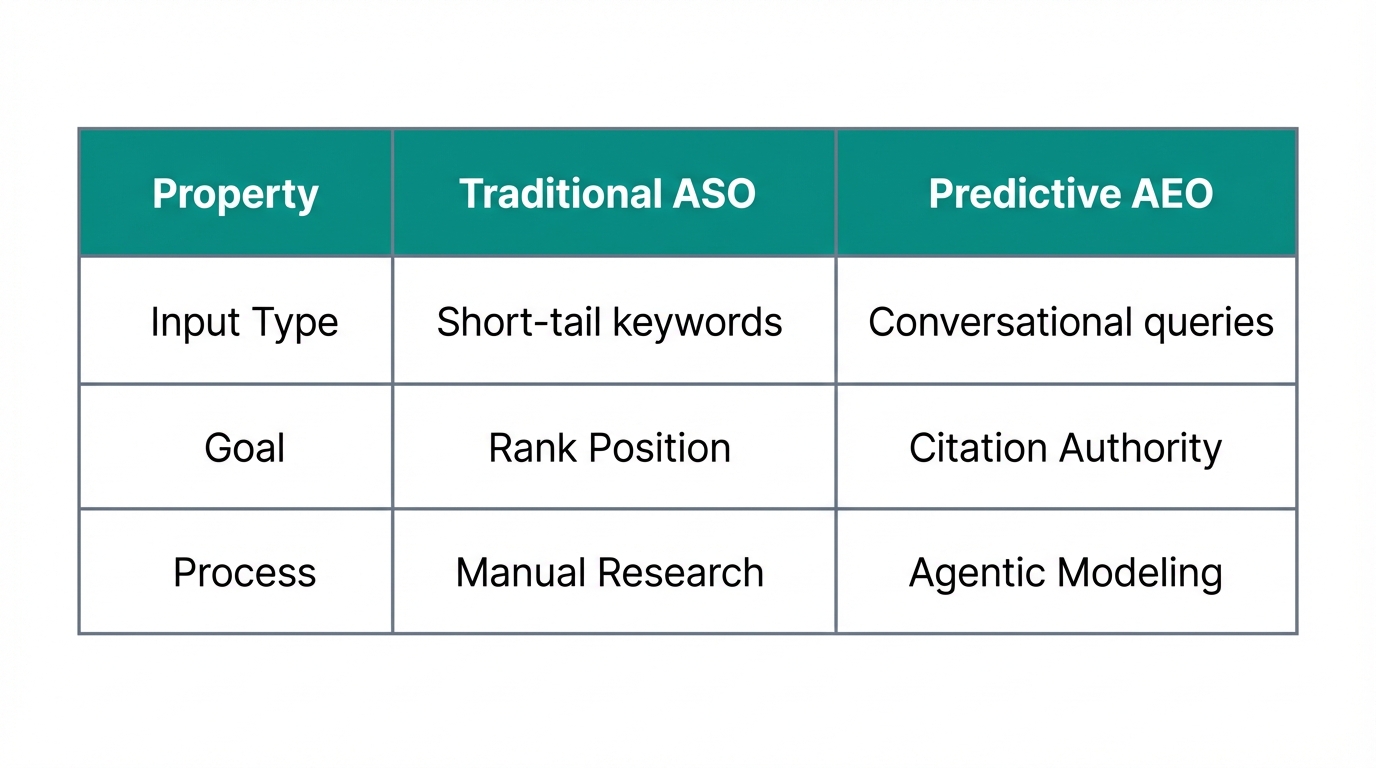
The way users interact with app stores is changing. With the rise of Siri, Google Assistant, and AI-powered search bars, we are seeing a massive shift toward Answer Engine Optimization (AEO). Users are no longer just typing "budget app"; they are asking, "What is the best budget tracker for a freelance graphic designer?"
Optimizing for these long-tail, natural language queries requires a deep understanding of conversational linguistics. AI agents can analyze thousands of user reviews to find the exact phrasing customers use. A case study involving a health app showed that by identifying a specific request for "Hindi local recipes" in reviews and adding it to the metadata, the app saw a 12% increase in conversion in the Indian market within just 30 days, according to Appbirds.
Actionable Workflow: Real-Time Metadata Adjustments
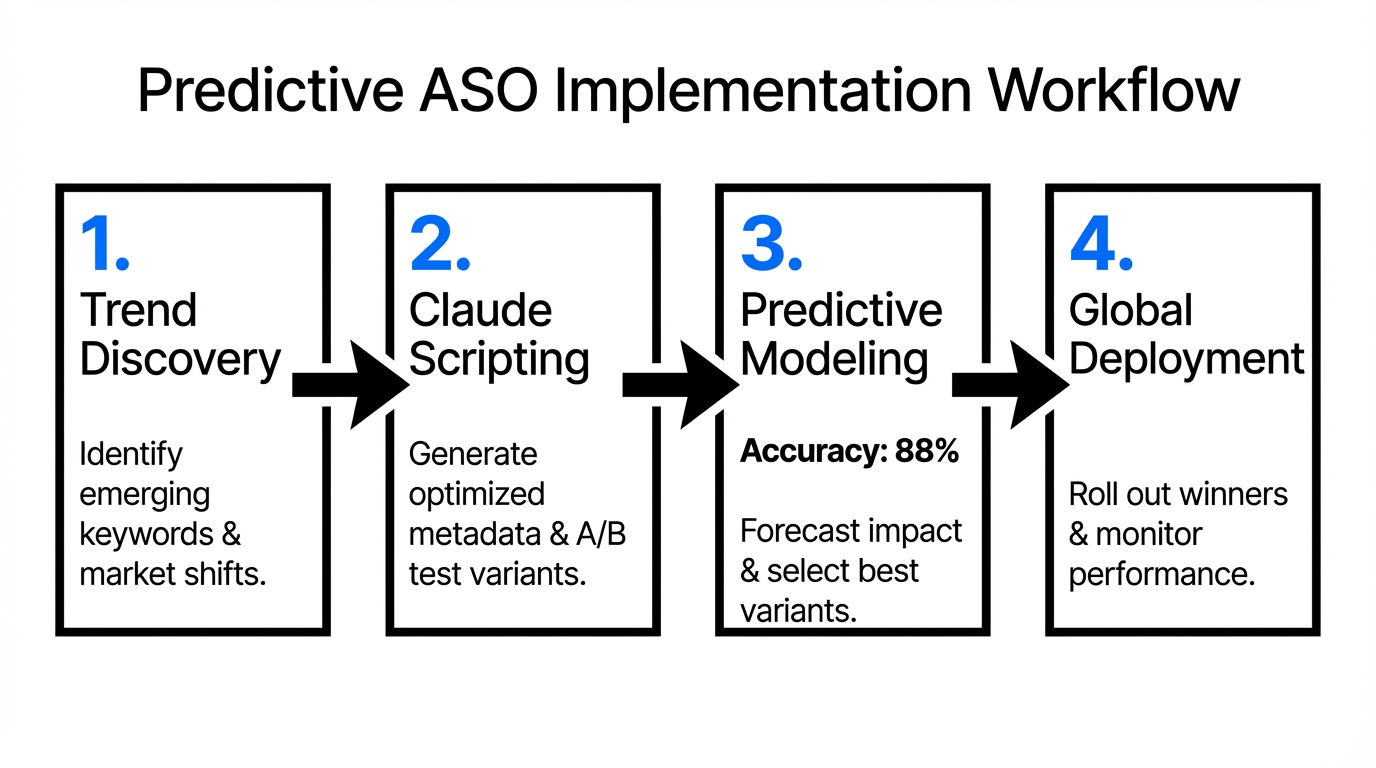
To implement a predictive ASO strategy that actually moves the needle, you need a repeatable playbook. Here is how to use agentic AI to maintain a 3-month roadmap in under 20 minutes:
Step 1: Data Ingestion
Prompt Claude Code to scan the top 50 trending apps in your category using an MCP connection to Sensor Tower or MobileAction. Ask it to identify the "Semantic Authority" of each leader—what specific niche do they own?
Step 2: Social Signal Cross-Referencing
Feed recent social media engagement data into the model. Platforms like Stormy AI can help you source which creators are driving the most conversation in your niche. If "productivity for ADHD" is trending on TikTok, the agent should flag this as a high-priority semantic cluster.
Step 3: The 6 Circles Research Method
Instruct Claude to score every potential keyword based on six dimensions: Relevance, Difficulty, Volume, Conversion Potential, Competitor Gap, and Semantic Authority. This ensures you aren't just chasing high-volume terms that are too difficult to rank for.
Step 4: Automated Localization 2.0
Move beyond literal translation. Use Claude to perform "cultural resonance" checks. As FoxData points out, literal translations often miss the idiomatic keywords real users type. Claude can suggest local slang and contextually relevant terms for 150+ markets instantly.
Avoiding Common AI Mistakes in ASO
While mobile marketing automation is powerful, it is not infallible. There are several traps that even experienced marketers fall into when using AI for ASO:
- Ignoring Real-Time Data: Never rely on an LLM's internal training data for keyword volume. Always use an MCP like SerpAPI to get live numbers.
- Keyword Stuffing: Modern algorithms, particularly on iOS, penalize poor readability. Always prompt your agent to "write for humans, optimize for machines."
- Over-Automation: While AI can generate the metadata, a human should always perform the final Conversion Rate Optimization (CRO) check. As Marina Roglic of TapNation suggests through AppAgent, CRO is now the primary growth engine as metadata impact stabilizes.
The Future of Predictive Growth
The transition to predictive app marketing is no longer a luxury; it is a necessity for survival in a crowded marketplace. By combining the agentic capabilities of Claude Code with the strategic insights of Answer Engine Optimization, developers can create a self-sustaining discovery engine. Success in 2025 and beyond requires a tech stack that is as dynamic as the users it serves. Start by automating your research, linking your social signals, and optimizing for the questions your users are actually asking. The future of ASO is agentic—ensure your app is ready to lead the charge.