In the world of modern marketing, there is a pervasive myth that quality is the enemy of speed. Founders and marketing leads often spend months polishing a single campaign, a single product feature, or a single landing page, convinced that if they just get it 'perfect,' the market will respond with a standing ovation. But the reality of product-led growth and sustainable brand building is far more counterintuitive. The path to quality isn't found through refinement; it is found through prolific, messy, and relentless quantity.
The Pottery Experiment: Why the Quantity Group Wins
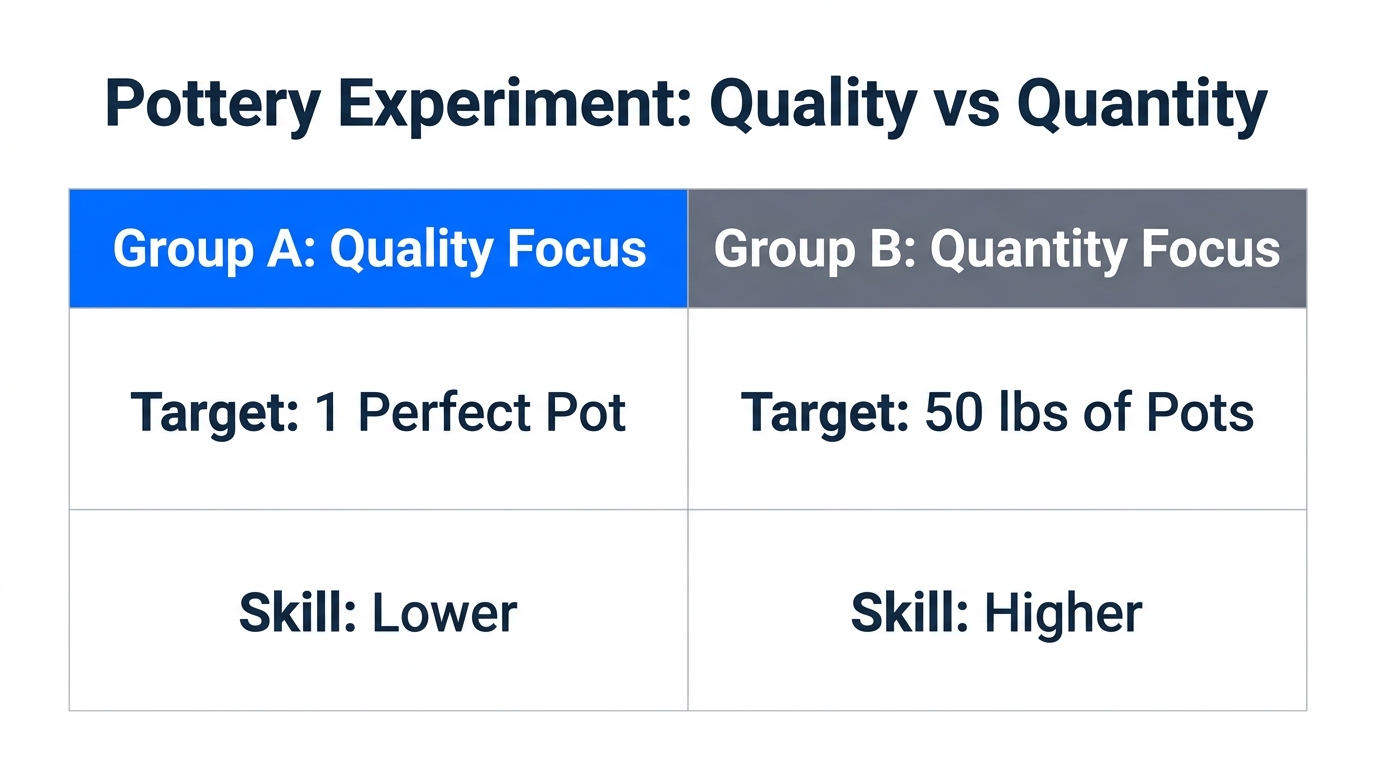
There is a semi-famous story, often cited in creative circles, about a ceramics professor in Florida. He divided his class into two groups for a semester-long project. The first group, the 'Quality' group, would be graded on a single piece of work. They had the entire semester to produce one perfect pot. The second group, the 'Quantity' group, would be graded solely on the weight of their output. If they produced 50 pounds of pots, they got an A; 40 pounds, a B, and so on.
As the semester ended, a fascinating pattern emerged. The finest, most artistic, and most technically proficient pots weren't produced by the 'Quality' group. They were produced by the 'Quantity' group. While the quality-focused students sat around theorizing about perfection and over-analyzing their designs, the quantity-focused students were getting their hands dirty. They were making mistakes, learning from the clay, and refining their physical skills with every failed attempt. By the time they reached their 50th pot, their 'junk' work was better than the 'masterpiece' work of the students who only tried once.
"The function of the overwhelming majority of work is simply to teach you how to make the small fraction of your art that soars."
Overcoming 'Self-Inhibition' in Marketing
Most growth experimentation frameworks fail because of 'Self-Inhibition.' This is the psychological barrier where we talk ourselves out of an idea before it even hits the market. We worry that it’s not 'on-brand' enough, or that the Meta Ads Manager creative isn't quite right. This overthinking leads to safe, boring projects that fail to cut through the noise.
To combat this, many successful founders adopt rules like the 5-second rule popularized by Mel Robbins. The premise is simple: when you have an impulse to act on a creative idea or a marketing experiment, you must physically move or start the work within 5 seconds before your brain has the chance to kill it with doubt. In an iterative marketing strategy, the goal is to reduce the time between 'idea' and 'execution' to nearly zero. This prevents the perfectionism trap that kills momentum.
The Vanta Case Study: 25 Projects to Billion-Dollar Fit
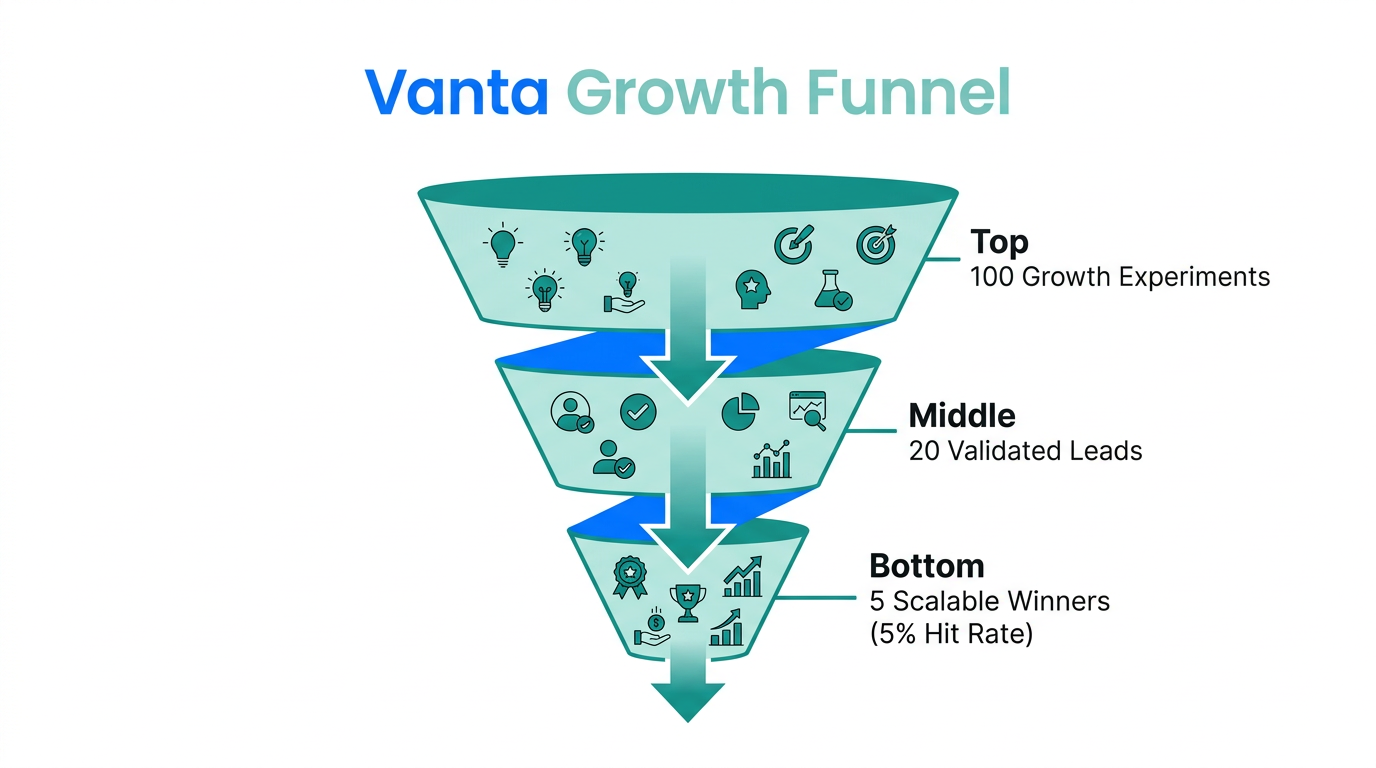
One of the most impressive examples of this 'quantity-first' mindset is Christina Cacioppo, the CEO of Vanta. Before building a multi-billion dollar company, Christina didn't just stumble upon a great idea. She treated her career like a series of laboratory experiments. She spent years building over 25 different 'mini-projects,' many of which never saw the light of day. She taught herself to code and built small tools, interactive tutorials, and spreadsheets, treating it like a full-time job.
Her breakthrough didn't come from a complex software architecture; it came from an Excel spreadsheet designed to help companies manage SOC 2 compliance. Because she had shipped so many previous projects, she had the intuition to recognize when a simple manual solution was actually a massive business opportunity. Today, Vanta is a cornerstone of the SaaS ecosystem, but it was born from the 26th 'pot' in her creative kiln.
| Approach | Focus | Risk | Outcome |
|---|---|---|---|
| Traditional | Perfection | High (All eggs in 1 basket) | Slow growth, fragile strategy |
| Iterative | Volume | Low (Diversified attempts) | Fast learning, 5% hit rate |
Measuring the 'Oven Temperature' of Your Team
When evaluating founders or marketing leads, there is a specific metric that often predicts success better than IQ or experience: output intensity, or what some call 'oven temperature.' Some people's ovens burn hotter than others; they are simply more generative. They produce more copy, test more hooks, and reach out to more partners in a week than others do in a quarter.
Take Peter Levels, the founder of Nomad List. He famously shared that out of 70+ projects he built, only 4 became significant successes. That is a 95% failure rate. If he had stopped after his 10th failure, he would have never found the projects that now generate millions in revenue. This entrepreneurial mindset requires a high tolerance for 'junk' work. In the realm of creator marketing, platforms like Stormy AI enable this high-intensity output by allowing brands to discover, vet, and outreach to hundreds of influencers in a single afternoon, effectively turning a month-long sourcing process into a daily routine.
"You don't find purpose, you create it. You don't find quality, you manufacture it through relentless quantity."
The Playbook: Setting a 'Weekly Shipping' Cadence
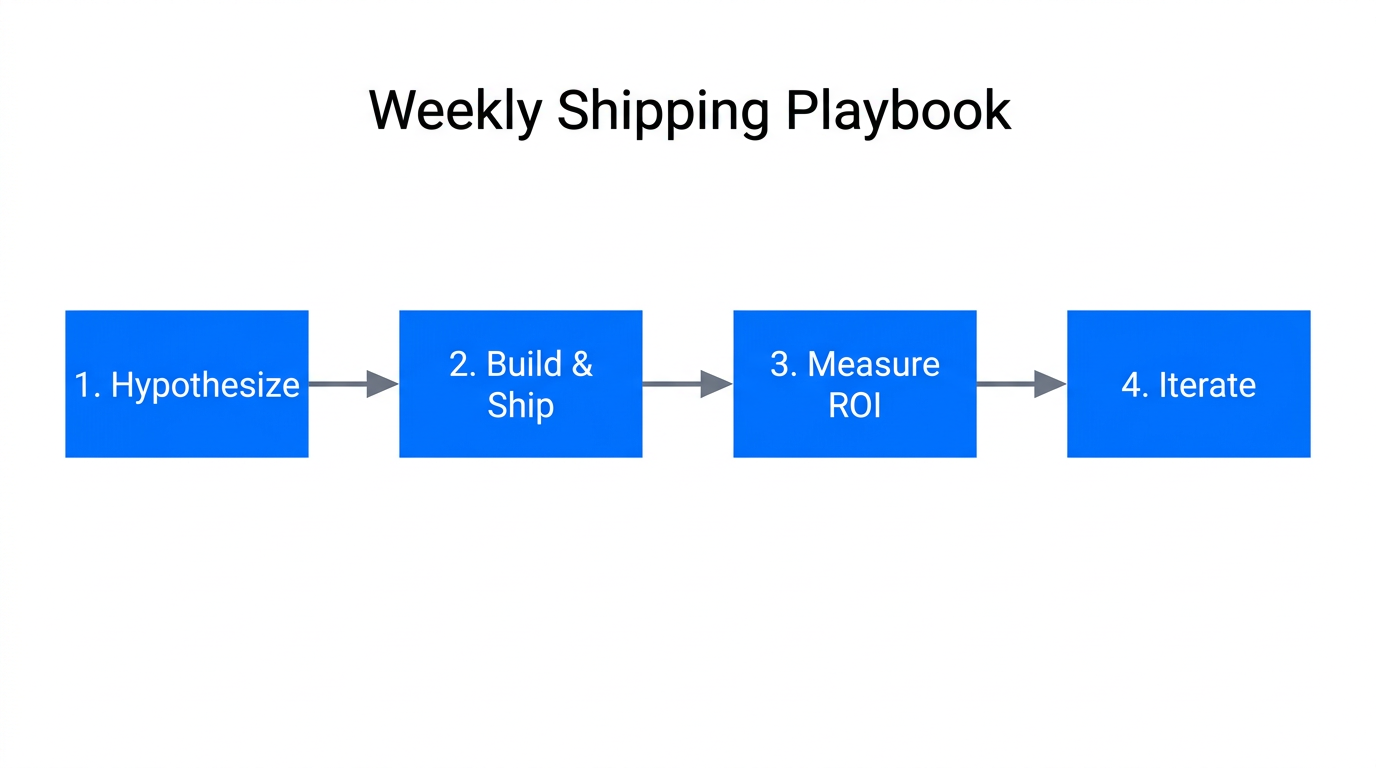
If you want to move from a 0% hit rate to a 5% hit rate, you must stop viewing your marketing as a series of grand launches and start viewing it as a shipping fast in business exercise. Here is how to structure a weekly cadence for growth:
Step 1: The Monday Idea Dump
Start every week by listing 10-20 small experiments you could run. These shouldn't be 'build a new product' level tasks. They should be 'A/B test a new headline on the home page,' 'reach out to 50 creators in a new niche using Stormy AI,' or 'launch a new set of TikTok ads with a different hook.'
Step 2: Choose Your Three Pots
Pick the three experiments that require the least amount of technical debt to ship. The goal is to maximize learning while minimizing 'waste.' Use tools like Canva for quick design and Zapier to automate the connections between your experiments and your CRM.
Step 3: Ship by Thursday
Whatever the experiment is, it must be live by Thursday. This leaves Friday for data analysis and reflection. If an experiment fails, you don't mourn it; you simply record the learning and move to the next 'pot' in the kiln.
The Path to Quality is Through Quantity
Whether you are a founder looking for product-market fit or a marketer trying to scale an app install campaign, remember the lesson of the ceramics class. The 'Quantity' group didn't just make more pots; they made better pots because they allowed themselves to learn through doing. High-output intensity is the ultimate competitive advantage.
Stop over-editing your copy. Stop waiting for the 'perfect' influencer to reply. Use tools like Stormy AI to cast a wider net, send more emails, and test more creators. By increasing your volume, you aren't lowering your standards—you are providing yourself with the raw material needed to eventually reach excellence. Start making more pots today.