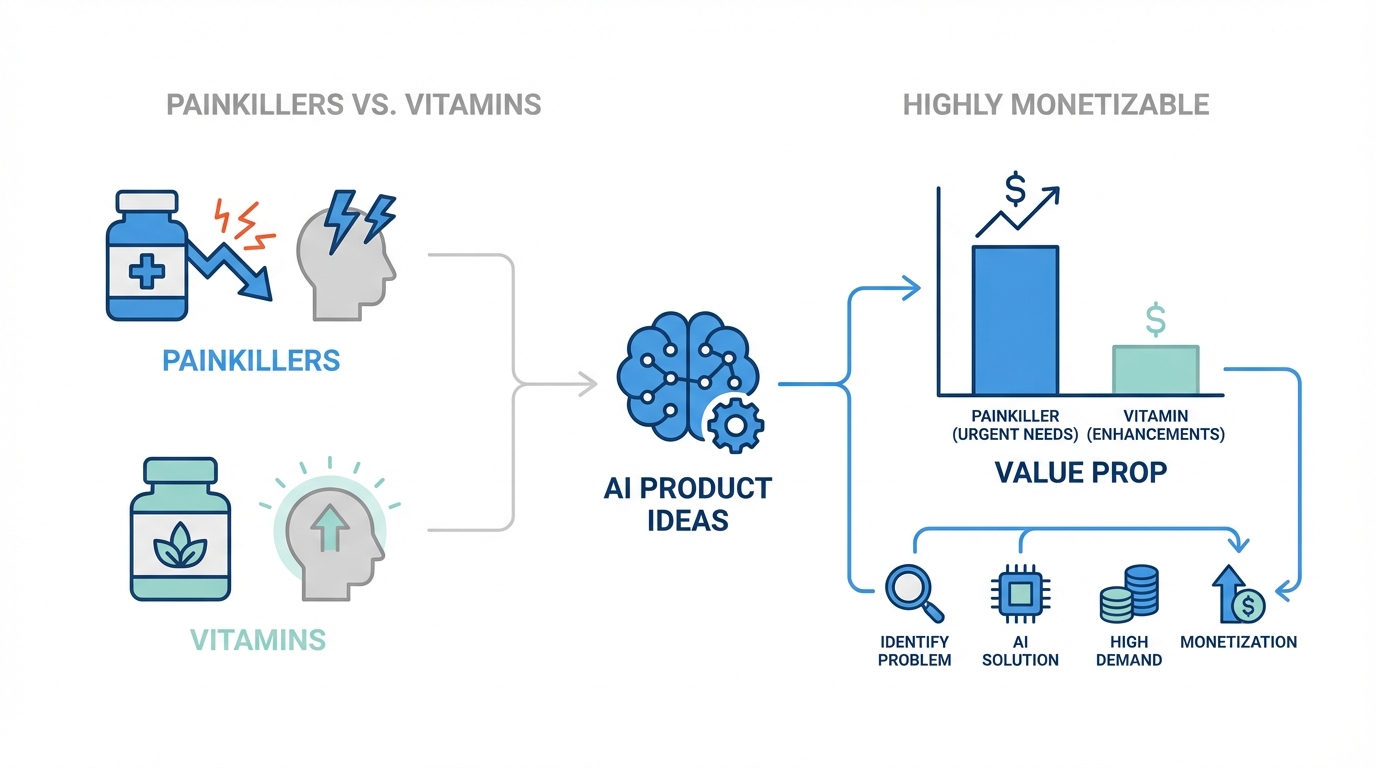
Every year, thousands of founders launch AI products that promise to make our lives marginally more efficient. They build smarter to-do lists, faster email draft generators, and automated spreadsheet organizers. Yet, a vast majority of these tools struggle to move beyond a few dozen users or ever see a dime in revenue. The reason isn't usually the technology; it is the product-market fit for AI strategy. Most of these founders are building vitamins—products that are nice to have but don't solve a burning, immediate need. If you want to build a business that prints money while you sleep, you need to stop selling vitamins and start selling painkillers. This guide explores the strategic framework of identifying profitable AI app ideas by focusing on deep-seated human problems and the 'derivative problems' created by the platforms we use every day.
The Painkiller vs. Vitamin Dichotomy in AI

In the consumer app world, products generally fall into two categories: vitamins or painkillers. A vitamin is something that improves a user's life over time. It offers incremental benefits, like 10% more efficiency or a slightly better way to organize bookmarks. These are notoriously difficult to monetize because they require the user to change their behavior and prioritize a non-urgent improvement. A painkiller, however, addresses an immediate, acute problem. When someone is in pain, they don't need to be convinced to buy a solution; they are actively searching for one. This is why consumer app monetization is significantly higher for apps that solve core human needs like romantic connection, financial security, or social status. Data from thousands of successful apps on Superwall shows that apps targeting these high-emotion pain points often have conversion rates that dwarf those of utility tools.
Take the example of YourMove AI, a platform that helps users automate their dating app interactions. Dating is a fundamental human need. For many, the inability to connect on platforms like Tinder or Hinge isn't just a minor inconvenience; it is a source of profound frustration and loneliness. By offering an AI that tells you exactly what to text, what photos to use, and how to write a profile, the product acts as a direct painkiller for the 'digital dating fatigue' that plagues millions of singles. This high level of product market fit for AI allowed the founder to scale the business to $30,000 a month with 80% margins, proving that users are willing to pay a premium for solutions that impact their core human experiences.
The Seven Deadly Sins: Finding AI Business Opportunities

If you are looking for AI business opportunities, start by looking at the Seven Deadly Sins: Lust, Gluttony, Greed, Sloth, Wrath, Envy, and Pride. While it sounds cynical, these represent the most powerful psychological triggers in consumer demand. Products that appeal to these 'sins' are almost always painkillers. For instance, apps that help users look better in photos (Pride/Envy) or tools that help users find romantic partners (Lust) tap into ancient biological imperatives. When you align your product strategy with these core drivers, you don't have to spend as much on 'push' marketing because the demand is already latent in the population.
Platforms like Stormy AI understand this dynamic well, as they provide an AI search engine across TikTok, Instagram, and YouTube to identify UGC creators who can speak directly to these emotional triggers. When an app solves a problem related to social status or romantic success, the marketing becomes much simpler: you are just showing the user a bridge to the person they want to be. Profitable AI app ideas are rarely about the tech itself; they are about how that tech serves an old human desire in a new, more efficient way. When you target these areas, you aren't just building a tool; you are providing a shortcut to a life-changing outcome, which is the ultimate value proposition for any consumer-facing business.
The 'Derivative Problem' Strategy

One of the most effective ways to find product market fit for AI is to solve 'derivative problems.' These are the problems created by other major platforms. For example, Instagram created a massive demand for photo editing and aesthetic curation. Tinder created a massive demand for 'rizz' or digital charisma. Every time a giant platform changes the way we interact, it solves one set of problems while creating a dozen new ones. These new problems are fertile ground for nimble AI founders. Because these problems are born out of existing behaviors on massive platforms, the target audience is already concentrated and easy to find.
If you build an app that makes it easier to get dates on Hinge, you are riding the coattails of Hinge’s multi-billion dollar user base. You don't have to educate the market on why dating is important; Hinge has already done that. Your job is simply to fix the friction points that Hinge introduced—like the exhaustion of constant small talk or the difficulty of choosing the right lead photo. This is the 'pull' signal you should look for. Instead of wondering 'if' people want your product, you look for people who are already struggling on an existing platform and offer them the 'cheat code' they’ve been looking for. This strategy reduces the risk of failure because the demand is pre-validated by the success of the parent platform.
Latent Demand vs. Induced Demand: The Marketing Engine
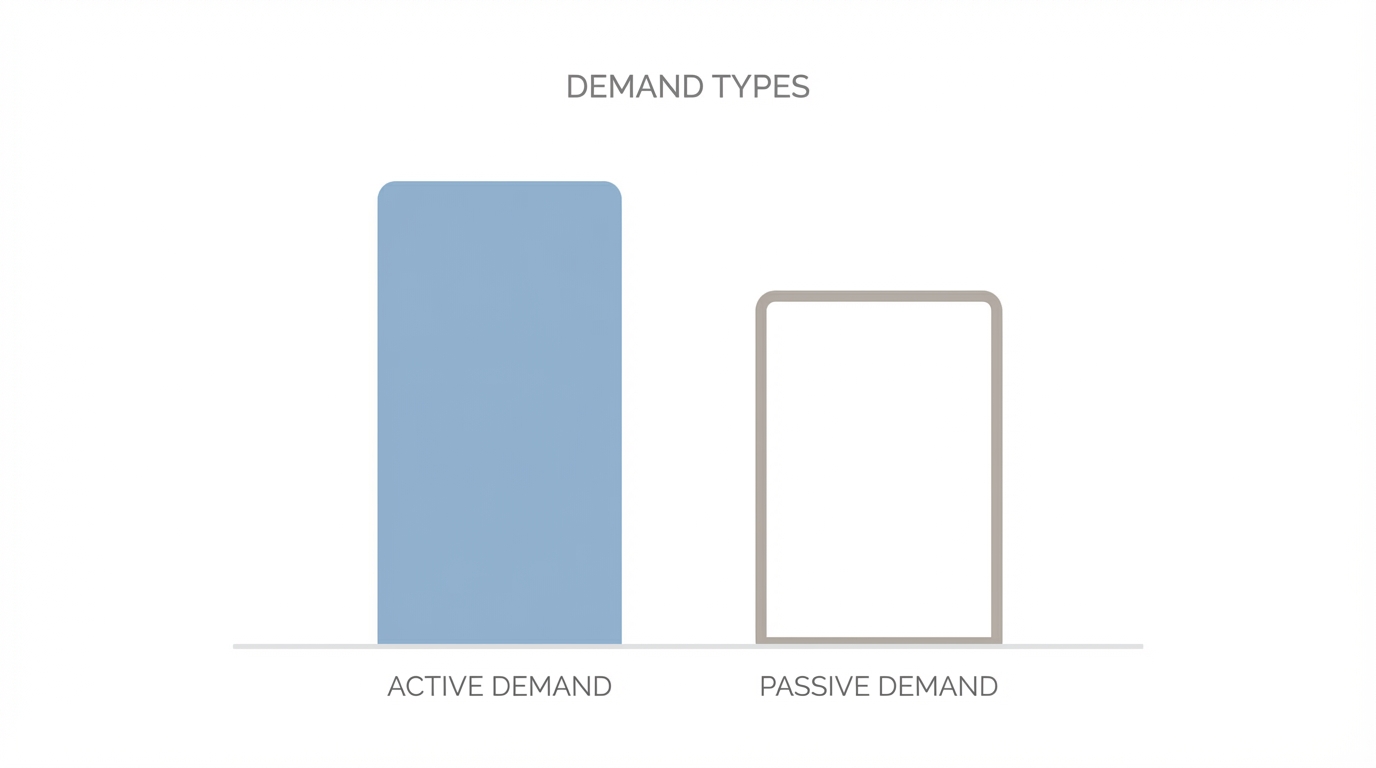
Understanding the difference between latent and induced demand is critical for consumer app monetization. Latent demand is the demand that already exists in the market. People are proactively searching for a solution on Google or Reddit. This is the 'pull' signal. When someone types 'how to text my crush' into a search engine, they are telling you they have a problem and are ready to pay for a solution. Capturing this intent via Google Ads or SEO is often the fastest way to get to your first $1,000 in revenue. It allows you to skip the expensive process of 'inducing' demand through disruptive ads.
Induced demand, on the other hand, is what you find on Meta Ads Manager or TikTok. Here, you are interrupting a user's scroll to convince them they have a problem they might not have been thinking about. While the scale of induced demand is theoretically much larger, it is also much more competitive and expensive. For a bootstrapped AI founder, starting with latent demand—specifically through SEO and high-intent keywords—is a much more sustainable path to profitability. Stormy AI can be an invaluable asset here by helping you vet creators and analyze deep audience demographics, allowing you to partner with influencers who already rank for these high-intent topics to capture that existing 'pull' traffic without burning through a massive ad budget.
The AI Product Validation Playbook

Building a profitable AI app requires a systematic approach to validation. You cannot rely on your intuition alone. Follow this playbook to ensure you are building a painkiller, not a vitamin.
Step 1: Identify High-Intent Search Clusters
Use keyword research tools like Ahrefs to find what people are actually complaining about. Look for long-tail keywords that indicate high frustration, such as 'dating apps not working' or 'how to pass an AI detector' [source: GPTZero]. These represent real pain points where users are desperate for a solution. Don't look for high-volume vanity keywords; look for high-intent keywords where the user is looking for a specific tool or answer. If you find a cluster of keywords with decent volume and low competition, you have found a potential SEO moat.
Step 2: Look for 'Pull' Signals on Social Forums
Go to Reddit, Quora, or niche communities. Are people asking for tools that don't exist? Are they sharing 'hacks' that are tedious and manual? When you share a half-baked prototype or a simple landing page and people ask, 'Wait, can I use this now?'—that is a pull signal. If you have to beg people to try your app, it’s a push signal, which usually means you’re building a vitamin. You can use Stormy AI to track individual videos and monitor engagement on related social content to see exactly what "hacks" are going viral. Your goal is to find a problem so painful that users are willing to use a 'janky' or imperfect tool just to get some relief.
Step 3: Test Monetization Early
Don't wait six months to add a paywall. If a problem is truly a painkiller, users will pay for it immediately. Use tools like RevenueCat or paywall experiment generators to test different price points and value propositions. If you can't get a single stranger to pay for your solution within the first month, you likely haven't found a deep enough pain point. Remember, the goal isn't just to get users; it's to find AI business opportunities that are sustainable and profitable from day one.
Scaling Your AI Business with Leverage
Once you have validated your painkiller, the next step is scaling. Many founders make the mistake of trying to do everything themselves. However, to hit milestones like $30,000 a month while working a full-time job, you need leverage. This means hiring contractors and using tools that automate the heavy lifting. Platforms like Upwork allow you to find specialized talent for SEO, development, and customer support. Furthermore, you can use Stormy AI to set up an autonomous AI agent that discovers and outreaches to creators on a daily schedule, ensuring your growth engine runs while you sleep.
This 'hybrid' approach—keeping your day job while funding your startup's growth—is one of the most underrated strategies for achieving financial independence. It removes the 'time pressure' to succeed, allowing you to make strategic decisions rather than desperate ones. Whether you are scaling through Apple Search Ads or building a long-term content strategy, the key is to focus your own time on high-leverage activities like product vision and strategic partnerships, while outsourcing the repetitive execution to experts. This ensures that your business grows consistently without leading to founder burnout.
Conclusion: From Vitamin to Painkiller
The path to profitable AI app ideas is paved with solutions to problems that people cannot ignore. Whether it's the 'sin' of wanting to be more attractive on dating apps or the 'derivative problem' of navigating complex digital platforms, your success depends on your ability to identify acute pain. By focusing on latent demand, validating with 'pull' signals, and scaling with strategic leverage, you can build an AI product that doesn't just exist but thrives. Stop building things that make people's lives 'slightly better' and start building the things they can't live without. When you solve a core human need, monetization isn't a struggle—it's an inevitability.