The era of the "blue link" is officially over. As we navigate the digital landscape of 2026, the primary goal of e-commerce SEO has undergone a fundamental transformation. We are no longer just ranking for clicks; we are optimizing for citations. With the explosion of Generative AI-powered shopping traffic—which surged by 4,700% year-over-year according to Adobe—the traditional search engine results page (SERP) has been replaced by AI-generated summaries and autonomous agents.
To survive in this zero-click search SEO 2026 environment, brands must shift their focus toward "feeding the LLM" (Large Language Model). If an AI agent like ChatGPT, Claude, or a specialized retail bot doesn't have your product in its "training pantry," your brand doesn't exist to the modern consumer. This article explores how to leverage an AI product description generator to create the structured, high-context data that AI models crave.
"The future of search isn't about winning the click; it's about becoming the definitive answer that the AI provides to the user."
Why 2026 SEO is Shifting from 'Ranking for Clicks' to 'AI Citations'
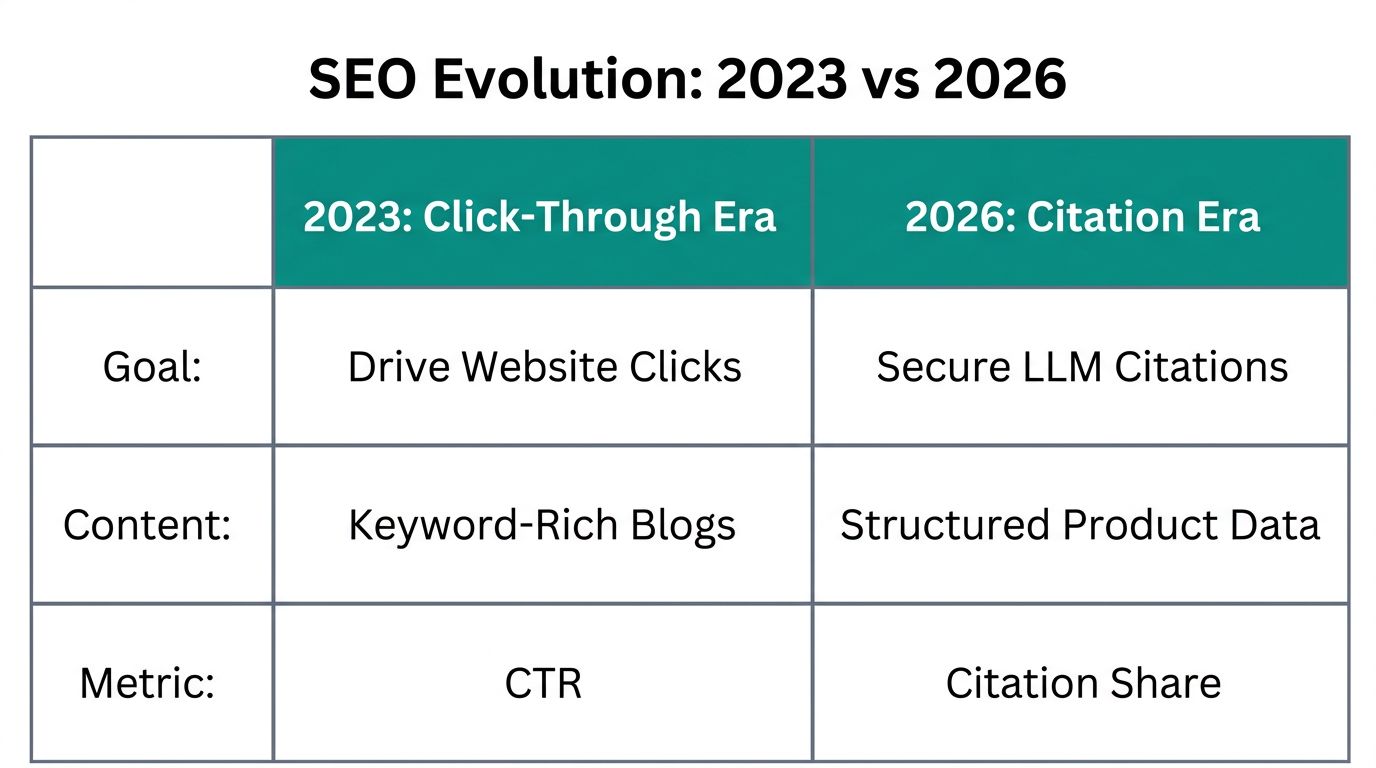
In 2026, 80% of consumers rely on AI-generated answers for their initial product discovery searches. This shift toward zero-click search optimization means that a user may never actually visit your website. Instead, they ask an AI, "What is the best eco-friendly yoga mat for hot yoga?" and the AI provides a curated list of recommendations with technical justifications.
If your product isn't cited in that summary, you lose the sale. This makes llm optimization for ecommerce the single most important pillar of your marketing strategy. AI models prioritize data that is structured, factually dense, and authoritative. By using an AI product description generator, you can produce content at a scale that satisfies these models while maintaining the technical precision they require to trust your brand as a source.
The Rise of Agentic Shopping and Autonomous Buyers
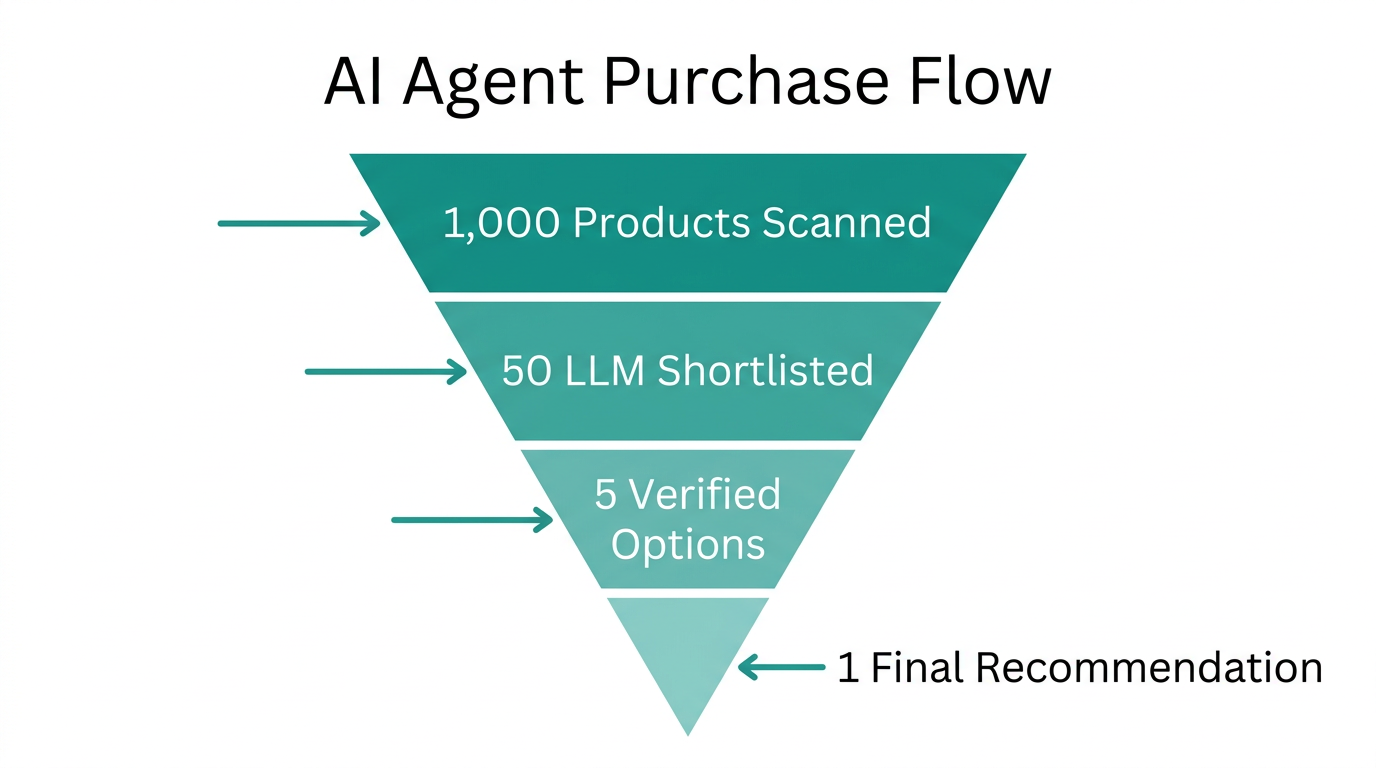
We have moved beyond simple chatbots. The current market is defined by "agentic operations," where AI agents autonomously compare products, manage complex buyer queries, and even execute purchases without human intervention. According to research from Digital Sense, this shift requires a new type of content: agent-readable metadata.
When an AI agent "scrapes" or accesses your site via an API, it isn't looking for flashy adjectives. It is looking for:
- Compatibility data: Does this product work with the user's existing ecosystem?
- Verification signals: Are there third-party certifications or structured data for ai search that confirm your claims?
- Contextual relevance: How does this product solve a specific, nuanced problem?
To stay competitive, many brands are now using Stormy AI to discover the creators whose content feeds these LLMs with the social proof and "human-in-the-loop" validation that AI agents use to rank product quality.
Choosing the Best AI Product Description Generator for 2026
The market for ecommerce seo trends tools has matured. You can no longer rely on a generic prompt in a basic LLM. You need specialized tools that understand PIM (Product Information Management) and SEO-rich metadata. Below is a breakdown of the leading tools for bulk enrichment and AI optimization.
| Tool | Best For | Key Advantage |
|---|---|---|
| Describely | Bulk Catalog & SEO | Native PIM integration and SEO-focused bulk generation. |
| Frase | AI Citations & FAQs | Excellent for generating SEO-rich FAQs that LLMs love to cite. |
| Hypotenuse AI | Large-Scale SKU Enrichment | Handles thousands of SKUs with consistent brand voice. |
| Shopify Magic | Direct Store Integration | Seamlessly updates Shopify product pages in real-time. |
Using tools like Frase allows you to generate secondary content—like FAQs and technical specs—that are specifically designed to be indexed by AI search crawlers. This ensures that when an AI looks for a specific technical answer, your site provides the clearest, most cite-able response.
The TCR Framework: Master Prompting for LLM Optimization
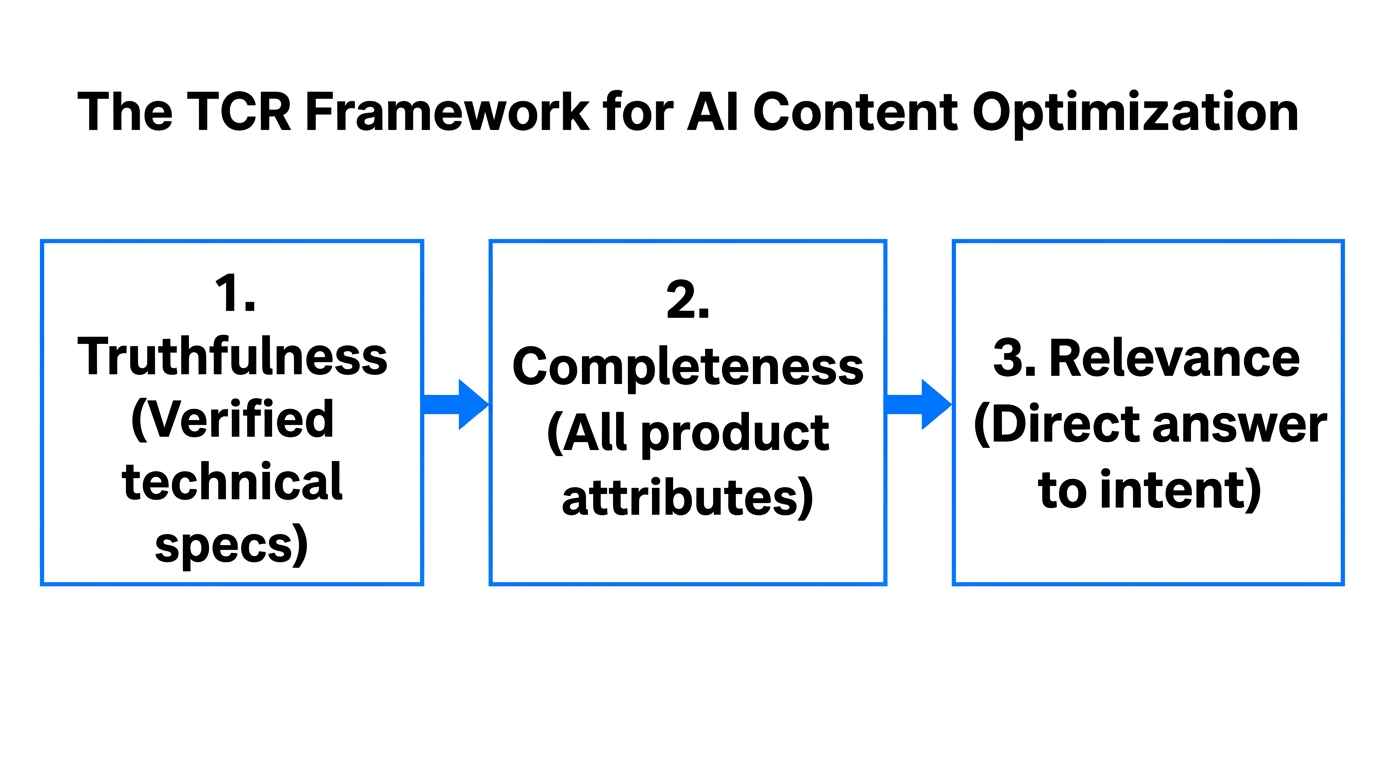
To get the most out of an ai product description generator, you must move beyond simple prompts. We recommend the Task-Context-Reference (TCR) framework to ensure your content is both human-friendly and agent-optimized.
Step 1: Define the Task
Don't just ask for a "description." Ask for a semantically enriched product profile. Tell the AI to include primary keywords and latently linked terms that define the niche.
Step 2: Provide Technical Context
AI models excel when they have constraints. Provide the exact material weight, dimensions, and software compatibility. This prevents the LLM from filling in the gaps with creative (but false) fiction. Remember, 78% of organizations are now using AI in their workflows, and McKinsey notes that data accuracy is the primary differentiator for successful adoption.
Step 3: Include Human Reference
Feed the generator 3-5 examples of your best-performing human-written copy. This ensures the AI product description generator maintains your unique brand voice while scaling output. As HubSpot's Kipp Bodnar famously stated, "The future of AI isn't human vs. AI — it's human with AI."
"AI won't replace humans, but humans with AI will replace humans without AI." — Karim Lakhani, Harvard Business School
The Danger of AI Hallucinations in Technical Specs
One of the biggest risks in llm optimization for ecommerce is the hallucination. If an AI generator claims your waterproof jacket is "fire-rated" when it isn't, you face more than just a return—you face a legal liability and a total destruction of your search credibility. AI search engines are increasingly penalizing sites that provide factually inconsistent information.
Actionable Strategy: Implement a "Human-in-the-Loop" review process. Companies like Wayfair have used generative AI to reduce production time by 68%, but they still maintain a rigorous verification layer for technical specifications. Never allow an AI to generate safety-critical specs without a manual audit.
Balancing 1-2% Keyword Density with Natural Language
In the old world of SEO, keyword stuffing was a (bad) tactic. In 2026, it's a death sentence. AI agents are trained on natural language processing (NLP). They can detect "forced" keywords a mile away. The goal for ecommerce seo trends this year is to maintain a 1-2% keyword density while prioritizing the semantic flow of the information.
Instead of repeating "best wireless earbuds" five times, use semantic variations: "Bluetooth 5.4 audio devices," "noise-canceling wearables," and "true wireless sound systems." This provides the LLM with a broader "semantic map" of what your product is, increasing the chances of being cited for a wider variety of user queries. Research from Linearloop shows that AI-enhanced, naturally written descriptions can lead to a 23.7% increase in conversion rates because they build more trust with the end user.
Structured Data: The 'Hidden Layer' of AI Search
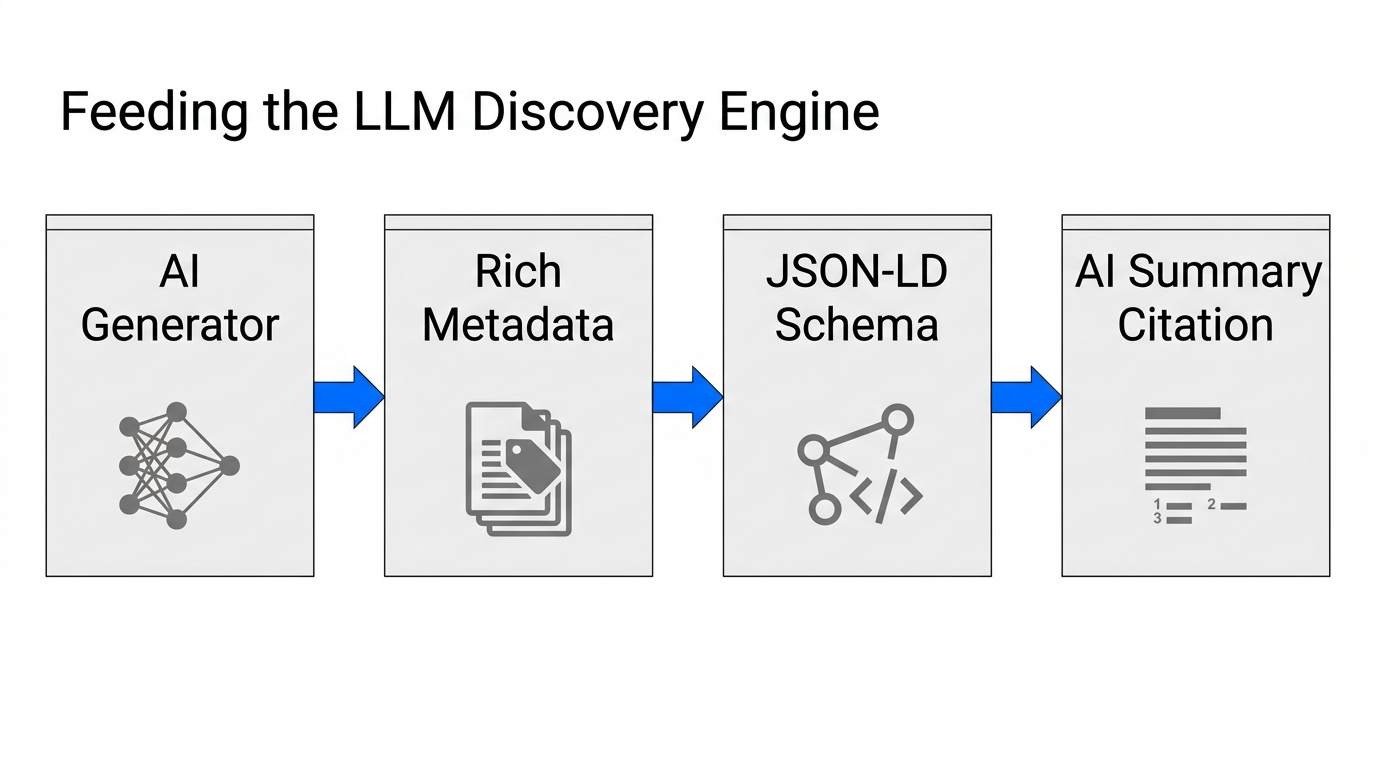
While the product description is for the human (and the AI's summary), structured data for ai search is for the AI's database. This includes Schema.org markup, JSON-LD, and microdata that explicitly tells search engines: "This is the price," "This is the stock level," and "This is the shipping time."
By using an AI product description generator that automatically outputs JSON-LD code alongside your product copy, you are giving AI agents a clean, machine-readable version of your store. This is how you win the zero-click search seo 2026 battle—by being the most accessible and reliable data source in your category.
Conclusion: The 2026 Roadmap for AI-Driven E-commerce
Optimizing for the LLMs is no longer an optional experiment; it is the infrastructure of modern commerce. By the end of 2026, the global AI-enabled e-commerce market will be worth billions, and the companies that dominate will be those that treat their product descriptions as AI training data.
To recap your 2026 strategy:
- Shift to Citations: Focus on being the reference point for AI summaries rather than just chasing clicks.
- Leverage Specialized Tools: Use platforms like Describely and Frase to build a semantically rich catalog.
- Prioritize Accuracy: Audit every technical spec to avoid hallucinations that could destroy your search authority.
- Optimize for Agents: Use structured data (JSON-LD) to ensure autonomous buyers can find and purchase your products easily.
For brands looking to bolster their AI presence through authentic human signals, tools like Stormy AI can help you find and manage the influencers who create the UGC that LLMs use to verify your product's popularity and quality in the real world.