The era of keyword stuffing is officially dead. As we navigate 2026, the Amazon marketplace has evolved from a simple search engine into a sophisticated AI-driven ecosystem. With the global e-commerce software market reaching a staggering $13.10 billion this year, the tools we use to dominate the search results have shifted from basic data scrapers to advanced AI agents. At the heart of this transformation is Amazon Rufus, the generative AI shopping assistant that has fundamentally changed how customers discover products. If your listing isn't optimized for semantic intent, Rufus simply won't recommend you.
For brands scaling toward the $716.9 billion in revenue Amazon reported last year, the challenge is no longer just appearing in search—it is winning the "Interests AI" layer. This guide dives deep into how to use the latest updates from Helium 10 and Jungle Scout to build "Rufus-ready" listings while leveraging an AI ecommerce employee like Stormy AI to handle the heavy lifting of back-office synchronization.
Understanding the 'Interests AI' Layer: Semantic Grouping in 2026
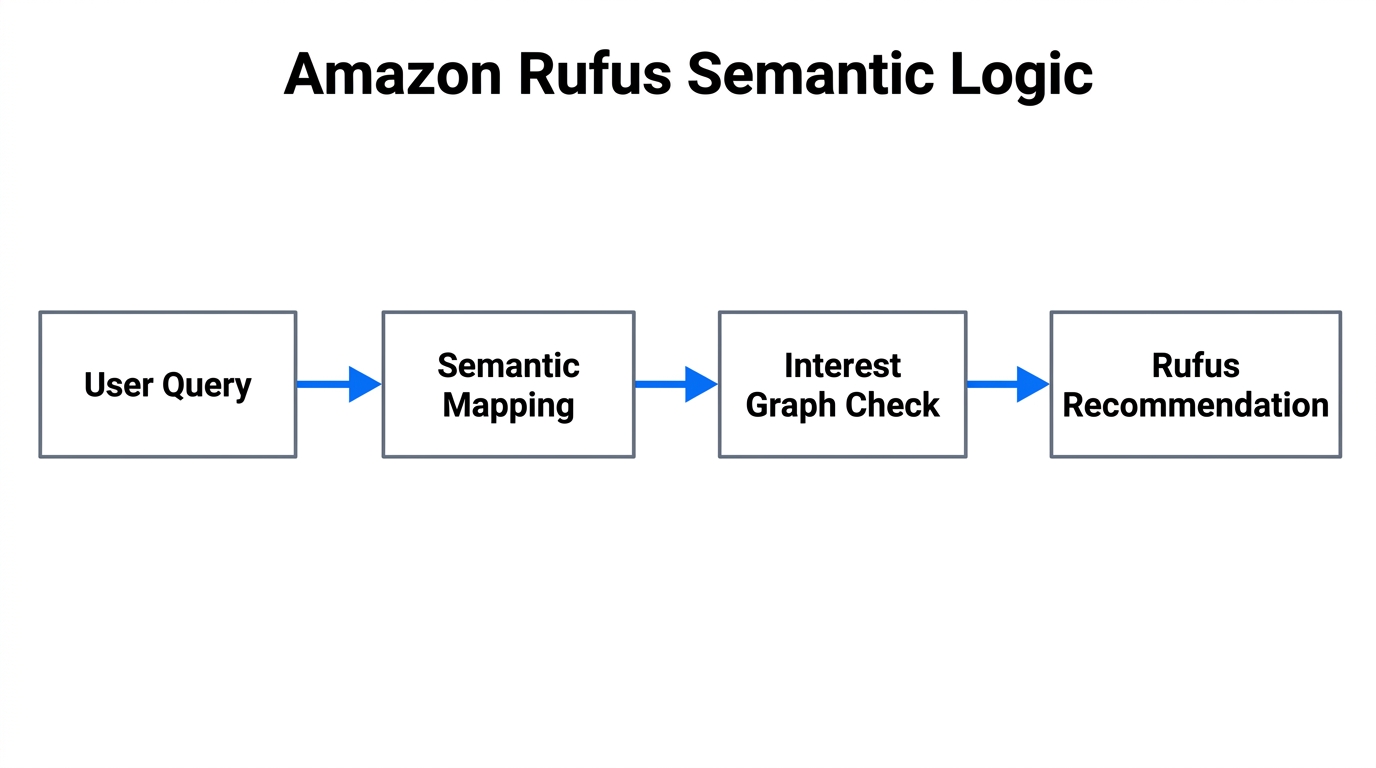
In 2026, Amazon's A10 algorithm focuses on semantic SEO rather than just lexical matches. This means the engine is trying to understand the meaning behind a query. Bradley Sutton, Director of Training at Helium 10, notes that you can't just stuff keywords anymore; you need to win the 'Interests AI' layer by having narrative-rich listings that AI agents like Rufus can recommend. Rufus doesn't just look for "organic electrolytes"; it looks for a product that fits the user's lifestyle, such as "keto-friendly hydration for marathon recovery."
This shift has made AI Keyword Clustering the most critical feature in your SEO stack. By grouping terms by intent, you signal to Rufus exactly which customer segments your product serves. While you focus on the creative strategy, Stormy AI can monitor these trends across your Shopify and Amazon stores, flagging when a specific keyword cluster starts losing traction so you can adjust before your BSR (Best Sellers Rank) drops.
"The biggest mistake in 2026 is picking an all-in-one tool that does everything at 60% quality. Winners combine specialized tools with AI agents to drive execution."
Tutorial: Using Helium 10’s AI Listing Builder for Narrative SEO
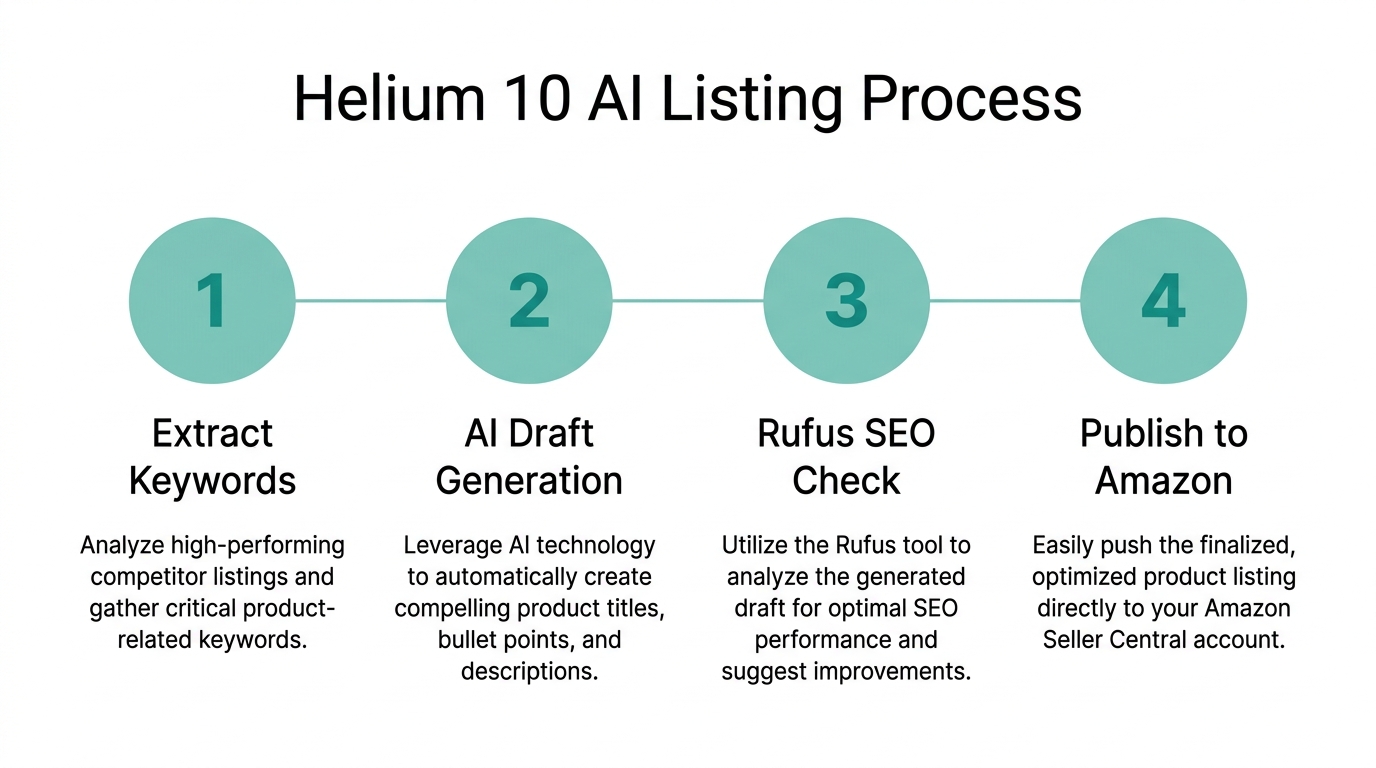
Helium 10 remains a powerhouse for deep SEO, especially since its 2026 accuracy study showed an 89.6% sales estimation accuracy rate. Their AI Listing Builder is specifically designed to create the "narrative-rich" descriptions Rufus craves. Here is how to use it effectively this year:
Step 1: Deep Keyword Mining with Cerebro
Start by running a Cerebro search on your top 5 competitors. Filter for "Top 10" organic ranks and high "Search Volume." In 2026, Helium 10’s "Normalized Search Volume" is 93.5% accurate compared to Amazon's internal data, making it the gold standard for identifying revenue-driving terms.
Step 2: Initialize the AI Listing Builder
Import your filtered keyword list into the AI Listing Builder. Select the "Semantic Optimization" mode. This mode instructs the AI to avoid repetitive phrases and instead weave your keywords into a natural, conversational story. Rufus prioritizes listings that answer potential customer questions within the bullet points.
Step 3: Intent-Based Semantic Grouping
Enable "AI Control" to allow the tool to suggest Intent-Based Semantic Grouping. This aligns your listing with the A10 algorithm’s preference for topical authority. Sellers using this feature have reported a 14% reduction in ACoS because their ads are served to more relevant, high-intent audiences. Once your listing is generated, you can ask Stormy AI to push these updates to your Amazon Seller Central and sync the updated product descriptions to your Shopify store automatically.
| Feature | Helium 10 (Diamond) | Jungle Scout (Brand Owner) |
|---|---|---|
| Price (Monthly) | $359/mo | $129/mo |
| Sales Accuracy | 89.6% | 78% |
| AI Listings | Unlimited | 100/mo |
| Primary Strength | Deep Technical SEO | Speed to Insight |
Leveraging Jungle Scout’s 'Speed to Insight' for Competitor Gaps
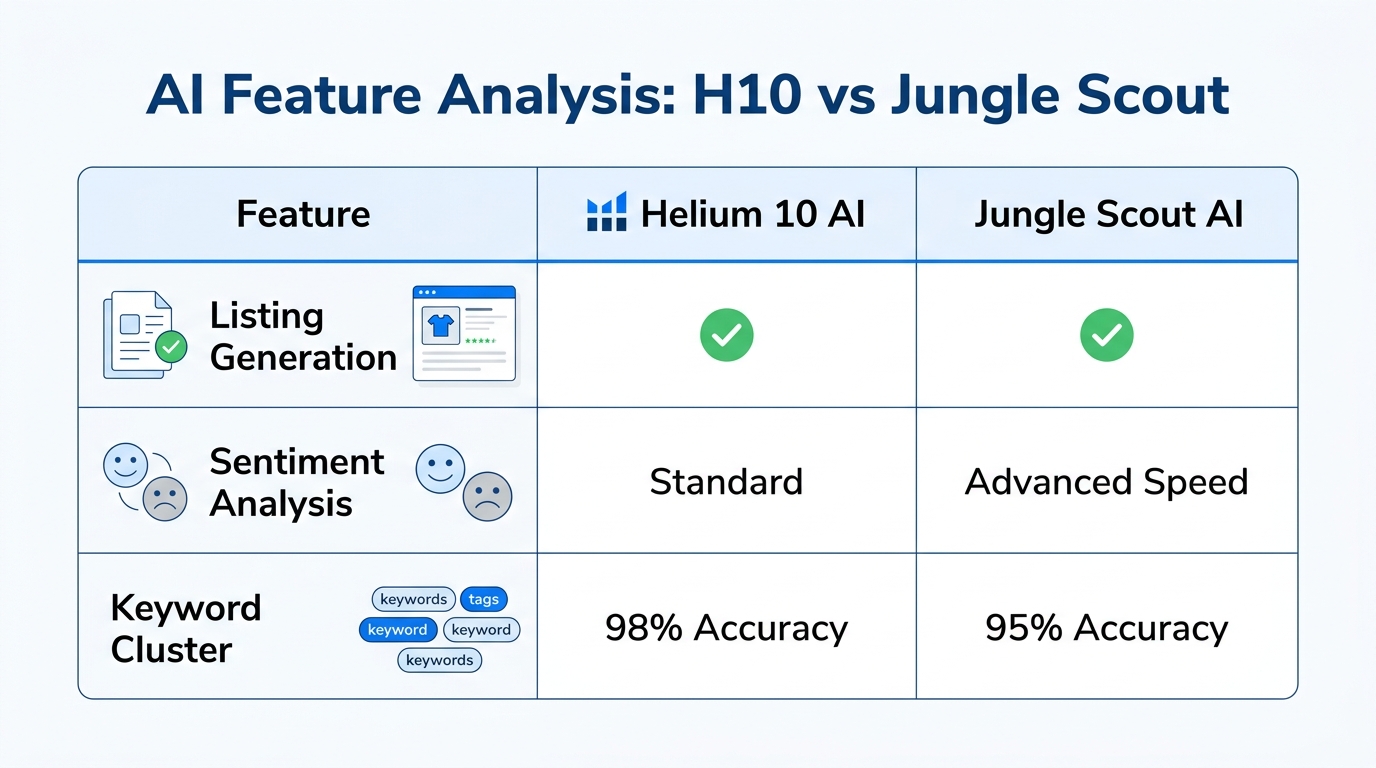
While Helium 10 wins on technical depth, Jungle Scout has pivoted its 2026 strategy toward "Speed to Insight." For established brands, the goal is to identify a competitor’s weakness and exploit it before they can react. MaryRuth’s Organics used this exact approach to drive 27% year-over-year growth by identifying keyword gaps in real-time.
The 2026 Jungle Scout Catalyst update features AI Agent Workflows that automate benchmarking reports. Instead of manually checking rank, you can set an alert for when a competitor’s listing is suppressed or when they run out of stock. The most successful 2026 sellers use Jungle Scout to find the "High Demand, Low Competition" scores of 7+ in the Opportunity Finder, then immediately deploy Stormy AI to research suppliers and draft outreach emails to secure inventory.
"Data accuracy remains the only moat. In a world where everyone has AI, the winner is the one who acts on accurate data the fastest." — Greg Mercer, CEO of Jungle Scout
The March 2026 Amazon Dynamic Canvas Update
A massive shift occurred in March 2026 with the release of the Amazon Dynamic Canvas. This free AI dashboard within Seller Central allows sellers to generate complex forecasts and scenario models from simple text prompts. This update has effectively rendered basic, entry-level profit tools obsolete, forcing platforms like Jungle Scout and Helium 10 to innovate deeper into multi-channel operations.
The Dynamic Canvas change means Amazon is now providing the "What" (your data), but you still need third-party tools for the "How" (optimization). For instance, while Dynamic Canvas might tell you your conversion rate is dropping, you still need Adtomic or Teikametrics to automate the bid adjustments. Note: Helium 10 recently introduced a management fee on ad spend for Adtomic users, so many lean brands are now tasking Stormy AI with pulling daily ROAS reports and flagging underperforming campaigns manually to avoid high software surcharges.
Managing Cross-Platform Sync with Stormy AI
In 2026, running a one-person or lean ecommerce brand requires agentic automation. You cannot spend your day copy-pasting descriptions from Helium 10 into TikTok Shop, Shopify, and Amazon. This is where Stormy AI acts as your AI ecommerce employee.
Stormy AI runs in the background of your operation to:
- Monitor Listings: Detect if a listing becomes suppressed or if an image goes missing across any marketplace.
- Sync Content: When you finalize a "Rufus-optimized" description in Helium 10, Stormy can automatically update the corresponding product pages on Shopify and Amazon Ads.
- Supplier Follow-up: If Keepa data suggests a surge in demand, Stormy can check your current inventory levels and automatically email your supplier to request a restock PO.
- Audit Ads: Pull campaign performance from Meta and Google Ads, comparing them to your Amazon TACOS to ensure your total business margin is healthy.
By delegating these messy back-office tasks to Stormy AI, you free up your time to focus on the high-level strategy of brand building and product development.
"The 2026 winner isn't the person who works the most hours; it's the person who manages the most efficient AI agents."
Conclusion: Your 2026 SEO Action Plan
Optimizing for Amazon Rufus requires a fundamental shift from keyword density to narrative clarity. Start by using Helium 10 for deep semantic research and Jungle Scout to find competitor gaps. Always prioritize the 'Interests AI' layer by grouping your keywords into clusters that reflect true customer intent.
As the marketplace becomes more automated, the distance between data and action is shrinking. Don't let your brand get buried by the A10 algorithm because you were too busy managing spreadsheets. Let Stormy AI handle the synchronization and monitoring while you build the next multi-million dollar FBA brand. The tools are here—it's time to use them.