How to Optimize Google Ads and Meta Ads for Shopify Using MER (2026 Playbook)
Learn how to use Marketing Efficiency Ratio (MER) to scale Google Ads for Shopify 2026. This guide covers Meta Ads scaling strategy and ad spend automation.
In 2026, the performance marketing landscape has shifted from chasing platform-level metrics to mastering the ecosystem. If you are managing a brand on Shopify, you have likely felt the frustration of seeing a 4.0 ROAS in Meta Ads Manager while your bank account remains stagnant. This disconnect happens because single-platform ROAS fails to account for the blended reality of modern ecommerce. To achieve profitable scaling for DTC this year, you must pivot to the Marketing Efficiency Ratio (MER).
MER is the high-level pulse of your business, calculated by dividing your total revenue by your total ad spend across all channels. While platforms like Google Ads and TikTok Ads provide siloed data, Stormy AI acts as your AI ecommerce employee to aggregate these disparate data points, ensuring your Google Ads for Shopify 2026 strategy is grounded in net profit, not just dashboard vanity metrics.
The MER vs. ROAS Dilemma: Why Dashboards Lie
Discover the differences between platform-specific ROAS and the holistic view of Marketing Efficiency Ratio.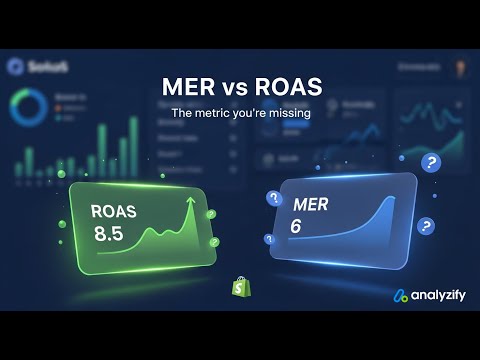
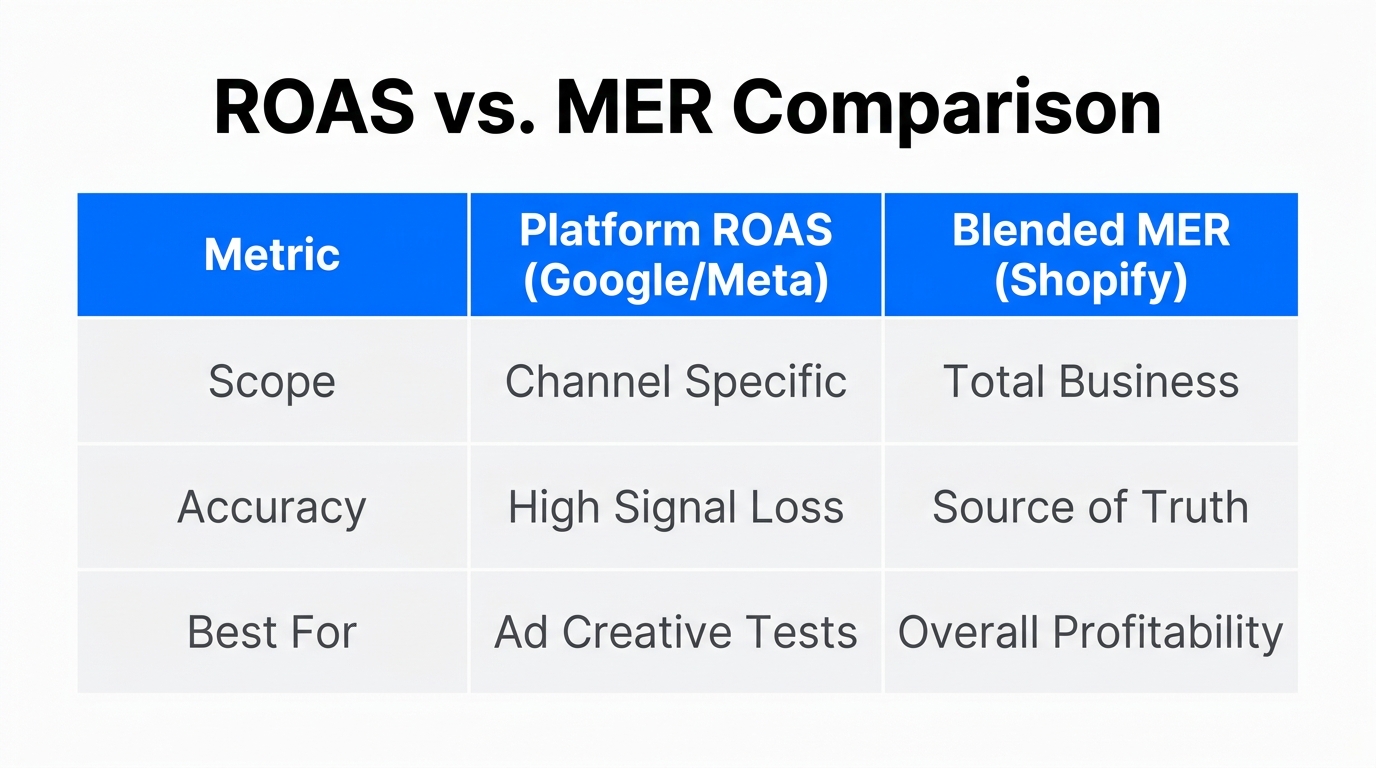
The core problem with relying solely on ROAS is that each platform claims credit for the same sale. If a customer clicks a TikTok Ad, later searches on Google, and finally buys via a Meta retargeting ad, your total ROAS might look like a 12.0 across three dashboards, but your actual bank balance tells a different story. Marketing Efficiency Ratio (MER) cuts through this noise by looking at the total revenue generated against every dollar spent on Amazon Ads, Meta, and Google combined.
"ROAS is a diagnostic tool for creative performance; MER is a diagnostic tool for business health. You can't pay your suppliers with ROAS."
In 2026, data privacy updates have made Shopify attribution guides more complex than ever. Platforms are increasingly using modeled conversions, which can inflate reported results. By tracking MER, you focus on the macro-efficiency of your marketing engine. An AI teammate like Stormy AI can automatically pull your total revenue from Shopify and compare it against your daily spend across all ad accounts, flagging when your blended efficiency drops below your break-even point.
| Metric | Scope | Primary Use Case | 2026 Reliability |
|---|---|---|---|
| ROAS | Channel-Specific | Creative & Campaign Testing | Moderate (Attribution Gaps) |
| MER | Total Business | Profitable Scaling for DTC | High (Single Source of Truth) |
| POAS | Net Profit | Margin-Based Bidding | High (Requires COGS Data) |
Setting Your 'North Star' MER Targets for 2026
Learn how to move from campaign-level questions to evaluating overall business health and growth.Before you implement a Meta Ads scaling strategy, you must define your target MER. This isn't a one-size-fits-all number; it depends entirely on your product margins and customer lifetime value (LTV). For a standard DTC brand with 60% gross margins, a 3.0 to 4.0 MER is often the sweet spot for aggressive growth. However, if you are selling high-ticket items on Amazon Seller Central with thinner margins, your target might be closer to 5.0 or 6.0.
To keep these targets accurate, you must integrate your Cost of Goods Sold (COGS) into your reporting. Using tools like Analyzify or the native Shopify marketing analytics dashboard allows you to see the "Total Net Profit" report. This is where ecommerce ad spend automation becomes powerful. Instead of manually checking these reports, Stormy AI can monitor your net profit daily, sending a Slack or Telegram alert if your MER deviates by more than 15% from your target.
The 'Scale or Kill' Framework: Tactical Ad Decisions
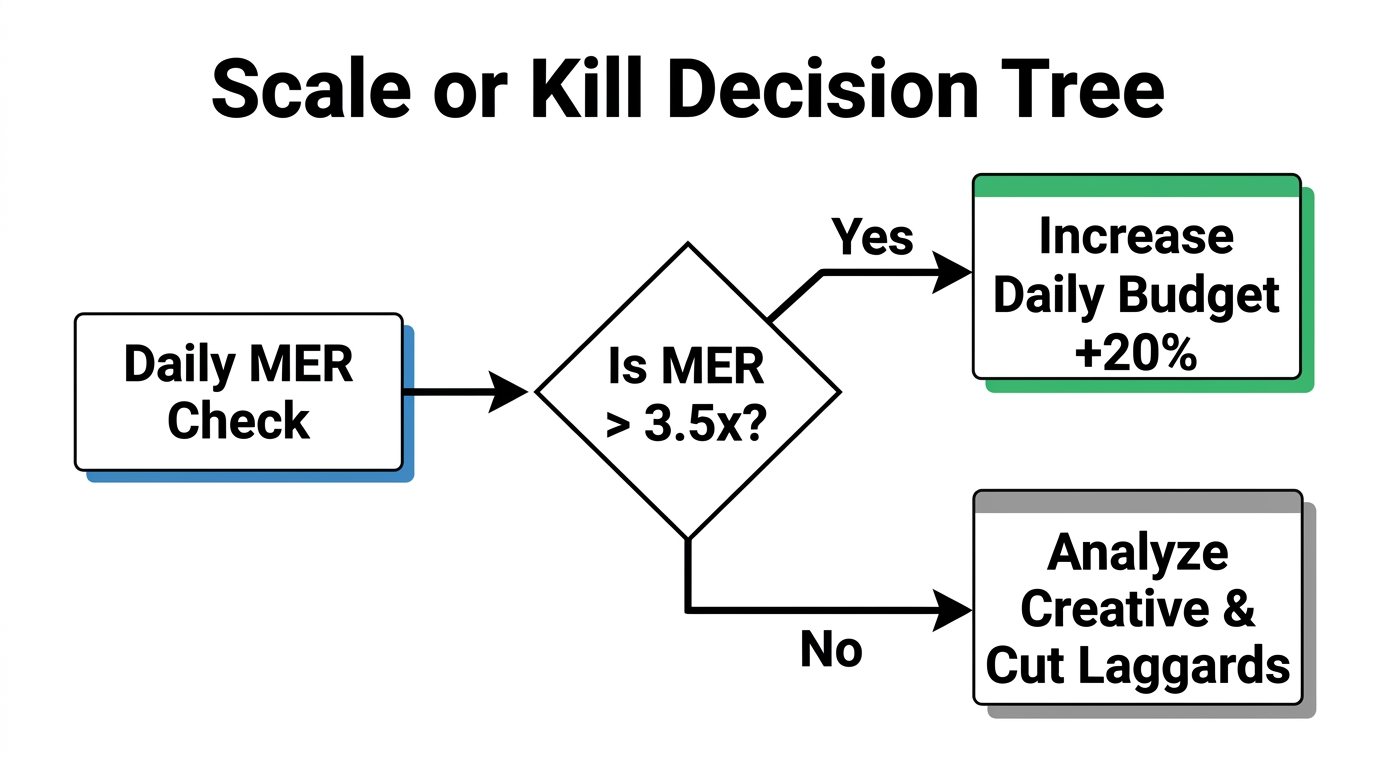
Successful profitable scaling for DTC requires a disciplined framework for budget allocation. In 2026, the best performers follow the "Scale or Kill" rule based on blended metrics. If your Google Ads for Shopify 2026 campaigns show a staggering 8.0 ROAS, but your overall store MER is dropping from a 4.5 to a 3.2, it means your Meta Ads or TikTok Ads are likely bleeding money or your Google Ads are simply capturing existing brand demand rather than driving incremental growth.
When to Scale:
- Your blended MER is 20% above your target threshold.
- New customer acquisition (nCAC) is stable or decreasing.
- Inventory levels are healthy (track this via Stormy AI to avoid scaling into a stockout).
When to Kill or Pivot:
- Your MER falls below your break-even point for 3 consecutive days.
- Platform ROAS is high, but Shopify total revenue is flat.
- Customer support tickets related to shipping delays are spiking (use Gorgias or Zendesk data to inform this).
"Scaling isn't about pushing more money into what the dashboard says is winning; it's about pushing more money into what makes the bank account grow."
Handling Attribution Gaps Between Meta and Shopify
Explore why Google Ads cannot report MER and how to bridge data gaps across platforms.One of the biggest hurdles in any Meta Ads scaling strategy is the attribution gap. Meta's 7-day click / 1-day view attribution often over-reports sales by claiming credit for organic or email-driven conversions. Conversely, Shopify's last-click attribution model often under-reports the top-of-funnel impact of social ads. To bridge this gap, top brands in 2026 use post-purchase surveys and UTM parameters religiously.
You should align your Meta Ads Manager data with your Klaviyo email flows to ensure you aren't double-counting revenue. Stormy AI can help here by acting as an autonomous analyst—it can pull performance data from Google Ads and Meta, cross-reference it with Google Analytics, and build a unified report that highlights where the attribution 'leakage' is occurring.
utm_source=meta&utm_medium=paid&utm_campaign={{campaign.name}}&utm_content={{ad.name}}. This allows your AI employee to parse the data accurately.Automating Budget Reallocations with AI Agents
The manual labor of moving budgets between Google Ads and Meta Ads is a relic of 2024. In 2026, ecommerce ad spend automation is handled by AI agents that understand the nuance of MER. An AI teammate like Stormy AI doesn't just look at numbers; it operates your tools. It can wake up every morning, check your yesterday's MER, and if it's above your 4.0 target, it can automatically increase your Meta Top-of-Funnel (TOF) budget by 10%.
This level of automation ensures you never miss a scaling opportunity while you're asleep. More importantly, it protects your downside. If a creative suddenly fatigues and your MER tanks, Stormy AI can pause underperforming sets and notify your creative team via Notion or Slack that new assets are needed. This turns your marketing from a reactive guessing game into a proactive growth machine.
The 2026 MER Scaling Playbook: Step-by-Step
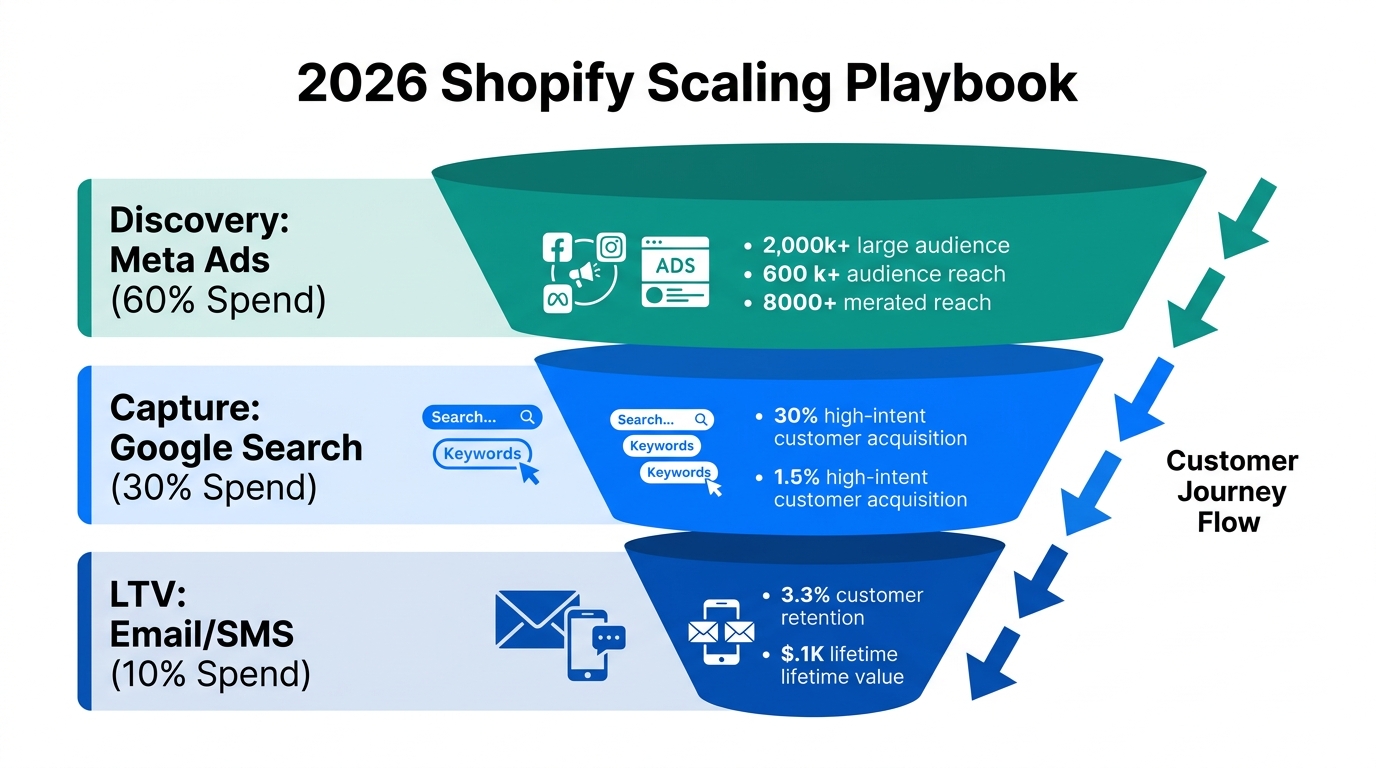
Follow these steps to implement a profitable scaling for DTC strategy today:
Step 1: Connect Your Data Sources
Integrate Shopify, Google Ads, and Meta Ads into a single source of truth. Use an app like Analyzify to ensure server-side tracking is capturing every event accurately. Shopify attribution guides recommend moving away from browser-only tracking to avoid loss from ad blockers.
Step 2: Define Your MER Thresholds
Calculate your break-even MER based on your 2026 COGS. If your gross margin is 50%, your break-even MER is 2.0. Aim for a target MER that leaves room for at least a 15-20% net profit margin after all operating expenses.
Step 3: Deploy Stormy AI for Monitoring
Assign Stormy AI the task of building a daily performance workbook. Ask Stormy to "Pull total revenue from Shopify and total spend from Meta, Google, and TikTok every morning at 8 AM, calculate MER, and flag any day where MER is below 3.0."
Step 4: Execute the 'Scale or Kill' Logic
If your daily MER is high, increase budgets on your highest-performing TOF campaigns. If MER is low, look for 'budget vampires'—campaigns that are spending heavily but not contributing to total revenue growth—and cut them immediately.
Conclusion: The Future of Ecommerce Ops
Scaling Google Ads for Shopify 2026 is no longer about finding the perfect keyword; it's about managing the efficiency of your entire capital stack. By shifting your focus to Marketing Efficiency Ratio (MER) and integrating COGS into your decision-making, you ensure that every dollar of ad spend is driving actual business value.
The era of manual spreadsheet updates and midnight dashboard checks is over. With an AI ecommerce employee like Stormy AI handling the monitoring and execution, you can focus on what actually moves the needle: high-level strategy and creative innovation. Start by setting your MER targets today, and let AI keep your operation running profitably in the background.