How to Optimize for AI Search: A Claude AI Guide to Ecommerce Discovery in 2026
Master generative engine optimization 2026 with our Claude AI SEO strategy. Learn how to capture the 4,700% surge in AI-driven retail discovery traffic today.
The search landscape has undergone a tectonic shift. As we navigate the midpoint of 2026, the traditional SEO playbook of 2024 is now a relic of the past. The data is staggering: traffic from generative AI sources to retail sites—where users ask assistants like Claude or Perplexity for product advice instead of browsing a list of blue links—has surged by an incredible 4,700% year-over-year, according to the latest research from Adobe Analytics. For ecommerce brands, this means the primary goal is no longer just ranking #1 on a search results page; it is about becoming the definitive recommendation within an AI’s conversational output. This is the era of Generative Engine Optimization (GEO).
To win in 2026, marketers must pivot toward AI search engine optimization that prioritizes technical specificity and conversational relevance. Central to this evolution is Anthropic’s Claude AI, which has emerged as the preferred tool for enterprise data tasks due to its massive 200k context window and superior performance in structured data handling. In fact, enterprise spending on Claude has seen a 55% month-over-month growth this year as brands race to optimize their digital presence for AI crawlers, as noted in the Brex AI Report. This guide provides a comprehensive playbook for using Claude AI to dominate ecommerce discovery in 2026.
Understanding Generative Engine Optimization (GEO)
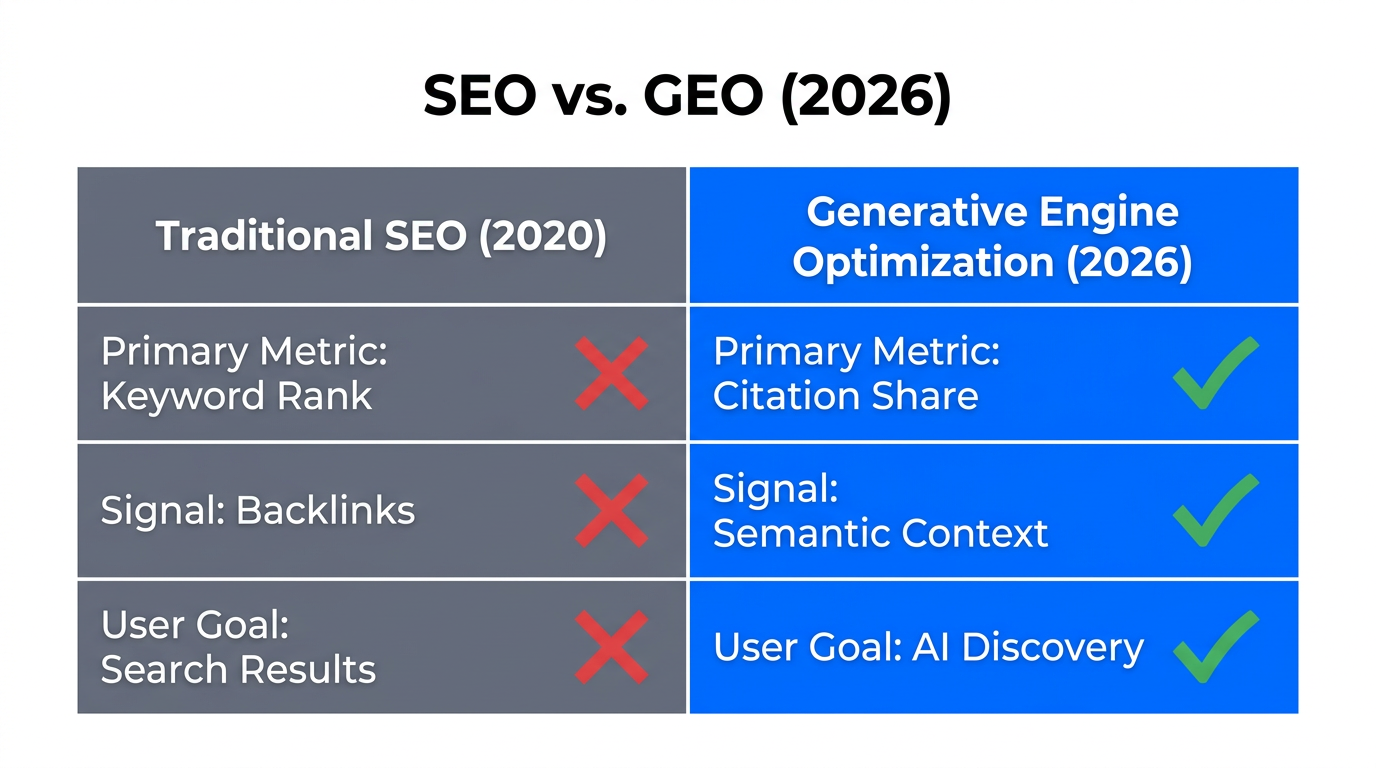
In 2026, the AI-enabled ecommerce market is valued at approximately $8.65 billion, on its way to a projected $22.60 billion by 2032, per research cited by Anchor Group. This growth is driven by a fundamental change in user behavior: conversational queries. Instead of searching for "waterproof hiking boots," users now ask, "I need a waterproof hiking boot for wide feet under $100 that can handle rocky terrain in the Pacific Northwest. What do you recommend?"
"Generative Engine Optimization (GEO) isn't about ranking first in a list; it's about being the only recommendation that survives the AI's filters."
Traditional SEO focused on keyword density and backlink profiles. Generative engine optimization 2026 focuses on "information density" and "contextual authority." AI crawlers do not just look for keywords; they synthesize information from your site to see if you meet the specific, multifaceted needs of the user. According to McKinsey and DemandSage, nearly 89% of organizations have now integrated AI into their marketing functions to address this complexity. If your product data is vague, you are invisible to the algorithms that now control the majority of retail discovery.
Why Claude AI is the Leader in 2026 Ecommerce SEO
While various LLMs exist, Claude 3.5 Sonnet has become the gold standard for ecommerce growth hacking. Experts at HubSpot note that while other models are excellent for rapid ideation, Claude wins for maintaining brand voice consistency and processing massive datasets. This is critical when you are asking an AI to analyze a 10,000-row product feed to find optimization gaps. Claude’s "Constitutional AI" framework also ensures fewer hallucinations, which is vital when dealing with technical product specifications.
Furthermore, specialists from Alumio highlight Claude’s structured data superiority. It can ingest complex, rules-based instructions for product data enrichment—such as tagging, categorization, and attribute mapping—with higher fidelity than its competitors. This makes it an indispensable tool for auditing the very data that AI search engines use to index your store.
The Playbook: Audit and Rewrite JSON-LD for AI Crawlers
AI search engines rely heavily on JSON-LD (JSON for Linked Data) to understand the context of a page. If your structured data is missing key fields like `material`, `color`, `size`, or `amenityFeature`, an AI agent will likely skip your product. Here is how to use Claude to fix this:
Step 1: Export Your Current Schema
Extract the JSON-LD from your top-performing product pages. You can use tools like Search Atlas to visualize how your data currently looks to crawlers.
Step 2: The Claude Audit Prompt
Upload your JSON-LD snippets to Claude and use the following prompt: "Analyze this JSON-LD schema against the requirements for Generative Engine Optimization. Identify missing attributes that would help an AI assistant recommend this product for specific use-case queries like 'best for wide feet' or 'eco-friendly materials'. Rewrite the schema to be more 'discoverable' for LLMs."
Step 3: Implementation
Claude will provide an enriched version of your schema. By including these technical specifics, you increase the likelihood that when a user asks a specific question, the AI has the data points necessary to "vouch" for your product. Brands that have implemented this level of AI-driven personalization report a 10%–12% revenue increase and a significant reduction in cart abandonment, according to data from Pippit AI.
"Technical specificity is the new backlink. If an AI cannot verify your product's specifications through structured data, your brand effectively does not exist in the conversational search era."
The Claude AI Workflow: Product Feed Enrichment
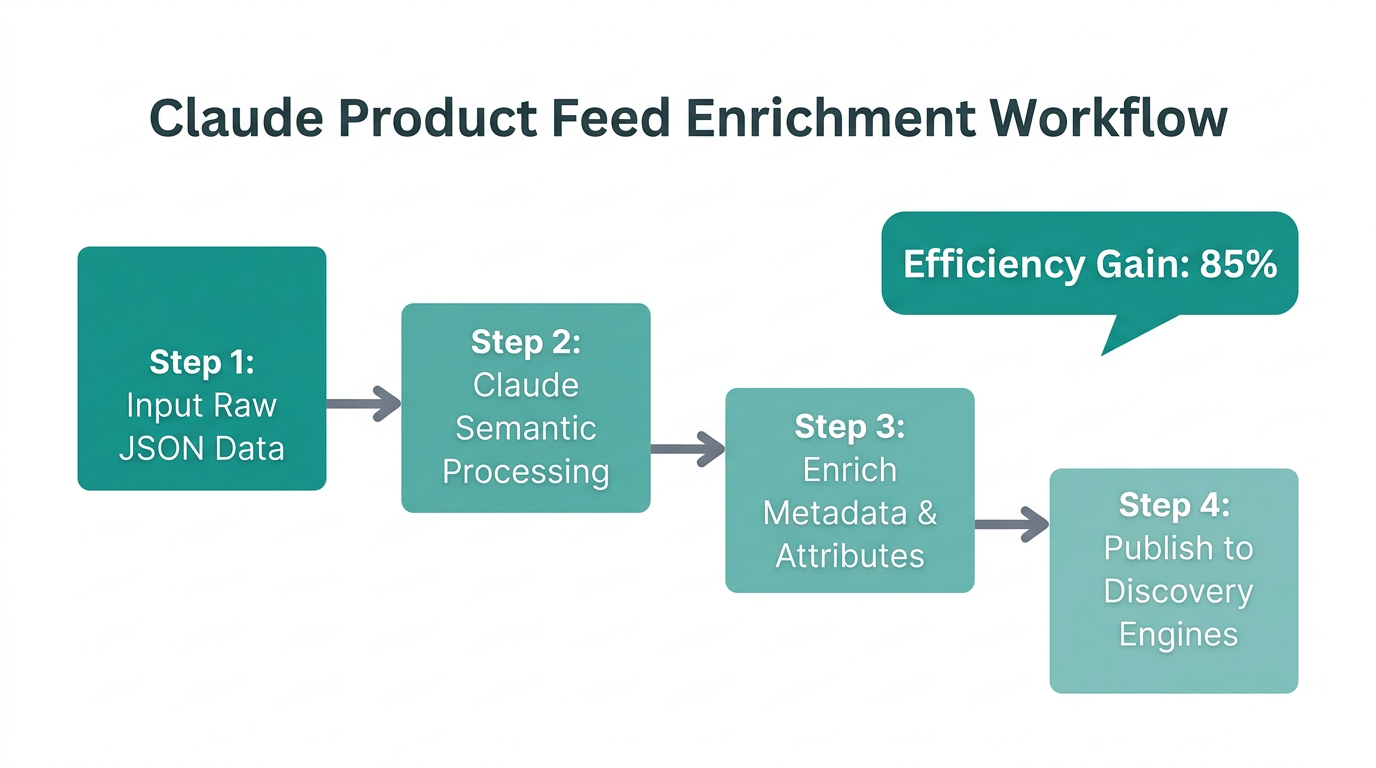
One of the most powerful Claude AI SEO strategies involves the use of "Claude Projects." By creating a dedicated project and uploading your entire product feed (typically a CSV from Shopify or Anchor Group), you can perform a site-wide audit in seconds.
- Upload the Feed: Drop your CSV into a Claude Project.
- Identify Gaps: Ask: "Identify where our product descriptions lack the technical specificity that AI search engines like Perplexity or SearchGPT use to recommend products. Highlight the bottom 20% of products in terms of 'information density'."
- Batch Rewrite: Instruct Claude to rewrite those descriptions. Ensure you provide your brand guidelines as a PDF in the project knowledge base to maintain tone.
This workflow turns a task that used to take weeks for a team of copywriters into a 30-minute automated process. As Thomas Laird, CEO of Expivia, suggests in recent industry reports, Claude is leading the race in automated campaign management, allowing even small ecommerce founders to act as sophisticated data scientists.
Mastering Long-Tail Conversational Queries
In 2026, ecommerce search visibility is won at the "long-tail" level. The query "best hiking boot for wide feet under $100" is a high-intent prompt that traditional search engines often struggle to answer perfectly, but generative engines excel at. To capture this traffic, your content must be structured as an answer to a question.
Use Claude to generate "Conversational FAQ" sections for your product pages. Instead of a simple bulleted list of features, create a section titled "Is this product right for you?" and address specific user personas. For example, if you sell hiking boots, have Claude write a section specifically for "Hikers with Wide Feet" or "Winter Trail Runners." This ensures that when the AI crawler searches for those specific terms, it finds a direct match in your content.
Ad Automation and Discovery with Stormy AI
Optimizing for organic AI search is only half the battle. In 2026, discovery is also driven by automated outreach and AI-managed ad campaigns. Using the Model Context Protocol (MCP), you can connect Claude to external tools like Stormy AI to handle the heavy lifting of distribution.
For instance, platforms like Stormy AI streamline creator sourcing and outreach by using natural-language AI to find the perfect influencers. You can use Claude as a "Conversational Ad Manager" by connecting it to your data through an automation layer. Additionally, Stormy AI allows you to discover and outreach to UGC creators who are already ranking in these new conversational search results, further boosting your brand's authority.
Visual Reasoning: The Secret to High Conversion
Claude 3.5 Sonnet's ability to "see" and analyze images is a game-changer for generative engine optimization 2026. You can upload screenshots of your competitor's checkout flow or landing pages and ask Claude to "Identify the psychological triggers and conversion elements used here, and suggest how I can improve my own page to beat them."
This visual reasoning extends to your own product imagery. Ask Claude to analyze your product photos and suggest if they clearly communicate the technical features described in your text. If the AI can't "see" the waterproof seal or the reinforced toe in the photo, it's a signal that your visual data is disconnected from your textual data, which can confuse AI crawlers trying to verify your claims.
The 2026 Ecommerce Discovery Tool Stack
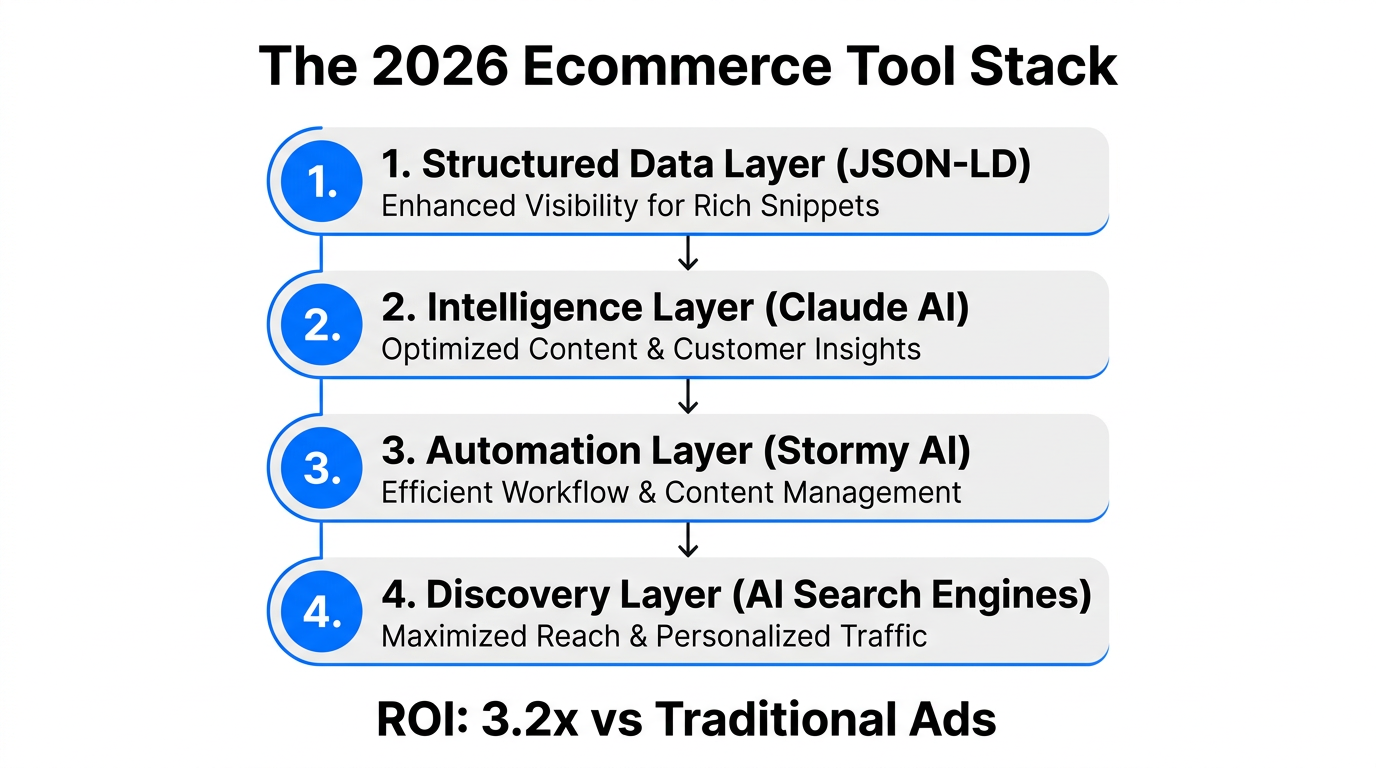
To stay competitive, you need a stack that integrates AI at every level, from the backend to the user interface. Here are the essential tools for 2026:
| Tool Category | Recommended Tool | Primary Use Case |
|---|---|---|
| Foundation AI | Claude AI | Data enrichment & GEO strategy |
| AI SEO / Catalog | Search Atlas | Schema auditing and AI indexing |
| Discovery & Outreach | Stormy AI | Automated creator discovery & AI outreach |
| Lifecycle Marketing | Klaviyo | AI-personalized email sequences |
| Data Analysis | Triple Whale | Attributing revenue to AI search sources |
Common Mistakes to Avoid in AI Search Optimization
As you implement your Claude AI SEO strategy, be wary of the following pitfalls that can tank your rankings:
- Stateless Chatbots: Using generic chatbots that don't remember previous sessions or access real-time inventory. According to Salesforce, 68% of customers abandon a chatbot after a single bad experience.
- Data Privacy Neglect: Failing to ensure your AI tools are GDPR/CCPA compliant. Pew Research notes that 81% of consumers are concerned about how businesses use their data. Ensure your Claude Project settings protect sensitive customer info.
- The "Prompt-Only" Trap: Relying on simple prompts without building a Knowledge Base. Without your specific brand guidelines and winning ad copy for context, the AI's output will remain generic and fail to stand out in generative search.
Conclusion: The Future is Conversational
In 2026, the battle for ecommerce dominance is won in the seconds it takes an AI to answer a user's question. By leveraging Claude AI to audit your structured data, enrich your product feeds, and optimize for long-tail conversational queries, you position your brand as the definitive choice for generative engines. Success in this new era requires a blend of technical precision and human-led brand consistency. Start by auditing your top 10 products today, and watch how your ecommerce search visibility transforms in the age of AI.