In the high-velocity marketing landscape of 2026, the era of the simple 'chatbot' has officially ended. We have entered the age of agentic AI—systems that do not just talk but actively execute complex tasks across the web and local environments. As of early 2026, the global AI agents market has surged to $11.55 billion, driven by a 49.6% CAGR that reflects a massive shift in how CMOs and founders allocate their martech budgets. No longer satisfied with linear automation, teams are now deciding between the reliability of traditional RPA like Zapier, the vision-based automation of Skyvern, and the autonomous reasoning power of OpenClaw.
"The demand in 2026 is for an AI that does things while you sleep, not one that just answers your questions." — Peter Steinberger, OpenClaw Founder.
For marketing leaders, the stakes couldn't be higher. Organizations using autonomous agents report 73% faster campaign development and a significant reduction in overhead. However, the choice of architecture—rigid logic vs. agentic reasoning—will determine whether your stack is a competitive advantage or a brittle liability. This guide provides a strategic deep dive into OpenClaw vs. Skyvern vs. Zapier to help you navigate the agentic revolution.
The Logic Gap: Why 'If-Then' is Losing to Reasoning
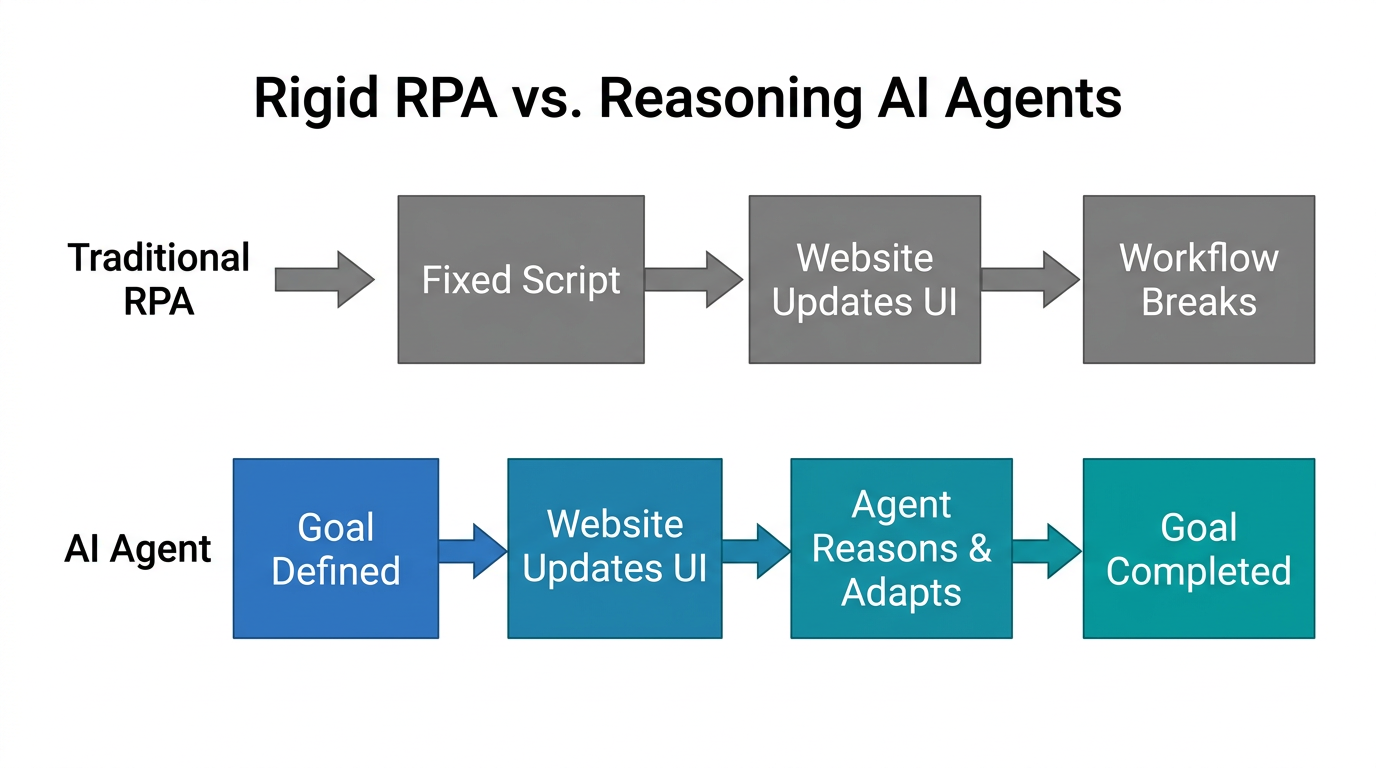
For over a decade, Zapier has been the gold standard for marketing automation. Its logic is simple: If a lead fills out a form, then add them to the CRM. This is Robotic Process Automation (RPA)—highly predictable but fundamentally "dumb." In 2026, marketing workflows have become too non-linear for these rigid paths. When a lead mentions a specific pain point on LinkedIn, you don't just want them in a database; you want an agent to research their recent Series B funding, cross-reference it with your product’s latest case study, and draft a hyper-personalized outreach email.
This is where OpenClaw excels. Unlike Zapier, OpenClaw uses Agentic Workflows—iterative cycles where the AI can correct its own mistakes and plan its next move based on the environment. According to Andrew Ng, these iterative cycles consistently outperform zero-shot prompting. If a website’s login button moves or a CAPTCHA appears, an RPA tool like Zapier (or its browser-based extensions) breaks. An agent like OpenClaw re-evaluates the UI, tries a different approach, and proceeds.
Cost-Efficiency Analysis: Fixed License vs. Token Usage
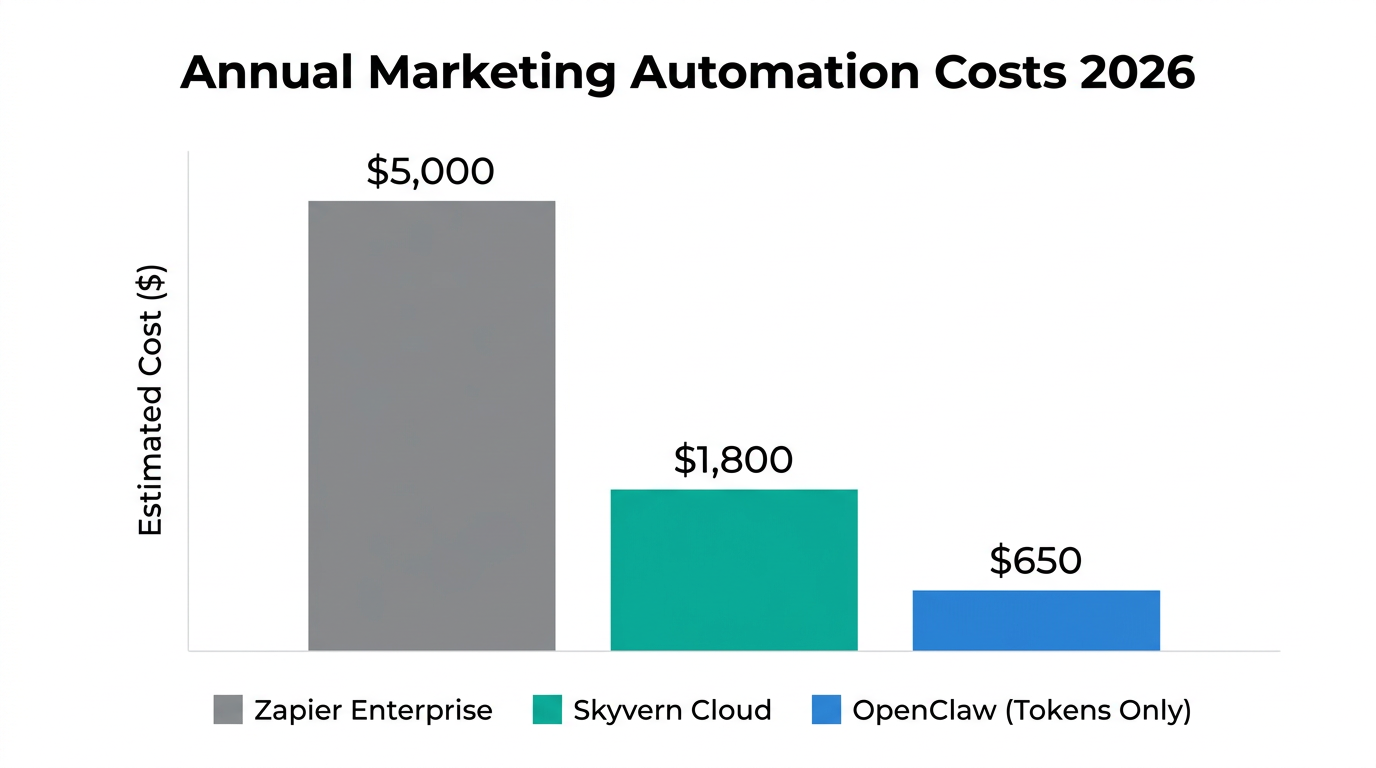
The financial model of your marketing stack in 2026 is shifting from "seats" to "tokens." Traditional tools like Relevance AI or Zapier often charge fixed monthly tiers. While this makes budgeting predictable, it can become prohibitively expensive for large-scale, bursty campaigns. OpenClaw, being open-source, allows for a usage-based token model that can be significantly more cost-effective for enterprise-scale operations.
| Feature | Zapier (RPA) | Skyvern (Agent) | OpenClaw (Autonomous OS) |
|---|---|---|---|
| Logic Type | Rigid If-Then | Vision-based Browser | Multi-step Reasoning |
| Pricing Model | Fixed Subscription | $0.05 per step / Pro tiers | Usage-based (Tokens) |
| Self-Healing | No (Breaks on UI change) | Moderate | High (Retries & Adapts) |
| Environment | App-specific APIs | Browser Only | Browser + Shell + Local Files |
In 2026, practitioners are utilizing Small-Large Model Cascades to manage these costs. By routing 80% of routine tasks—like cleaning data or basic research—to smaller, cheaper models ($0.10/M tokens) and reserving "Frontier" models like GPT-5 for final creative strategy, teams using OpenClaw can slash their marketing overhead by up to 12.2%, according to data from Level8.
Cross-Platform Execution: Navigating the Web vs. Proprietary APIs
While Zapier relies on established API connections, Skyvern and OpenClaw operate at the UI level. Skyvern is specifically designed for browser automation using computer vision. It is exceptional at filling out complex forms, booking travel, or navigating legacy insurance portals that lack APIs. However, OpenClaw goes a step further by operating as an Autonomous OS.
An OpenClaw agent can move seamlessly between a headless browser (via Browserbase), a local terminal, and your internal marketing files. This cross-platform capability is vital for 2026 workflows like Agentic SEO. For example, a growth lead might use OpenClaw to monitor competitor pricing hourly, trigger a content skill to draft a reactive post, and then send a Slack notification for final human approval. For brands looking to scale these workflows into the influencer space, platforms like Stormy AI provide a specialized version of this automation, allowing for the discovery and outreach of thousands of creators using natural language prompts.
"We have moved from 'AI-assisted' to 'AI-driven' operations. 40% of enterprise apps now have embedded agents that act independently of human clicks." — Gartner (2026)
Memory and Persistence: The SOUL.md Protocol
One of the biggest complaints about early AI tools was their statelessness. They forgot the context of the previous campaign the moment the session ended. In 2026, OpenClaw has solved this through Persistent Memory using local .md files. This isn't just a log; it’s a living document of your brand's voice, ethics, and past performance.
A critical innovation in this space is the SOUL.md Protocol, popularized by experts like Ethan Mollick. By defining a "soul" for your agent in a simple markdown file, you can set hard constraints that the agent reads before every prompt. For marketing, this includes rules like: "Never approve a budget increase over 10% without human Slack approval" or "Always prioritize brand safety over reach when vetting UGC creators."
Security and Hardening: Running Agents Safely
With great power comes significant risk. The early 2026 "ClawHavoc" attack, which saw hundreds of malicious skills uploaded to open-source hubs, proved that unvetted agents can be a security nightmare. Marketing teams must adopt a "Defense-in-Depth" strategy when deploying OpenClaw or any autonomous system.
- Sandboxing: Never run an agent directly on your primary OS. Use dedicated E2B sandboxes or Docker containers with restricted permissions.
- Human-in-the-Loop Checkpoints: Ensure your agents utilize "Checkpoint" states. An agent should never send an outbound email to a partner or spend ad budget on Meta Ads Manager without a human hitting the "Yes" button in Slack.
- Credential Management: Use proxy services like Aquaman so your agent never sees your raw master passwords.
The Verdict: Choosing Your 2026 Champion
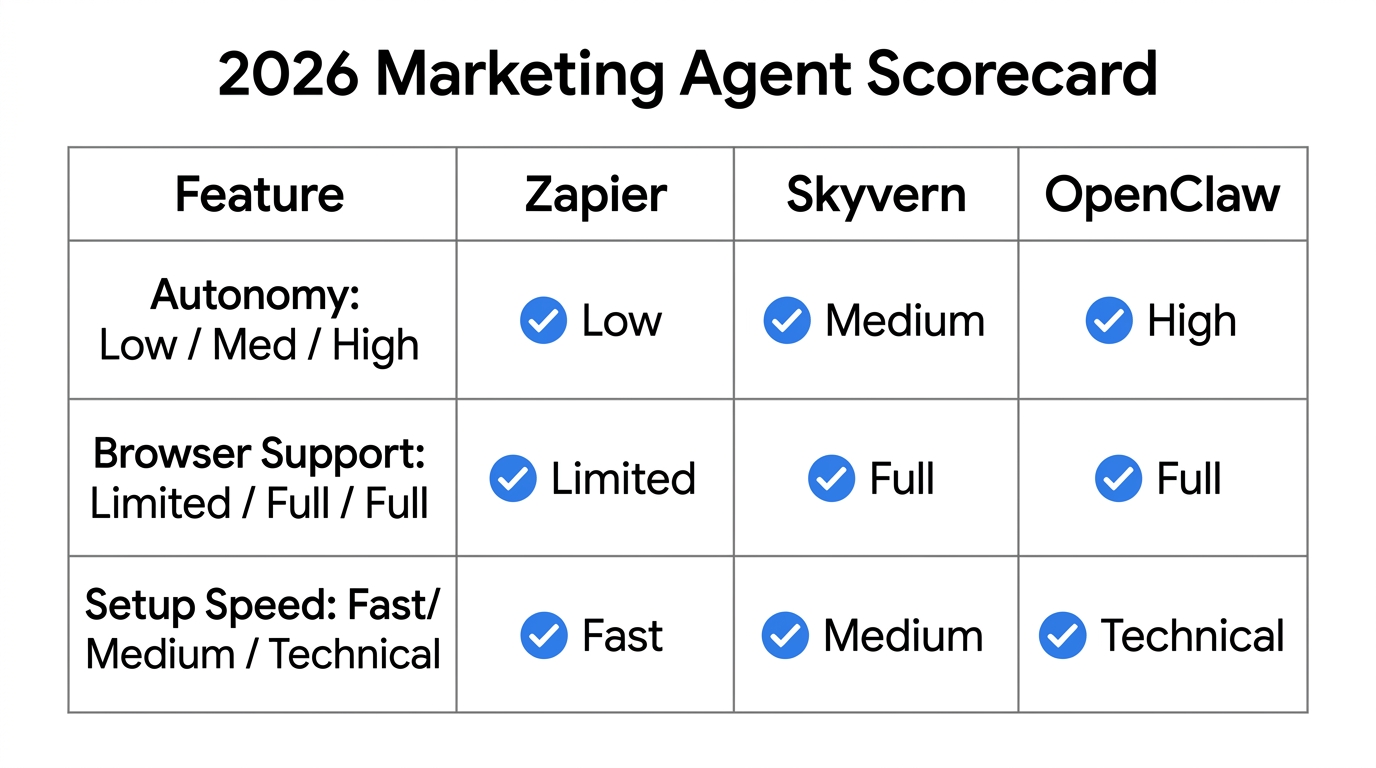
The choice between OpenClaw, Skyvern, and Zapier depends entirely on your operational maturity. If your goal is to move data between two SaaS apps with 100% reliability, Zapier remains the safest bet. If you need to automate legacy websites or specific browser-based tasks like inventory scraping, Skyvern is your specialist.
However, for the CMO or founder who wants to build a fully autonomous marketing department, OpenClaw is the clear winner. Its ability to reason, remember, and adapt to UI changes makes it the only tool in this lineup that truly qualifies as a "digital employee." When paired with specialized discovery platforms like Stormy AI for creator management, your marketing stack becomes an unstoppable, self-optimizing engine. In 2026, the competitive advantage doesn't go to those with the biggest teams, but to those with the most capable agents.