In 2026, the battle for consumer attention isn't won within the interface of Meta Ads Manager; it is won by the speed and precision of your creative feedback loop. As the industry has shifted from traditional SaaS to Agent-as-a-Service (AaaS), performance marketers are moving away from manual dashboard monitoring toward autonomous frameworks. Leading this revolution is OpenClaw, an open-source AI agent framework that allows brands to deploy reasoning-driven "Skills" to manage their Meta Ads ecosystems. By automating OpenClaw creative analysis and competitor intelligence, growth teams are finally solving the plague of creative fatigue before it eats their margins.
"The shift to agentic marketing means the AI handles the math while the marketer handles the direction, allowing for creative cycles that move at the speed of social media."The Shift to Agentic Meta Ads in 2026
The current landscape of competitor ad intelligence 2026 is defined by "local-first" AI. Due to increasing GDPR and CCPA regulations, 58% of top-tier brands now prefer running agents locally on their own hardware to keep sensitive first-party data secure. While native tools like Meta Advantage+ offer liquidity, they often prioritize platform spend over advertiser profitability. OpenClaw provides a bridge, giving you an AI-driven creative strategy that prioritizes your specific ROAS targets and brand safety.
The Creative Analyst: Diagnosing Fatigue with 7, 14, and 30-Day Windows
One of the most critical components of the OpenClaw framework is the Creative Analyst skill. This module is designed to solve the most expensive problem in performance marketing: asset decay. Instead of waiting for a high CPA to signal failure, the agent monitors Click-Through Rate (CTR) decay over specific lookback windows. By comparing performance across 7, 14, and 30-day periods, the agent can predict when a creative is losing its "thumb-stop" ability before the conversion rate drops.
How the Decay Windows Work
- 7-Day Window: Identifies immediate winners and losers. If a new hook fails to meet the baseline CTR within 168 hours, it is flagged for an immediate pivot.
- 14-Day Window: Measures the stability of the creative. This is where most "fatigue" begins to show as frequency increases among your core audience.
- 30-Day Window: Provides the long-term benchmark. Assets that survive this window are your "evergreen" creatives, but even these are monitored for the slow ROAS erosion that human analysts often miss.
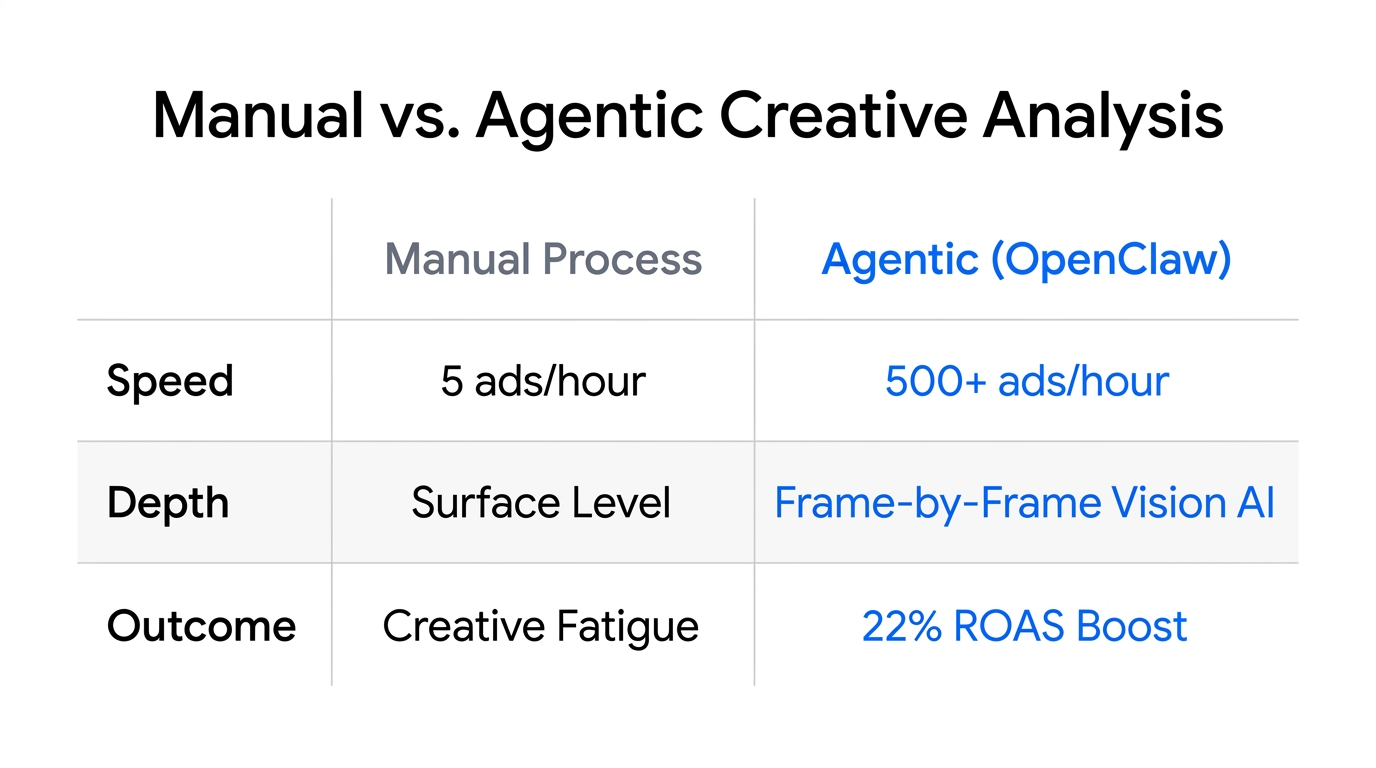
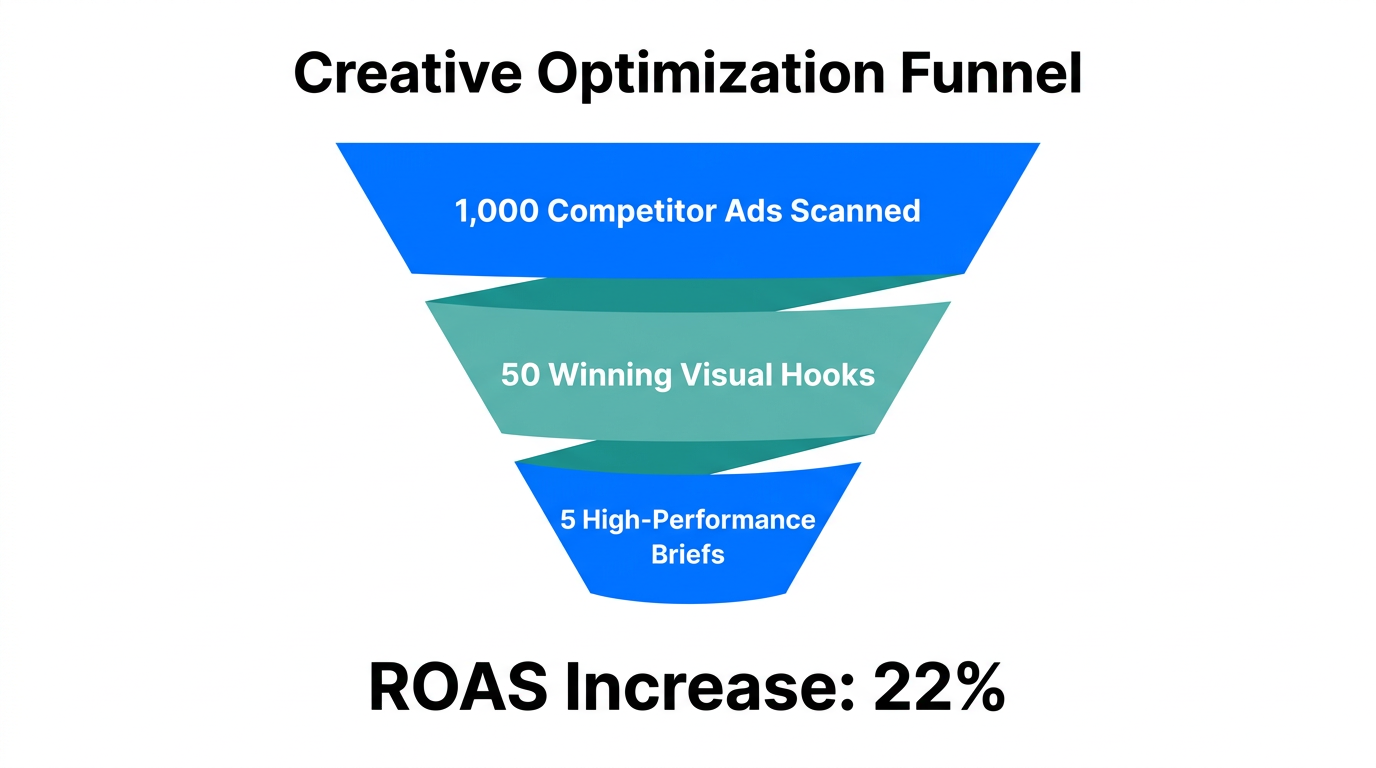
According to research from Ryze AI, brands using agent-assisted creative monitoring report a 22% increase in ROAS. This performance jump is attributed to maintaining fresh creative cycles and never allowing a stagnant ad to drain the budget. If you are struggling to keep up with content demands, using a tool like Stormy AI can help you discover and outreach to high-performing UGC creators to fuel these automated creative cycles.
| Metric Window | Primary Goal | Action Taken by Agent |
|---|---|---|
| 7 Days | Velocity Check | Pauses bottom 20% of hook variations |
| 14 Days | Frequency Audit | Adjusts budget to prevent audience over-saturation |
| 30 Days | Efficiency Baseline | Archives assets and requests fresh creative concepts |
Implementing the Competitor Auditor: Your Meta Ad Library Scraper Tool
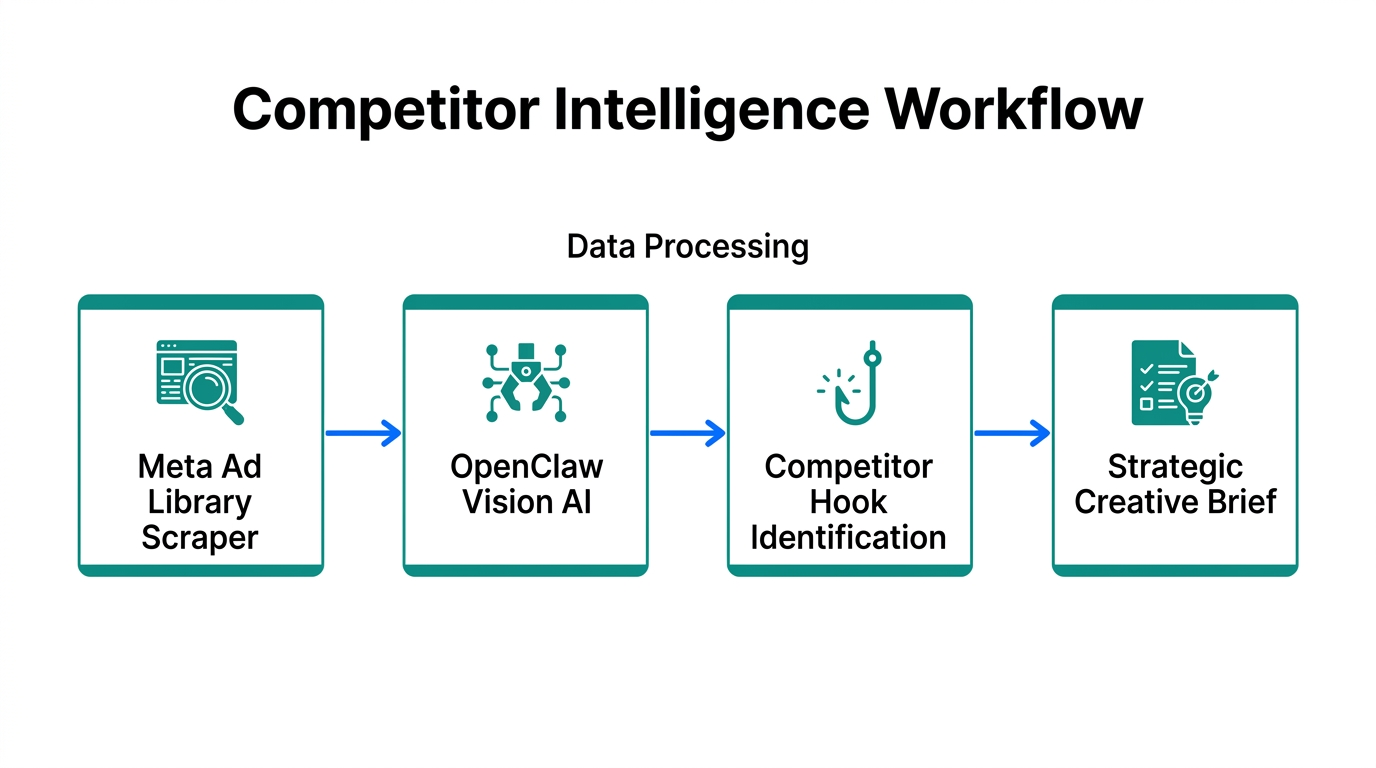
In the past, keeping tabs on competitors involved manual scrolling through the Meta Ad Library. In 2026, OpenClaw’s Competitor Auditor skill automates this entire intelligence gathering process. This skill uses a browser-control mechanism to visit the library, extract competitor ad copy, and download hooks for analysis. It doesn't just collect data; it scores competitor creatives against your internal Brand Bible to see what they are doing better—or worse—than you.
Building the Creative Intelligence Report
When the agent scrapes a competitor's active ads, it looks for shifts in messaging. Is a direct competitor suddenly leaning into "Fear of Missing Out" (FOMO) hooks? Are they using split-screen UGC or high-production cinematic shots? The Competitor Auditor analyzes these trends and generates a weekly report. This Meta Ad Library scraper tool functionality ensures you are never the last to know when a competitor finds a winning creative angle.
"The average AI-driven tool in 2026 yields $4.52 in revenue for every $1 spent on Meta platforms, largely due to better creative intelligence."Once your agent identifies a successful competitor hook, the next logical step is to iterate. This is where Stormy AI becomes invaluable. You can take the insights from your competitor ad intelligence 2026 reports and use Stormy's AI search to find creators who specialize in those specific styles—whether it's "unboxing" videos or "problems/solution" testimonials—ensuring your creative output matches the market demand in real-time.
Building a Creative Feedback Loop via Slack and Telegram
Automation is only useful if it informs action. A sophisticated OpenClaw setup doesn't just live in a terminal; it integrates directly into your team's workflow. By connecting the Reporting Assistant skill to tools like Telegram or WhatsApp, you can create a real-time Command Center.
The agent uses the Model Context Protocol to aggregate data from the Meta Ads API and Google Analytics 4. Instead of a 40-slide deck, your creative team receives a natural language summary in Slack every Monday morning. It might say: "The 'Free Shipping' hook is decaying. Competitor X just launched 5 new 'Expert Recommendation' ads. Suggest briefing 3 new UGC videos focusing on authority and trust."
The Playbook: Deploying Your AI Creative Strategy
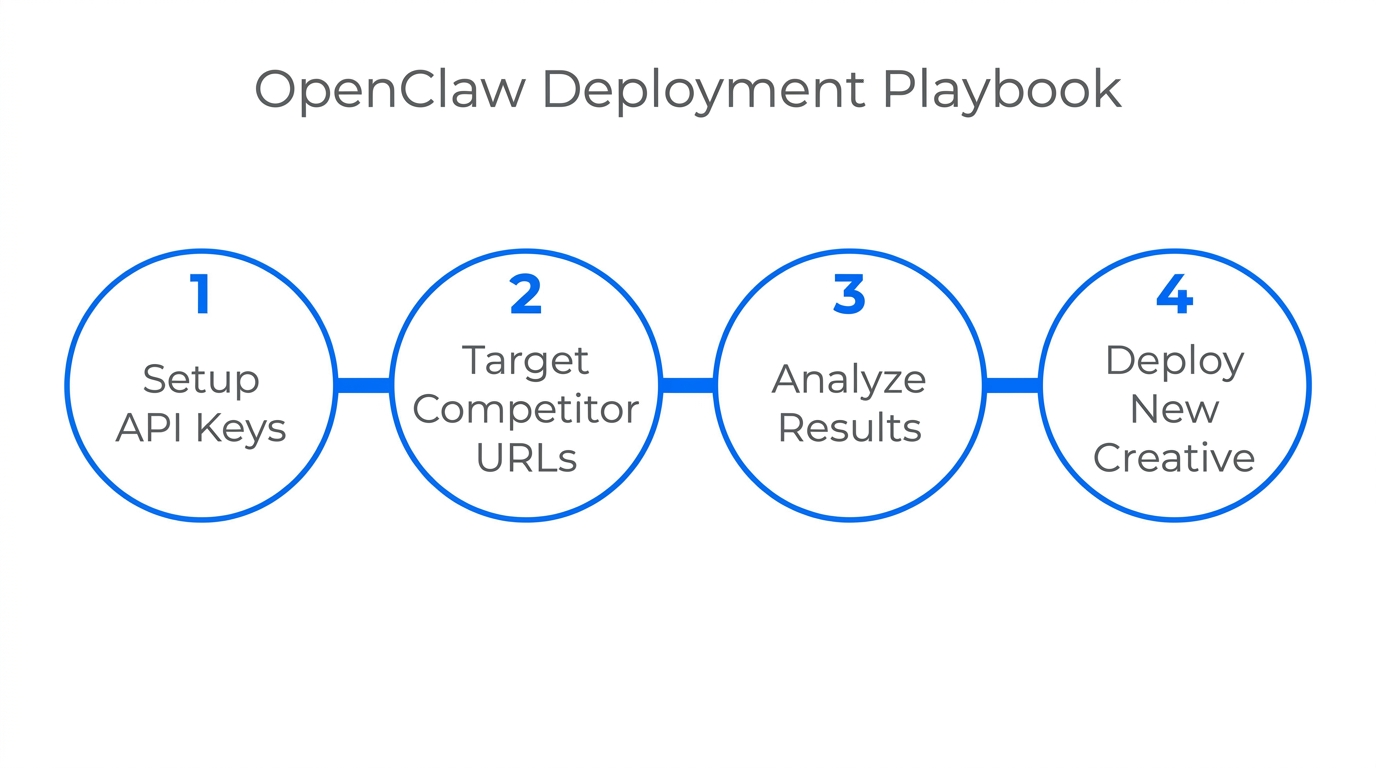
Ready to move away from creative fatigue automation theory and into implementation? Follow these steps to set up your local-first OpenClaw environment.
Step 1: Secure Your Hardware
Adopt the "Mac Mini Strategy." Host OpenClaw on a dedicated local machine or a Virtual Private Server (VPS) like AWS Lightsail. This ensures 24/7 monitoring without relying on third-party cloud tools that might compromise your data privacy.
Step 2: Install Essential Skills
Download the pre-configured OpenClaw skill files. At a minimum, you need the Performance Auditor, the Creative Analyst, and the Competitor Auditor. For those looking for a head start, the Adspirer Plugin offers a optimized 14KB Markdown file specifically for Meta Ads management.
Step 3: Establish Guardrails
One of the biggest mistakes in AI-driven creative strategy is the "Rogue Agent" scenario. Never give an agent full "Write" permissions on day one. Implement a 14-day Read-Only Phase where you review the agent's logic before allowing it to pause or scale ads. Ensure you have the Meta Conversions API (CAPI) properly installed so the agent makes decisions based on server-side data rather than pixel signals alone.
The Future of Meta Ad Intelligence
Automating your Meta Ads creative analysis with OpenClaw isn't just about saving time—it's about survival in a market where CPAs are rising and attention spans are shrinking. By utilizing a Meta Ad Library scraper tool and an agentic feedback loop, you can achieve the 30% reduction in CPA that has become the benchmark for e-commerce excellence in 2026. Stop guessing which ads will work and let an autonomous agent find the signal in the noise while you focus on the big-picture growth of your brand.