In the rapidly evolving landscape of 2026, the digital advertising industry has undergone a seismic shift. The "Chatbot-era" of passive assistants is being replaced by the age of Execution Agents. For CMOs and Growth Leads, the traditional reliance on static SaaS dashboards is giving way to OpenClaw, an open-source AI agent framework that doesn't just suggest changes—it executes them. As teams strive for autonomous ad management, the efficiency gains and conversion lifts provided by these agentic frameworks have become a competitive necessity for staying ahead in the Google Ads ecosystem.
The Shift from 'Chatbot-era' Assistants to 'Execution Agents'
For years, marketing automation meant setting up basic rules or using generative AI to draft headlines. However, 2026 marks the point where software stops being a mere tool and starts being a teammate. The rise of OpenClaw (formerly known as Moltbot) represents this transition perfectly. Unlike standard SaaS platforms that lock you into a proprietary black box, OpenClaw is a self-hosted AI agent that runs on your own infrastructure, whether that's a local machine or a DigitalOcean VPS.
The core difference lies in the Model Context Protocol (MCP). This allows the agent to connect directly to your Google Ads account, internal spreadsheets, and communication tools like Telegram or Slack. It doesn't just wait for you to log in; it "reasons" through live data and executes adjustments in real-time. This is why growth teams are moving away from manual dashboarding and toward autonomous loops that manage spend while the team focuses on high-level strategy.
"The transition from SaaS to Agent-as-a-Service marks the point where software stops being a tool and starts being a teammate." — Peter Steinberger, Creator of OpenClaw.
Analyzing the 2.5–4% Conversion Rate Lift
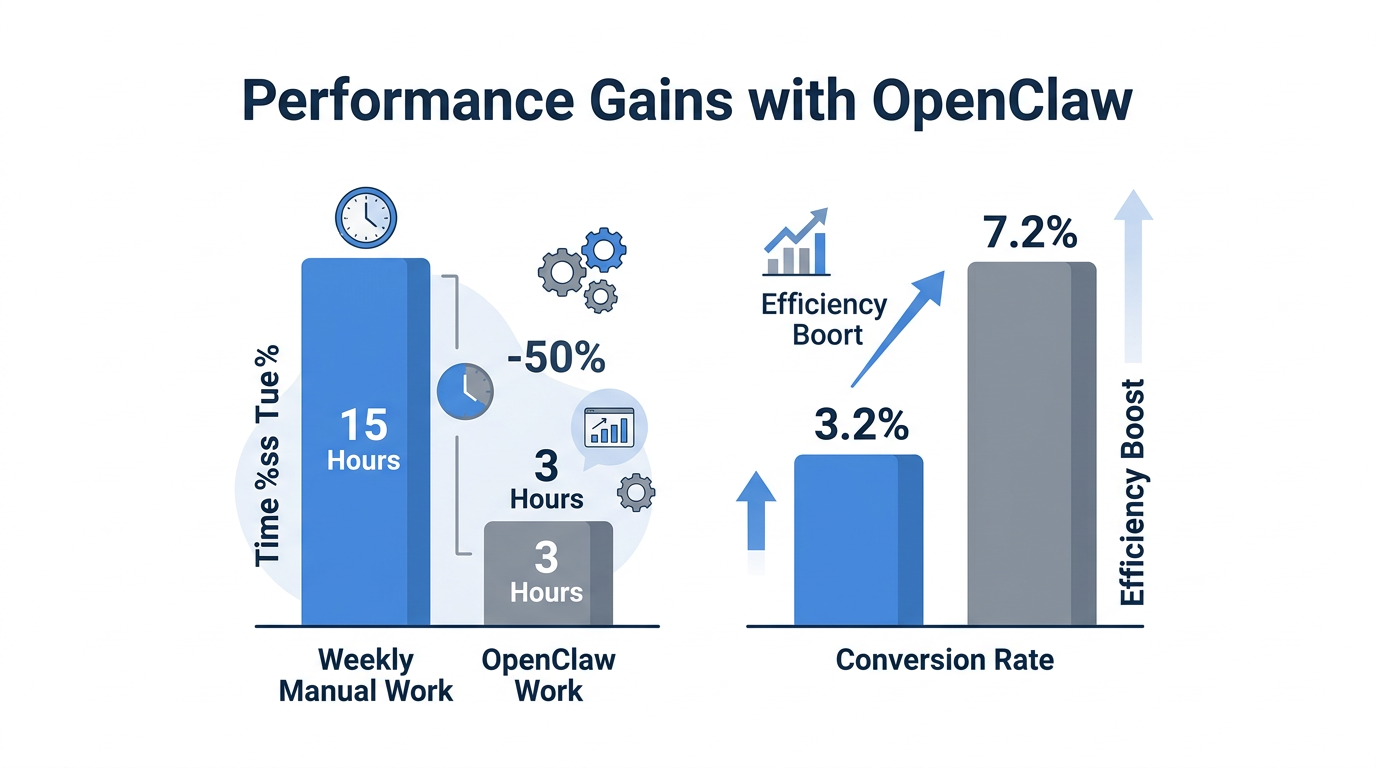
Data from late 2025 and early 2026 reveals a startling performance gap between traditional automation and agentic optimization. According to research from Stormy AI, OpenClaw-optimized ad copy is currently seeing a 2.5–4% conversion rate. When compared to the industry average of 1.2% for standard automated copy generated by legacy tools, the advantage is clear. The agent's ability to analyze search intent nuances and adjust headlines in real-time results in a significantly more relevant user experience.
This efficiency argument is backed by industry reports on Medium, which highlight how PPC agency efficiency gains are being driven by agentic auditing. Instead of a human spending Monday mornings pulling CSVs and identifying waste, an agent performs a full account health check at 2 AM, flagging issues by revenue impact before the team even starts their day. For brands running high-volume campaigns, this level of autonomous ad management is no longer a luxury—it is the baseline for profitability.
The 'Skill' Architecture: How Performance Auditor and AdWhiz Work
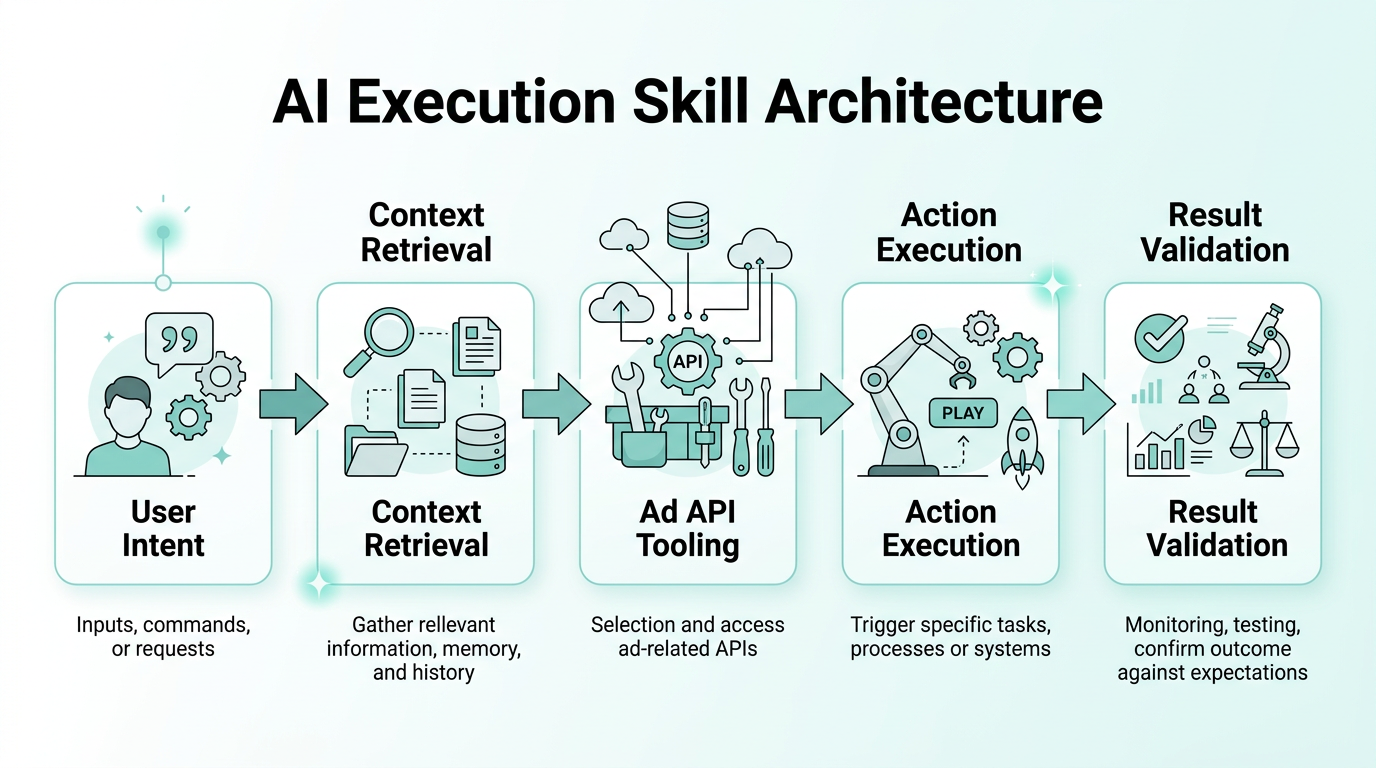
The power of OpenClaw resides in its modularity. It operates via Skills—structured markdown files that define specific task logic. This allows teams to customize their agent's "brain" without writing complex code from scratch. Two of the most critical skills for modern growth teams are the Performance Auditor and AdWhiz.
- Performance Auditor: This skill performs full account health checks, automatically flagging "bleeding" keywords (e.g., those spending over $500 with zero conversions) and ranking issues based on their immediate impact on the bottom line.
- AdWhiz: A specialized toolset featuring 44 MCP tools designed specifically for auditing, creating, and optimizing Google Ads directly from within the AI environment. You can find these shared in the GitHub Skills Directory.
- Keyword Opportunity Finder: This skill scans search term reports for high-intent queries emerging in AI Overviews (SGE) and adds them as keywords with tight tCPA constraints, ensuring you capture new traffic trends instantly.
| Feature | Traditional Marketing SaaS | OpenClaw Agentic Framework |
|---|---|---|
| Execution | Manual approval required | Autonomous loops |
| Integration | Limited APIs | Model Context Protocol (MCP) |
| Cost | High monthly per-seat fees | Open-source / Infrastructure-only |
| Transparency | Black-box algorithms | Fully auditable Skills (Markdown) |
The Rise of Open-Source Marketing Infrastructure
One of the most telling signs of this shift is the explosive growth of the OpenClaw community. As of early 2026, the project has surpassed 219,000 GitHub stars, making it the fastest-growing open-source marketing infrastructure in history. You can track the project's progress on the Official GitHub repository. This massive adoption suggests that growth leads are increasingly wary of being locked into proprietary platforms like legacy marketing suites for specialized ad management, preferring instead to own their AI infrastructure.
By using an open-source framework, teams can leverage the collective intelligence of thousands of developers while keeping their data secure on their own servers. This is particularly relevant for startups and agencies that need to maintain high-security standards while utilizing cutting-edge OpenAI or Anthropic models.
"In 2026, the competitive advantage doesn't go to the marketer who writes the best prompts, but to the one who deploys the most efficient autonomous systems." — Industry Insight from Stormy AI.
A Playbook for Autonomous Google Ads Management
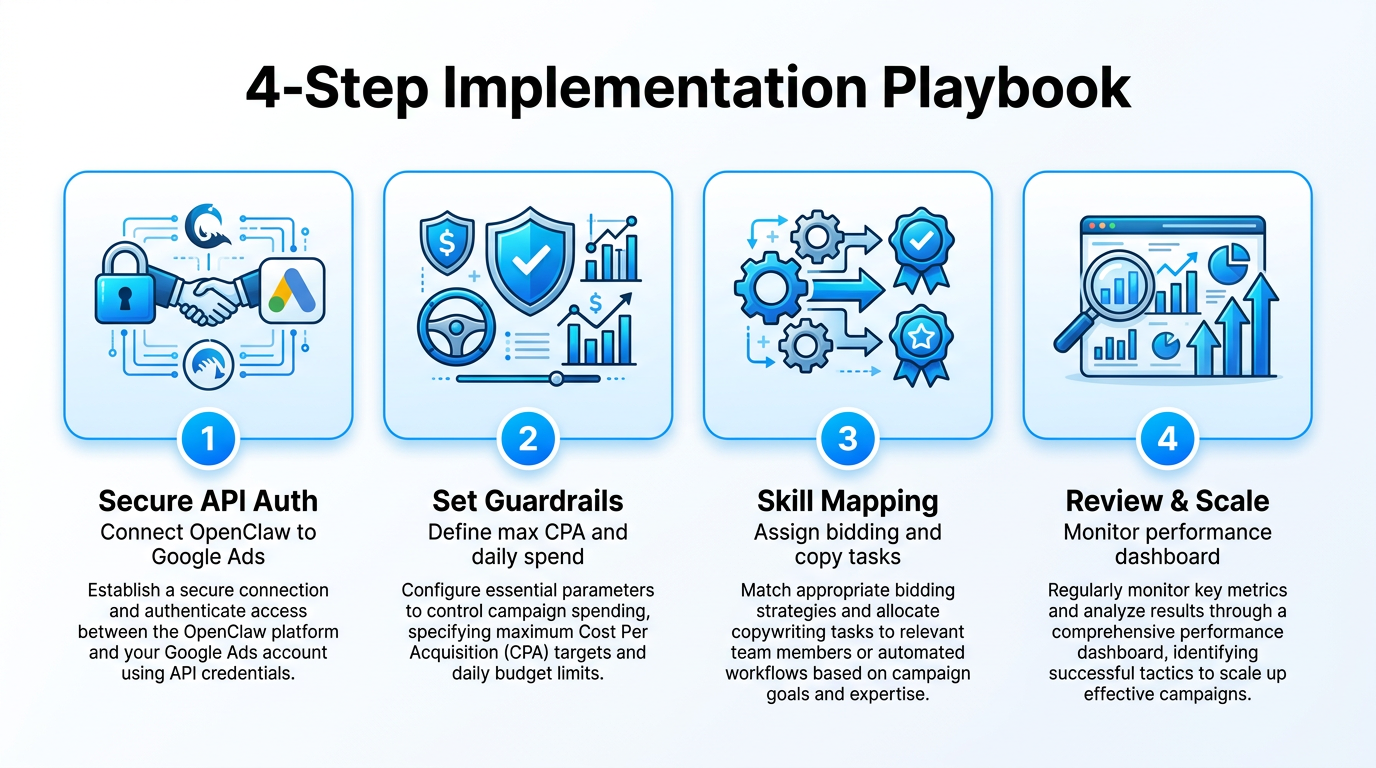
If you are looking to implement OpenClaw within your growth team, here is a clear three-step playbook to get started with AI agents vs marketing SaaS workflows.
Step 1: The "Zero-Conversion Filter"
Set up a weekly cron job (automated task) in your agent. The agent should scan for any keyword or asset group that has spent 3x your target CPA without a single conversion. Have the agent automatically pause these at 2 AM on Mondays. This ensures your week always starts with a pruned budget and minimal waste. You can find similar logic patterns discussed on HackerNoon for agentic development.
Step 2: Value-Based Bidding with CRM Integration
Instead of just optimizing for "leads," bridge the gap between your ad platform and your CRM, such as Salesforce. Use OpenClaw to pull actual margin data and feed it back into the bidding engine. This allows the agent to favor high-lifetime-value (LTV) customers over low-quality leads, a strategy often mentioned by UserIntuition as critical for sustainable growth.
Step 3: The Creative Refresh Loop
Use vision models like Claude 3.5 Sonnet to analyze CTR trends. When the agent detects "creative fatigue" (defined as a 20% drop in CTR over a rolling 7-day period), it should automatically draft three new headline variations. The agent then pings your team via Telegram for a simple "thumbs up" approval before pushing the changes live.
Common Mistakes and Risks in 2026
While the benefits are immense, the move to open-source marketing infrastructure is not without its pitfalls. Security and compliance are paramount when giving an AI agent control over your credit card and ad accounts.
- The "Public Gateway" Vulnerability: According to Secure.com, many users (CVE-2026-25253) mistakenly run OpenClaw on public ports without passwords. This can lead to WebSocket hijacking, where malicious actors take over your agent. Always bind your gateway to
127.0.0.1and use Tailscale for secure remote access. - API "Backdoor" Bans: Early in 2026, hundreds of developers saw their accounts locked for using subsidized developer tokens for commercial management. To avoid this, always use your own paid API keys from OpenAI or Anthropic.
- Memory Bloat: As agents run, they accumulate "stale" memory that can slow down execution and increase token costs. Experts at Clawdboss.ai recommend implementing a decay architecture for your
MEMORY.mdfiles, pruning data that hasn't been referenced in 14 days.
The Bottom Line for CMOs
The switch to OpenClaw is more than just a software change; it's a shift in organizational philosophy. By moving from manual management to autonomous ad management, growth teams can achieve 1.8x ROAS or higher by delegating the tedious auditing and bid management tasks to specialized agents. For those also managing influencer relationships, platforms like Stormy AI can be paired with these agentic workflows to ensure that both paid search and creator-led marketing are running on fully optimized, AI-driven loops. The future of marketing isn't just about who has the most data—it's about who has the most efficient systems to act on it.