In early 2026, Jensen Huang made a statement that sent shockwaves through the marketing world: every company now needs an "OpenClaw strategy." He famously called this agentic framework the "new computer." But as many early adopters have discovered, installing OpenClaw is only the first step. The real challenge lies in wiring the system so it sounds like your brand and acts like a true extension of your marketing philosophy, rather than another generic bot producing AI slop.
If your AI agent doesn't understand your unique voice, it becomes a liability. To avoid this, you must master the hierarchy of the Soul.md and Identity.md files. These aren't just configuration files; they are the genetic code of your digital employee branding. In this guide, we will break down the exact steps to move from a basic install to a fully personalized brand-building powerhouse.
The Hierarchy of OpenClaw Files: Understanding Agents, Soul, and Identity
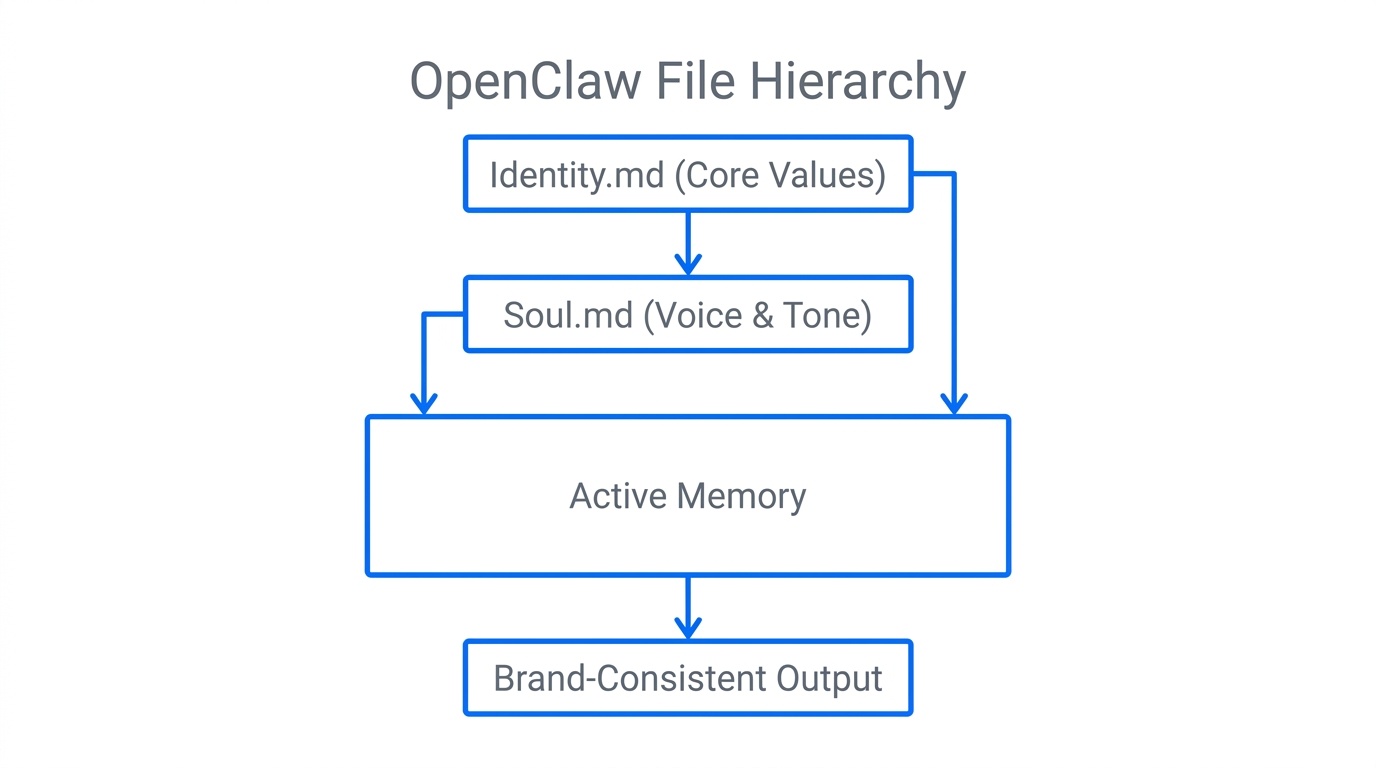
To achieve OpenClaw brand personalization, you must understand how the system prioritizes information. When you launch a session, OpenClaw loads specific markdown files from your workspace folder. If these files are generic, your output will be generic. If they are hyper-specific, your agent becomes a superhuman employee that understands your brand's nuances.
| File Name | Primary Function | Brand Impact |
|---|---|---|
| Agents.md | Defines high-level agent behavior and tool permissions. | The "Manager" layer that keeps the agent on task. |
| Soul.md | Defines the agent's personality, tone, and conversational style. | Ensures the AI agent identity feels authentic to your brand. |
| Identity.md | Stores brand history, values, mission, and specific constraints. | Prevents the agent from making claims that contradict your brand. |
| User.md | Information about you (the founder/marketer) and your preferences. | Aligns the agent's output with your personal marketing philosophy. |
Think of Agents.md as the job description, while Soul.md is the personality hire. If your brand is "bold and disruptive," your Soul.md should explicitly forbid corporate jargon. If your brand relies on ASO (App Store Optimization) and data-driven growth, your Identity.md should include your past campaign results and core metrics to guide its decision-making.
Creating a Troubleshooting Baseline: The OpenClaw Support Project
 9:47
9:47One of the biggest hurdles in OpenClaw marketing setup is the "broken bot" syndrome. Because OpenClaw is open-source and rapidly evolving, errors are common. To maintain 100% uptime for your brand-building activities, you need a troubleshooting baseline. Instead of shouting into the void (or Reddit), you should use the "Support Project" method.
Go into your Claude Desktop or ChatGPT project settings and create a dedicated workspace called OpenClaw Support. The secret sauce here is context. Download the latest documentation from Context7, which provides compressed, LLM-friendly versions of official docs, and upload them to your project.
"The secret to a 24/7 digital employee isn't perfect code—it's giving your AI the documentation it needs to fix itself when it hits a wall."
By providing the raw documentation as a persistent file, you stop the AI from hallucinating fixes. This creates a robust feedback loop where you can simply paste an error from your terminal, and the support agent will reference the exact 2026 documentation to provide a solution.
Step-by-Step Guide: Uploading Your Marketing Brain to OpenClaw
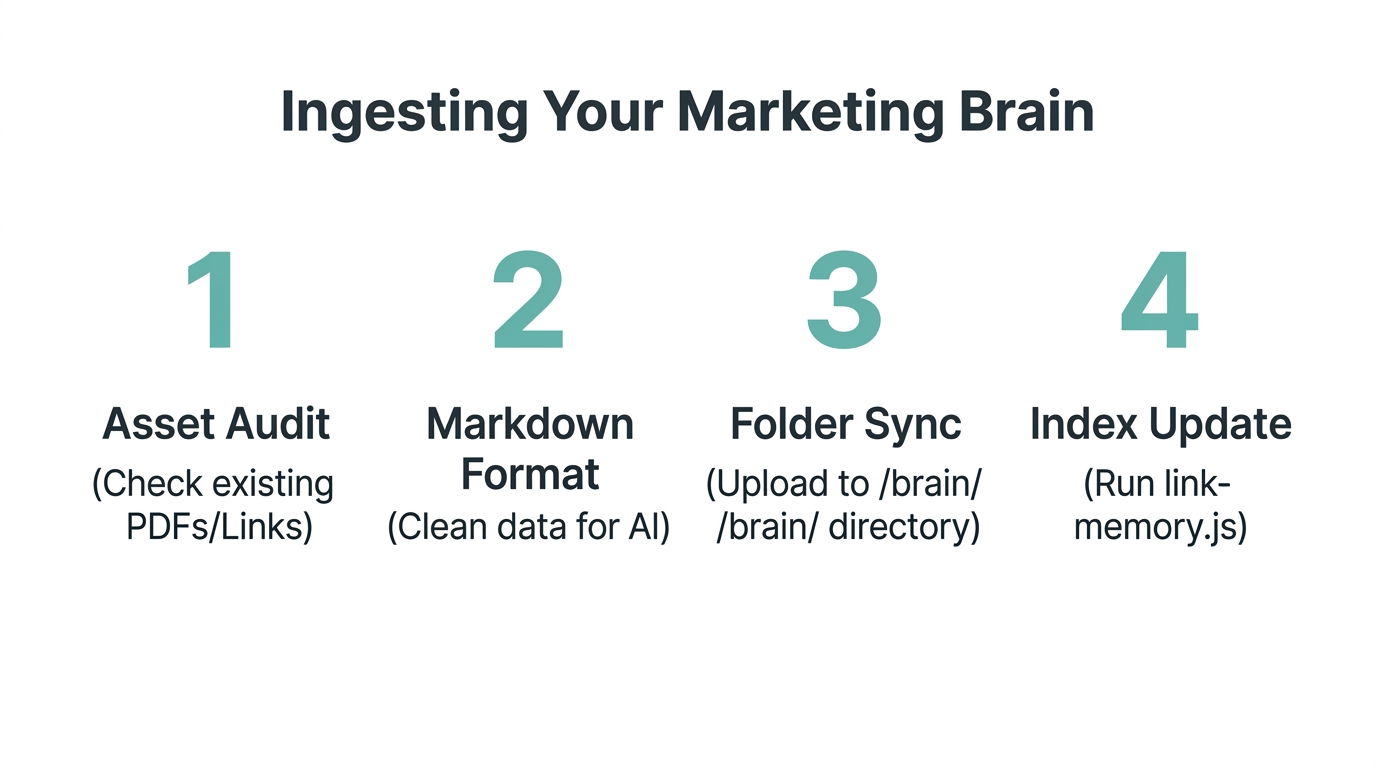
To move from generic responses to brand-first distribution, you need to perform what we call a "brain upload." This involves dumping your specific marketing frameworks, successful past content, and even your dislikes into the Workspace folder.
- Audit Your Best Content: Gather your top-performing 10 videos, 10 emails, and 10 social posts. Summarize the "why" behind their success.
- Define Your Constraints: Create a section in
Soul.mdtitled "The Never List." For example: "Never use the word 'delve', never use emojis in professional threads, and never suggest TikTok trends that require dancing." - Map Your Tech Stack: Mention the tools you already use, such as Meta Ads Manager or Apple Search Ads, so the agent can suggest strategies that fit your existing workflow.
- Initialize via Terminal: Once your files are ready, tell your OpenClaw agent: "Read my Identity.md and Soul.md. From now on, every suggestion you make must be filtered through these brand constraints."
Managing Memory.md: Avoiding Marketing Mistakes
15:17A common complaint in early 2026 is that AI agents "forget" what they learned yesterday. To build a consistent brand, your agent must have a long-term memory that persists across sessions. In OpenClaw, this is handled by Memory.md and the daily memory/ folder logs.
To ensure your agent actually improves, you must enable compaction memory flushing. Use the terminal command: set compaction memory flush enabled to true. This forces the agent to write a summary of the current session to Memory.md before it reaches its context limit. Without this, your agent will "lose" the learnings from a 3-hour strategy session as soon as the window resets.
Additionally, you can personalize your Heartbeat.md file—the script that runs every 30 minutes to keep the agent "alive." Add a command to the heartbeat that instructs the agent to: "Check if today's memory file is updated. If I've made a marketing mistake today, log it as a constraint for the future."
From Generic Responses to Brand-First Distribution: The Content System
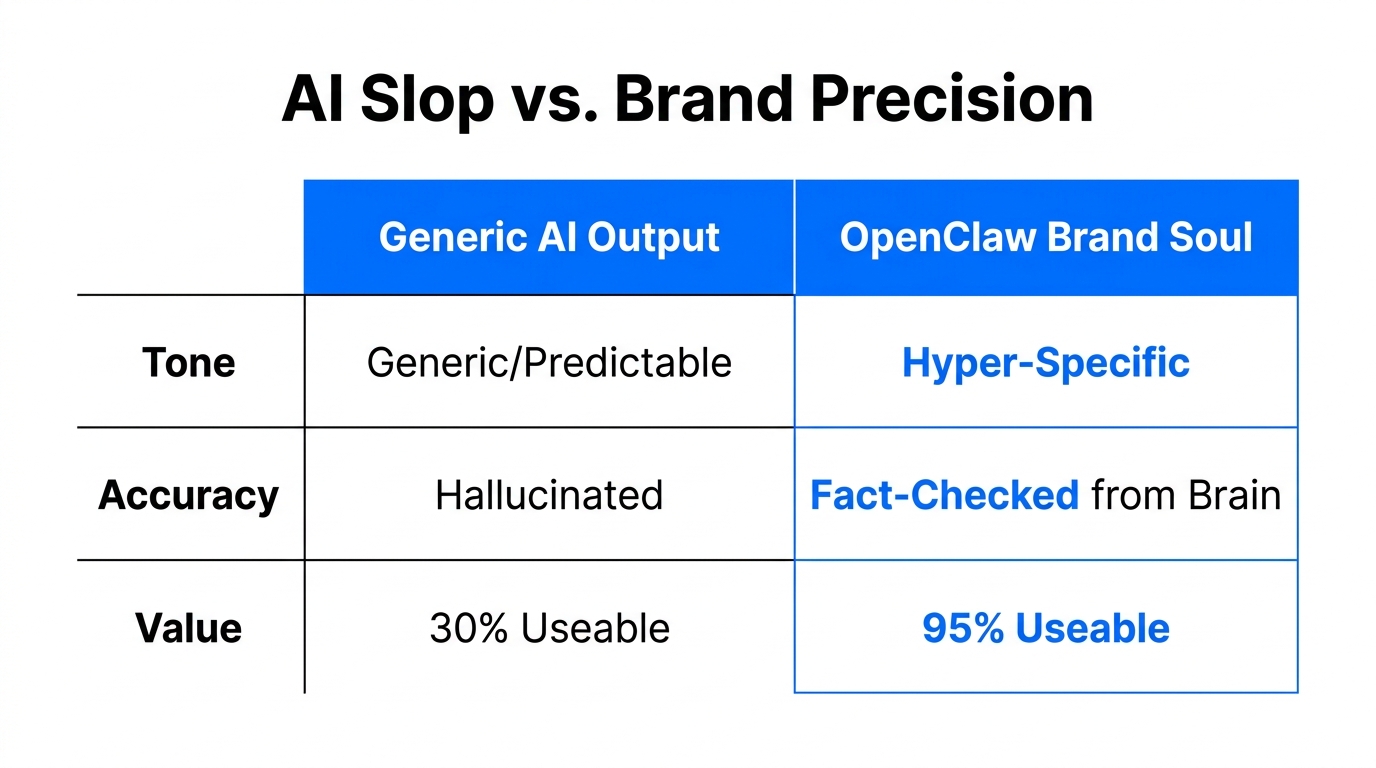
In 2026, the internet is flooded with "AI slop"—content that looks and feels like it was generated in a vacuum. To win at brand building automation, you need a system that captures authentic ideas and transforms them into high-signal content. Here is a 3-step workflow to achieve this with OpenClaw:
1. The Multi-Channel Idea Capture
Configure your OpenClaw agent to track specific "Inspiration Channels." You can create a channels.md file listing your favorite creators or competitors. Using its built-in browser tool, the agent can scrape these channels nightly, logging high-performing topics into an ideas.md list. You can also send voice notes or links directly to your agent via WhatsApp or Telegram to ensure no "shower thought" is lost.
2. The Scripting Loop
Instead of asking for a "viral script," tell the agent: "Reference my Soul.md and my top 3 past videos in the workspace. Write a script for a 60-second video about UGC creator sourcing that sounds like me." This ensures the digital employee branding remains intact. If you are scaling an app, you might even have it reference current ASO trends to ensure the content drives actual installs.
"The goal isn't to let the AI do the work—it's to let the AI do the 90% of the prep work so your 10% of human intuition can shine."
3. Integrating Influencer Analytics
Content doesn't live in a silo. For brands focusing on UGC (User Generated Content) for mobile app marketing, you can connect your OpenClaw workflow to specialized platforms. For instance, you can use Stormy AI to discover and vet creators who match your brand's specific "Soul" profile. Your OpenClaw agent can then manage the outreach emails, using the personalization logic you've already defined in your Identity.md.
Security Basics: Protecting Your Brand Identity
34:47As you give your OpenClaw agent more power, security becomes paramount. You are essentially giving a digital employee keys to your business. In 2026, "prompt injection" is a real threat—this is when a malicious email or web page tries to override your agent's instructions.
To mitigate this, follow the Principle of Least Access. Do not give your agent access to your primary 15-year-old Gmail account. Instead, create agent-owned accounts. Set up a dedicated brand email (e.g., agent@yourbrand.com) and only share the specific Google Sheets or folders it needs to do its job.
For maximum security, run your OpenClaw instance on a local machine (like a Mac Mini) rather than a VPS (Virtual Private Server). This keeps your .env files and API keys behind your local firewall, making it much harder for external actors to hijack your AI agent identity.
Conclusion: The Future of Agentic Branding
Personalizing your OpenClaw 'Soul' is not a "set it and forget it" task. It is an iterative process of refining your Soul.md and Memory.md until the agent truly understands your brand's heartbeat. By moving away from generic prompts and toward a structured markdown-based identity, you transform a simple bot into a digital employee capable of managing everything from CRM follow-ups to complex content machines.
As we navigate 2026, the companies that win won't just be the ones using AI—they will be the ones whose AI actually sounds like them. Start by uploading your brain, securing your environment, and using tools like Stormy AI to bridge the gap between automated strategy and real-world creator execution. The era of the agentic brand is here; make sure yours has a soul.