Sam Altman, CEO of OpenAI, famously predicted the rise of the one-person billion-dollar startup. In a world where intelligence is becoming a commodity, the traditional overhead of scaling a workforce is being replaced by autonomous AI workflows. We are moving beyond the era of simply "tinkering" with LLMs and entering the era of the Agent Director. This shift represents a fundamental change in how companies are built, moving from labor-intensive departments to high-leverage digital workforces. To understand this transition, we look at the insights of builders like Furkan, the former co-founder of AppLovin, who is now developing platforms that act as the connective tissue for this new economic reality.
The Shift from Tinkering to Obsession

For the last few years, many entrepreneurs have been in a "tinkering" phase—experimenting with ChatGPT, building small scripts, or using basic Zapier integrations. However, to build a one-person billion-dollar startup, the mindset must shift toward obsession-level autonomous systems. This means building agents that don't just answer questions, but actually execute complex multi-step processes across the web without human intervention. The goal is to move from manual prompts to systems that run on a schedule, or "cron," handling everything from content creation to technical support while you sleep.
When you stop viewing AI as a chatbot and start viewing it as a digital employee, the potential for scale becomes infinite. High-level builders are now using tools to create "Agent Networks" where one agent acts as a researcher, another as a writer, and a third as a critic. By leveraging platforms like Nebula, founders can connect these agents to their existing tech stacks, including Slack, GitHub, and Linear, creating a seamless flow of work that mimics a multi-department corporation. This is the foundation of AI agents for business that can truly drive revenue.
Cloud Code for Everything Else: Connecting the API Economy
In the world of software engineering, developers have long had access to powerful tools like Cursor and Codex to accelerate their output. However, the rest of the business world—marketing, sales, and operations—has often been left behind, relying on manual entry and disjointed SaaS tools. The next evolution of automate business with AI involves treating these non-engineering tasks as "Cloud Code." This means using agents to manipulate Google Slides, manage Notion databases, and interact with web browsers just as a developer would interact with a code repository.
By using a platform that mimics a messaging experience like Slack, but where every participant is an agent, a solopreneur can manage complex projects through simple directives. For example, you can tell an agent to "connect to Google Slides, research the latest trends in VR, and generate a 15-slide deck with custom images." The agent doesn't just write the text; it writes the Python code required to interface with the Google API, handles the file management, and executes the design. This level of autonomous AI workflows allows a single person to produce the output that previously required an entire creative agency.
Identifying the 2% Creativity vs. 98% Mundane

The secret to the one-person billion-dollar startup lies in the brutal 98/2 rule. In almost every business process, 98% of the work is mundane: research, data entry, scheduling, formatting, and follow-ups. Only 2% is the "creative spark"—the strategic decision-making and unique taste that defines a brand. To successfully automate business with AI, you must ruthlessly delegate that 98% to your agent workforce. This leaves the human founder to act as the "Director," spending their time refining the prompts and setting the vision rather than performing the tasks.
Take, for instance, running a niche content site. The 98% includes searching X (formerly Twitter) for trends, drafting posts, generating images, and SEO optimization. The 2% is deciding which niche to enter and what the "voice" of the brand should be. By automating the former, a solopreneur can launch dozens of "Business in a Box" models simultaneously. These models can range from affiliate marketing blogs on Ghost to lead generation services that manage conversations over email and CRM systems.
The Agent Director Playbook: A Step-by-Step Guide
Building an autonomous business requires a structured approach. You aren't just a founder anymore; you are a conductor of digital talent. Here is the playbook for setting up your first AI solopreneur tools and workflows.
Step 1: Define the Workflow as a Logic Stream
Don't just ask AI to "do marketing." Instead, break it down into a logical stream. For example: "Search Google News for AI startups, summarize the top three stories, check LinkedIn for the founders' names, and draft a personalized outreach email." By defining the logic, you create a recipe that an agent can follow consistently. Use tools like N8N or specialized agent platforms to map these paths.
Step 2: Connect the API Connectors
Your agents need hands. Connect them to your primary work hubs—your CRM, your CMS, and your communication tools. This is where the one-person billion-dollar startup becomes real. When an agent can see your PostHog analytics and then automatically adjust a landing page or a marketing campaign based on that data, you have achieved true autonomy.
Step 3: Implement the 'Agent Critic' Loop
One of the biggest mistakes in autonomous AI workflows is assuming the first output is perfect. Instead, build a loop. Create a second agent—the "Critic"—whose only job is to grade the work of the first agent. Tell it: "Review this blog post and ensure it meets a 9/10 score on readability and SEO. If it doesn't, send it back for a rewrite." This internal quality control is what separates low-quality spam from billion-dollar value.
Step 4: Schedule and Scale
Once a workflow is proven, set it on a "cron" or trigger. Whether it's daily, weekly, or triggered by a specific event (like a new lead signing up), the goal is to remove yourself from the execution entirely. At this stage, you are simply monitoring the results and tweaking the high-level directives as needed.
AI-Powered Growth and Creator Management
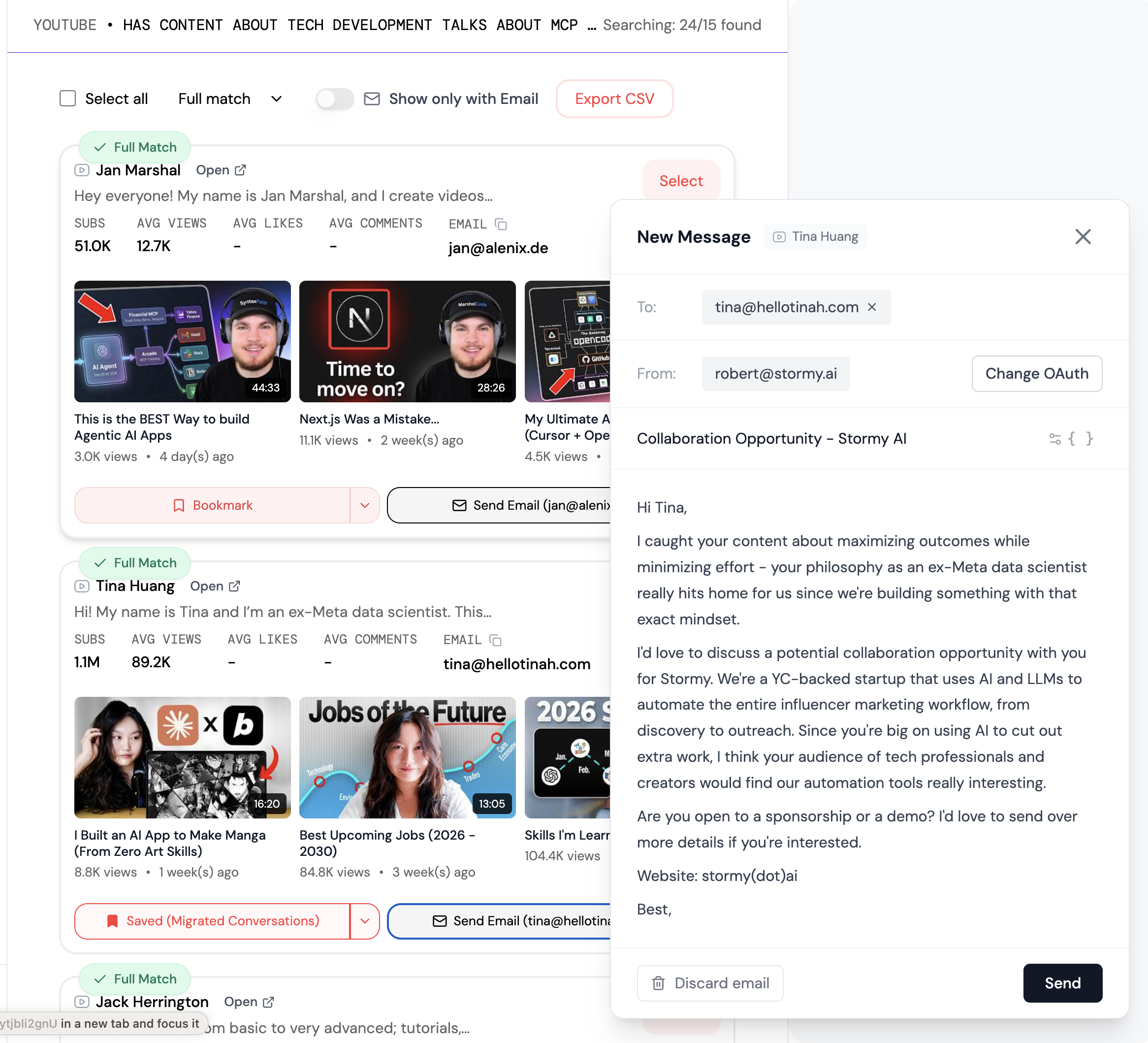
As you scale your one-person billion-dollar startup, one of the most effective growth levers is influencer marketing and User-Generated Content (UGC). However, finding, vetting, and managing hundreds of creators is exactly the kind of "98% mundane" work that kills solopreneurs. This is where specialized platforms become essential. For example, tools like Stormy AI allow you to use natural language to discover thousands of creators across TikTok and Instagram instantly.
Instead of hiring a massive marketing team, you can use an AI agent to outreach to these creators, handle the follow-up emails, and manage the entire relationship inside a CRM. By automating the discovery and outreach process, a single person can run a massive creator-led campaign that would have historically required a 20-person agency. This integration of AI agents for business into the creator economy is a massive unlock for app developers and e-commerce founders alike.
The Future: Age of Abundance vs. Age of Taste
As AI solopreneur tools become widely available, the basic version of every service will be commoditized. When everyone can generate a 1,000-word blog post in seconds, the value of a 1,000-word blog post drops to zero. We are entering an "Age of Abundance" where content, code, and basic analysis are everywhere. In this landscape, the only thing that remains scarce—and therefore valuable—is human taste.
The successful one-person billion-dollar startup will be the one that uses AI to handle the volume but uses human creativity to ensure the output is superior. Whether it's a more refined visual aesthetic, a more engaging narrative, or a more intuitive product experience, "crafted" will beat "automated" every time. The winner is the person who can use autonomous AI workflows to do the heavy lifting while focusing 100% of their energy on the details that matter to the customer. The future belongs to the Agent Director who can point a digital workforce at a problem and solve it with better taste than a traditional corporation ever could.
Conclusion: Take the Leap
The transition to a one-person billion-dollar startup is not a far-off dream—it is happening now. By leveraging AI agents for business, identifying the 98% of tasks that can be automated, and acting as a strategic director, you can achieve a level of scale that was impossible just five years ago. Start by automating one workflow today, whether it's your lead generation, your content pipeline, or your influencer discovery process. The age of abundance is here; it's time to build.