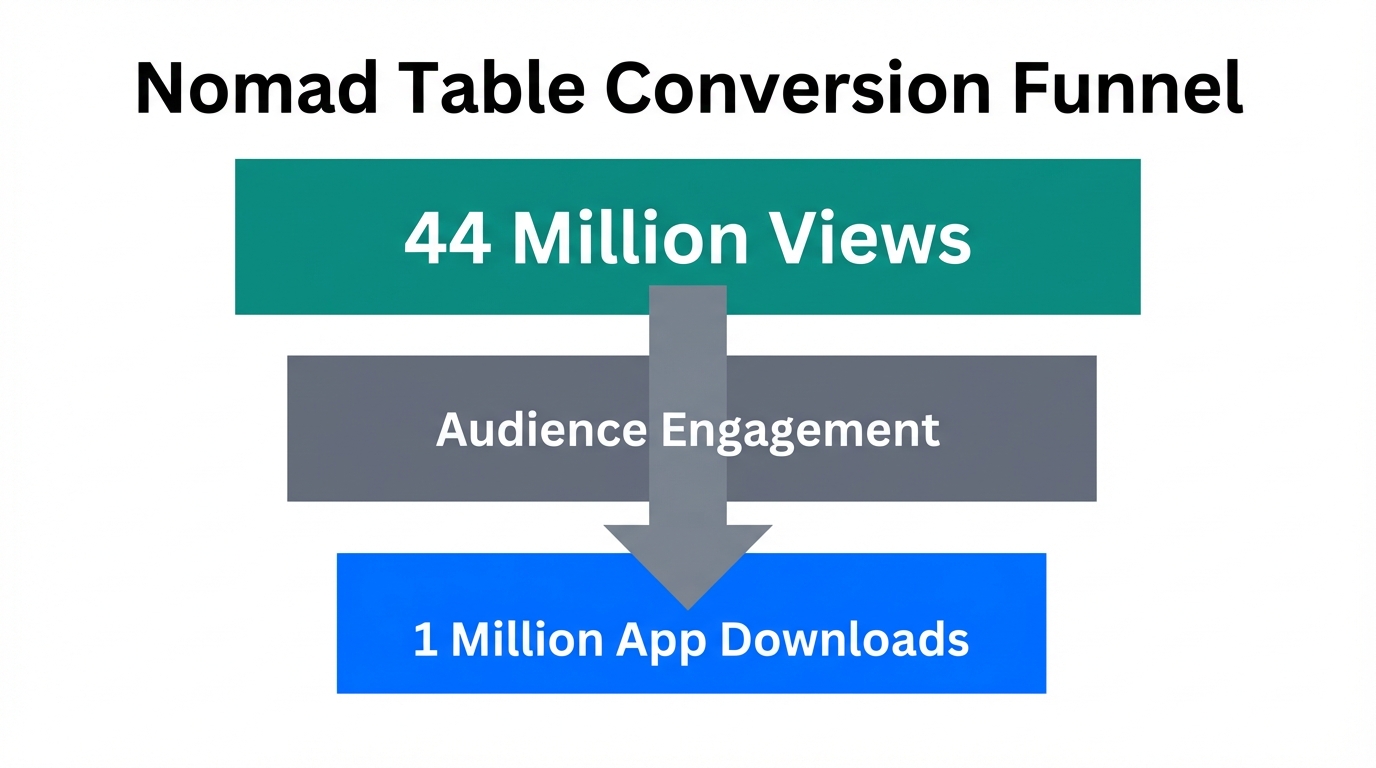
In the world of mobile app distribution, the traditional path often involves massive VC funding and a heavy reliance on paid acquisition. However, solo founder Jay, the creator of the solo travel app Nomad Table, has turned that model on its head. By building a decentralized UGC strategy for apps, Jay has scaled his product to over 1 million downloads and $65,000 in monthly revenue—all while remaining completely bootstrapped.
During a masterclass interview on the Superwall podcast, Jay revealed how he manages a network of 60+ creators that generates a staggering 44 million views per month. His approach isn't just about high volume; it's about a scientific understanding of organic app marketing and human psychology. For founders looking to master scaling influencer marketing without a massive overhead, Jay’s playbook offers a blueprint for doing more with less.
The Founder-First Model: Validating Formats in the Trenches
One of the most common mistakes founders make when scaling influencer marketing is outsourcing content creation too early. Many founders hire creators, give them a loose brief, and hope for the best. Jay took the opposite approach. He didn't hire his first creator until he had already personally generated between 50,000 and 100,000 downloads through his own accounts on TikTok and Instagram.
Jay acted as his own "quality filter." He spent months testing different hooks, visual styles, and narrative structures to see what actually resonated with solo travelers. By being the one in the trenches, he developed a proprietary "gut feeling" for what works, which eventually became the framework for his entire creator economy growth strategy. Even today, with 60 creators on the team, Jay is often the top performer in terms of views, proving that he hasn't lost touch with the pulse of his audience.
"I do think it helps a lot that I'm also posting alongside them. It motivates them more when they see me as the founder getting in the trenches as well."
This "lead by example" philosophy does two things: it provides the creators with a proven template for success, and it establishes Jay as an authority. When he gives feedback, creators listen because they know he is currently achieving the same results they are striving for. This minimizes friction and ensures that the brand's organic app marketing remains consistent, even as it scales.
The Only Metric That Predicts Virality: 3-Second Retention
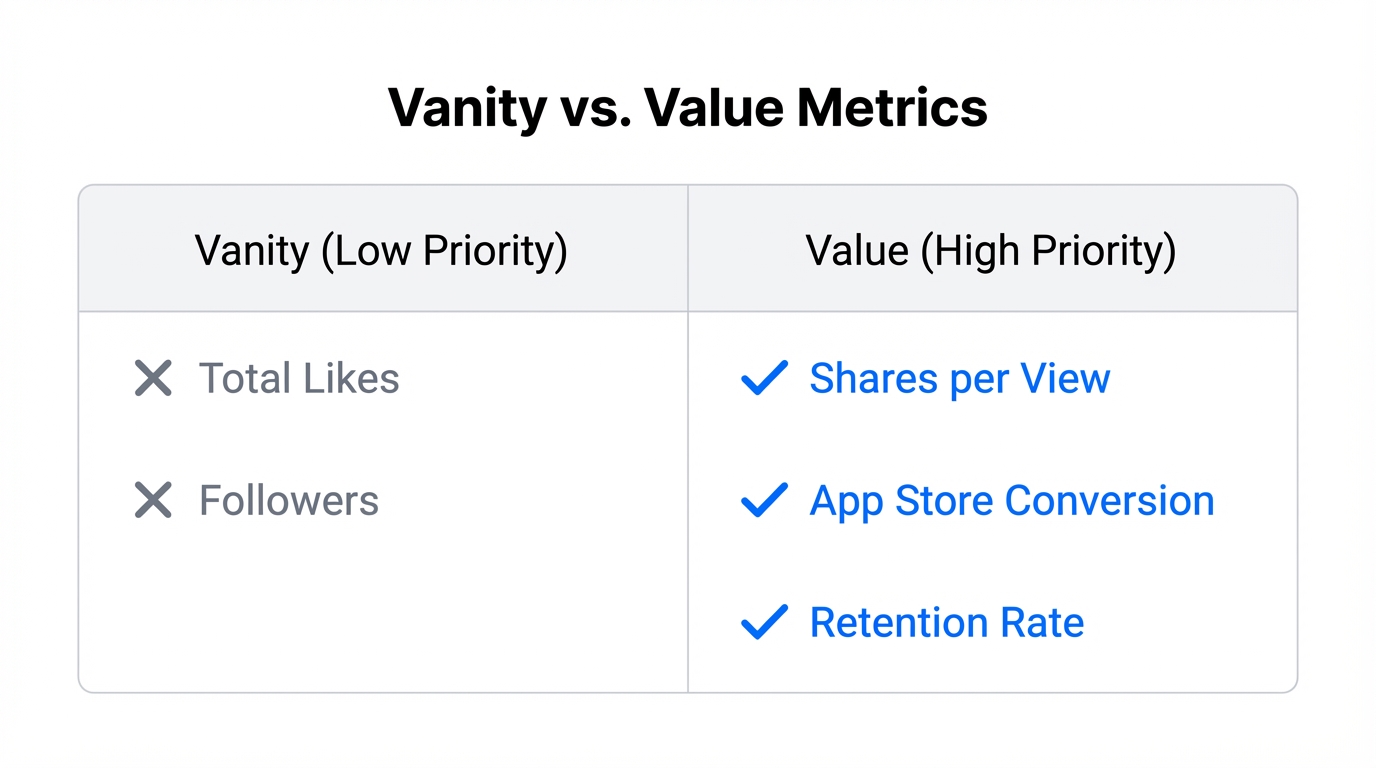
Early in his journey, Jay fell for what he calls the "view trap." He would post a clickbait video—for example, a shot of a girl in a hostel with a caption implying something scandalous—and it would rack up 300,000 views. But when he looked at the conversion data, the engagement was brutal. One video with 300,000 views only received 174 likes and zero meaningful downloads.
He realized that Instagram and TikTok algorithms prioritize watch time, but watch time on clickbait doesn't translate to user intent. This led him to discover the "Golden Metric" of organic app marketing: the 3-second retention rate. Specifically, Jay looks for a 75% to 80% retention rate past the first 3 seconds of a video.
| Metric Type | Example Data | Business Impact |
|---|---|---|
| Vanity Metrics | 300,000 Views / 174 Likes | Low conversion, high noise |
| Retention Metrics | 80% 3-Second Hook Rate | Predictable virality & growth |
| Engagement Metrics | 74,000 Likes / 30,000 Saves | High download intent |
Jay shifted his UGC strategy for apps away from clickbait and toward "Hook-Demo" formats. The formula is simple: a compelling 3-second visual or text hook that identifies a specific pain point (e.g., "Imagine being scared of solo traveling when this exists"), followed immediately by a clear product demonstration. This ensures that the people staying past the 3-second mark are actually interested in the app, leading to much higher conversion rates.
How to Manage 60+ Creators as a Solo Founder
Managing 60 creators should, in theory, be a full-time job for a whole marketing department. Jay manages it alone by utilizing decentralized communication tools like WhatsApp. He maintains a large group chat where he shares new formats and successful hooks, but he also engages in one-on-one feedback sessions to help creators improve their performance.
While Jay manages his current team manually, modern platforms like Stormy AI are becoming essential for brands looking to replicate this success. Using Stormy AI, founders can discover high-quality creators, vet their audience demographics for fake followers, and manage personalized outreach at a scale that was previously impossible for a solo operator. This allows the founder to focus on growth strategy while AI handles the administrative heavy lifting of creator management.
Jay’s payment structure is also a masterclass in incentive alignment. He primarily pays on a performance-based CPM (Cost Per Mille) model, usually between $1 and $2 per 1,000 views. This ensures that he only pays for results. However, he warns that you cannot start with a CPM model; you must first prove that your app can go viral. Once you have several videos with 100k+ views, you can show creators that "easy money" is on the table if they follow your proven formats.
"You have to be able to prove to the creators that your app goes viral. If they see the evidence, they'll happily agree to a performance-based deal."
Solving the Cold Start Problem in Social Apps
Social apps like Nomad Table face a unique challenge known as the "Cold Start Problem." An app designed to help you meet people is useless if no one else is on the app in your current city. Jay prepared for this by building a 15,000-person waitlist before launch, largely through creator economy growth tactics and being public about his "build in public" journey.
He referenced Andrew Chen’s book The Cold Start Problem as a guide for building density. Because Nomad Table targets travelers, Jay didn't need millions of users everywhere; he just needed a few dozen in major travel hubs like Barcelona or Bangkok at any given time. By focusing his mobile app distribution on high-intent travelers rather than general users, he was able to create "social magic" from day one.
Jay also noted a shift in his traffic sources over time. Initially, 100% of his traffic was cold organic traffic from social media. Now, as the user base has grown, roughly 15% of new users come from word-of-mouth referrals. This organic loop is the holy grail of organic app marketing, as it significantly lowers the effective CAC (Customer Acquisition Cost) over time.
The Nomad Table UGC Scaling Playbook
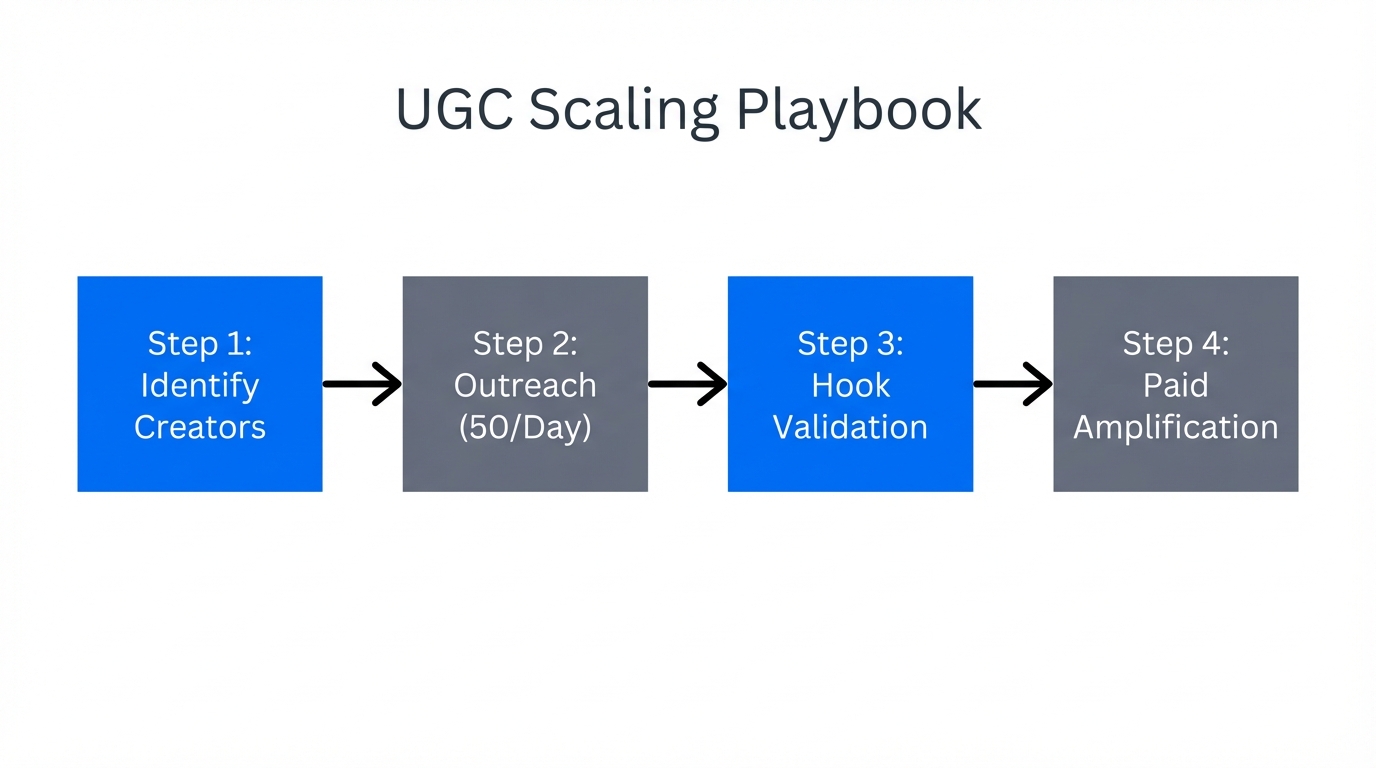
If you are a founder looking to implement Jay's UGC strategy for apps, follow these sequential steps to build your own growth machine:
- Master the Format Yourself: Do not hire creators until you have personally created at least 3-5 videos that have reached 10k+ views. You must understand the organic app marketing nuances of your niche first.
- Focus on Hook Retention: Analyze your video analytics on TikTok Ads Manager or organic insights. If your 3-second retention is below 60%, your hook is failing. Iteratively test text overlays and visual cues until you hit 75%.
- Recruit via Performance Proof: Reach out to creators and show them your own viral successes. Offer a $1-$2 CPM payout. This attracts high-quality creators who are confident in their ability to generate views.
- Implement a Feedback Loop: Use a central hub (like WhatsApp or a dedicated creator CRM) to share winning hooks and provide feedback. If a creator’s video flops, analyze the retention curve together to find the drop-off point.
- Scale via Decentralization: Once you have 10 successful creators, double down. Jay found that with 60 creators, the "surface area of luck" increases so much that he hits at least one major viral video every week.
The Future of Solo-Founder Growth
Jay’s success with Nomad Table proves that mobile app distribution in 2024 is no longer about who has the biggest venture check, but who has the best UGC strategy for apps. By combining a deep understanding of content psychology with a decentralized network of creators, he has built a growth engine that generates more views than most mid-sized agencies.
The transition from a solo operator to a 60-person creator network requires discipline, a data-driven approach to retention, and the right toolset. Whether you are using manual management or leveraging AI-powered platforms like Stormy AI to source your creators, the core principle remains the same: the founder must be the keeper of the quality.
Ready to start building your own creator network? Focus on the first 3 seconds, lead from the trenches, and let the algorithm do the rest.