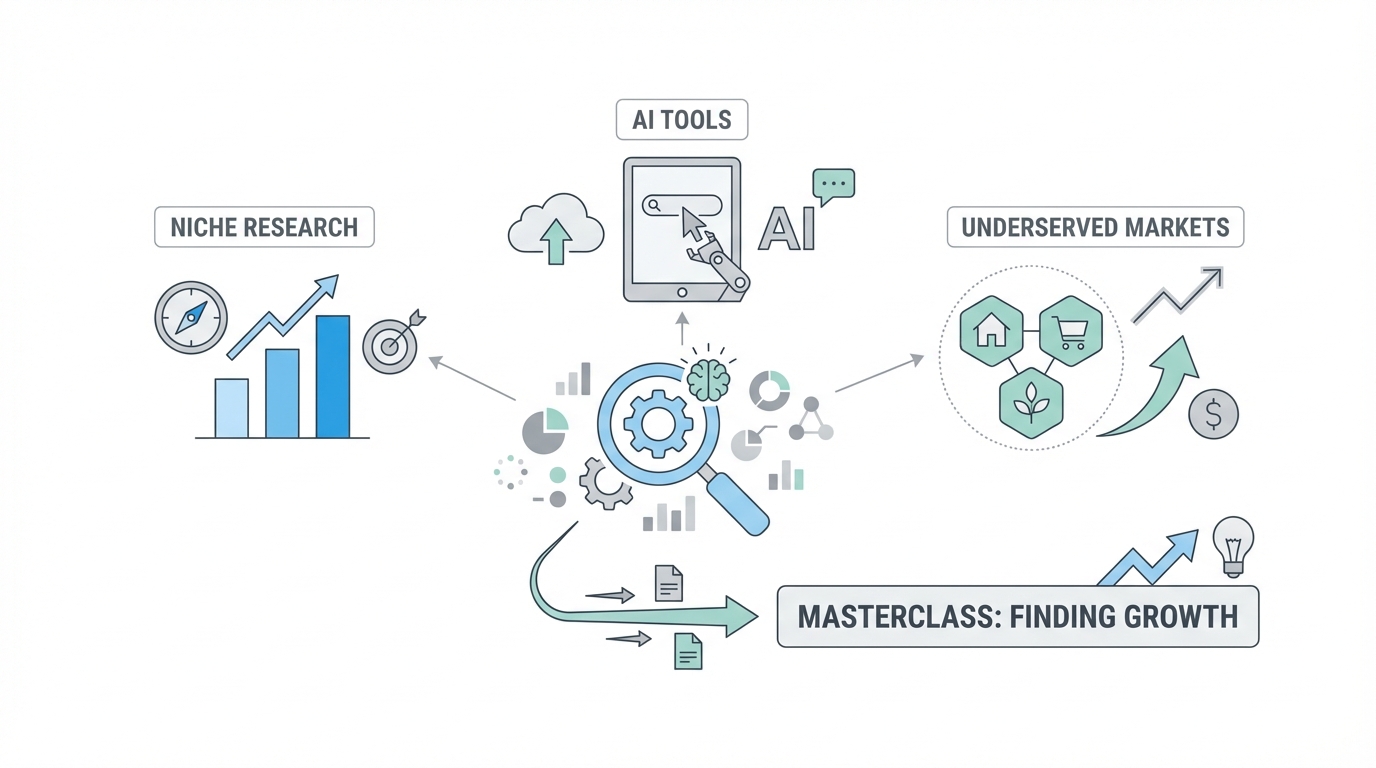
We are currently living through the most prolific era for builders in human history. The cost of launching a product has plummeted, while the reach afforded by social platforms has scaled to billions. However, 90% of startups fail not because they can’t build, but because they build for a market that doesn't care. The traditional path of writing code first and finding customers later is dead. To succeed in the modern era, you must adopt a research-first mindset, utilizing niche research tools and market research with AI to identify gaps before committing a single line of code.
Step 1: Identifying High-Growth, Underserved Niches

The first rule of finding a business niche is to avoid crowded rooms. An underserved niche isn't just a small market; it’s one where the existing solutions are outdated, overpriced, or non-existent despite a growing interest. You want to build on the back of a trend because it provides a natural tailwind for your growth. When a market is expanding, there is more than enough room for a new player to grab significant market share without fighting for every inch.
To find these opportunities, professional builders use data-driven platforms. Start with Google Trends to see the macro-movements in consumer interest. If you see a steady 24-month upward climb for a specific keyword but the search results show only forum posts or ancient software, you’ve found a potential gap. For more granular inspiration, tools like Idea Browser provide daily, data-backed startup concepts that allow you to "steal" validated ideas rather than guessing what might work.
When you are looking for profitable AI business ideas, look for "high friction" workflows. These are tasks that people complain about constantly on social media but haven't been automated yet. The goal is to find a niche where you can become a "skyscraper"—a dominant, specialized force—rather than a generic "strip mall" that offers a little bit of everything to nobody in particular.
Step 2: Conducting AI-Driven Pain Point Analysis
Once you’ve identified a potential niche, you need to understand the psychology of your future customers. What keeps them up at night? What memes do they share? What specific language do they use to describe their frustrations? This is where market research with AI becomes your unfair advantage. Instead of manually reading thousands of comments, you can feed data from platforms like Reddit and TikTok into AI models to extract recurring themes.
Go to the subreddits related to your niche and look for threads starting with "How do I..." or "I hate it when..." and "Is there a tool for...". Collect this data and use AI to categorize the top five recurring pain points. This process ensures your eventual product solves a real problem rather than a perceived one. On TikTok, pay attention to the comments section of viral videos in your niche. The comments often reveal more about what the audience feels is missing from the current landscape than the video itself.
Understanding the format of content your niche prefers is equally vital. Do they respond to long-form educational threads, or are they more likely to engage with short-form vlogs? By mastering their language and preferred content mediums early, you set the foundation for a community that feels you are "one of them." This cultural alignment is what differentiates a cold brand from a community-led powerhouse like those built at Late Checkout.
Step 3: The 'Reply Guy' Strategy for Initial Distribution
A common mistake is trying to be everywhere at once—Instagram, LinkedIn, TikTok, and X. To build an audience on X effectively, you must focus. Pick one platform and master it until you hit a significant milestone, like 25,000 followers. If you're starting from zero, the fastest way to gain traction is not by shouting into the void with your own tweets, but by piggybacking on the reach of established creators.
This is known as the 'Reply Guy' or 'Reply Gal' strategy. Here is the playbook:
- Identify 10-20 "Alpha" accounts in your chosen niche—creators who already have 100k+ followers.
- Set up tweet notifications for every one of these accounts.
- When they post, be the first to leave a thoughtful, high-value reply. Do not just say "great thread." Add a statistic, a counter-intuitive insight, or a helpful resource.
- Repeat this 10-20 times a day.
By providing value in the comments of a large account, you are effectively stealing a percentage of their impressions. If your reply is good, people will click your profile. If your profile is optimized to show you are an expert in that niche, they will follow. This method can consistently net you 5 to 10 new followers every single day, building a foundation of 1,000 true fans who are actually interested in the problem you are solving.
Step 4: Leveraging AI for Creator Outreach and Discovery

As your presence grows, you'll realize that growth isn't just about your own posts; it's about who you know. Partnering with other creators can exponentially speed up your niche research and distribution. As the creator economy approaches $480 billion, finding the right partners who actually have an authentic audience (not just bot-inflated numbers) is a manual nightmare.
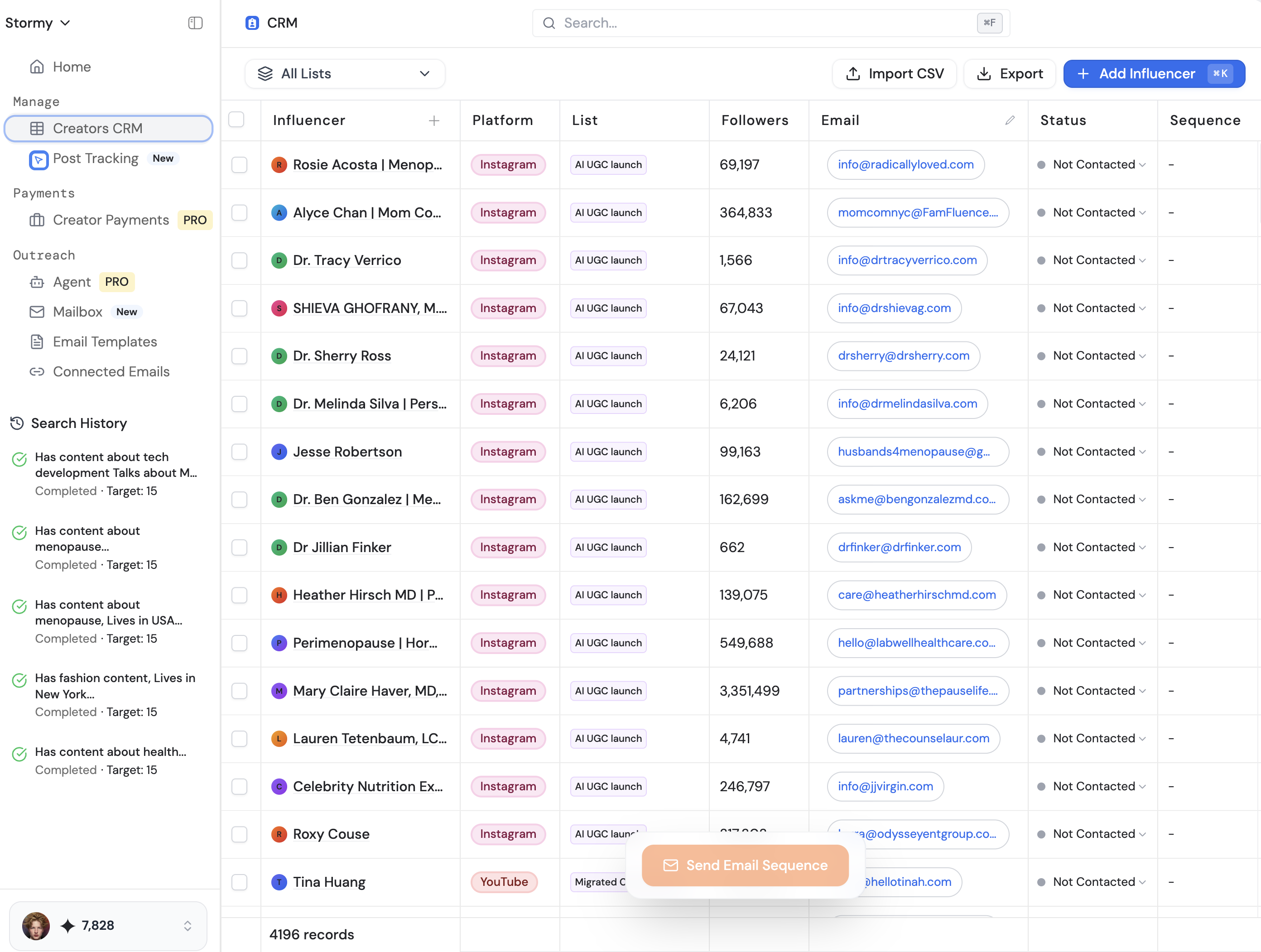
This is where modern platforms like Stormy AI can change the game. Instead of manually searching hashtags, you can use natural language to discover creators who fit your exact underserved niche. For example, you can search for "creators talking about productivity for remote architects in Europe" and get a vetted list instantly. Once you have your list, you can use Stormy’s AI-powered outreach to send hyper-personalized emails, helping you build those crucial partnerships for equity or revenue share deals early on. Having a creator CRM to manage these relationships ensures that as you scale, no potential partnership falls through the cracks.
Step 5: Testing the Pipeline with Throwaway Brands
Before you commit to your main brand, you should treat marketing like a scientist treats a laboratory. This is the concept of Marketing R&D. Instead of risking your main reputation on an unproven angle, create "throwaway brands" or handles on platforms like TikTok to test content formats and messaging.
If a specific hook or value proposition fails on a throwaway account, it’s a data point, not a disaster. If it takes off, you’ve just discovered a winning marketing channel that you can port over to your main business. This "Idea to Launch" pipeline allows you to fail fast and cheap, following the core principles of the Lean Startup methodology. You are effectively testing your distribution before you finalize your product. If you can’t get 100 people to sign up for a waitlist with a basic landing page and a few viral videos, the problem is likely your niche or your positioning, not your code.
Use this stage to experiment with modular pricing as well. Test different price points—from a $29/month subscription to a $3,000 high-ticket service—to see where the resistance lies. You might find that your niche is happy to pay a premium for a specialized service that you can eventually automate into software using tools like Stripe for seamless billing.
Step 6: Building in Public to Attract Acquirers

The final pillar of this masterclass is building in public. While you don't need to share your sensitive financial data or Stripe screenshots, sharing your journey, your logic, and your mistakes creates an "unfair advantage." It builds trust with your audience and, perhaps more importantly, puts you on the radar of potential partners and acquirers.
When you document how you use niche research tools to identify a gap and how you solved specific user pain points, you are creating a narrative. This narrative increases the enterprise value of your business. An acquirer isn't just buying your code; they are buying your distribution loop and the community you’ve built around it. By being vocal on X or Indie Hackers about your building process, you turn your startup into a "star in a constellation," making it part of a larger ecosystem that becomes harder and harder for competitors to displace.
Conclusion: Building a Profitable Flywheel
Mastering how to find a business niche is not a one-time event; it is a repeatable system. By starting with underserved data, conducting deep AI-driven pain point analysis, and building an audience on platforms like X through high-value engagement, you eliminate the guesswork of entrepreneurship. Remember to build once and compound forever. Every follower you gain, every creator relationship you manage through tools like Stormy AI, and every piece of data you collect from your throwaway brands adds "luckiness" to your life. Stop guessing and start researching—the profitable AI business ideas are waiting for those who look where others aren't.