The dream of bootstrapping a startup to a $100M+ valuation usually starts with a massive funding round or a deep bench of silicon valley connections. However, for Guillaume Moubeche, the founder of Lemlist, the journey began with exactly $1,000 in savings and a string of failed experiments. After being rejected for a job at McDonald's and watching his first T-shirt business collapse with only six sales, Guillaume realized that the traditional path to success was broken. He didn't need more capital; he needed a better framework for startup validation and execution. This roadmap outlines the tactical steps used to transform a final $1,000 into a company generating $30M in annual recurring revenue, proving that constraints are often a founder's greatest advantage.
Why Your First $1,000 Should Be Spent on Validation, Not Development


Most first-time founders make the mistake of spending their entire budget on building a product before confirming anyone actually wants it. Guillaume's early failure with a LinkedIn-related project cost him $5,000 and months of development, only for the entire project to be wiped out by a single line of code change from LinkedIn. This experience taught him a critical lesson: when bootstrapping a startup, your early capital is a tool for learning, not just asset creation.
Instead of chasing "Blue Ocean" ideas that require complex, unproven technology, Guillaume pivoted to a "Red Ocean" strategy. He looked at markets where competitors were already making "shit tons of money." This confirmed startup validation existed—the problem was solved, but the execution could be improved. When you how to start a saas on a budget, you should focus on a minimum viable product that solves one specific, painful problem better than the incumbents. For Lemlist, that was making sales outreach feel more human through personalization.
In the early stages, manual outreach is your best friend. Modern founders are often turning to AI-native tools to streamline this process. For instance, Stormy's AI search allows bootstrapped founders to find their ideal customer profile across platforms like TikTok and YouTube in seconds, ensuring that those first validation dollars are spent talking to the right people rather than guessing who they are.
Building a 2-Week MVP: The Power of Radical Focus
The minimum viable product (MVP) should not be a smaller version of your final vision; it should be the simplest possible solution to the core problem. Guillaume and his team built the first version of Lemlist in just two weeks. They didn't worry about every feature their competitors had; they focused on a key differentiator: image personalization for cold emails. By ignoring 90% of the features and perfecting the 10% that mattered, they were able to go to market before their budget ran out.
This speed allows for a faster feedback loop. When you ship in two weeks, you start getting real user data immediately. Guillaume closed his first 100 customers through live demos and outbound sales. He wasn't waiting for users to find him via Google Ads; he was in the trenches, showing the product and identifying bugs in real-time. This iterative process is what separates successful startups from those that spend six months building a product no one uses.
The 'Manual Service' Hack: Ensuring Early Success
A common hurdle when bootstrapped founders launch is a low activation rate—the percentage of users who actually derive value from the tool. Guillaume noticed his activation was low, so he implemented a "manual service hack." He told early customers: "Buy the software subscription, and I will myself write the campaigns for you." This did three things: it guaranteed the user saw results, it provided Guillaume with deep insights into user pain points, and it created instant success stories for marketing.
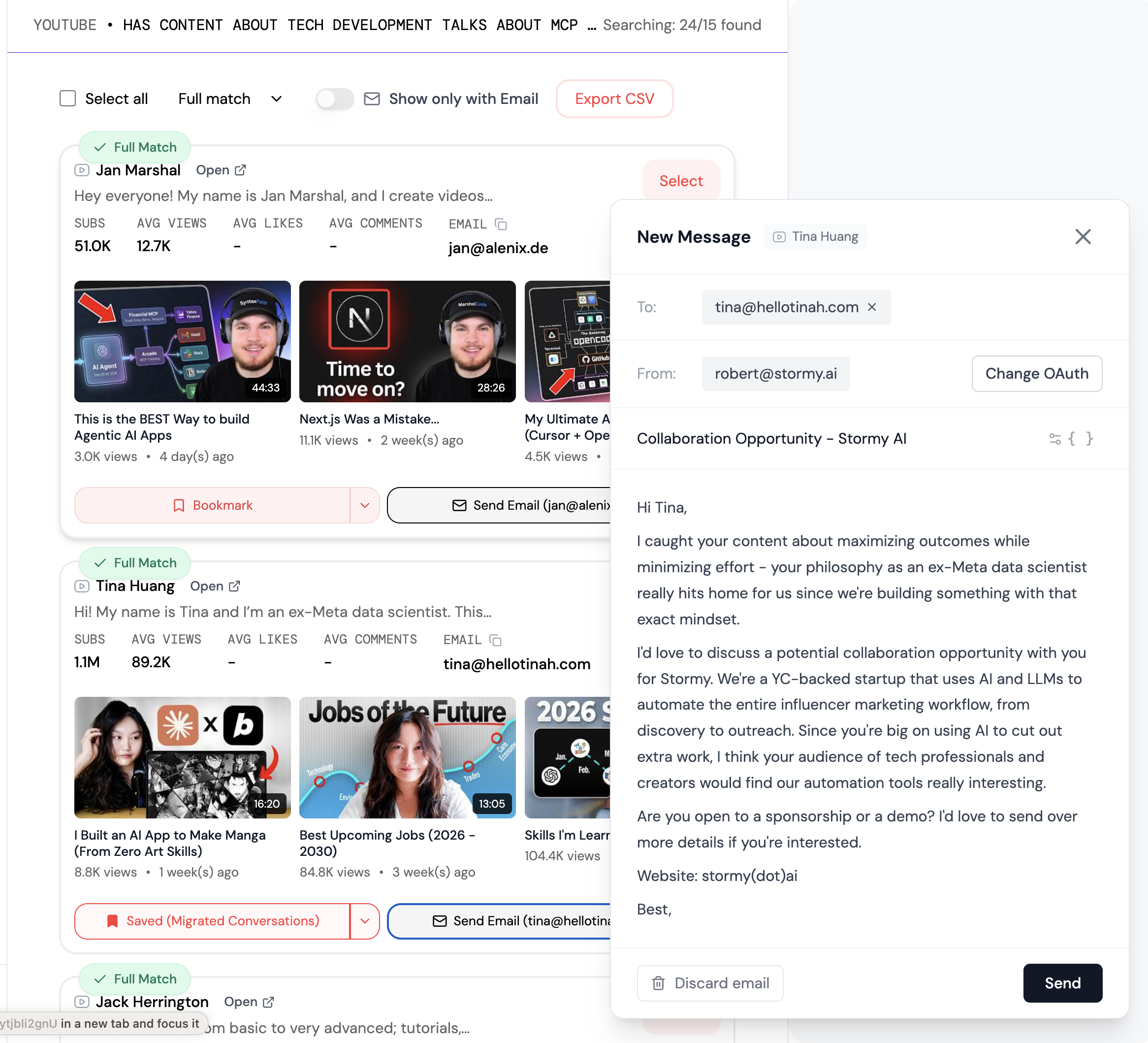
To scale this kind of high-touch outreach today, founders leverage Stormy's AI outreach, which generates hyper-personalized emails for creators and prospects automatically, including automated follow-ups. This allows you to maintain that "manual" feel and high quality of communication without the founder having to spend 20 hours a day in their inbox. By combining the manual service hack with AI automation, you can drive your annual recurring revenue faster by ensuring every early user becomes a walking testimonial.
Scaling from Zero to $250k and then to $1M ARR
Reaching the first $250,000 ARR took the Lemlist team roughly one year. At this stage, the founder's daily routine is almost entirely focused on growth loops. Guillaume's loop was simple: use the product, help people with campaigns, create content about those successes, and push that content into communities like Facebook or Notion groups. This organic growth engine meant they didn't need a massive marketing budget.
As you move from $250k to $1M ARR, the complexity of managing relationships grows. You can no longer keep everything in a spreadsheet. Utilizing a dedicated Stormy AI creator CRM becomes essential for tracking every interaction, negotiation, and collaboration history. Managing these deal stages effectively is what allows a founder to scale from a solo operator to a team lead without losing the personal touch that won them the first 100 customers.
Technical Debt vs. Speed: Rebuilding for the $10M Mark
One of the most painful lessons in how to start a saas is dealing with technical debt. To grow 40% month-over-month, Guillaume's team "coded the product really quickly to ship a lot of features." However, once they hit $10M ARR, the architecture began to buckle under the weight of their user base. They hit a plateau because the very speed that got them to $1M was now preventing them from scaling to $100M.
Guillaume spent over a year rebuilding the entire architecture from scratch. While this slowed down feature releases temporarily, it was necessary to ensure long-term stability. For modern startups, tracking these performance metrics and campaign results is vital. Using Stormy's post tracking and analytics helps founders see where their growth is coming from, allowing them to make data-driven decisions about when to stop building new features and start fixing the foundation. If your activation rate drops or your churn increases, it's often a signal that your technical infrastructure or user experience needs a fundamental overhaul.
The Magnet Persona Strategy
To break through the $10M plateau, Guillaume identified what he calls the Magnet Persona. This is a specific segment of your audience that attracts others. For Apple, it was designers. For Lemlist, it was sales reps. By becoming the go-to tool for the most "vocal" and success-driven users in the industry, they created a natural word-of-mouth engine that drove them to $30M ARR.
Focusing on a Magnet Persona requires deep demographic and quality analysis. You need to know who your most loyal users are and why they stay. This is similar to how brands use influencer marketing to find creators who embody their brand values. Identifying these key users allows you to spend your marketing dollars—whether on Meta Ads Manager or creator partnerships—with surgical precision. For those vetting their own advocates, Stormy AI's influencer analysis can detect fake followers and analyze audience demographics to ensure your "magnets" are genuine.
Final Takeaways for the Bootstrapped Founder
The transition from a $1,000 budget to a $150M valuation isn't about luck; it's about aggressive action and extreme patience. Guillaume Moubeche's story proves that you don't need a perfect product or a massive team to start. You need startup validation, a minimum viable product built with speed, and the willingness to do the manual work that doesn't scale in the early days. By the time you reach the annual recurring revenue milestones of $1M and $10M, your role as a founder will shift from doing everything to building the systems and teams that allow the company to thrive without you.
Success in SaaS is an "overnight" story that usually takes ten years of grinding. Invest in your own learning, stay impatient with your daily actions, and remember that the journey is as important as the outcome. Whether you're just starting out or looking to break through a growth plateau, the fundamentals remains the same: solve a real problem, tie it to revenue, and never stop talking to your customers.