The days of endlessly scrolling through pages of keyword-driven search results are coming to an abrupt end. For e-commerce entrepreneurs, the ability to source a product used to depend on knowing the exact technical specifications or industry jargon of a manufacturer. Today, the landscape has shifted toward multimodal product search, a technology that allows brands to find suppliers using nothing more than a photo, a voice command, or a rough hand-drawn sketch. With the global B2B e-commerce market projected to hit $36 trillion by 2026, staying competitive requires adopting these agentic AI tools to compress months of research into a single afternoon.
The Power of Image-to-Supplier Sourcing
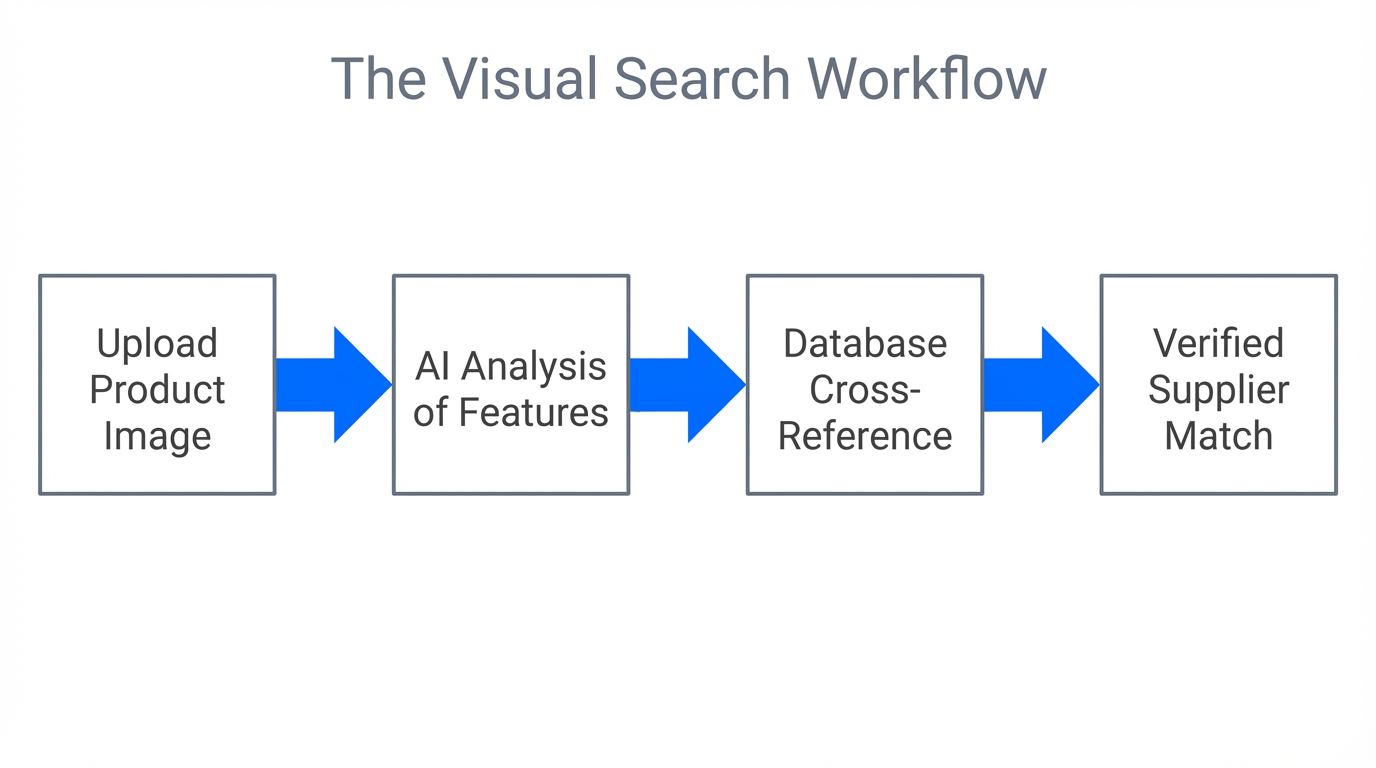
Visual search for ecommerce has evolved from a novelty feature into a high-stakes competitive advantage. Instead of guessing which keywords a factory in Shenzhen might use to describe a specific ergonomic chair, you can now simply upload a photo of a competitor's bestseller. Advanced platforms like Accio, Alibaba's AI-powered sourcing agent, use computer vision to identify the exact silhouettes, materials, and components of an item, matching them against a database of over 1 billion product listings.
This "reverse engineering" capability allows SMEs to identify direct manufacturers rather than middleman trading companies. By analyzing the visual signatures of a product, the AI can cross-reference factory capabilities, certifications, and historical shipment data. This democratizes the supply chain, giving small businesses the same sourcing precision previously reserved for enterprise-level procurement teams with massive travel budgets.
Omnichannel Sourcing: Alibaba, 1688, and AliExpress in One Interface
One of the biggest friction points in global trade has been the fragmentation of platforms. A product might be listed on Alibaba.com for international buyers, but the raw material supplier or the deeper-discounted version often lives on 1688.com (Alibaba’s domestic Chinese site). Navigating these requires different accounts, languages, and logistics setups. However, a new wave of agentic AI is consolidating these silos.
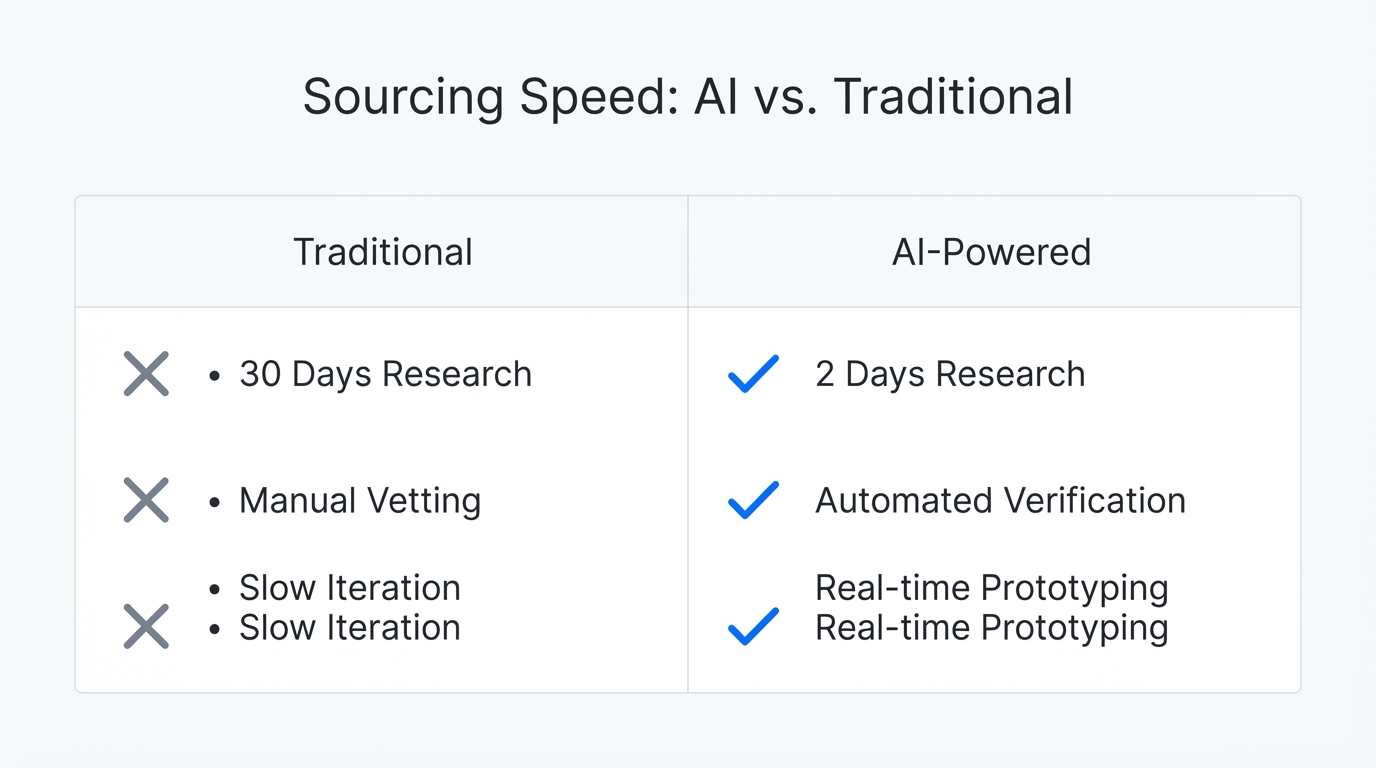
| Feature | Traditional Sourcing | AI-Powered Multimodal Sourcing |
|---|---|---|
| Search Method | Keywords & Filters | Voice, Image, & Natural Language |
| Turnaround Time | 7–14 Days | < 24 Hours |
| Supplier Vetting | Manual Review | AI-Generated Side-by-Side Comparison |
| Language Barriers | High (Requires Translators) | Zero (Real-time AI Translation) |
By using an Alibaba AI sourcing platform, users can leverage multi-round reasoning to refine complex requirements. For instance, you could say, "Find me the factory on 1688 that makes these specific bamboo toothbrushes, but ensure they have GOTS certification for the packaging and can ship to a warehouse in Germany." The AI agent handles the cross-platform search, translation, and initial inquiry autonomously, pulling data from over 50 million businesses across 100+ markets.
"Our goal is that by the end of 2025, AI tool adoption among sellers will reach 100%... turning ideas into actionable plans in minutes." — Kuo Zhang, President of Alibaba.com
Innovative Product Development: From Sketch to Supplier
Beyond finding existing items, multimodal AI is revolutionizing innovative product development. Startups are now using generative AI to create design sketches and immediately feeding those sketches into sourcing engines to find factories capable of manufacturing them. In one recent pilot, a startup redesigned wireless earbuds by uploading a concept image; the AI generated 20 design variations and identified 10+ verified suppliers with the specific machinery needed for the new design in seconds.
This workflow eliminates the expensive "dead-end" phase of product design where a beautiful concept is created that no factory can actually build. By integrating the design and sourcing phases, brands ensure that every iteration is grounded in manufacturing reality. Once your physical product is ready for the market, tools like Stormy AI can help source the right UGC creators to film the high-converting content needed for a successful launch on TikTok or Instagram.
Integrating Sourcing with Your Google Business Profile
Sourcing the perfect product is only half the battle; you also need customers to find it. Jeff Hirz from OuterBox notes that e-commerce SEO accounts for roughly 33% of all traffic in 2025. Savvy retailers are using the data-backed certainty provided by AI sourcing tools—such as precise material lists and certification data—to build superior product descriptions that rank higher in search engines.
For brick-and-mortar or hybrid retailers, integrating these sourced products into your Google Business Profile is essential. By using the "Products" feature in your profile, you can signal to local shoppers that you have specific, high-demand items in stock. When your sourcing AI identifies a trending product (like eco-friendly yoga mats), getting that item listed locally with high-quality visual data ensures you capture intent-driven traffic both online and off.
Security Best Practices: Protecting Your Proprietary Designs
While multimodal AI offers incredible speed, it introduces new risks regarding intellectual property. Feeding proprietary product designs into public AI models can accidentally expose your "secret sauce" to competitors if privacy settings aren't strictly managed. Innovative product development requires a balance between speed and security. Always check if the AI sourcing tool you are using has an enterprise-grade privacy policy that prevents your inputs from being used to train general models.
Furthermore, many AI tools might overlook Minimum Order Quantities (MOQs) or specific logistics hurdles. While the Agentic AI trend is making supply chains more efficient, human oversight remains mandatory for the final negotiation and quality control phases. Using a platform like Stormy AI to manage the creator-side of your business can free up your time to focus on these critical supply chain manual checks.
"Agentic AI is the defining trend of 2026, shifting the focus from customer acquisition to high-efficiency supply chain retention." — James, Searchanise
Conclusion: The Era of Predictive Procurement
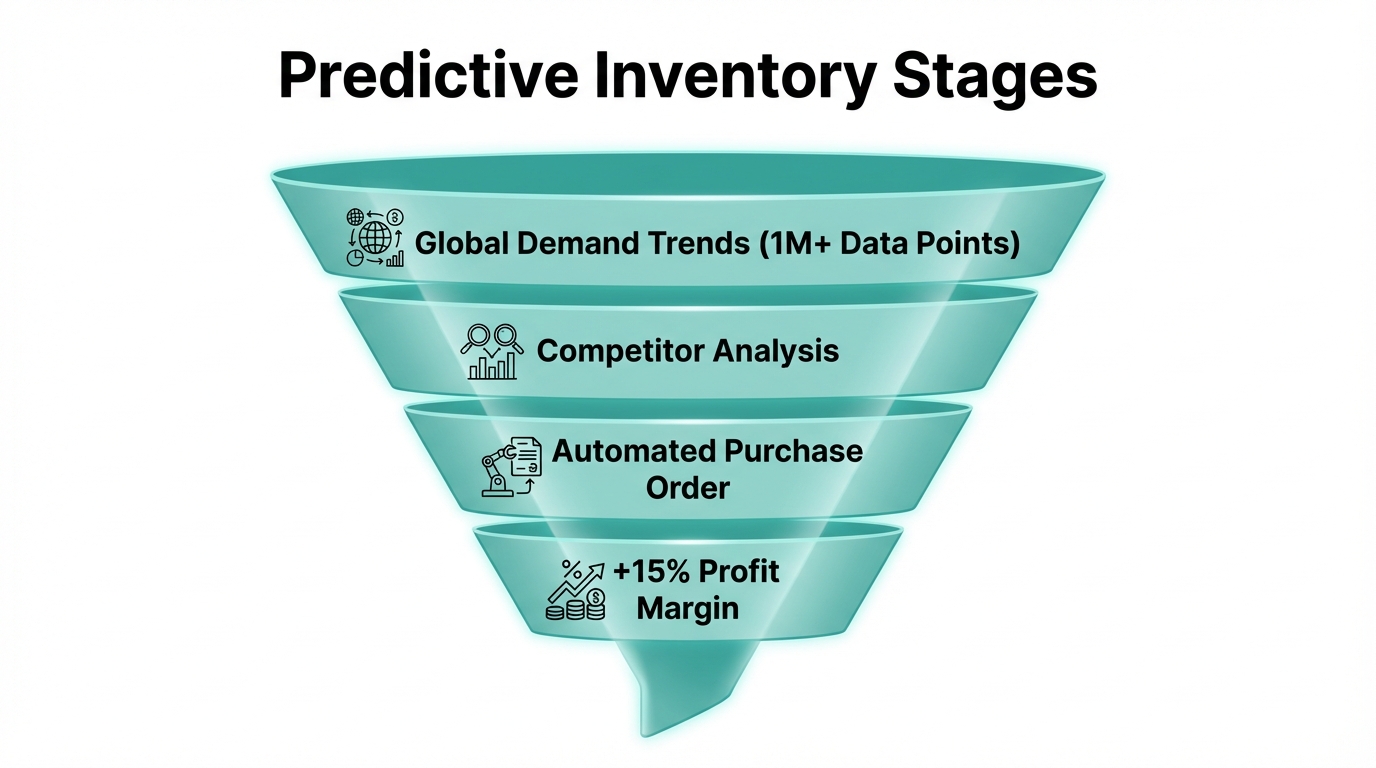
The future of e-commerce isn't just about finding products faster; it's about finding them before your competitors even know they are trending. We are entering an era of predictive procurement, where AI agents analyze social media trends and Amazon sales data to suggest what you should source for the next season. By combining multimodal search with autonomous outreach, SMEs can now operate with the speed and sophistication of global conglomerates.
Whether you are using visual search to reverse-engineer a competitor's bestseller or leveraging voice commands to coordinate an omnichannel shipment from 1688 and Alibaba, the goal is the same: radical efficiency. Embrace these tools today, or risk being left behind in the $36 trillion B2B revolution.