By 2026, the era of the static marketing dashboard has officially come to an end. For years, media buyers spent their mornings logging into complex UI environments, cross-referencing tabs, and trying to decipher why a ROAS dip occurred twelve hours ago. Today, the most elite growth teams have moved toward a real-time, interactive reporting environment. Instead of hunting for data, the data finds them. This shift is powered by OpenClaw reporting automation and the rise of Agent-as-a-Service (AaaS) models that live where we already work: in our messaging apps.
The transition from traditional SaaS to decentralized AI agents has changed the fundamental architecture of Meta Ads analytics 2026. By leveraging the Model Context Protocol (MCP), marketers are now building "Command Centers" on WhatsApp and Telegram that don't just report numbers—they reason through them. In this guide, we will explore how to deploy a local-first OpenClaw agent to manage your Meta Ads and GA4 data, providing you with a unified source of truth delivered straight to your pocket.
The Death of the Static Dashboard: Why Natural Language Wins
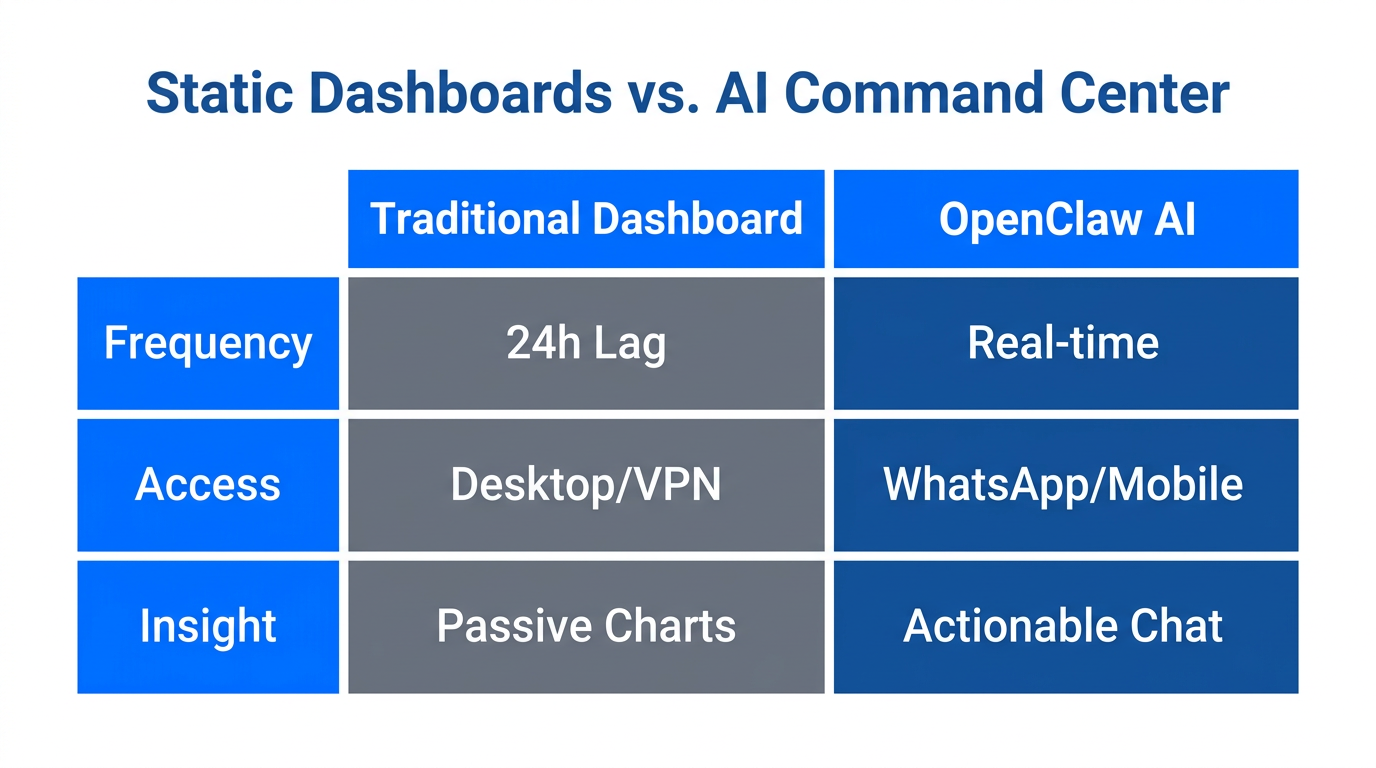
Traditional dashboards are reactive by design. They require a human to look at a chart, identify a trend, and then navigate to a separate platform to take action. In a high-velocity market, this lag is expensive. OpenClaw, an open-source AI agent framework, has revolutionized this workflow by shifting from "If-Then" rules to autonomous, reasoning-driven "Skills." Instead of a bar chart showing a CPA spike, an OpenClaw agent sends a WhatsApp Business API notification: "CPA on the 'Summer Core' campaign has jumped 30%. I've analyzed the creative fatigue and suggest swapping the hook for asset #4. Should I execute?"
This isn't just about convenience; it's about profitability. While native tools like Meta Advantage+ are powerful, they often prioritize platform liquidity over advertiser margins. By using an independent agent, you regain control over the logic. You can instruct your agent to prioritize actual profit margins rather than just the platform's internal signals. This level of granular control is why AI-driven tools currently yield an average of $4.52 in revenue for every $1 spent on Meta platforms [source: Statista].
"The industry has transitioned from Software-as-a-Service to Agent-as-a-Service. The AI handles the math; the marketer handles the direction."
Building the Foundation: MCP and Unified Data
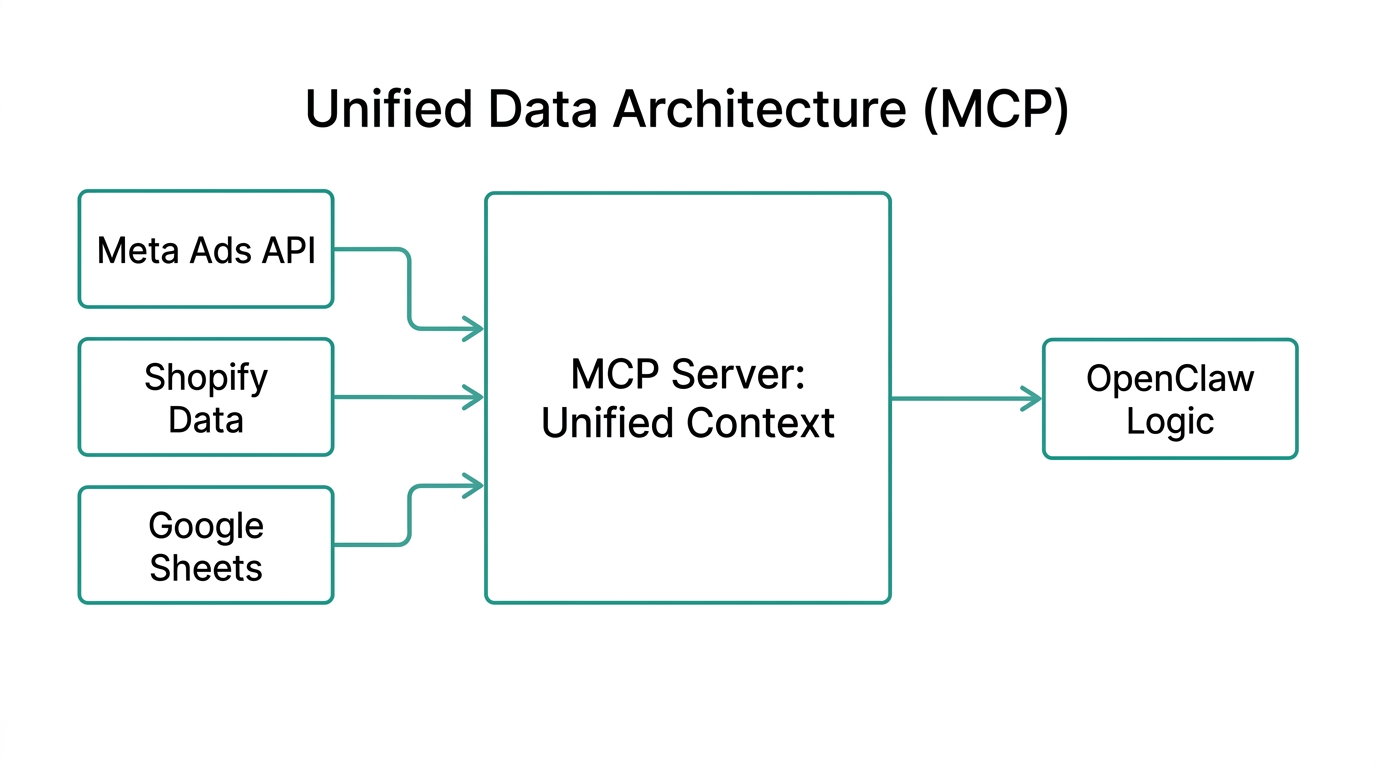
One of the biggest hurdles in Meta Ads reporting has always been the discrepancy between Meta’s in-platform data and Google Analytics 4 (GA4). This is where the Model Context Protocol (MCP) comes in. MCP allows your OpenClaw agent to aggregate data from multiple sources—Meta Ads API, GA4, and even your Shopify backend—to create a single, unified source of truth. It acts as the bridge that lets the LLM (like Claude 3.5 Sonnet or GPT-4o) "see" all your data at once.
| Reporting Type | Traditional Dashboards | AI Command Center (OpenClaw) |
|---|---|---|
| Data Latency | 2-4 hours (Batch updates) | Real-time (API-driven) |
| Actionability | Static/Passive | Interactive/Proactive |
| Insight Delivery | Manual Login | WhatsApp/Telegram/Slack |
| Cross-Platform | Requires connectors (e.g., Zapier) | Native via Model Context Protocol |
When your agent has access to the full funnel, it can identify "audience overlap" between your prospecting and retargeting campaigns. For example, it can ensure you aren't bidding against yourself for the same user across different ad sets. This architectural shift ensures that your AI marketing command center is making decisions based on the big picture, not just siloed platform metrics.
The "Mac Mini Strategy": Local-First AI for Privacy and Compliance
In 2026, data privacy is no longer optional. With GDPR and CCPA regulations tightening, 58% of top-tier brands now prefer running agents locally rather than sending sensitive customer data to cloud-only SaaS tools. This has given rise to the "Mac Mini Strategy." By hosting OpenClaw on a dedicated local machine (like an M4 Mac Mini) or a private VPS such as AWS Lightsail, you keep your Meta API keys and first-party data on your own hardware.
This local-first approach provides several advantages:
- Security: Your Meta Ads API credentials never leave your environment.
- Speed: Local processing reduces latency when running complex auditors or scrapers.
- Compliance: It simplifies data processing agreements (DPAs) because the AI is technically an internal tool.
- Reliability: Your agent runs 24/7 on a "Heartbeat Scheduler," catching CPA spikes before they deplete your daily budgets.
To implement this, marketers are increasingly using tools like the Adspirer Plugin for OpenClaw, which includes pre-configured instructions for Meta Ads. This setup allows for a 30% reduction in Cost Per Acquisition (CPA) across the e-commerce sector by ensuring that optimization never sleeps.
"Local-first AI isn't just a privacy trend; it's a performance strategy. When the agent lives on your hardware, the response time is near-instant."
Interactive Reporting: The WhatsApp and Telegram Command Center
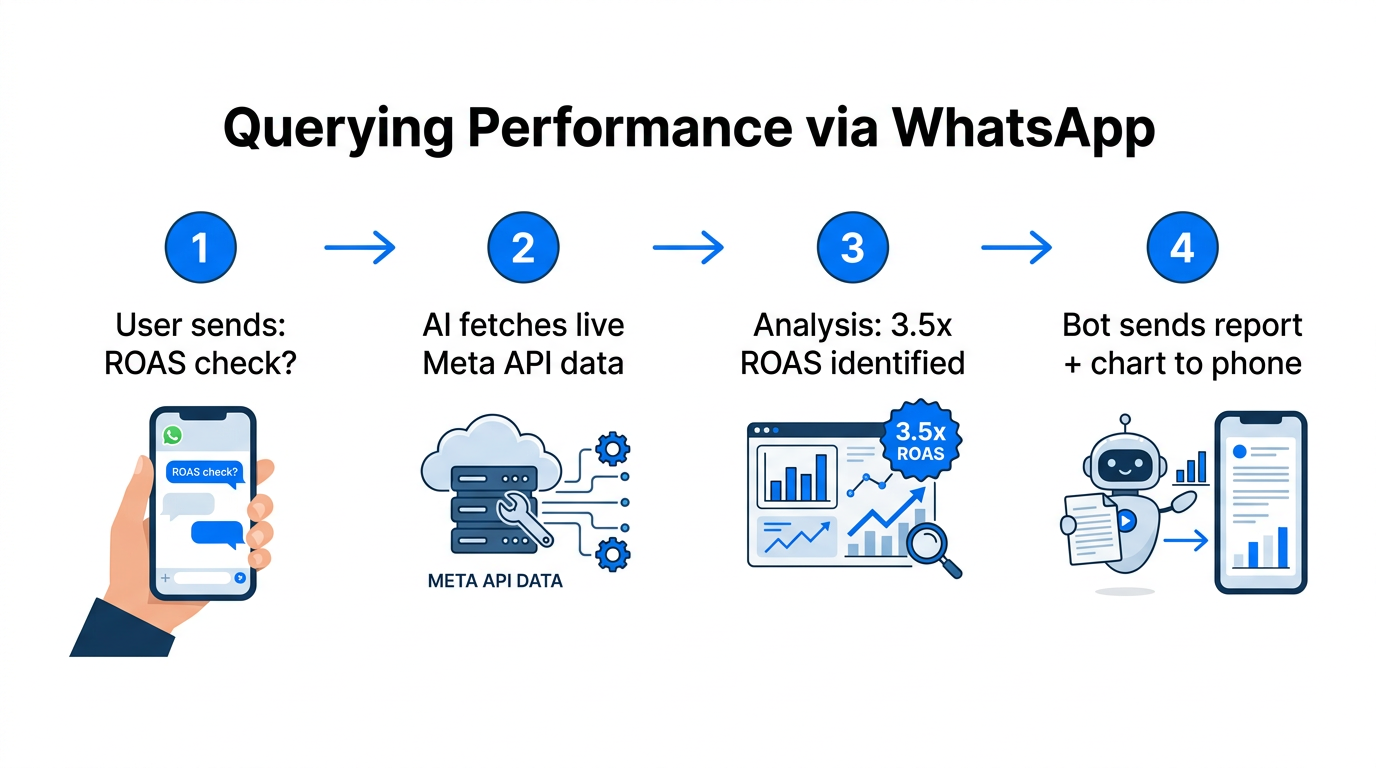
The true power of OpenClaw reporting automation is realized when you connect the agent to Telegram or WhatsApp. This transforms reporting from a one-way notification into a two-way dialogue. You can issue voice and text commands to your agent to adjust campaign settings on the fly. For instance, while you're in a meeting, you might receive a report on a winning creative. You can simply reply: "Increase the budget on that ad set by 15%."
When issuing these commands, it is crucial to follow the "10-20% Rule"—instructing the agent to scale budgets by no more than 20% every 48 hours to avoid resetting the Meta learning phase. This prevents the common mistake of "runaway scaling," which can destabilize an account's performance. For those managing high-volume campaigns, platforms like Stormy AI can help source the fresh UGC creators needed to fuel these scaling efforts, providing the raw content that the Creative Analyst skill then monitors for fatigue.
7 Essential Skills for Your Reporting Assistant
OpenClaw operates via modular .md (Markdown) skill files. These instructions teach the AI how to execute specific marketing tasks. To build a robust AI marketing command center, your agent should be equipped with these seven skills:
- The Performance Auditor: Scans for budget leaks and ad sets stuck in the "Learning Phase." It ranks issues by revenue impact.
- The Creative Analyst: Monitors CTR decay over 7, 14, and 30-day windows. Brands using this report a 22% increase in ROAS.
- The Bid & Budget Manager: Scales winners and trims laggards based on profit margins.
- The Audience Architect: Detects overlap and ensures your funnels are clean.
- The Competitor Auditor: Uses a browser-control skill to visit the Meta Ad Library and extract competitor hooks for comparison.
- The Reporting Assistant: The core of your command center, aggregating Meta and GA4 data into natural language.
- The Landing Page Auditor: Verifies site health. If a "Buy" button breaks, the agent immediately pauses the ads, saving up to 13 hours per week in manual checking.
By combining these skills, you create a self-healing account. If the Landing Page Auditor detects a slow-loading URL, it notifies the Reporting Assistant, which then sends a message to your Telegram channel and pauses the affected spend simultaneously.
The Fuel: Why Meta Conversions API (CAPI) is Non-Negotiable
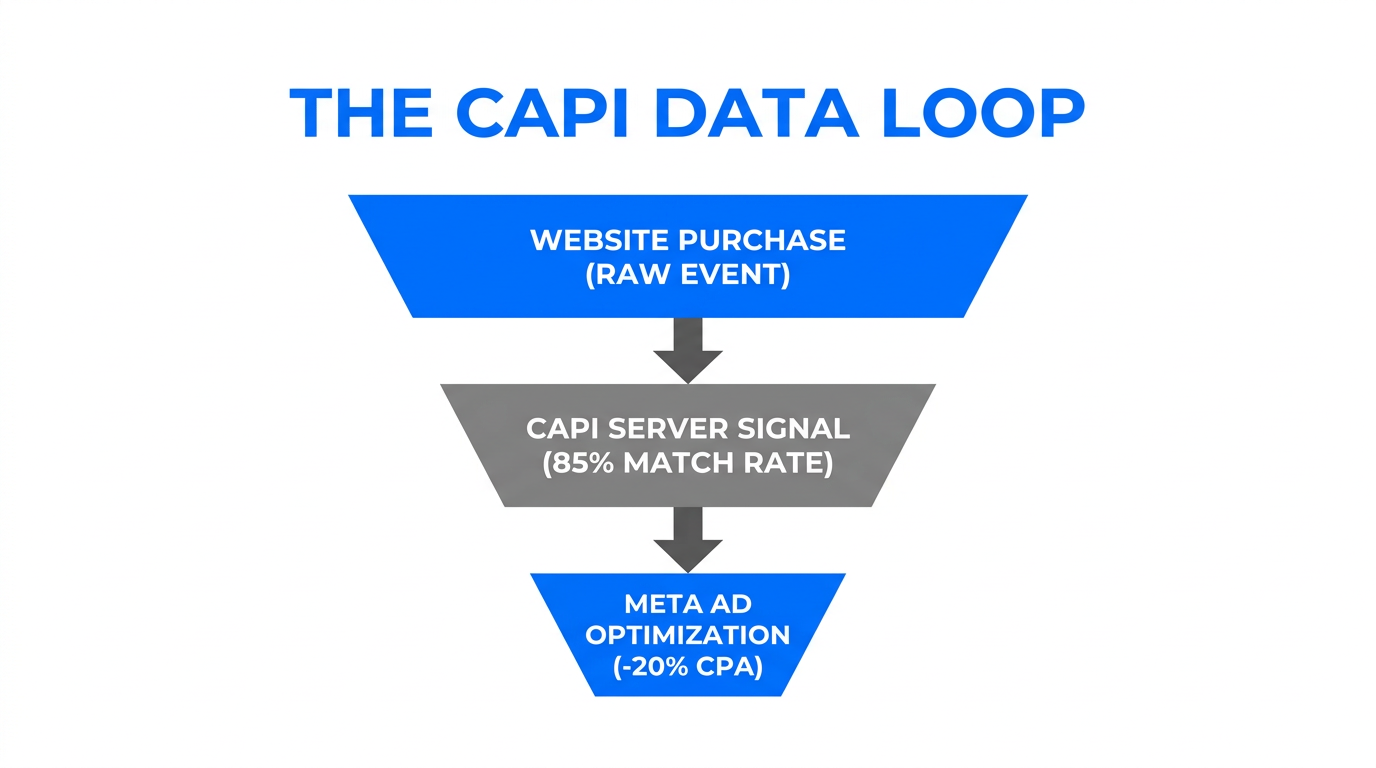
An AI agent is only as good as the data it consumes. One of the most common mistakes when setting up Meta Ads analytics 2026 is feeding the agent incomplete data. Without the Meta Conversions API (CAPI), the agent is making decisions based on browser-side signals that are often blocked by privacy settings or ad blockers.
CAPI allows you to send web events directly from your server to Meta, bypassing the browser entirely. This provides the high-quality, server-side data that your OpenClaw Reporting Assistant needs to calculate true ROAS. When you combine CAPI with a local-first agent, you create a feedback loop that is far more accurate than what standard pixel tracking can offer. If you want to dive deeper into how to structure these instructions, you can find more resources in this OpenClaw Meta Ads guide.
"Feeding an AI agent browser-only data is like asking a pilot to land in the fog without instruments. CAPI is your radar."
Conclusion: The Future of Media Buying
Building an OpenClaw Command Center via WhatsApp and Telegram isn't just about modernizing your reporting—it's about changing the way you interact with your marketing data. By 2026, the competitive advantage belongs to those who can move from insight to action in seconds. By utilizing the Model Context Protocol for marketers and the Mac Mini Strategy, you can build a reporting environment that is private, proactive, and incredibly efficient.
To get started, focus on these steps:
- Deploy OpenClaw on a local machine or AWS VPS.
- Integrate your MCP connectors for Meta Ads and GA4.
- Connect your agent to a Telegram bot for real-time interaction.
- Fuel your campaigns with fresh UGC creators using Stormy AI to ensure your Creative Analyst skill always has high-performing assets to monitor.
The transition to agentic reporting is inevitable. The only question is whether your brand will be leading the charge or still refreshing a static dashboard while the market moves on without you.